

"If God is sovereign, then his lordship must extend over all of life, and it cannot be restricted to the walls of the church or within the Christian orbit." Abraham Kuyper Common Grace 1.1.
Saturday, 22 March 2014
A Reformation Timeline
This timeline of the Reformation is taken from Harry Reid's book Reformation: The Dangerous Birth of the Modern World St Andrew Press, 2009. (I love the subtitle!)

Review: Antinomianism by Mark Jones

Antinomianism
Reformed Theology's Unwelcome Guest?
Mark Jones
Philadelphia: P&R Books, 2013.
£12.99, pbk, 176pp
ISBN: 9781596388154
Antinomianism is a familiar pejorative term. Many hyper-Calvinists in the seventeenth century were accused of it; their riposte was to accuse their accusers of Arminianism or of legalism. The arguments prompted more heat than light. This book by Mark Jones throws some helpful insights on the arguments and sadly shows that it is not just a debate that was left in the seventeenth century.
The initial impetus for this book was the response to Jones’ review of Tullian Tchividjian’s Jesus + Nothing = Everything. Jones shows how Tchividjian’s book has antinomian tendencies. In Jones’ book he carefully shows how antinomianism is a “system of thought that has to be carefully understood in its historical context”. Antinomianism isn’t simply a rejection of moral law.
Jones maintains that the first antinomian was Adam in the garden and he shows that antinomianism isn’t a “monolithic group”. Diverse Calvinists such as John Eaton (1574/5–1630/31), Tobias Crisp (1600–1643), John Saltmarsh (d. 1647), John Traske (c. 1585–1636), and Robert Towne (1592/3?–1664) have all been described as antinomian.
Jones provides a helpful set of questions around which the issue(s) of antinomianism arises:
1. Are there any conditions for salvation?
2. Is the moral law still binding for Christians?
3. What is the precise nature of, and relationship between, the law and the gospel?
4. Are good works necessary for salvation?
5. Does God love all Christians the same, irrespective of their obedience or lack thereof?
6. Who is the subject of spiritual activity, the believer or Christ?
7. May our assurance of justification be discerned by our sanctification?
8. Does God see sin in believers?
9. Is a person justified at birth or upon believing?
The book is however not merely a historical survey - but he does show how important is an historical understanding. The great strength of the book is that it places the discussion in a clear Christological context: “The solution to antinomianism must be to understand and love the person and work of Christ”; “Christ is not only the pattern for our Christian life, but also the source of our Christian life.” "In essence, the mistakes of legalism and antinomianism are Christological errors."
Those not familiar with the historical context may find this book a little hard-going at times, but it is worth persevering with. Jones has done an excellent job in analysing the issues that surround antinomianism and show how the past can help us understand the present.
Contents
Foreword by J. I. Packer ix
Preface xiii
Acknowledgments xvii
Editor’s Notes xix
1. Lessons from History 1
2. The Imitation of Christ 19
3. The Law 31
4. The Law and the Gospel 43
5. Good Works and Rewards 61
6. Amor, Amor 81
7. Assurance 97
8. Rhetoric 111
9. Toward a Definition and a Solution 123
Bibliography 131
Index of Scripture 137
Index of Subjects and Names
Recent Kuyperania (March 2014)
Mars Audio have made available a full version of the interview with James Bratt
Rod Dreher comments on the Bratt interview.
The fourth volume of the Kuyper Center Review has been announced - release in May 2014 - with papers from the Neo-Calvinism and Democracy conference held at the Kuyper Center for Public Theology last year.
 ISBN: 9780802871152
The contents:
George Harinck "Neo-Calvinism and Democracy: An Overview from the Mid-Nineteenth Century till the Second World War"
David Little "Calvinism, Constitutionalism, and the Ingredients of Peace"
Jeffrey Stout "Christianity and the Class Struggle"
Clifford B. Anderson "Liberalism versus Democracy? Abraham Kuyper and Carl Schmitt as Critics of liberalism"
Michael Bräutigam "The Christian as homo politicus: Abraham Kuyper and Democratic Imbalance in Post-Democratic Times"
Clay Cooke "Distinctively Common: Advancing Herman Bavinck's Theology to Pressure Liberal Democratic Ideals"
Michael DeMoor "Legitimacy, Public Justice, and Deliberative Democracy"
James Eglinton "Democracy and Ecclesiology: An Aristocratic Church for a Democratic Age?"
Brant Himes "Distinct Discipleship: Abraham Kuyper, Dietrich Bonhoeffer, and Christian Engagement in Public Life"
Harry Van Dyke "Abraham Kuyper between Parsonage and Parliament"
Harry Van Dyke "Kuyper as Emancipator and Christian Democrat"
Harry Van Dyke
Rod Dreher comments on the Bratt interview.
The fourth volume of the Kuyper Center Review has been announced - release in May 2014 - with papers from the Neo-Calvinism and Democracy conference held at the Kuyper Center for Public Theology last year.
The contents:
George Harinck "Neo-Calvinism and Democracy: An Overview from the Mid-Nineteenth Century till the Second World War"
David Little "Calvinism, Constitutionalism, and the Ingredients of Peace"
Jeffrey Stout "Christianity and the Class Struggle"
Clifford B. Anderson "Liberalism versus Democracy? Abraham Kuyper and Carl Schmitt as Critics of liberalism"
Michael Bräutigam "The Christian as homo politicus: Abraham Kuyper and Democratic Imbalance in Post-Democratic Times"
Clay Cooke "Distinctively Common: Advancing Herman Bavinck's Theology to Pressure Liberal Democratic Ideals"
Michael DeMoor "Legitimacy, Public Justice, and Deliberative Democracy"
James Eglinton "Democracy and Ecclesiology: An Aristocratic Church for a Democratic Age?"
Brant Himes "Distinct Discipleship: Abraham Kuyper, Dietrich Bonhoeffer, and Christian Engagement in Public Life"
Harry Van Dyke "Abraham Kuyper between Parsonage and Parliament"
Harry Van Dyke "Kuyper as Emancipator and Christian Democrat"
Harry Van Dyke
Friday, 21 March 2014
British Calvinists: William Perkins (1558-1602)
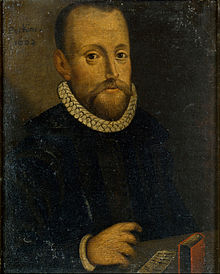
William Perkins (1558-1602) was one of the Cambridge Calvinists. He was born in Warwickshire and graduated from Christ College, Cambridge in 1581 with a BA and an MA in 1584. In between these he was converted from idle and debauched undergraduate lifestyle.
He was elected fellow of Christ's College. In 1585 he became a lecturer at Great St Andrew's Church, Cambridge.
Perkins has been described as a "moderate Puritan"; he was an ordained Anglican who was opposed to separatists and non-confomists as well as the Romanising of the Anglican church. He was an advocate of double predestination (God chose some to be saved and some to be condemned), limited atonement and held to a supralapsarian position.
R. T. Kendall in his Calvin and English Calvinism to 1649 (Oxford University Press) maintains that Perkins and William Ames took their theology from Theodore Beza rather than Calvin. The result, according to Kendall, is that the Puritan tradition became anticalvinistic and almost Arminian in many respects. It was Beza et al who developed the idea of limited atonement something, Kendall maintain, that Calvin never taught. This view was disputed by Paul Helm in Calvin Among the Calvinists (Banner of Truth, 1982).
He was highly influential on William Ames and Paul Baynes. Baynes took up Perkins position of lecturer at St Andrew's on his death.
Perkins' Golden Chain showing the order of salvation (click to enlarge):

Further Reading
Jonathan Long (1989) William Perkins: ‘Apostle of Practical Divinity’ Churchman 103 (1) 1989 online: http://www.churchsociety.org/churchman/documents/Cman_103_1_Long.pdf
William Perkins
Joel Beeke and Randall J. Pederson (2007) Meet the Puritans. Reformation Heritage Books Section on Perkins: http://www.monergism.com/thethreshold/articles/onsite/meetthepuritans/williamperkins.html
Thursday, 20 March 2014
British Calvinists: Robert Browne (1550-1633)
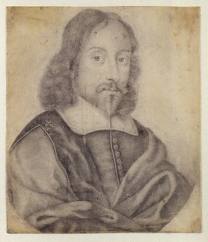
Robert Browne (1550-1633) was a separatist Puritan and has been described as the founder of Congregationalism. He gave his name to a separatist movement: the Brownists. He was born in Tolethorpe Hall, Rutland. He graduated form Corpus Christi, Cambridge in 1572 and was then ordained into the Anglican church.
While at Cambridge he became friends with the Norwich-born Robert Harrison (c.1546- 1585). Both were influenced it appears by Thomas Cartwright's lectures. They both settled for a while in Norwich. Browne was imprisoned by the bishop of Norwich in 1581 for preaching. He was released through the help of Lord Burghley. On release he went to Middelburg in the Netherlands where he set up a church based on Congregationalist principles
There were a number of disputes in the church at Middelburg and Browne left with a small number of followers to go to Edinburgh. He was imprisoned there but soon released. He was excommunicated form the Anglican church. However, he was reconciled with the church authorities and rejected his separatist teachings.
,br.,br.
Wednesday, 19 March 2014
David Koyzis' new book: We Answer to Another: Authority, Office, and the Image of God.
David Koyzis' new book We Answer to Another: Authority, Office, and the Image of God is now available.

Here is a description of the book from the back cover:
The quest to escape authority has been a persistent feature of the modern world, animating liberals and Marxists, Westerners and non-Westerners alike. Yet what if it turns out that authority is intrinsic to humanity? What if authority is characteristic of everything we are and do as those created in God's image, even when we claim to be free of it? What if kings and commoners, teachers and students, employers and employees all possess authority?
This book argues that authority cannot be identified with mere power, is not to be played off against freedom, and is not a mere social construction. Rather it is resident in an office given us by God himself at creation. This central office is in turn dispersed into a variety of offices relevant to our different life activities in a wide array of communal settings. Far from being a conservative bromide, the call to respect authority is foundational to respect for humanity itself.
Monday, 17 March 2014
British Calvinists: John Greenwood (c. 1550-1593)
John Greenwood (c. 1550-1593) was a separatist Puritan. He graduated form Corpus Christi College, Cambridge in 1578. He then was ordained and minsitered in Wyam, Leicestershire until 1585 when he left the established church.
He was good friends with Henry Barrowe and they were executed together in 1593 for their separatist ecclesiastical views. Greenwood was an undergraduate at Cambridge during the Thomas Cartwright controversy.
He was good friends with Henry Barrowe and they were executed together in 1593 for their separatist ecclesiastical views. Greenwood was an undergraduate at Cambridge during the Thomas Cartwright controversy.
Greenwood was the leader of the London separatists. He was ordained into the Church of England by Thomas Cooper, the bishop of Lincoln, but he later renounced his ordination.
He was imprisoned in 1586 and spent most of the rest of his life in gaol. With Barrowe he wrote a number of books and tracts from prison, they were both hanged at Tyburn in 1593.
Both Barrowe and Greenwood are regarded as the pioneers of Congregationalism.
Both Barrowe and Greenwood are regarded as the pioneers of Congregationalism.
Saturday, 15 March 2014

Review: The New Calvinism Considered by Jeremy Walker

A Personal and Pastoral Assessment
Jeremy Walker
EP Books
Pbk, 128pp, £6.99
ISBN 978-0852349687
Jeremy Walker, pastor of Maidenbower Baptist Church, Crawley, provides a good introduction and analysis of the New Calvinists and its proponents such as John Piper, Mark Driscoll, C. J. Mahaney and Matt Chandler. Being a Brit Walker presents a helpful outsider’s view of New Calvinism.
New Calvinists are rarely out of the Christian-social-media news; and, often, not for the best of reasons: we have had the Elephant Room with T. D. Jakes and Steven Furtick, the abuse allegations at Sovereign Grace Ministries, plagiarism, and the blatant use self-promotion techniques in order to appear to be big and successful. Tim Challies has recently produced an excellent infographic on New Calvinism - it presents a skewed one-sided view of it (inevitably!); he appropriates John Stott to the cause and makes the success of Rap and Hip Hop down to the endorsement of John Piper (HT @wyclif)!
New Calvinism came to the attention of the wider public when it was named as one of the 10 ideas changing the world by Time magazine - although Challies places its origin to the 1986 publication of Piper’s Desiring God. Unfortunately, Time used the term neo-Calvinism to describe it. Not realising that it had already been taken! New is definitely not neo when it comes to Calvinism. Sadly, many have made that mistake. Fortunately Walker is not one of them.
Walker as the subtitle implies presents a personal and pastoral assessment and so, helpfully, avoids a polemical approach - I didn’t spot any straw men. As he puts it: “I’d rather use hard arguments than hard words” and “I would rather deal with the issues, but the issues are so intertwined with the personalities”. Walker is aware that New Calvinism is not “monolithic” it is more an amorphous conglomeration of networks and conferences, rather then a clearly defined entity.
Walker starts in good sh*t sandwich fashion by outlining some of the good things that he sees in New Calvinism these include being:
- Christ-oriented;
- grace-soaked;
- avowedly a missional movement;
- a complementarian movement;
- immersed and inventive (“If you own a PC you are almost by definition not a New Calvinist”)
- commitment in principle to expositional preaching.
Personally I wouldn't place complementarian in this category. Too often it leads to an unbiblical view of authority:

Walker then takes a look at some of his cautions and concerns. These include:
- The tendency towards pragmatism and commercialism
- An unbalanced view of culture. Here Walker suggests that “a neo-Kuyperian perspective dominates the movement” (if only that were true!). There has been a misappropriation of Kuyper to justify using “worldly” methods - Walker suggests that for the New Calvinist culture is neutral and so can be appropriated by Christianising it - this is certainly not what Kuyper taught or thought!
- A troubling approach to holiness - manifested in incipient antinomianism (we are not under law, so we can do what we like) and unbiblical views of sanctification. Walker makes an excellent point here: “principled obedience is not legalism”.
- A potentially dangerous ecumenism - an emphasising of unity over truth
- A genuine tension with regard to spiritual gifts.
- A degree of arrogance and triumphalism
It should be emphasised that Walker doesn’t see all these in all of the New Calvinists. He is careful not to overgeneralise.
For Walker New Calvinism is at best Christ-centred and at worst human-centred. He focuses primarily on the theology of the movement. His critique could have been helped by sociological and historical perspectives. He mentions that it is centre-bounded rather than boundary-bounded, but doesn’t develop this helpful insight and it implications. Nevertheless, this is a good place to start to understand the strengths and weakness of a movement that is probably past its heyday.
Let’s forget New Calvinism, we want a Newer Calvinism, and then the Newest Calvinism. This faddishness evidenced in some New Calvinists can be remedied, Walker suggest, by being mere Calvinists - or has it: “be Calvinists. Don’t be new Calvinists or any other particular brand or stripe of Calvinists, whatever those distinctions may presently mean, or may come to mean.
Friday, 14 March 2014
British Calvinists: Henry Barrowe (c 1550-1593)
Henry Barrowe (c 1550-1593) born in Norfolk was a separatist Puritan. He graduated from Cambridge and trained for the bar at Bray's Inn, London. It was during this time that he became converted and became a Puritan. He became firm friends with John Greenwood (c. 1550-1593).
When Greenwood was arrested an Imprisoned Barrowe went to visit him and he to was arrested for his ecclesiastical views. he was examined by Whitgift and the Court of High Commission. He and Greenwood were indicted under the 1581 Act and sent to Fleet prison.
Barowe spent the rest of his life in prison. But here he wrote many books which were smuggled out and printed abroad. In these books he articulated his view that a Church must be a faithful company of people and separated from unbelievers. there was no place for a mixed church. The word of God not tradition should be the guide. He was firmly opposed to the Established Church with its hierarchy and thought that church government should be in the hands of the elders.
He established a form of separatist quadrilateral: separation was needed as the established church involved: false worship; promiscuous membership; false ministry; and flase and anti-Christian government.
He established a form of separatist quadrilateral: separation was needed as the established church involved: false worship; promiscuous membership; false ministry; and flase and anti-Christian government.
It was for these writings that he was eventually hanged with John Greenwood on 23rd March 1593. He is regarded as one of the fathers of Congregationalism.
Further reading
John Brown 1998 [original end 1910] The English Puritans Fearn, Ross-shire: Christian Focus.
Thursday, 13 March 2014
British Calvinists: John Rainolds (1549-1607)

John Rainolds (aka Reynolds) (1549-1607) was a Puritan, he was one of the initiators of the King James Authorized Bible. He was born in Pinhoe, near Exeter.
Rainolds studied at Merton and Corpus Christi colleges at Oxford. When he graduated he became a tutor to Richard Hooker. Elizabeth I objected to Rainolds being appointed the Regius Professor of Divinity at Oxford, so Thomas Holland was given the post instead.
In 1593 he became the Dean of Lincoln Cathedral and then in 1598 he was elected president of Corpus Christi (1598-1607). He was one of the key Puritan members of the 1604 Hampton Court Conference in the early days of James I.
The Hampton Court Conference was convened in response to the Millenary Petition - signed by supposedly 1000 Puritans. The Puritans had high hopes of James I as he was familiar with Scottish Presbyterianism. The Puritans expressed revulsion against several Episcopal ceremonies including the signing of the cross at baptism, bowing at the name of Jesus, and the wearing of the surplice and the cap. Unfortunately, the Puritans didn't win the backing of the king. Rainolds left the conference largely satisfied but the more radical Puritans were disappointed.
The main gain of the conference was the initiation of the Authorized Version (KJV) of the Bible, but subscription to the Prayer Book was still enforced and the episcopal structure remained. Bancroft who succeeded Whitgift as the Archbishop of Canterbury was even more zealous that his predecessor in enforcing the Prayer Book and the use of copes, caps, hoods and surplices.
Wednesday, 12 March 2014
British Calvinists: John Field (1545-1588)
John Field (1545-1588) (aka Fielde) was a graduate of Christ Church, Oxford. he was ordained by Edward Grindal in 1556.
He worked in London for a while, there he voiced criticism of the Established church which led to him being suspended from preaching from 1571 to 1579. He was opposed to the Act of Uniformity and to Romanising tendencies in the Church of England.
He wrote A View of Popish Abuses yet remaining in the English Church in 1572 for which he was imprisoned for a year.
"… we in England are so far off from having a Church rightly reformed, according to the prescript of God's word that as yet we are not come to the outward face of the same. …"From the Admonition to Parliament (1572)
In 1584, he helped compile the Book of Discipline which served as as a model for how Parliament should be reforming the Church. Field unsuccessful in trying to organise the Puritans into presbyterian synods.
British Calvinists: Edward Dering (c.1540-1576)
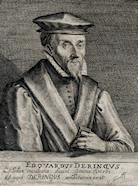 Edward Dering (c.1540-1576) was born in Kent, he was a graduate of Christ's College, Cambridge
He offended Queen Elizabeth when he preached before her, and was consequently banned from preaching. He was a great supporter of Thomas Cartwright, but unlike Cartwright was a non-separating Puritan.
He died from tuberculosis in Essex.
Tuesday, 11 March 2014
British Calvinists: Laurence Chaderton (1536-1640)

Laurence Chaderton (1536-1640), born in Oldham, was one of the key Puritan tutors at Cambridge. He was friends with Thomas Cartwright and William Perkins. Peter Toon (1973) in Purtians and Calvinsim describes his as the pope of "Cambridge Puritanism" (p 17). He was bought up a Catholic but when converted to Reformed views was disinherited by his father.
He was appointed the first master of Emmanuel College, Cambridge.
He drew up a special programme designed to provide parishes with clergy who knew their theology. One of his innovations was the "mutual conference". This model was used by the Puritans in their "prophesying" conferences.
He was one of those those involved in the Hampton Conference translators of the newly commissioned Authorised Version (KJV) of the Bible.
Monday, 10 March 2014
British Calvinism: Thomas Cartwright (1535-1603)

Thomas Cartwright (1535-1603) was born in Hertfordshire and educated at St John's, Cambridge. He has been called the "father of English Presbyterianism". He became professor of Trinity College. In 1569 he was appointed as The Lady Margart Professor of Divinity. He was used his position to criticise the Church of England, much to the disgust of John Whitgift, who was the vice chancellor who removed him from post.
Cartwright proclaimed six propositions, which formed the basis of presbyterianism in England:
1. That the names and functions of archbishops and archdeacons ought to be abolished.
2. That the offices of the lawful ministers of the Church, viz., bishops and deacons, ought to be reduced to their apostolical institution: bishops to preach the word of God, and pray, and deacons to be employed in taking care of the poor.
3. That the government of the Church ought not to be entrusted to bishop's chancellors, or the officials of archdeacons; but every church ought to be governed by its own ministers and presbyters.
4. That ministers ought not to be at large, but every one should have the charge of a particular congregation.
5. That no man ought to solicit, or to stand as a candidate for the ministry.
6. That ministers ought not to be created by the sole authority of the bishop, but to be openly and fairly chosen by the people.
Cartwright went to the Continent and visited Theodore Beza, Calvin's successor at Geneva. He returned to England but had to escape to Antwerp in 1574, where he became the pastor to English residents. In 1585 he returned without permission to England and was arrested. His influential friends managed to secure his release.
It is claimed that he was the first preacher to have practised extempore prayer before preaching.
Some of his writings are available here:
C. S. Lewis on the Puritans: "bishops, not beer, were their special aversion"

We can hardly help calling them 'Puritanism' and 'humanism', but neither word meant the same as it does in modern America. By purity the Elizabethan Puritan meant not chastity but ‘pure’ theology and, still more, ‘pure’ church discipline. That is, he wanted an all-powerful Presbyterian Church, a church stronger than the state, set up in England, on the model of Calvin’s church at Geneva. Knox in Scotland loudly demanded, and at least one English Puritan hinted, that this should be done by armed revolution. Calvin, the great successful doctrinaire who had actually set up the ‘new order’, was the man who had dazzled them all. We must picture these Puritans as the very opposite of those who bear that name today: as young, fierce, progressive intellectuals, very fashionable and up-to-date. They were not teetotallers; bishops, not beer, were their special aversion.
C. S. Lewis "On Edmund Spenser". Studies in Medieval and Renaissance Literature. p. 121.
Sunday, 9 March 2014
Kuyper on the Lord's Prayer

"The Lord's Prayer is a liturgical prayer that has been used throughout the world and throughout the centuries. It is a prayer that still unites all Christians. The prayer is arranged symmetrically to facilitate firmer and easier retention. The plural that is used indicates that it was not primarily to be prayed by one individual alone, but by many in community. And the liturgy of the Reformed churches indicates that it was thought to have been given for our use as well. In fact, its contents are too overwhelming for such a prayer to be used once only. Praying the Lord's prayer for a life time will certainly enrich a person even in old age. We can even say that the Lord's Prayer puts the stamp of the Saviour's approval on liturgical prayer." (p. 34)He then goes on to say: "It should be understood, however, that this does not mean that we recoomend all existing liturgical prayers. On the contrary, in many respects the liturgical prayers we find in our liturgy leave much to be desired."
Friday, 7 March 2014
British Calvinists: William Whittingham (c. 1524-1579)
William Whittingham (c. 1524-1579) was born in Chester and educated at Brasenose College and Christ Church, Oxford. He went to France to help in his language studies. He returned to England in 1553 but his Reformed views meant he had to go into exile when Mary I came to the throne.
He was one of the first to arrive in Frankfurt which became a centre for Marian exiles. He became friends with John Knox there and supported Knox in the dispute over the form of church service. Knox wanted a more Reformed approach, others, such as Richard Cox, a more Reformed Anglican approach - here can be seen the start of another of the inter-family disputes among the Reformed and perhaps the roots of non-Conformism. Knox had to leave and went to Geneva. Whittingham soon followed Knox to Geneva. In 1575 Whittingham published an account of the dispute: A brieff discours off the troubles begonne at Franckford in Germany, Anno Domini 1554.
In Geneva Knox became the minister of the English-speaking exiled group there. In 1558 Whitingham was elected elder. In 1559 when Knox left for Scotland Calvin suggested that Whittingham take over as minister.
The Genevan congregation drew up a service format and a form of church discipline that was very similar to Calvin's system, with elected ministers, elders and deacons and the power of ex-communication.
When Elizabeth I came to the throne many of the Genevan exiles returned to England. Whittingham stayed to complete his work on the Geneva Bible. He also worked on metrical Psalms.

In 1560 he left Geneva for England via France. In 1563 he became the dean of Durham.
Whittingham disliked the "popish apparel" of surplice an cope and originally refused to wear them. Several complaints were made against Whittingham, including one that maintained that he was not properly ordained.
He died on 10 June 1579, he was buried in Durham Cathedaral.
Some of his writings are available here: http://www.prdl.org/author_view.php?a_id=1321
Tuesday, 4 March 2014
British Calvinists: Edmund Grindal (1519-1583)

Edmund Grindal (1519-1583) was the second archbishop of Canterbury appointed by Elizabeth I, the first was Matthew Parker.
He was born in Whitehaven, Cumbria and was educated at Pembroke Hall, Cambridge. Under Edward I he was prebendary of Westminster, but on Edward's death became one of the Marian exiles in Frankfurt.
On return to England he was made the bishop of London and helped to revise the Book of Common Prayer. He was "promoted" to York in 1570. During this time he ensured that church furniture such as crosses, candlesticks and altar stones were removed and replaced by a simple communion table. In 1575 became archbishop of Canterbury.
During his time at Canterbury he became embroiled in a debate over the "Puritan prophesyings". These were meetings in which clergy prayed and discussed the Scriptures. These prophesyings originated in Northampton. It seems that on Saturdays from 9 to 11 am a number of ministers would gather to expound the same scriptures one after the other and then discuss how they handled the text. The first minster was not to exceed three-quarters of an hour (see Geoffrey Nuttall The Holy Spirit in Puritan Faith and Experience. University of Chicago Press, 1992).
Grindal refused Elizabeth I's order to silence them and so was suspended from his bishopric. Grindal felt that the prophesyings were helping to stem the tide of catholicism. In 1582 he was later reinstated but by then his health was deteriorating and he died in July 1583.
Grindal was replaced as archbishop by John Whitgift, who was no friend of Puritans.
Some of Grindal's works are available here: http://www.prdl.org/author_view.php?a_id=318
Further reading
Patrick Collinson 1979. Archbishop Grindal 1519–1583: The Struggle for a Reformed Church. University of California.
John Strype 1710, Life and Acts of Edmund Grindal, Archbishop of Canterbury. Available here.
Sunday, 2 March 2014
Subscribe to:
Posts (Atom)


