DCF Epilogue
Epilogue: the sea of faith – Darwin didn’t drain it R. J. Berry and T. A. Noble
Taking a metaphor from Matthew Arnold's 'On Dover Beach' and popularised by Don Cupitt, Berry and Noble maintain that faith is still unscathed by Darwin's ideas. This book is an attempt to show that. Even tricky doctrines like the fall and Adam and Eve can be salvaged in the light of Darwin. But I wonder at what cost?
The strength of this book is that within a narrow range we have diverse views. Some see the fall as a cosmic event, others as an an event without cosmic implications, but an event in time nonetheless. Adam has different roles, for Blocher he is an historic person, for others they 'cannot rule out the existence of a historic Adam'. For some Adam is the ancestor of us all for others he is a federal head. However, this range of views is a weakness of the book. There is sadly no discussion and critique of each other's views. There is no attempt ot come to a consensus.
Throughout the book the views of Patricia Williams and Christopher Southgate are briefly mentioned and critiqued. Their shadow is felt. It would I would have liked to have seen a fuller engagement with their work. Next to Darwin and Augustine, their names occur most often in the index. And it is their work that has most recently outlined the evolutionary challenge to a traditional Christian theology of the fall. Williams dismisses it and rewrites theology, whereas Southgate rejects a historical fall as being a 'spurious reading', a general condition rather than a chronological event.
The unexpressed presupposition is that Darwin was largely right and evolution is correct. However, they don't express which view of evolution they adhere to. There is no clear scientific consensus; we have a wide range of views from naturalistic evolutionism (which obviously they dissent from) to theistic evolution. However, which form of theistic evolution do they accept? Is it a form of structuralism, cladism, punctuated equilbrium, neo-Darwinism or what? How does God work through evolutionary chance(?) processes? Though, to be fair, to address this would mean another book.
It doesn't really fully address the issue of pain and suffering prior to the fall. How are we to reconcile that with the God of the scriptures? This remains an unanswered question.
Nevertheless, this book provides much food for thought. It will help all those who accept an evolutionary framework attempt to reconcile the fall with evolution.

"If God is sovereign, then his lordship must extend over all of life, and it cannot be restricted to the walls of the church or within the Christian orbit." Abraham Kuyper Common Grace 1.1.
Showing posts with label DCF. Show all posts
Showing posts with label DCF. Show all posts
Thursday, 3 December 2009

Monday, 30 November 2009
Darwin, Creation and the Fall: chapter 8

Mortimer has recenlty completed a PhD on different interpretations of the fall. Here he looks at Henri Blocher's view of the fall and original sin.
Original sin has been described as 'lack[ing] biblical warrant, is incoherent, unscientific and unhelpful' (p 174) Blocher's work, Mortimer notes, is important because 'Blocher asserts not only the scriptural validity of the doctrine but also its positive value' (p. 174).
Mortimer provides an excellent summary of Blocher's views. 'Blocher affirms the historical schema of creation, fall and redemption. It is the historical fall that is remedied by the historical cross' (p. 183).
Mortimer then looks at the evolutionary challenge to Blocher's views. He takes issue with Blocher's monogenism - the idea that 'Adam and Eve were a literal couple from whom the human race derives' (p. 187); a view he sees as 'inadequate' (p. 191). Polygenism - humans developed in several lines and so not all have Adam as an ancestor - is more in line with the evolutionary synthesis Mortimer maintains. And he is keen to defend polygeneism but hold on to a historic Adam and Eve. (A similar view is held by R J Berry in chapter 2.) To do this he suggests two possible options. One is to see Adam as a federal head, following Derek Kidner and Douglas Spanner; the other is to see, with Karl Rahner, Adam and Eve as representing a population rather than as a couple. Mortimer favours the latter option, but acknowledges it does need to be developed further.
It is a shame that Blocher hasn't responded to this paper. It does seem, from the previous chapter, that Blocher's views have slightly changed; he no longer sees the evidence for Adam and Eve as Cro-Magnons around 40 000 BC as conclusive.
Saturday, 28 November 2009
Darwin, Creation and the Fall: chapter 7
Theology of the Fall and the origins of evil Henri Blocher
Blocher starts by stating that he is a theologian and an amateur when it comes to science. Nevertheless, this is an issue that he has written about and considered over a number of decades. Not least in his In the Beginning (IVP, 1984).
I was particularly pleased that he spelled out how he sees science and the Bible interacting. We must take the Bible first, in the light of the original intention of the author and then 'Only secondarily should we reflect on the modern relevance of the meaning and any confrontation with contemporary scientific opinion' (p. 150).
He is right to remind us that 'science' is not 'immune from errors, frauds or ideological slant' (p. 151). This is particulalry true to remember in the light of the recent climategate e-mails. One wonders how much we are also kept in the dark about other scientific theories?
It is refreshing to see him unequivocally state that 'Whatever the tensions, the non-historical interpretation of Genesis 3 is no option for a consistent Christian believer' (p. 155). He briefly discusses James Barr and Christopher Southgate and Moltmann and dismisses their objections and interpretations.
Again, he stresses: 'The issue of historicity here is no peripheral matter for hair-splitting theologians: it is vital for the biblical message - it is the heart of the message' (p. 158); also: 'The issue is not whether we have a historical account of the Fall [no scare quotes here], but whether we have the account of a historical Fall (p. 159).
He then looks at palaeoanthropology and sees what light this can provide in light of the fact that 'A historical Fall is a non-negotiable article of faith' (p. 169). He notes that 20 years ago it looked like human origins could be traced back to 40 000 BC from one centre, but this no longer seems the case. Hence, he concludes that we need not be embarrassed that we have scientific uncertainties we can trust the Creator and Redeemer.
Friday, 27 November 2009
Darwin, Creation and the Fall: chapter 6

I wasn't too familiar with Iranaeus's (c. 115-221AD) view of the fall so this chapter was a welcome addition.
Lane is keen to defend the Irenaeus's view against a number of recent commentators who seem to have misread/used Irenaeus. These include the Dominican Denis Minns.
Irenaeus held that Adam and Eve were not created perfect. But, this does not mean that they were sinful. He also distinguishes between the image and likeness of God. Adam was created in God's image but the likeness was something he had yet to attain. The likeness was lost and is something that Christ restores.
Minns maintains that for Irenaeus Gen 1-3 was in part symbolic and is thus more in tune with modern understanding than Augustine (p. 140). However, Lane argues that 'Irenaeus's theology is undermined more than most others by the suggestion of a non-historical Adam' (p. 141).
Lane then looks at three important questions when considering the nature of the Fall:
- Was the world perfect?
- Were Adam and Eve perfect?
- Were Adam and Eve immortal?
What concerns me most is that Lane suggests that we ought to be more sympathetic to a nature-supernature approach (p. 146). This might leave the way open to avoid a science-theology conflict over Genesis 1-3, but it would result in more problems than it would solve.
It would have been interesting to have considered why Augustine's view has been the dominant paradigm in theology through the centuries. Why is it that now Irenaeus's view is being reconsidered now? Is it an apologetic response to Darwin? Or is it a fresh understanding of the scriptures? I suspect the former.
Tuesday, 24 November 2009
Darwin, Creation and the Fall: chapter 5
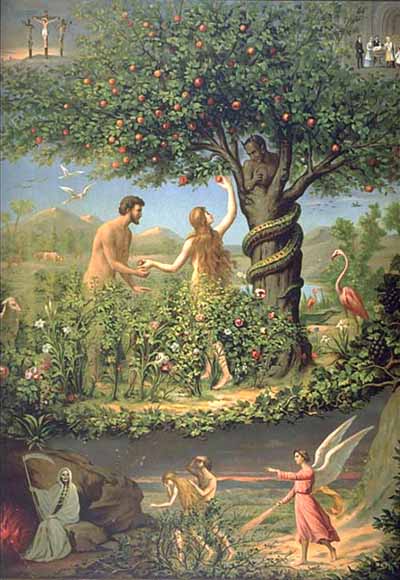 "Original sin and the Fall: definitions and a proposal" T. A. Noble
As Noble rightly states: 'The doctrine of original sin and the doctrine of the Fall are inextricably linked in historic Christianity'. He identifies and briefly discusses ten facets of original sin:
1. Universal sin
2. Fallenness
3. The original act of sin
4. Original guilt
5. Original sin as a vitium or disease
6. Heredity sinfulness
7. An inner disposition, tendency ot 'bent toward sinning'
8. The propagation of sin through sexual desire
9. The flesh
10. Corporate sin
It was good to have these different aspects spelled out; though, of course not all of them - particularly point 8 - are biblical facets. But these concepts have been associated with original sin throughout the ages. As Noble points out this analysis can help towards constructing a more 'concise and coherent' doctrine of original sin.
He then looks at the Fall examining three aspects: alienation, death and sin. He makes an excellent point, that is often forgotten, that we need to interpret the Fall in the light of the New Testament.
The Fall for Noble is an event, a 'spiritual and ethical' event. It can't be seen as an explanation for evil, as evil is 'inexplicable'. The Fall is not a theodicy, it's not part of apologetics but of dogmatics. It is also an event in time. He unequivocally states that: 'we must maintain a temporal Fall even though the language is prophetic and full of imagery' (p. 115). Though he thinks we may not be able to date it since it 'may not be open to our historical inquiries' (p. 115). Again, 'Quite why Noble thinks this not not quite clear. It may be that he wants to maintain a complementarity between science and revelation. He draws paralles between the parousia and the Fall, both are known through revelation and neither can be known by 'natural human insight, research and investigation'. He almost gets into a sacred/ secular dualism here. He summarises his perspective:
In short, from the viewpoint of natural science and the historical-critical method, both of which methodologically project present conditions into the past and future, the world must look as if it has been fallen and always will be (p. 119)
He then tursn to death. As he rightly states 'death came through sin' (Rom 5:12) 'seems to fly in the face of scientific investigation..' (p. 120) He warns again of taking the doctrines of Christian faith 'as if they were scientific theories'.
He comes back to consider sin. He sees it as important that we discern two aspects to sin: the acts of sin and the condition of sinfulness.
He concludes by making an excellent point: Darwin 'has created an apologetic problem for the Church, but Christian theology must resist the temptation to be driven by apologetics' (p. 129). Which begs the question: how much is this book being driven by apologetics in the light of Darwin?
Monday, 23 November 2009
Darwin, Creation and the Fall: chapter 4
God and origins: interpreting the early chapters of Genesis Richard S. Hess
Hess raises the question: 'What does the Bible say about origins?' There is no mention of Darwin or even biology, he focuses solely on the biblical text and of Genesis 1:1-2:4 in particular.
He first places Gn 1:1-2:4 in its literary context and then compares it with other creation stories. The major difference between the biblical and other creation accounts 'is that only Genesis describes one God acting alone without reference to or acknowledgement of other deities' (p. 91).
The first verse of the Bible he sees as a title - 'it does not describe and initial event followed chronologically by the events of verse 2' (p. 93). He gives careful and considered support to a creation out of nothing.
He then turns to the creation of humanity and the terms image and likeness. He understands them as synonyms; the terms are used to describe a statue that represents the king's royal authority. Humans are not statues of God but they do represent his authority, they are to continue his work. They are to continue 'the divine act of creation'. I appreciated this emphasis as it serves to underline the importance of, in neocalvinist terms, the cultural mandate.
Jesus is the true image of God and in his proclamation of the kingdom the challenge to develop creation is passed on to the church.
He summaries his key points:
- creation is cosmological
- the days of creation are logical not chronological
- creation is not primarily ontological but concerned with life
- creation climaxes on the seventh day - as a day of rest
- creation is meant to be 'led and guided by 'adam who is created in God's image as male and female'.
Saturday, 21 November 2009
Darwin, Creation and the Fall: chapter 3
Theological challenges faced by Darwin Darrel R. Falk

Falk identifies three theological problems that faced Darwin: a good God bringing forth new species through processes that involved pain and suffering; the implications for God's providence: is God present in random chance events?; and the death of his ten-year-old daughter Annie.
Falk makes a good point that none of the challenges are new. They are problems of 'natural theology'. He goes on to claim that Darwin's theory raises no new theological barriers. That may be the case, however, it does, though, bring into sharper focus some issues. for example, it means that suffering is 'natural', evolution depends on suffering. As Berry put it in the preceding chapter: 'physical death was a part of the creation from the beginning' does this mean that suffering was too? This issue has so far been unaddressed.

Falk makes a good point that none of the challenges are new. They are problems of 'natural theology'. He goes on to claim that Darwin's theory raises no new theological barriers. That may be the case, however, it does, though, bring into sharper focus some issues. for example, it means that suffering is 'natural', evolution depends on suffering. As Berry put it in the preceding chapter: 'physical death was a part of the creation from the beginning' does this mean that suffering was too? This issue has so far been unaddressed.
Wednesday, 18 November 2009
Darwin, Creation and the Fall: chapter 2
2. Did Darwin dethrone humankind? R. J.Berry

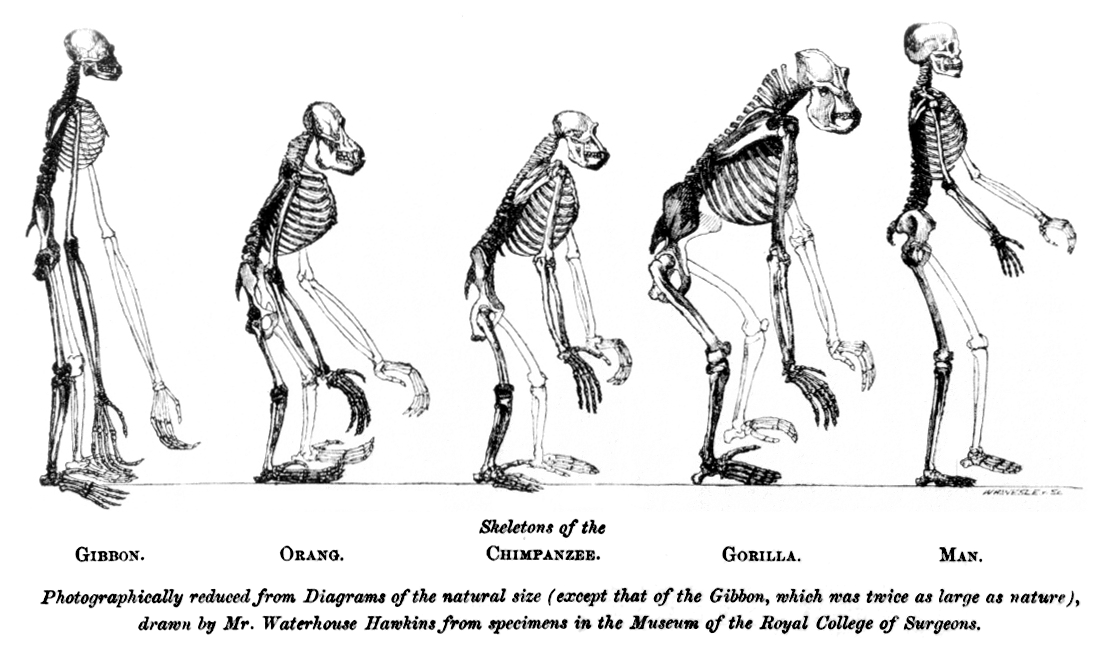
This is the longest chapter in the book and it deals with a number of important issues. Not least the issue of a historic Adam and the meaning of the image of God. Before examining these two important issues Berry looks at the varied reactions to Darwin's theory. He then goes on to look at the 'special nature of humankind in the face of evolutionary science' (p. 61). As Berry notes 'The Fall is the place above all where biology and theology conflict' (p. 72). In this chapter he attempts to reconcile the adam, the fall and evolution.
He suggests that it may be possible to distinguish between humanness emerging gradually and its instaneous 'instantation by God'. These are interesting ideas but he doesn't really develop them fully. He then looks at the question 'Did God make a single person (or pair) in his image or did his image appear in a group of individuals?'
James Dunn suggests that Adam is to be understood as 'collective humanity' but John Stott, James Barr and Leon Morris stand by a historical Adam. The choice of commentators that Berry cites is limited and I would have expected other commentators ideas to be added to the mix here. (However, to be fair to Berry this issue alone would require a full monograph or PhD!) It's not clear, from this chapter, where Berry stands. But he does suggest that resolution 'must be left to theological debate', which sounds like a hollow answer as he has bought science into it! It raises the question how are Bible and science related? This is an important question that Berry doesn't examine.
He does, however, suggest that science can bring two insights into the presumably theological debate. First, the imago if 'conferred on an individual, there is no reason why it should not spread by divine fiat to all other members of Homo sapians at the time.' (pp 65-66). Second, 'death' that entered was separation from God; and that physical death was part of creation from the beginning, as seen in plants eaten by animals.
Some, such as Teilhard de Chardin, Julian Huxley and C. H. Waddington see the Fall as an upward leap - Berry rightly sees this view as erroneous as it does damage to 'the biblical meta-narrative'. (p. 67) We are not improving morally.
What are the effects of Adam's disobedience? Is the next question under discussion. For Berry 'The Fall [here the scare quotes used previously - "The Fall" - are discarded] is not primarily about disease and disaster, nor about the dawn of self-awareness. Rather it is a way of describing the fracture in relationship between God and the human creature made in his image' (p. 70).
Again, there are some snide remarks about intelligent design (ID): 'at best it can be regarded as little more than Deism reborn' (p. 73). This is hardly a comment that will aid dialogue. In fact it probably says more about Berry than ID.
A small point but the authors seem to persist in shortening the title of Darwin's 1859 book from On the Origin of Species to Origin of Species, though this may have been a copy-editor's rather than authors' error.
There are some nuggets in the footnotes (of which there over 100):
Berry has made some good points in trying to reconcile biology with origins, however, I feel there is still much more work to do here.
Other writings by Berry on these issues include:
This is the longest chapter in the book and it deals with a number of important issues. Not least the issue of a historic Adam and the meaning of the image of God. Before examining these two important issues Berry looks at the varied reactions to Darwin's theory. He then goes on to look at the 'special nature of humankind in the face of evolutionary science' (p. 61). As Berry notes 'The Fall is the place above all where biology and theology conflict' (p. 72). In this chapter he attempts to reconcile the adam, the fall and evolution.
He suggests that it may be possible to distinguish between humanness emerging gradually and its instaneous 'instantation by God'. These are interesting ideas but he doesn't really develop them fully. He then looks at the question 'Did God make a single person (or pair) in his image or did his image appear in a group of individuals?'
James Dunn suggests that Adam is to be understood as 'collective humanity' but John Stott, James Barr and Leon Morris stand by a historical Adam. The choice of commentators that Berry cites is limited and I would have expected other commentators ideas to be added to the mix here. (However, to be fair to Berry this issue alone would require a full monograph or PhD!) It's not clear, from this chapter, where Berry stands. But he does suggest that resolution 'must be left to theological debate', which sounds like a hollow answer as he has bought science into it! It raises the question how are Bible and science related? This is an important question that Berry doesn't examine.
He does, however, suggest that science can bring two insights into the presumably theological debate. First, the imago if 'conferred on an individual, there is no reason why it should not spread by divine fiat to all other members of Homo sapians at the time.' (pp 65-66). Second, 'death' that entered was separation from God; and that physical death was part of creation from the beginning, as seen in plants eaten by animals.
Some, such as Teilhard de Chardin, Julian Huxley and C. H. Waddington see the Fall as an upward leap - Berry rightly sees this view as erroneous as it does damage to 'the biblical meta-narrative'. (p. 67) We are not improving morally.
What are the effects of Adam's disobedience? Is the next question under discussion. For Berry 'The Fall [here the scare quotes used previously - "The Fall" - are discarded] is not primarily about disease and disaster, nor about the dawn of self-awareness. Rather it is a way of describing the fracture in relationship between God and the human creature made in his image' (p. 70).
Again, there are some snide remarks about intelligent design (ID): 'at best it can be regarded as little more than Deism reborn' (p. 73). This is hardly a comment that will aid dialogue. In fact it probably says more about Berry than ID.
A small point but the authors seem to persist in shortening the title of Darwin's 1859 book from On the Origin of Species to Origin of Species, though this may have been a copy-editor's rather than authors' error.
There are some nuggets in the footnotes (of which there over 100):
I was interested to read that Popper had retracted his comment about his view of Darwinism as a metaphysical research programme rather than a testable scientific theory - his retraction was apparently in New Scientist 87 (1980): 611 (p. 48, fn 40)
Berry thinks that Gosse's Omphalos idea is the only (albeit unfaithful to reality) alternative to evolution (p 42-3 fn 30).
Berry has made some good points in trying to reconcile biology with origins, however, I feel there is still much more work to do here.
Other writings by Berry on these issues include:
M Northcott and R J Berry (eds) Theology After Darwin (Carlisle: Paternoster, 2009)
God and the Biologist (Apollos, Leicester, 1996).
God and Evolution: Creation, Evolution and the Bible (Regent College Publishing, 2001)
'This cursed earth. Is "the Fall" credible? Science and Christian Belief11 (1) (1999): 29-49; 165-167.
'The fall of history' Science and Christian Belief 12 (1) (2000): 53
'A cosmic fall?' Science and Christian Belief 19(1):78
'Nothing makes sense except in the light of evolution' Science and Christian Belief 18 (1)(2006): 23-29
'Eden and ecology: evolution and ecology' Science and Christian Belief 19 (1) (2007): 15-35
Monday, 16 November 2009
Darwin, Creation and the Fall: chapter 1
'Worshipping the creator God: the Christian doctrine of creation' David Wilkinson
The opening chapter fittingly deals with the creator. Wilkinson looks to Colossians 1 rather than Genesis 1 to present a Christocentric vierw of creation.
There is much I loved in this chapter; not least:
This is slightly detracted by the times Wilkinson caricatures other perspectives, for example he implies that Intelligent Design is an approach that 'look(s) for gaps within the scientific account' (p. 21) and that some six-day creationists argue 'Now that I have proved Genesis is correct, then the whole of the Bible follows' (p. 20). This is similar to asserting that some theistic evolutionists argue 'Evolution shows that there is no fall, so there is no fall'. Indeed some do, but certainly not all.It's easy to tarnish all with the same brush.
Nevertheless, this is an inspiring chapter and one that glorifies and exalts Christ.
The opening chapter fittingly deals with the creator. Wilkinson looks to Colossians 1 rather than Genesis 1 to present a Christocentric vierw of creation.
There is much I loved in this chapter; not least:
- the Christocentric perspective;
- the emphasis that the universe cannot be fully understood without reference to God
- his endorsement of creatio ex nihilo. (Interestingly he cites May as a detractor from this view - though Copan and Craig in their Creation out of Nothing have dealt with their views and found them wanting. Surprisingly Copan and Craig's view was not referenced);
- the emphasis on science as 'a Christian vocation rather than a secular threat' (p. 25) and as a Christian ministry;
- and the endorsement of the view that imaging God implies responsible stewardship.
This is slightly detracted by the times Wilkinson caricatures other perspectives, for example he implies that Intelligent Design is an approach that 'look(s) for gaps within the scientific account' (p. 21) and that some six-day creationists argue 'Now that I have proved Genesis is correct, then the whole of the Bible follows' (p. 20). This is similar to asserting that some theistic evolutionists argue 'Evolution shows that there is no fall, so there is no fall'. Indeed some do, but certainly not all.It's easy to tarnish all with the same brush.
Nevertheless, this is an inspiring chapter and one that glorifies and exalts Christ.
Sunday, 15 November 2009
Darwin, Creation and the Fall: Introduction

Edited by R. J. Berry and T. A. Noble
Leicester: Apollos, 2009
ISBN 978-1-84474-381-0
£9.99 208pp pbk
Not surprising - being the of the bicentenary of Darwin's birth and the 150th anniversary of the publication of On the Origin of Species - 2009 has seen the publication of many books on Darwin. This one is an attempt to address the theological issues and challenges raised by Darwin's theory. Four theologians and four scientists address many of the key issues. The book had its origins in a Tyndale Fellowsip and a Christians in Science conferences. All the authors are evangelicals and 'accept the contemporary scientific picture of the world' (p. 12).
Evolution raises a number of important theological and biblical issues. Not least the following:
- What are the implications for a fall and original sin?
- How are we to understand good and evil and evil and suffering?
- Is suffering intrinsic to the world?
- Is it possible for humans to be fallen without a Fall?
- How are we to understand humans as being created in the image of God?
- How are humans different to other animals?
- Is it credible in the light of science to believe in a historic Adam and Eve?
- Should science shape the Bible or Bible science?
The Fall has been a problem for theistic evolutionists and until recently little has been written on this important aspect. Hence, this book is a welcome addition to the literature. I hope in subsequent posts to look at some of the key issues raised in this book. In the meantime here is a table on contents:
Foreword - R. J. Berry and T. A.Noble
1. Worshipping the Creator God: the doctrine of creation David Wilkinson
2. Did Darwin dethrone humankind? R. J. Berry
3. Theological challenges faced by Darwin Darrel R. Falk
4. God and origins: interpreting the early chapters of Genesis Richard S. Hess
5. Original sin and the Fall: definitions and a proposal T. A. Noble
6. Irenaeus on the Fall and original sin A. N. S. Lane
7. Theology of the Fall and the origins of evil Henri Blocher
8. Blocher, original sin and evolution Richard Mortimer
Epilogue: the sea of faith – Darwin didn’t drain it R. J. Berry and T. A. Noble
Subscribe to:
Posts (Atom)


