An accidental blog

"If God is sovereign, then his lordship must extend over all of life, and it cannot be restricted to the walls of the church or within the Christian orbit." Abraham Kuyper Common Grace 1.1.

Showing posts with label Book reviews. Show all posts

Friday, 7 July 2023

This Earthly Life Matters by A.A. Van Ruler - a review

This Earthly Life Matters: The Promise of Arnold A. van Ruler for Ecotheology

Arnold Van Ruler

Ernst M. Conradie (Editor), Dirk van Keulen (Introduction), Douglas G. Lawrie (Translator)

Pickwick Publications, 2023, 381 pp, hbk.  
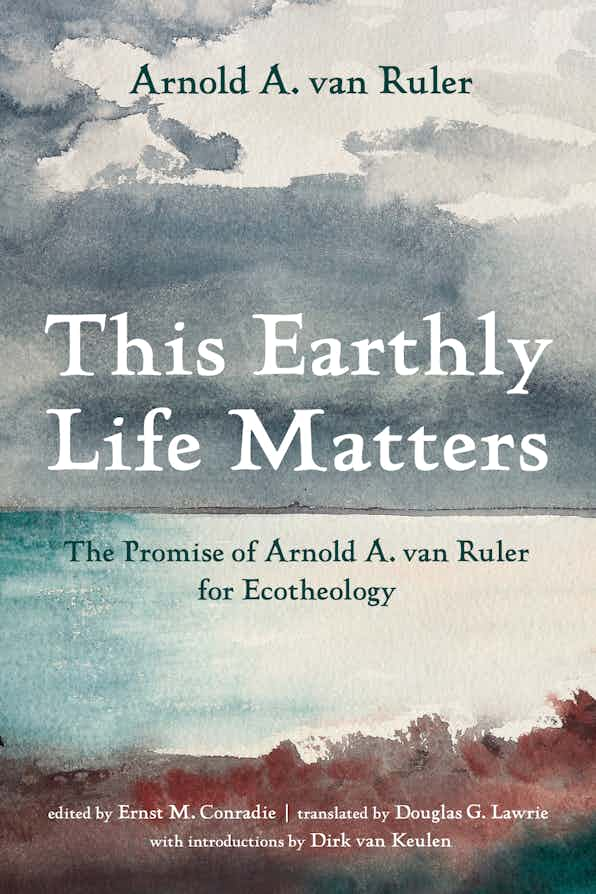

Arnold Albert Van Ruler (1908-1970), a former professor of dogmatics at the University of Utrecht, is not well-known in the English-speaking world. This is mainly because only a few of his works have been translated. Thus this volume is more than welcome.

Van Ruler's approach has been described as "creation theology" by W.H. Velema, and he himself has been called "a theologian of earthly reality" by L.J. Van den Brom. It is exciting to see this volume dedicated to Van Ruler's approach to ecotheology. His thinking was largely influenced by theocratic ideas and his involvement with the "Protestantse Unie", which aimed to promote the theocratic vision of P.J. Hoedemaker (1839-1910), a writer who greatly influenced Van Ruler, especially in his views on a State church. Although this volume only provides glimpses of Van Ruler's theocratic notions.

Dirk van Keulen, who provides an introduction and a brief biography in this volume, has edited Van Ruler's Collected Works in Dutch. The selected translations by Douglas G. Lawrie included in this volume cover various topics such as God, creation, providence, being human, sin, earthly life, and animal protection. These chosen topics highlight Van Ruler's significance for ecotheology.

Van Ruler's writings are not easy to read, and some of the selections in this volume consist mainly of bullet points. However, he does offer some insightful aphorisms. Here are a few examples:

God did not create me in order to get me down on my knees and to extend grace to me as a sinner.

The Creator is revealed in creation—that is the mystery that evokes worship.

Not only Holy Scripture is the Word of God; the entire created reality is that too.

Heaven is created reality. Just as much as the earth is.

Our knowledge of God is never direct and unmediated. It is always mediated.

Even when we question anthropologically—and question thoroughly—we automatically question theologically.

the Creator ≠ creation

The world is indeed a “cosmos” but in the sense that it is a jewel, a bracelet on the arm of the Creator.

Conradie's essay in this volume provides an excellent overview of Van Ruler's approach. Conradie observes that Van Ruler's polemical intention is to affirm creation as good, even eschatologically, without the need to add or replace anything in creation. He emphasizes the importance of recognizing ourselves as creatures and the concept of re-creation. This notion of re-creation aligns with Herman Bavinck's understanding of restoration rather than repristination. Van Ruler's work can in some sense be seen as an extrapolation and eschatological radicalization of Bavinck's position. Van Keulen has described Van Ruler's approach as a radicalized reception of Bavinck's central thought that "grace does not abolish nature, but affirms and restores it."

Van Ruler's emphasis on re-creation and his strong doctrine of creation provides valuable insights for ecotheology. He firmly believes that the world was intentionally created by God and, therefore, belongs to God. Creation is not divine or demonic; it is a good thing that came into existence ex nihilo, from nothing. Van Ruler contrasts Christianity with paganism philosophy, noting that in Christianity, the world is not necessary but is good, while in paganism, the world is seen as necessary but not good.

In addition to his focus on creation, Van Ruler stresses the importance of eschatology. He stresses “God will not create a new world to put it in the place of the present world. God will renew this old world of ours and this renewed world will be the new world.”.

Overall, this volume serves as an excellent introduction to Van Ruler's work and provides valuable insights into a Christianity that not only affirms but embraces creation.

Tuesday, 27 June 2023

The Evangelical Imagination by Karen Swallow Prior

The Evangelical Imagination: How Stories, Images, and Metaphors Created a Culture in Crisis 


 Karen Swallow Prior

Hi, 304pp, Brazos, 2023 

ISBN 9781587435751


Prior is a reader, writer, and professor of English and Christianity and culture at Southeastern Baptist Theological Seminary. In this  book she draws upon her evangelical background and her academic speciality, to examine evangelical sensibilities. She writes as a critical friend,  and as an insider. As she puts it, “In a way, what follows in these pages is simply my testimony. It is a picture of the evangelical imagination as I have found it over the course of years of researching, studying, reading, worshiping, and living and grappling with my own imagination—what fills it and fuels it.”

In many ways it is an iconoclastic book - in it she shows how evangelical culture has been shaped by Victorian values and ethos as much as it has by biblical ones. Drawing on her academic research she examines Victorian literature:

You will notice a pattern emerging from all this Victorian literature. You will see in both the texts and their surrounding historical contexts qualities strangely similar to many of the defining characteristics of modern American evangelical culture. And by seeing in that literature many of the values and beliefs prominent within American evangelicalism today, you might find yourself wondering whether some of the ideas that characterize today’s evangelical culture are Christian as much as they are Victorian.

She provides an excellent critique, and one that deserves close attention. She ably exposes contemporary evangelicalism’s overemphasis on patriotism, self-improvement, achievement, marketing, business techniques, triumphalism, and consumerism.  Two quotations will serve to illustrate:

Evangelicalism’s infatuation with secular notions of social progress and self-improvement is marked throughout the nineteenth and twentieth centuries. While evangelicals initially opposed nineteenth-century movements that emphasized the possibility that human effort could bring physical healing, mind cures, victory over sin—movements such as New Thought, the Keswick movement, and the Victorious Life—the influence of these popular teachings could not be entirely stemmed: therapeutic culture snaked its way into evangelicalism. Nineteenth-century revivalists such as D. L. Moody and Billy Sunday were among those whose teachings blended evangelicalism with notions of social progress and transformation through personal purity and piety. 

And:

This triumphalist spirit of empire was cultivated on an individual level too. “Do great things for God!” was for a generation (or two) of evangelicals not just an encouragement but an expectation that became a mandate. One younger friend who grew up evangelical told me she had the sense that if she didn’t grow up to do something great or radical, then she would have failed as a Christian.


Components of evangelicalism see examines include: Conversion, Testimony, Improvement, Sentimentality, Materiality, Domesticity, Empire, Reformation, and Rapture. For each one she shows how these are integral to evangelicalism and how each one has been shaped by the Victorian ethos. Her analysis is nuanced and profound. The literature she discusses includes work by well-known authors such as Dickens, Swift, Defoe, Bunyan, Alcott, Hardy along with the currently less popular works including Pamela; or Virtue Rewarded,  by Samuel Richardson. Works of “art” by Thomas Kinkade and Warner Sallman’s Head of Christ are also examined, both as examples of evangelical sentimentality.


In short, The Evangelical Imagination is an engaging, well-written, and thought-provoking read; it may disturb, but it will disturb those that need to be disturbed. Her main concern is that evangelicalism becomes more focused on Jesus and the scriptures rather than exemplify a Victorian ethos.  


Contents
Introduction: Victorians, Evangelicals, and the Invitation
1. Made in His Image
Imagination, Imaginaries, and Evangelicalisms
2. Awakening
Mumford, MLK, Hurston, Hughes, and Other Poets
3. Conversion
Language, Dr. Pepper, and Ebenezer Scrooge
4. Testimony
Grace Abounding and "Evangelically Speaking"
5. Improvement
The Puritan Work Ethic, Paradise Lost, and the Price of Progress
6. Sentimentality
Sweet Jesus, Uncle Tom, and Public Urination
7. Materiality
Jesus in the Window, the Virgin Mary on Grilled Cheese, Gingerbread Houses, and the Sacramentality of Church Space
8. Domesticity
Angels and Castles and Prostitutes, Oh My!
9. Empire
"The White Man's Burden," His Man Friday, the Jesus Nobody Knows, and What Johnny Cash Really Knew
10. Reformation
Pardon Me, Reckoning or Rip Van Winkle?
11. Rapture
Or How a Thief Came in the Night but Left My Chick Tracts Behind


Thursday, 27 April 2023

Review of J.H. Bavinck's Personality and Worldview


 Personality & Worldview

J. H. Bavinck

Translated by James Eglinton

208pp, hbk, 

Crossway Books

ISBN: 978-1-4335-8483-1


J.H. Bavinck (1895–1964) was the nephew of Reformed theologian Herman Bavinck (1854–1921) and a professor of missiology at Kampen Theological School and the Free University of Amsterdam. He had also been a pastor and missionary in Indonesia, so, he was no armchair missiologist. In this book, a translation of Bavinck’s 1928 book Persoonlijkheid en wereldbeschouwing. This was originally a set of lectures for engineering students. The book is thus not overly technical, it is clear, accessible, and straightforward in its approach.

"Worldview" is a concept that is starting to go out of fashion. Keller, in his Foreword, notes some key reasons for this - particularly in North America; it is seen as being: 

Individualistic

Rationalistic

Simplistic 

Triumphalistic

To this, we could add that it has recently lost favour due to concerns about its ambiguity, and connection to Western-centric and imperialist methods of analysing culture and society. Bavinck’s approach provides an important correction to these misconceptions regarding worldviews, not least because Bavinck was fully acquainted with East Asian culture as a pastor. 

By "personality", Bavinck means “an organized soul that has come to consciousness of itself.” 

One of Bavinck’s main theses is the intriguing distinction he makes between a worldview and a worldvision. He maintains that we all have a worldvision but only a few move to a worldview. 

A person without a worldview is a person without a firm foundation, without a compass, without a vista. He may have a worldvision; he might live, for example, as though there are no norms. But such a worldvision proceeds from himself and is rooted in his nature. He cannot pull himself upward on it, and with it he always remains on the same plane. A person with a worldview, in all cases, has light, sees more widely, more broadly, more deeply. And however much deeper and more objective that worldview is, the more it gives him stability to leave this maze of subjective inclinations and climb up to the height of the life that is grounded in the truth.

 Unfortunately, this insight is left largely undeveloped - it would be interesting to trace what mileage this distinction had in Bavinck’s further writings. 

In exploring the relationship between personality and worldview, he notes two positions that must be guarded against: that they are one and that they are utterly different.

In chapter 3 especially, we can see in Bavinck two important neo-Calvinist themes: the distinction between creator and creation, and a disdain for dualism. He makes some important points regarding dualism: it disjoints personality, it means that salvation is only possible through world flight and that it leads to mysticism and asceticism.

Chapter 4 provides some fascinating insights into the distinction between Eastern and Westen thinking and an overview of the impact of the Renaissance on British empiricism particularly. Here he provides a devastating critique of the poverty of empiricism in that it devours itself.

Chapter 5 exposes the problems with rationalism, Descartes, and Spinoza. He makes the interesting point that pantheism is a presupposition of rationalism: “Pantheism is not the conclusion of rationalism, but it is its presupposition. Reason only has such power when it is itself god.” 

Chapters 4 and 5 show that neither empiricism nor rationalism have explored the depths of personality.

Kant attempted to reconcile empiricism and rationalism, but as Chapter 6 shows, this project was unsuccessful. 

Mysticism, a topic Bavinck studied for his doctorate and while he was in Java, comes under scrutiny in Chapter 7. As he observes, mysticism is difficult to define as it is not a single worldview. It is an emphasis on the being of God, and yet he is a formless and utterly other divinity. There is no comfort or salvation in such a god. It results in self-withdrawal from life and groping after eternity. He notes that Christian mysticism is differently focused and maintains the boundary between God and creation.

The final Chapter provides an overview of the main themes. Most people live as if there is no worldview, although it is there in seed form, worldview is the revelation of the personality, although there is often tension between the two. We all need a worldview, as it provides norms, direction, and unity in living. He contrasts two common Western worldviews, atheistic materialism and positive Christianity. Atheistic materialism is never accepted unreservedly, and Christianity, a relationship with the living God, depends not on us but on revelation.

This book is certainly well worth buying. The introduction by Eglington alone is worth the price of the book. 


Foreword by Timothy Keller

Acknowledgments

Editor’s Introduction

Chapter 1: The Struggle for a Worldview

Chapter 2: The Essence of Personality

Chapter 3: The Problem of Unity

Chapter 4: Passive Knowing

Chapter 5: The Power of Reason

Chapter 6: The Reaction of the Conscience

Chapter 7: Mysticism and Revelation

Chapter 8: Personality and Worldview

General Index

Scripture Index


Thursday, 22 December 2022

Paul Tyson's A Christian Theology of Science


A Christian Theology of Science: Reimagining a theological vision of natural knowledge
Paul Tyson
Baker Academic £17.99
978-1-5409-6551-6


Tyson, a Senior Research Fellow at the Institute for Advanced Studies in the Humanities at the University of Queensland, explores the role of science as the "first truth discourse" in "secular academic modernity." He suggests that science has replaced theology as a first truth discourse. However, this is not always the case - there is a distrust of theology but also a distrust of science - even though during the Covid pandemic we were told: “we are following the science”. Yet there is a distrust not only of scientists but also experts.
Tyson in this book attempts to understand science theologically. He “seeks to presuppose Christian theology as a first truth discourse when thinking about science; it seeks to recover and reimagine the theology of science.” 

We might well as the question: Why a theology of science? Why not a philosophy of science? Isn’t theology just as much an academic discipline as science? 

The book is written in an academic style as so won’t be accessible to the “layperson in the pew”. It presupposes some knowledge at least of philosophy.

There is much in this book that is good - for example, he shows how “modern science is the love child of Christian theology and a devotion to the Creator by means of understanding the wonders of creation.” He shows the false presuppositions that underlie much of the science and religion debate which sees them in conflict. He exposes the reliance of modern science on “three foundational philosophical and methodologically applied commitments: empiricism, rationalism, and physical reductionism”. And the absence of focus on specific scientific results or ideas is the book's most notable flaw. Instead, the book deals with how science affects our thinking. His development of a Christian theological epistemology is to be applauded.

There is a helpful glossary of key terms and a 9-page bibliography.

My thanks to Baker Academic for supplying an ARC.

Friday, 18 November 2022

Justin Bailey’s Interpreting Your World - a review

 Interpreting Your World

Five Lenses for Engaging Theology and Culture

Justin Ariel Bailey

Grand Rapids: Baker Academic, 2022

ISBN-13: 9781540965066


Justin Bailey is an assistant professor at Dordt College. This is a book about culture and theology, a lived-out everyday life. He wrote this book in part “in part because I am troubled by the dismissive tone with which many of my fellow Christians (and particularly my fellow Calvinists) approach culture”. 

 Karl Marx’s eleventh of his Theses on Feuerbach is: “Philosophers have hitherto only interpreted the world in various ways; the point is to change it.” Here Bailey writes on ways to interpret the world but as Marx observes interpretation must move on to engagement and where needed transformation. But then before transformation must come interpretation.

 Culture is an elastic term. Bailey is rightly concerned that we do not adopt a thin view of culture or a reductive view of culture. To avoid that he discusses five lenses or “penta-focal lenses” through which culture can be observed and interpreted. He doesn’t define exactly what he means by culture – perhaps that is deliberate? One of the best definitions is that of Christian philosopher Herman Dooyeweerd – who is surprisingly absent from Bailey’s writings. Dooyeweerd in his Roots of Western Culture describes culture as “… the term culture refers to whatever owes its existence to human formation in contrast to whatever develops in ‘nature’.

 Bailey’s five lenses are:

 1.         The Meaning Dimension: Culture as Immune System

2.         The Power Dimension: Culture as Power Play

3.         The Ethical Dimension: Culture as Moral Boundary

4.         The Religious Dimension: Culture as Sacred Experience

5.         The Aesthetic Dimension: Culture as Poetic Project


For each of the dimensions, he identifies a practice. For the meaning dimension the practice is hosting; for the power dimension the practice is iconoclasm; for the ethical dimension the practice is servant hood; for the religious dimension the practice is discernment; and for the aesthetic dimension the practice is making. These provide constructive and interesting insights into how we respond to, approach, and shape culture. 

He correctly realises that cultural participation must go beyond resistance and critique. It also needs to include the cultivation of beautiful things. And helpfully identifies some “characteristic flaws” in Christians’ approach to culture:

intellectualism (overreliance on analysis), triumphalism (overestimation of our ability to “transform the culture”), and parochialism (underappreciation of the gifts on the outside).

Sadly, these have often marred a distinctly Christian approach. Hopefully, Bailey’s book will go towards helping alleviate these unbiblical traits.

Bailey notes that


I was attracted to the Dutch “Reformational” tradition because of the way it trained me to recognize the multifaceted glory of creation and the beauty of ordinary life. This tradition has trained me to oppose reductionism at every turn.

 And there are obvious echoes of this tradition in what Bailey writes, but, surprisingly, there is no interaction with Dooyeweerd – though Kuyper, Herman and J.H. Bavinck do get some mentions. Dooyeweerd identifies fifteen different modal aspects, and it would have been good to see all of these aspects explored concerning culture. 

 The book is well written and provides some excellent questions for reflection and discussion at the end of each chapter. The appendix also has a set of thought-provoking questions. Even though this book doesn’t have all the answers to Christian cultural interaction it does pose important questions and offers some wisdom into how we approach culture.


My thanks to Baker Academic for supplying an ARC.

Tuesday, 27 September 2022

Christian Atheists?

Christian Atheist: Belonging Without Believing


Brian Mountford


ISBN 978-1-84694-439-0


John Hunt Publishing, 2011


The term Christian Atheist is something of an oxymoron. It could be described as “Christianity - good, God - a bit iffy”. This book was written when Mountford - who by his own admission is a liberal Christian - a Vicar of the University Church, Oxford. It seeks to explore why there are atheists who attend church services and appreciate Christian aesthetics, liturgy, values, morals and so forth without any belief in God. This is an interesting phenomenon that Mountford explores through interviews. Unfortunately, the “research” method is flawed as it is based on opportunity sampling - he interviews those he knows. Nevertheless, he makes some interesting points based on the interviews he has conducted. All those interviewed are “Anglican” in disposition, so the book might better be titled Anglican Atheists. It would be interesting to do a much broader study of those in different denominations. Could there be Calvinist Atheists?


Thursday, 24 March 2022

Review of God, Technology and the Christian Life

 God, Technology, and the Christian Life
Tony Reinke

Crossway Books

9781433578274

320pp, pbk

Book website here


Recent years has seen Christians are becoming aware of the impact of technology on cultural life. Although technology has always been with us, from the time Adam used a branch to reach fruit on a tree (as Calvin Seerveld observes) it is good to see books written on a Christian view of technology (see a list here). The 1986 book Responsible Technology was one of the first in recent decades to take it seriously. They pointed out that technology was not a neutral activity and that it must be done under the Lordship of Christ. One of the authors of that book Egbert Schuurman has written extensively on the impact of technology.


It is good to see that Christians are taking this issue seriously and in the last 12 months has seen several books on this topic. One of them is this book by Tony Reinke. Reinke is no stranger to technology he has previously written on 12 Ways Your Phone Is Changing You. In this book, he examines the border effects of technology ostensibly drawing on the insights of John Calvin, Charles Spurgeon, Abraham Kuyper, Herman Bavinck, Jacques Ellul, Wendell Berry, Kevin Kelly, Elon Musk, and Yuval Noah Harari. 


He identifies and debunks 12 common myths regarding faith and technology. These are:


Myth 1: Human innovation is an inorganic imposition forced onto the created order. 

Myth 2: Humans set the technological limits and possibilities over creation. 

Myth 3: Human innovation is autonomous, unlimited, and unchecked. 

Myth 4: God is unrelated to the improvements of human innovation. 

Myth 5: Non-Christian inventors cannot fulfill the will of God. 

Myth 6: God will send the most beneficial innovations through Christians. 

Myth 7: Humans can unleash techno-powers beyond the control of God. 

Myth 8: Innovations are good as long as they are pragmatically useful. 

Myth 9: God governs only virtuous technologies. 

Myth 10: God didn’t have the iPhone in mind when he created the world. 

Myth 11: Our discovery of atomic power was a mistake that God never intended. 

Myth 12: Christian flourishing hinges on my adoption or rejection of the technium.


Each chapter ends with a numbered list of take-always. 

I was hoping to see more on Kuyper and Bavinck - but they like to other authors mentioned are only utilised in passing. It is a shame that the two (unrelated) Schuurman’s are not drawn upon mere extensively - as both Schuurman’s provide some of the best Christian insights int technology. This is no academic book but provides a good introduction to the subject.


One point I found stimulating was Reinke’s observation in Chapter 3 he makes an interesting observation: Cutting-edge advances will mostly come through God rejectors. 


Of course, this is not always the case - most of the early scientists were Christian. And we have the Christian Faraday to thank for discovering electromagnetism. Reinke’s point does however show the effect of common grace. It begs the question is this descriptive or prescriptive?


Why is it the case? Is it because Christians are too heavenly minded to be if earthy use? Is it because technological involvement takes second place to church-based activities? Of course, it shouldn’t be the case - that it is is an indictment on dualistic Christianity.


Contents:

Chapter 1: What Is Technology?

 Chapter 2: What Is God’s Relationship to Technology?

 Chapter 3: Where Do Our Technologies Come From?

 Chapter 4: What Can Technology Never Accomplish?

 Chapter 5: When Do Our Technologies End?

 Chapter 6: How Should We Use Technology Today?

General Index

 Scripture Index


My thanks to Crossway for a review copy.


Saturday, 24 July 2021

The Reformed Pastor by Richard Baxter - updated and abridged by Tim Cooper

The Reformed Pastor

Richard Baxter; updated and abridged by Tim Cooper

Crossway Books

Hardback; 176 pp; £18.50

ISBN 978-1-4335-7318-7


Richard Baxter (1615-1691) was known as 'Scribbling Dick' because of his prodigious writings. He was born Rowton, Shropshire. When a teenager he was influenced by the works of William Perkins, Richard Sibbes and Edmund Bunny. In 1638 he became the master at the free grammar school in Dudley, where he was ordained by the bishop of Worcester, John Thornborough. The main part of his ministry took place in Kidderminster at St Mary and All Saint's Church (1647-1661).  During the Civil War he left Kidderminster as a chaplain to the parliamentary army, but later returned to Kidderminster. In 1662 he married and retired to Middlesex after being part of the Great Ejection bought about by the Act of Uniformity. 


He was a prolific writer and wrote over 140 books. It was during his first spell at Kidderminster that he wrote The Reformed Pastor in 1656That is the book is still in print today is and merits a new abridged edition is a testimony to its impact and longevity. James I. Packer named it among one of the five books that have most influenced him. Packer described Baxter as “the most outstanding pastor, evangelist and writer on practical and devotional themes Puritanism has produced”. 


This is not the first time this book has been abridged - the standard edition was edited and abridged by William Brown in 1829 and republished by The Banner of Truth Trust in 1974. The BoT edition still used archaic language. What Tim Cooper has done is to make this book much more readable and accessible. It is also much shorter, but still keeps the key message of the book.


Cooper is no stranger to Baxter. He is author of Fear and Polemic in Seventeenth Century England: Richard Baxter and Antinomianism (Aldershot: Ashgate Publishing, 2001), John Owen, Richard Baxter and the Formation of Nonconformity (Aldershot: Ashgate Publishing, 2016), and co-editor of Richard Baxter: Reliquiæ Baxterianæ: Or, Mr Richard Baxter's Narrative of the Most Memorable Passages of his Life and Times (Oxford: Oxford University Press, 2020). Thus, he is well equipped to abridge and edit this book. 


Cooper has added a useful summary at the beginning of each chapter. A series of pertinent and challenging questions also conclude each chapter. This adds to the value of Baxter’s book. 


What Baxter puts forward in this book is a call for church ministers to take pastoral work seriously. This for Baxter entails, not only teaching and preaching from the pulpit but also daily visitation. Visitation includes private instruction with the use of a catechism - it is one-to-one personal discipleship. He stresses the need for pastors to know themselves and to know their flock.


What Baxter is very good at is exploring the motives behind the nature of pastoral work. He is both an encourager and an exhorter. He deals extremely well with possible objections to the nature of this type of ministry and pulls no punches. 


Baxter held to a view known as neo-nomianism, and there are traces of this that can be seen in his (over)emphasis on the need for faith and repentance and human autonomy; sometimes his exhortation comes close to legalism. This does not detract from the importance of this book - it should be required reading for all pastors. 


Thanks to Crossway for a review copy of this book.


Monday, 10 May 2021

Review of Work & Worship by Kaemingk and Willson from Baker Academic

My review of the excellent  Work and Worship: Reconnecting Our Labor and Liturgy by Matthew Kaemingk and Cory B. Willson has been published in the Spring 2021 edition of Foundations.

You can read it here:


Saturday, 21 November 2020

A Short Introduction to Abraham Kuyper’s Lectures on Calvinism By Jesse Sumpter


Jesse Sumpter is a Classical school educator based in Moscow, Idaho. In this brief - 48 page - introduction to Kuyper’s Stone Lectures he begins by identifying three of Kuyper’s “key ideas”. These he identifies as the lordship of Jesus; Calvinism as life system; and spheres of authority. 

The remaining chapters in this booklet then follow each of Kuyper’s lectures. Sumpter provides a summary of each one and provides copious quotes from each lecture. 

The book provides an entry-level introduction to the lectures and would be helpful for those who haven’t as yet read Kuyper’s lectures.


Friday, 20 November 2020

Fashion Theology - a brief review


 Fashion Theology

Robert Covolo

Waco Texas: Baylor University Press.


ISBN 978-1-4813-1273-8

Hbk, xiv + 200 pp


This book is a wonderful, nuanced discussion of the relationship between fashion and theology. Covolo shows that fashion is not independent of theology. Theologians have not been as silent about fashion, as has often been supposed, and their discussions go beyond accusations of fashion being trivial and being about vanity. Those discussed include Tertullian, Augustine, Aquinas, Calvin, Kuyper and Barth.


In these excavations of theological discourse and 


fashion theory Covolo identifies several interesting interrelations. Fashion theology is much more than fig leaves!

Friday, 23 October 2020

Review of Toxel’s What is Man?


What is Man?
Basics of the Faith
A. Craig Troxel
Philipsburg, NJ: P&R Publishing
Pbk, 36pp, £3.99
ISBN 978-1-59638-166-7


This is a brief introduction to biblical anthropology and is part of the rapidly increasing series on the Basics of Faith from P&R Publishing. Troxel is a professor of systematic theology at Westminster Theological Seminary in Philadelphia and is the author of a fuller book on the subject With all Your Heart. 

The strength of this book is that it begins with humans made in the image of God. He sees humans as a unity of body and soul and espouses a holistic dualism. He provides good arguments for the rejection of the trichotomous views (ie body, soul and spirit). 

He then moves in briefly to discuss the heart: “the Bible’s principal word to describe humanity’ inner self”. 

The central core of the booklet then utilises Thomas Manton’s notion of the fourfold state of man: man in a state of innocence, in the state of sin, in the state of grace, and in the state of glory. 

This is a useful introduction to a holistic dualism - even if I don’t fully agree with some of his points. I look forward to reading his fuller treatment of the human heart.


Sunday, 19 January 2020

Review of The Lord’s Supper by Mathison


The Lord’s Supper
Keith A. Mathison
Reformation Trust Publishing
ISBN 978-1642891355
Pbk, 99pp, £6.00.


Terminology is important. How we describe something often betrays a theological or philosophical position. For example,  mass, the Eucharist, communion, the breaking of bread, the Lord’s supper, are all different terms that describe the same biblical injunction and behind each term often comes a theological position. It is no surprise then as this book is entitled The Lord’s Supper we have a Reformed perspective. 
In this short but informative book Mathison, professor of systematic theology at Reformation Bible College in Sanford in Florida, examines the biblical background, the theological issues, and practice behind this covenantal meal instituted by Christ.

He does so by posing and answering 11 questions in the 11 chapters.

The questions posed are as follows

1. What Is the Lord’s Supper?
2. What Are the Different Views of the Lord’s Supper?
3. Why Did Jesus Institute the Lord’s Supper on the Passover?
4. What Did Jesus Mean When He Said, “This Is My Body and “This Is My Blood of the Covenant?
5. What Does Paul Teach concerning the Lord’s Supper in 1 Corinthians 10–11? 
6. Is Jesus Present in the Lord’s Supper? 
7. Is the Lord’s Supper a Sacrifice? 
8. What Are the Elements of the Lord’s Supper? 
9. How Frequently Should the Lord’s Supper Be Observed
10. How Should Believers Prepare for and Partake of the Lord’s Supper?
11. Should Children Partake of the Lord’s Supper?

Mathieson is well equipped to do this as he had previously written Given for You: Reclaiming Calvin's Doctrine of the Lord's Supper (P&R, 2002).


The strength of the book is its brevity, but its brevity does not sacrifice depth. The aim of the book is ‘to help Christians better understand the doctrine and practice of the Lord’s Supper in the Reformed tradition.’ Mathison has succeeded in this and the book will help clarify many of the questions the topic raises.
Below is a concept map summary based on chapter 11, the issue of paedocommunion


Saturday, 30 November 2019

Review of Meadors (ed) Where Wisdom may be Found


Where Wisdom May Be Found
The Eternal Purpose of Christian Higher Education
Edward P. Meadors (editor)
Eugene, OR: Pickwick Publications
ISBN 978-1-4982-9610-6

As the title suggest the main underlying theme of this book is Wisdom. As Meadors explains in his introduction:

The thesis of this volume is simple: the purpose of education is to cultivate eternal wisdom.

And:

Wisdom is the goal of education.

In the remainder of the book, the other 26 contributors explicate this theme in and through their different subjects. The subjects include not only traditional academic subjects such as biblical exegesis, theology, philosophy, politics, literature, history, mathematics, engineering, geology but also sustainability, health, theatre, athletics and kinesiology.
The strength of the book is the underlying theme of wisdom which provides a coherence, the range of subjects covered and their brevity. The weakness is the brevity of the chapters. I was left wanting more after reading each chapter. There was a brief bibliography after each of the chapters, but a briefly annotated list of books/ articles would have added benefit.
The chapter by Vanhoozer on theology for me was slightly problematic. He seems to be elevating theology to more than an academic discipline. For Vanhoozer theology ‘is the study of God’ (43) and ‘the index of each discipline’s incompleteness’ (47). Vanhoozer, it seems, laments the loss of theology as the queen of the sciences.
 Spiegel provides a fascinating discussion of Socratic philosophy but does not deal with the role of philosophy in the academy or its relationship with other academic disciplines sadly.
Many of the chapters begin with brief biographical reflections on how the authors came to understand their calling to the different spheres. These provide helpful insights. 
For me, the chapters by Sikkema and Schuurman in physics and engineering, respectively, were the two stand-out chapters. This may be because of the subjects and that they were writing out of a Dooyeweerdian perspective. 
If nothing else this book reveals the concern of the creator God for all areas and aspects of his creation. It provides an excellent starting point for someone looking for a Christian approach to a variety of disciplines. 


Wednesday, 30 October 2019

Review of Christian Worldview by Bavinck


Christian Worldview
Herman Bavinck
Translators and Editors: Gray Sutanto, James Eglinton, and Cory Brock
Crossway
ISBN 9781433563195
Hbk, 144pp,

The term worldview was first introduced to the Christian world by Abraham Kuyper, who drew upon the insights of James Orr. Unfortunately, the term has become abused, overused and misused.

This book by Herman Bavinck (1854-1921), Kuyper’s successor as professor of theology at the Free University, is a welcome addition to the worldview literature, particularly as it was written well before the term had fallen into a theoretical trap. This then is not a summary of Christian thinking and theology as much Christian worldview material seems to be today - for some then the title may cloud the content. What it is is an apologetic for an organic Christian perspective rooted in a creator God, against the arid, one-dimensional worldviews around at the turn of the nineteenth century.

The editors’ introduction serves the volume well and places Bavinck’s work in its historical and philosophical milieu.

Likewise, in his introduction, Bavinck places his work in context. He writes at a time when science and technology were expected to make religion superfluous (p. 25), yet there was an increase in interest in new religions, in a ‘this -worldly’ ‘world religion’ (p. 26).
Bavinck identifies three key questions, which he goes on to examine in the subsequent chapters.

There are:
What is the relation between thinking and being;
between being and becoming;
and between becoming and acting.

It is only Christianity, Bavinck argues, that preserves the harmony between them and ‘reveals a wisdom that reconciles the human being with a God and, through this, with itself, with the world and with life’. (p. 29).

1. Thinking and being

In the first chapter Bavinck examines epistemological concerns and the relation between subject and object. Even though Bavinck was professor of theology he shows here his awareness of philosophy. Philosophers are discussed rather than theologians.
Here he discusses nominalism, idealism and voluntarism, and shows how they fail to articulate a coherent view. He emphasises that it is only Christianity that can adequately describe things as they are. He goes further:

‘No matter how we look at it, the concept of truth and science - if we think consistently and without prejudice - brings us to Christianity.’ (p. 45).

2. Being and becoming

In the second chapter, once again Bavinck places different philosophical and scientific perspectives alongside Christianity and shows them to be defective. In particular, here he focuses on the mechanical worldview. He makes the interesting observation that

‘Those who have abandoned the mechanical worldview as untenable continue to honour it secretly as the scientific ideal.’ (p. 69)

He sees Christianity as an organic worldview - something that a Kuyper also maintained. For which Kuyper was occasionally criticised as being reliant on idealism, however, the critics seem to miss that it is also a biblical metaphor (cf John 15 and the vine). For Bavinck:

‘According to the this organic worldview, the world is in no sense one-dimensional; rather it contains a fullness of being, a rich exchange of phenomena, a rich multiplicity of creations.’ (p. 71-72).

The mechanistic worldview, unlike the organic worldview, fails to explain development. The mechanistic worldview fails ultimately because it has no answers to the origin and development of life:

‘It is only provided by the Christian confession that God is the Creator and that his glory is the goal of all things. Everything is subservient to this. Everything is directed to it.’ (p. 83)

3. Becoming and acting

In the final chapter, the issues that Bavinck addresses is one of freedom and ethics. He points out that:

‘This objective reality of logical, ethical, and aesthetic norms points back to a world order that can have its origins and existence only in God almighty.’ (p. 106)

And goes on to maintain

‘If the logical, ethical, and aesthetic norms deserve absolute validity; if truth, goodness, and beauty are goods worth more than all the treasures of this world, then they cannot thank the human—for whom law was made—for their origins.’ (p. 108)

Christianity thus provides the only coherent and consistent framework for life. The other perspectives Bavinck ably shows are incoherent and cannot account for the diversity of creation, among other things. This is hardly surprising as they deny or ignore the Creator that created the creation.

This book is a very welcome addition to the rapidly expanding corpus of Bavinck in English.


My thanks to Crossway for the review copy in exchange for a fair review.