An accidental blog

"If God is sovereign, then his lordship must extend over all of life, and it cannot be restricted to the walls of the church or within the Christian orbit." Abraham Kuyper Common Grace 1.1.

Tuesday, 9 August 2016

Interview with Timothy Sherratt author of Power Made Perfect?

Sherratt_Tim_2007_2016_06_03_03_38_52Timothy Sherratt, a long-time contributor to the Center for Public Justice, has recently published a book dealing with a Christian approach to politics: Power Made Perfect? (Wipf and Stock, 2016). He kindly agreed to be interviewed. 

Thanks for agreeing to this interview Tim, could you start by telling us a little bit about yourself?
I grew up in North Devon the younger son of parents who were teachers. I made a faith commitment as an undergraduate at Oxford in 1973, and came to graduate school in the U.S. a few years later, completing a Ph.D. in political science at the University of Kentucky. After sojourns in Arizona and New York, I accepted a position teaching American politics and constitutional law at Gordon College in Massachusetts in 1989 and have remained there to the present. Gordon is a Christian college in the evangelical tradition. My wife and I have four children and three grandchildren.

Who (or what) are the major influences on you?
I think you may mean major influences on my life, rather than on the book, so let me split the difference and try to give you a sampling of both.
  • In my family, Christian morality was taken for granted as simply part of reality but Christian theology was not very prominent—and somehow that combination gave me the space to take God for granted, too, without getting bogged down in doctrinal disputes or to fake a relationship with God out of a desire to please. One way or another, I’ve always been grateful for both what was emphasized and what wasn’t. Add to this combination, rural North Devon in the 50s/60s, kind and indulgent neighbors on the farms surrounding us who let me wander around wherever I wanted to, and never complained when I got under their feet—blessings, pure and simple.
  • The Book of Common Prayer. Surely, the Church of England’s gift to the world. Its influence settled into my life through my good memory that has since boarding school years allowed words and phrases to become part of my mental and religious furniture, to equip and to encourage. When I came to faith, I was probably something of an Anglican Evangelical. Over time, noun and adjective may have reversed themselves! I owe a huge debt to evangelicalism for bringing the Faith to life and to the Book of Common Prayer for helping me try to live out the Faith as a member of the Body of Christ.
  • The Center for Public Justice, a Christian think-tank in Washington, under its founding president, Jim Skillen, was formative as I was trying to make sense of Christian faith in relation to politics. I have written for the Center since 2003 and that exercise helped prepare the ground for Power Made Perfect?
  • I’ve already made reference to the early (but appreciated) deficit in Christian theology, but I like to read good theology, clearly articulated and well written. N.T. Wright has been a major influence in that regard that I’m happy to acknowledge. (But how does he manage to write so many books?!)
  • My wife and my children are influences on a non-computable scale, I suspect!

How did your interest in politics start?
I can’t remember not being interested. My family listened to regular BBC news bulletins so the national and international political scene made its way into my consciousness early on—but with very little understanding on my part, I’m sure. My father professed an enthusiasm for the Liberals at one point—Jeremy Thorpe was MP for North Devon in the 1960s and I recall the yellow jacket of Jo Grimond’s The Liberal Challenge on the bookshelf. (But I don’t remember reading it myself!) By my teens, American history and politics held a stronger fascination. A few years later, Jimmy Carter’s presidential campaign coincided with my coming to faith so I was intrigued by the question of what difference it made that Carter professed his faith so openly—was there a “Christian politics?” A year or so into his presidency, I wrote an article about him and sent it to the Church Times, which, to my great surprise, published it. By this time, I was beginning to pursue the possibility of coming to the U.S. to go to graduate school, which I did in 1978. That’s only an outline but those were important influences.

Your recent book Power Made Perfect? has been recently published, could you tell us a little about it?CASCADE_Template
I wrote the book with two readerships in mind: the Christian students I teach and have taught for many years, and that (hopefully not imaginary) “intelligent lay Christian” readership that worships, works, serves and, though often frustrated by politics, is still prepared to ask good questions.
What I try to do in the book is to consider how Christians have “done” politics and to acknowledge major traditions of Christian reflection on politics. Before theory, so to speak, I wanted look at practice. So the first two chapters examine the Religious Right in the United States and the Christian Democratic Union in Germany—not because these are paragons but because they’re seasoned examples of has occurred, for better or worse, and we can lean much from both. It helps that the two took different paths to political engagement, that the one reflects evangelical protestant influence and the other largely Roman Catholic influence, and so on.
From there I introduce the major conviction that prompted me to write: Christian political thinking needs to pay more attention to a central biblical paradox, namely that in surrendering to the Roman authorities who then executed him, Jesus was in fact exercising true power, what I, following St. Paul, call the “power made perfect” (in weakness). A host of questions follow this: what are the implications of trying to orient Christians’ and by extension everyone’s political engagement to true power? What can this look like? Does it simply place politics under judgment or are there ways to put it into practice? How should we conduct ourselves from the perspective of Christ, the risen King?
These questions take me to traditions of Christian thought that help us do so: the Catholic and neo-Calvinist traditions that urge us to derive normative principles from the moral law that accompanies the physical creation; the tradition of Christian piety (often rendered as an apolitical tradition) that calls us to please God, to cooperate with Him; and the prudential tradition with its origins in the Lutheran reformation that explores the balancing act of living by biblical principles in a fallen world. I take these traditions as providing a kind of composite response to the question of how to conduct responsible Christian political engagement.
I then turn to several sets of political issues especially significant in American politics—education and immigration policy, abortion and same-sex marriage, and last, foreign policy under globalization, and the prospects for reform of the electoral system.
The final chapter complements the chapter that introduces the “power made perfect” theme, urging readers to “Be the Church!” Here my concerns are with declining church attendance and also with the vital role of the church in helping believers remain focused on the good news that Jesus Christ is risen, so that they may take this hope into all walks of life, including political engagement. Only the churches, I contend, can properly articulate the problem of evil, set aside grandiose, idolatrous hopes for political action, learn an appropriate humility grounded in Christian Hope, and persist in obedient service even when confronted by daunting social or political issues.
And I close by arguing that a Christian politics for this century will “depend more on the cultivation of the faith and rather less on the forms that political expression takes” (p.123). So another way to sum up is to say that Christian political engagement should take its bearings from the Hope of the resurrection of Jesus. This may not making deciding what to do easy, but it is the place to start from.

What was the highlight in writing the book?
I think it was seeing it start to come together, and the accompanying certainty that it was going to see the light of day. I really did have that from quite early on. Now some wonderful things happened, too, including some excellent copy-editing help, and meeting John Topliff at my daughter’s wedding of all places. John’s a book agent and he found me my publisher. I’m very grateful to everyone who helped me.

It's not the first book on a Christian approach to politics you have published. In what ways have your thoughts developed since the publication of Saints as Citizens?
I have a real fondness for short articles, in the 600-800 word range, and much of my work from about 2003 to 2013 was writing those for the Center for Public Justice, a Christian think-tank in Washington (www.cpjustice.org). They force you to be clear and not to waste words. But I had felt that it was time to try to write a second (mature?) version of Saints as Citizens. I actually started out by re-reading it and attempting a revision, but soon set it aside so that I could organize Power Made Perfect? in the way I’ve described to you. The way my thinking has developed could best be described by saying it’s tried to take more into account than the first book did. When we wrote Saints as Citizens I was especially impressed by the possibilities of the neo-Calvinist political perspective in the work of Abraham Kuyper, and his contribution to what would become the (mainly European) tradition of Christian Democracy. That’s the direction that book tried to lead its readers.
Power Made Perfect? is much more conscious of Roman Catholic social teaching, in effect, the senior partner of Christian Democracy’s development, and I’m no less impressed by the potential in Christian Democracy than I was back then. But it’s also less about presenting Christian Democracy as the “best” approach and tries to hold all the traditions of Christian political reflection, Christian pluralist, pietistic, prudential, to the “power made perfect” standard, and the good news it embodies. N.T. Wright’s Surprised by Hope and How God Became King played a valuable role in crystallizing my thoughts—though I do wish Wright had written a further chapter in the latter working out more of the implications! His political leaders tend to collapse into an authoritarian Caesar, I think, but the power made perfect has just as profound implications for democrats as dictators. But those books helped me a lot, no question.

In the book you make mention of Abraham Kuyper, what do you see as the important lessons for today from Kuyper's approach? 
I was introduced to the Kuyper tradition around the time I began teaching at Gordon College. Let me just mention two lessons: in terms of Christian thinking about politics and government, Kuyper is perhaps best known for the concept of “sphere sovereignty,” which among other things is a way of placing government within the wider context of society. In doing we can distinguish the tasks that fall to government from those that are the responsibility of other social bodies, from families to commercial enterprises and more. In fact, a major role of government is to try to create conditions under which those other bodies are able to do what they are fitted for. Elusive as it can be to put this into practice, here is a comprehensive vision of justice “under God,” as it were, one that acknowledges the sovereign Creator’s care for every area of life.
The political tradition in the United States is especially concerned with the reach of government—Americans value individual liberty and self-government —but sphere sovereignty insists that government has clear God-given responsibilities to pursue justice. There are limits to limited government! Kuyper’s approach is practical, biblical, and most useful for thinking well about the scope and limits of government in society.

Many, particularly in the UK, are suspicious of a Christian political party. Do you think a Christian political party is a viable option? 
There’s nothing wrong with a Christian political party, but neither the ways Christianity expresses itself in the UK nor the electoral system seem likely to encourage the formation of such a party.
Britain’s mix of parties has come about for reasons of regional politics—one thinks of Welsh and Scottish nationalism, the distinct politics of Northern Ireland, etc.—but the electoral system of single-seat constituencies is much friendlier to a two-party system. So ideologically grounded or religiously grounded parties have not taken off.
The successful Christian parties have understood that their purpose is to govern (rather than to evangelize) and that government is a this-worldly activity that should be guided as much as possible by a biblical view of human beings, their needs and their destiny. Government is service. Government is stewardship. Government is responsible for national defense and criminal justice.
 Some Christian traditions are better situated to embrace these responsibilities than are others. The Roman Catholic social and political teachings are a good example of an engaged, theologically developed tradition—in many respects quite like the Kuyper tradition—and it’s no surprise that both have underwritten effective political organization and engagement.
So, with those traditions relatively weaker in Britain than in continental Europe, and with the complicating factor of the Established Church, Christian political engagement has been similarly complicated. So rather than a straight answer, I hope I’ve at least offered a context for trying to reach one!

What role - if any - do you see the local church having in politics? 
In the book, my hope for the churches is that they can nurture Christian understanding of the proper ends of politics. With reference to the unhelpful rhetoric of American party politics in recent years—even before the emergence of Donald Trump—I stress how important it is that government in a fallen world is not about ultimate matters, ultimate solutions, but about trying to approach public justice.
Of course, members of churches should debate these things, not merely accept some official view. Above all, they should make the case to one another that there is a place for political engagement and no good case for simply avoiding all mention of politics—perhaps more of an American than a British failing? After all, Christians are equipped in a unique way: we hold by faith the hope of eternal life, of society made new, relationships healed and restored and Christ fully acknowledged as King. From the perspective of that hope the mundane tasks of governing and the privileges of democracy are set in context and lent their importance, for we are God’s stewards of creation, made in His image.
If we rehearse this good news in our churches through, preaching, teaching, fellowship, and service, then our churches will be doing their work well, equipping us for the tasks God calls us to do in whatever professional, familial, charitable fields we work in—including seeking and holding political office. None of this work can ever be simply “secular” to believers if the local church is doing what it should, again, politics and government included.

What advice would you have for Christian who wants to get involved in politics?
I see some of the students I teach getting involved most fruitfully when they volunteer in election campaigns. Those are fast-moving classrooms where the volunteer can get a lot of experience in a short space of time and see this aspect of politics up close—sometimes a more sobering experience than they expect.
As a British citizen, I’ve always been envious of the openness of American society and the hospitality American organizations from private businesses to government offices, non-profits, interest groups and political campaigns extend to interns. Of course, in the university context, the intern comes back, takes a course, and writes papers integrating experience from the internship with insights from political science. Not everyone can put things together in such an organized fashion, let alone in a context explicitly committed to asking questions about the implications for Christian perspective, etc. But approximating that approach is the best way for the student to test the waters of a political interest.

What books have you recently being reading?
Jayber Crow, by Wendell Berry, my favorite American writer, perhaps. He’s one of those writers who, though his characters don’t stray far from their rural Kentucky community, manage to illuminate everything that matters.
Pope Francis, by Paul Vallely, whom I met earlier this year (Vallely, that is)—I found this to be a quite extraordinary work, so comprehensively researched to reveal Francis in three dimensions. A real page-turner.
Second Royal Gloucestershire Hussars: Libya-Egypt 1941-42, by Stuart Pitman. My late father began his teaching career in Gloucestershire in the late 1930s, joined up, and fought in this campaign.
The Road to Little Dribbling, by Bill Bryson. I purchased it at Heathrow to read in the plane on a trip home from the UK. Inimitable Bryson, with that mix of the insightful and the irreverent that is his version of loving the place—and, I would assert, you could find Brexit between the lines of this book (or at least rendered perfectly understandable)!

And finally, in true desert-Island-discs style: If you were on a desert island what two luxuries would you take with you?
If I may assume that the Bible and Shakespeare are in place, I’d like to make my desert island sufficiently fertile with enough rainfall to make gardening worthwhile: then seeds and garden tools would be luxury enough as one of the above.
The other? High-quality binoculars for birding. (I’m far from expert in the “twitching” department, but it’s been a source of joy for many years.)

Monday, 8 August 2016

Pro Rege by Abraham Kuyper

Pro Rege
Living Under Christ the King: Volume 1
Abraham Kuyper
Translated by Albert J. Gootjes
Edited by John Kok and Nelson D. Koosterman
Bellingham, WA: Lexham Press/ Acton Institute, 2016.
ISBN 978-1577996545
xxxi+ 507pp; hbk


As with the majority of Kuyper’s works, this book began life as series of newspaper articles. The articles that make up this volume began in January 1907. They were then published as Pro Rege of het Koningschap van Christus in 1911. This English translation, the first of three volumes, is split into three parts of increasing size. The first ‘The darkening of Christ’s kingship’ (§§I.1-11), the second the ‘undermining of Christ’s Kingship’ §§II.1-16) and the third ‘the Kingship of Christ according to scripture (§§III.1-28). In it Kuyper covers some major topics; these include secularisation, the nature of miracles and the role of angels and demons.

As the introduction states: 'Judging Kuyper’s views on class, gender, and race requires a decent understanding of his historical world. Kuyper holds views that we find completely unacceptable today’. Aspects of this book (and Kuyper himself) were products of the Victorian age - yet other aspects transcend that age.

Kuyper begins by relating his experiences he alos recounted in Om de oude wereldzee (Around the Old World Sea) regarding Islam. He has a high regard for their energy zeal, which he notes would put Christians to shame.
'The indifference toward Jesus encountered in Christian countries, or cowardly silence when the Divine Founder of our religion is defamed, is virtually unheard of in Islamic nations when it comes to Muhammad' (7). 
He notes that:
The kingship of Jesus comes to you with a demand. It demands faithfulness, allegiance, and submission. It demands of you—especially in this Christian nation—that you confess him, that you stand up for him, and that you plead for the honor of his Name (10)
But Kuyper laments: ‘in public life there is no regard whatsoever for Jesus’ kingship’ (18). He then traces some the reasons why this is the case. Here Kuyper is exploring the reasons for secularisation - and this was before it became a popular area of research. Some of these reasons he identifies are: the rise of science; the pressures of work and life; shifting patterns of living and lifestyles; changing patterns of work; busyness; and religion seen as outmoded:
‘Religion is an extinguished phenomenon, a remnant of the past to which modern man looks back with a melancholic curiosity’ (54).
The result is ‘Religion no longer occupies the place it used to in social and public life’ (55).

As Kuyper points out: we need a king. If we deny Jesus’ kingship then humanity itself seeks to be king. Even with secularisation there is still search for transcendence - that is looked for in among other things art:
‘This is why art arose from the spheres of religion and first entered the world from that sacred sphere. First came temples, then monuments and palaces. First came psalms and hymns, then national anthems and epics. It is for that reason not strange, but entirely natural and necessary, that where society leaves and abandons religion, art comes to take its place’ (94).
Kuyper then develops his view of miracles. He links miracles to the dominion over nature, this dominion is over all the earth is part of being the image of God. We can only understand the significance of miracles by looking back to God’s ordinance to humanity to subdue the earth. It is in the miraculous that humanity’s kingship over the earth is restored. Unlike some Reformed theologians Kuyper maintained that miracles still happen today.

Another area of extended discussion in this volume is angels and demons. He sees this as an important area as: ‘Nothing has done more damage to the church’s confession of Jesus’ kingship than the marked increase in the indifference toward the spirit world, whether toward angels or of demons’ (423). As C.S. Lewis noted several decades later in his The Screwtape Letters (1941) there are two errors regarding demons - disbelieve in them or have ‘an excessive and unhealthy interest in them’. Kuyper avoids both extremes. He stays close to Scripture:
‘In Scripture, Satan and his henchmen are perpetually seen as beings created by God himself, who exist through [God’s] power alone and will in the end be subjected to his power once more. Nevertheless, it remains within the essence of the spirit’s nature to exercise power and influence also over visible things, on visible nature, on what lies before one’s eyes’ (428).
There are a number of things that Kuyper writes that might raise a few eyebrows. These are not only his stereotyping of races and cultures but also his seeming acceptance of clairvoyance and hypnosis. For example: ‘Only in clairvoyance, and recently also with x-rays, do we have the ability to look through walls and from afar’.

This first volume is a very welcome addition to the Abraham Kuyper Collected Works in Public Theology and I look forward to the remaining volumes to be published.


God in Public - a brief review

God in Public
How the Bible speaks truth to power today
Tom Wright
London: SPCK, 2016
ISBN 978-0281074235
Pbk, 208pp; £12.99

Tom Wright is an extremely prolific writer - he has produced over seventy books.  This is the latest, but it seems to have had little attention so far, which is a shame as the theme is very important.
The book is a collection of lectures Wright has delivered from 1999 to 2015, so there is nothing new here, although the lectures have been updated for publication. Each deal in different ways with faith and public life - or as the title of the book has it: God in Public.

One key theme comes through several times: there is a stand-off between fundamentalism and secularism in the public arena. This clash is shot through with three elements: postmodernity, Gnosticism and empire. These themes are echoed again and again throughout the lectures. Particularly in the first three chapters - which for me were the stand out chapters.

Wright is strong on critique of the (failed) Enlightenment project and the analysis of worldview. He is weaker on the practical aspects. He gives some example of doing God in public; these include, Desmond Tutu, Cicely Saunders, Wilberforce, the street pastors and the salvation Army. But what is lacking is the emphasis on Christians organising for political action - there is no mention, for example on the possibility of a Christian political party or trades union. Nevertheless, Wright does show that doing God in public is a necessary and that religion and politics do mix.


Sunday, 31 July 2016

Abraham Kuyper


Abraham Kuyper by Sophie Bishop 

#Kuyperania July 2016

James Bradford Pate has a review of Kuyper's Our Program.
He concludes:
Those looking for a thoughtful and edifying discussion of political philosophy from a Christian perspective will find that in the book.  But the book is not entirely that, for there are huge parts of it that are technical discussions about the issues of the day, such as public hygiene.  The technical parts of the book may be interesting to historians or people with a historical interest, from an antiquarian perspective.  Many readers’ eyes may glaze over those parts, though.  There were parts of the book that were rather elliptical: one would have to know the historical background to understand what Kuyper was saying.  In many cases, the footnotes were helpful.  In some cases, there were not footnotes, or the footnotes talked more about names, dates, and events, which did not shed much light on Kuyper’s discussion.

Thursday, 21 July 2016

Chemistry by Daniel R. Zuidema - a brief review

Chemistry
Faithful Learning Series
Daniel R. Zuidema
P&R Publishing, 2016, 56 pp
ISBN 9781596389205
Publisher's website here.

Chemistry has often been the cinderella of the natural sciences when it comes to Christian writings. Physics and biology generate more controversy with the Big Bang and evolution to name but two issues and so much more has been written on them. All this underlies the fact that much Christian writing on the science is of an apologetic nature. Chemistry it seems generates much less controversy and thus has attracted less attention. So, this booklet is a welcome addition. 

Zuidema utilises the creation, fall and redemption framework and the idea of common grace to develop a ‘biblical Christ-centered approach’ to chemistry. This is a helpful introduction to a Christian approach to science - although it didn’t really focus closely on chemistry. Much of what was said could equally be applied to any of the natural sciences. In the book he illustrates clearly that chemistry is just as much a Christian calling as a doctor or pastor. As Zuidema puts it : ‘The researcher who spends her days devising new ways to reduce ketones can glorify God in her work every bit as much as the missionary doctor does.’ And ’’When a Christian does chemistry, he or she is doing “kingdom work.”’ These are important points which deserve reiterating.

The booklet is part of the Faithful Living series from P&R - most it seems are written, as this one, by professors at Covenant College. It is a useful series and provides a good brief and introductory starting point for thinking about academic subjects from a Christian perspective.


Wednesday, 20 July 2016

Sociology by Matthew Vos - a brief review

Sociology
Faithful Learning Series
Matthew S. Vos
P&R Publishing, 2014, 48 pp
ISBN 9781596384507
Publisher's Website


Vos, a professor of Sociology at Covenant College, has provided a clear, brief guide for Christians to the academic discipline of sociology. The book is part of the Faithful Learning series. Vos stresses the social nature of humans - we are made for fellowship with God and one another, hence society and sociology is important. 

He sees sociologists as collecting data in order to see what is rather than what should be. Consequently, the Christian sociologist ‘hopes to better understand how God’s work and human work fit together in order to gain a more complete picture of reality than the empirical tradition alone can offer’.

Although brief this is an excellent introduction. Not least his analysis of some of the key theories that have dominated sociology of late: functionalism, the conflict perspective (including Marxism) and symbolic interactionism. I also appreciated his view that sociology can challenge what we perceive as normal; it helps us to identify idolatries.

He concludes the book with a brief description of some living Christian sociologists: Nancy Ammerman, Peter Berger, Lisa Graham McMinn, David Moberg, Christian Smith, Robert Wuthnow and George Nancy. To this list we could also add Alan Storkey, Bruce Wearne and David Lyon. There is also a useful list of discussion questions, but sadly no suggested further readings.

Monday, 18 July 2016

What about Free Will? A review

 What About Free Will
Reconciling Our Choices with God's Sovereignity
Scott Christensen
P&R Publishing, 2016
ISBN 978-1629951867; 304 pp; £12.99; pbk
… the gravest question before the Church is always God Himself, and the most portentous fact about any man is not what he at a given time may say or do, but what he in his deep heart conceives God to be like–A.W. Tozer, 1961 The Knowledge of the Holy. Bromley: STL, p9. 

There is unequivocal biblical evidence for the belief that God is sovereign. Likewise, there seems to be biblical evidence for the belief in free will. How do we reconcile these two seemingly contradictory beliefs? Do we need to engage in double think, i.e. believing two mutually contradictory events as true? The temptation is to either affirm one and deny the other. But is that the only way to go?

One way that has recently been suggested to get around this problem is to affirm that God is in charge but he’s not in control (cf Bill Johnson). This however, makes God into a CEO, or someone like Queen Elizabeth II, ruling but not reigning. Such a perspective of a god is far from the biblical picture of God. So how can God be in control? If God controls all things then what about free will, prayer, and suffering and evil? If God controls all things are we left with fatalism? Does it mean that free-will is an illusion, that intercessory and petitionary prayer is fruitless, and that God is the cause of evil and suffering? It is these questions and issues that this book addresses.

Most Calvinists would affirm both the sovereignty of God and human free will; they hold to a position known as compatibilism - but is this doublethink? This book is an attempt to explain and  defend the compatibilist position. If God is not sovereign then how can he be God? If we deny the sovereignty of God, then it means that in some way humans are responsible for their own salvation.

The strength and also weakness of the book is that it simplifies the issues. It means that the issues are made clear but the subtle nuances of the different positions are often missed. As such it then serves as a good introduction to the subject and a good first place to start for someone who wants to understand the key issues of human freedom and responsibility under a sovereign God.

Thursday, 30 June 2016

#Kuyperania June 2016

The first volume of Kuyper's Pro Rege is about to be published by Lexham Press:


David Engelsma's Chritianizing the World is a book that began life as a lecture. In it he criticises Kuyper's view of common grace.


The prolific polymath Vern Poythress has a new book The Lordship of Christ: Serving Our Savior All of the Time, in All of Life, with All of Our Heart - in it there is a brief chapter on Kuyper and his sucessors.


Wednesday, 15 June 2016

Tribute to E.L. Hebden Taylor (1925-2006): British Export to North America

My paper on Stacey Hebden Taylor has know been published in Pro Rege:

Bishop, Steve (2016) "Tribute to E.L. Hebden Taylor (1925-2006): British Export to North America," Pro Rege: Vol. 44: No. 4, 1 - 8.
Available at: http://digitalcollections.dordt.edu/pro_rege/vol44/iss4/1

Friday, 3 June 2016

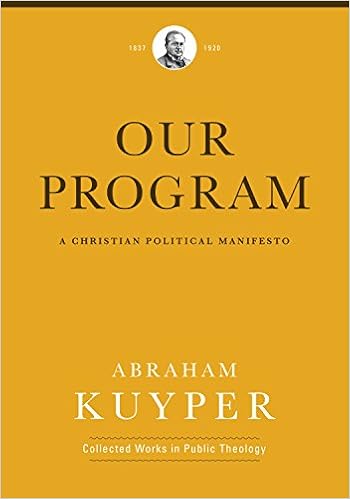
Our Program by Abraham Kuyper - a review

Our Program
A Christian Political Manifesto
Abraham Kuyper
Collected Works in Public Theology
Translated and edited by Harry van Dyke
Bellingham WA: Lexham Press/ Acton Insitute
ISBN 978-1-57-799655-2
hbk; xviii+ 410pp; £34.81


The Antirevolutionary Party (ARP), the first national political party in the Netherlands, was founded on 3 April 1879. Kuyper was its chief architect and leader. He took the movement started by Guillaume Groen Van Prinsterer (1801-1876) and formed it into a political party. Kuyper wrote a series of commentaries on the ARP’s political programme, and these were published as an Ons program [Our Programme] in March 1879 (1879.04 in Kuipers, 2011). Our Program is the English translation of Ons program; it is the latest product from the Kuyper Translation Project. It provides fascinating reading and insight into what a Christian political programme looked like. Harry Van Dyke does an excellent job as a translator. (My interview with Harry Van Dyke is here.)

As Kuyper points out the ARP had another name: ‘Christian-Historical’. The name ARP indicated what they opposed, and the Christian-historical approach was what they promoted. The revolution mentioned in ARP is the French Revolution. The ARP was against the principles that were behind the French Revolution, namely the attempt to place humanity and reason over and above God. The name indicates that the party was a ‘militant party, unhappy with the status quo and ready to critique it, fight it, and change it’. Kuyper preferred the term ARP to Christian-historical, as ARP was more ‘energetic and compelling’ (p. 4). 

Kuyper steers a political course between a Calvinistic utopia, which he recognises is untenable, and a political arrangement for ‘a pure, unmixed Calvinistic nation’ (p. 377). Kuyper didn’t intend for a theocracy, unlike the theonomists in the United States who (mis)appropriated some of Kuyper’s ideas. Kuyper recognises that what is presented here is a ‘rough and very cursory and unfinished sketch of our view of the state’ (p. 377). Nevertheless, this programme was still used by the ARP (with modification in 1916, 1934 and 1961) into the early sixties.

The scope of the topics is impressive: from church and state to overseas development. We have 22 chapters that are a commentary on 21 articles (Article 4 is split into two parts in chapters 4 and 5)

1. The movement 
2. Authority 
3. The ordinances of God 
4. Government 
5. No secular state
6.’By the grace of God’
7. The forms of government 
8. The constitution 
9. Popular influence 
10. Budget refusal 
11. Decentralisation 
12. States and councils 
13. Education 
14. The justice system 
15. Public decency 
16. Public hygiene 
17. Finance 
18. National defence 
19. Overseas possessions 
20. The social question 
21. Church and state 
22. Party policy

 The first part focuses on God, as one might expect from a Christian political party manifesto. God is the source of authority for the movement and that authority comes through his ordinances - all else is delegated through the notion of sphere sovereignty. The ‘source of authority does not reside in the law or the will of the people but in God’ (p. 16 - Article 2); sovereignty ‘flows over all creation, not just in the political field but in every domain’ (p. 20). It starts with God and flows from him to all of creation. God is no gloss over a secular political philosophy – he is integral in all the positions taken by Kuyper in this programme. 
For Kuyper then the role of government is to determine the law of the land and to uphold that law. The laws that the government makes can only be done on the basis that justice already exists. Justice is an ordinance of God and not the whim of the people or of rulers. As Kuyper makes clear: 
… sound and comprehensive knowledge of those principles can only be attained by studying God’s Word and researching God’s ordinances (p. 30). 
The state exists so that communal life can exist; the state is not an end in itself. This communal life is only a foretaste of that which will be revealed in the kingdom of God. As the title of chapter 5 states there is no secular state. The state cannot exist without God and so a secular state is a contradiction. There is no private/ public divide in Kuyper’s thought. Government is a servant of God and as such Kuyper maintains it should: 
allow unrestricted freedom for (1) the gospel’s influence; (2) the people’s spiritual formation; (3) the manner in which people choose to worship; and (4) people’s conscience’. … government is duty-bound to (1) maintain law and order; (2) honor the oath; and (3) dedicate one day a week to God. (p. 57-58) 
It is important to remember that Kuyper was writing this when the Netherlands was a “Christian nation” and atheism was the exception. The situation is very different today. Today, in most western countries, Christianity is the exception. But what is clear here is that Kuyper does not want a theocracy or a government that eliminates all other opposing views; instead, space is created for opposing religions and worldviews.

Inevitably, this is a document of its time. Some of the Sunday restrictions and alcohol control seem very dated. Vaccinations he thinks should be limited – compulsory cowpox vaccination should be ‘out of the question’ (p. 248) – as it means that government is overstepping its bounds: ‘the government should keep its hands off or bodies’.

 Surprising to those who are not aware of Kuyper’s views is the discussion of church and state. He likes the separation of church and state and sees it in a three-fold way: political unity is not coupled to church unity; each have ‘a unique zone in life where each functions as a minister of God’ (p. 354); and there should be a bilateral relationship. But what is clear in the programme is that the form of government is ‘relatively immaterial’ although Kuyper prefers a constitutional monarchy, however, God is the real ruler.

This is not a document that could be adopted wholesale as the manifesto of a contemporary political party; the programme is too historically and geographically bound for that, nevertheless, what it does do is show how political principles arise from faith in God. Politics and faith were intertwined for Kuyper. As with politics so too with education and scholarship: scholarship as politics is to be performed under the sovereignty of God. Both require the realisation that they are creaturely and cultural callings but are contaminated by sin and both require the direct revelation of God through his divine ordinances. 


Review adapted from Bishop, S., 2015. "More Kuyperania". Koers — Bulletin for Christian Scholarship, 80(3). 
Available at: http:// dx.doi.org/10.19108/ koers.80.3.2240


Tuesday, 31 May 2016

#Kuyperania May 2016

James Bradford Pate's  A review of Common Grace Vol1.
http://jamesbradfordpate.blogspot.co.uk/2016/05/book-write-up-common-grace-volume-i-by.html
My areas of confusion notwithstanding, I still found Kuyper in this book to be lucid, winsome, engaging, interesting, and thoughtful.

Bruce Ashford looks at 4 Essential Guidelines for Mixing Christianity and Politics drawing on Kuyper: the first guideline is three key questions:
What is God’s creational design for this sphere of culture or this aspect of public life?
In which ways has sin and sin’s consequences corrupted and misdirected God’s design?
How can we bring healing and redirection to this sphere of culture or this aspect of public life?
The second, principled pluralism; the third, the separation of church and state; and the fourth, the distinction between the church as institute and as organism.

Micah Watson Review of "Abraham Kuyper, Conservatism, and Church and State" by Mark J. Larson Journal of Markets and Morality 19(1)

Friday, 27 May 2016

Interview with Keith Sewell

Wipf and Stock have recently published a new book by Keith Sewell, The Crisis of  Evangelical Christianity: Roots, Consequences, and Resolutions. Full details of the book are available here
I recently caught up with Keith to discuss his important book.

Thanks for doing this interview Keith.
Could you start by saying something about yourself?
I was born in London in 1944, and professed the faith and was baptized in 1961. In 1969 I migrated to Australia, and in 1971 married Alida who had previously emigrated with her family from the Netherlands to New Zealand. We have two sons. I commenced my tertiary studies at the University of Canterbury in 1971. I was a Professor of History at Dordt College in Sioux Center, Iowa from 1998 to 2012. In that year we retired to Australia.
Who or what have been your main influences?
I have been influenced by a variety of authors. As a young Christian I found my way from Arthur Pink and J.C. Ryle to Abraham Kuyper, and from Kuyper to Herman Dooyeweerd, and especially his In the Twilight of Western Thought. Nevertheless, I am a historian and not a philosopher, and greatly admire the work of historians such as Richard Bauckham, Peter Brown, William Reginald Ward, and Heiko A. Oberman. I did my doctoral research on Herbert Butterfield, and I continue to be interested in his work.
How did your interest in history start?
When I was very young, growing up in severely war damaged and down-at-the-heel London, I was struck at the contrast between the evidences of former wealth and power and the straightened circumstances of my own time and place. I seemed to be growing up amid the ruins of Victorian and Edwardian greatness. I think that’s what got me thinking, rather than history classes at school or anything like that. The first history books I read were from the Penge and Anerley Urban District Public Library.
How did you come to lecture in history at Dordt College?
In 1998 I met Don Petcher (of Covenant College) who was on a visit to Melbourne. He told me that Dordt College was advertising a position in History. It was at a time when I was seeking to “move up” from senior secondary to tertiary teaching, so I applied. At Dordt College I had the privilege of working with some excellent colleagues. 
What is it that distinguishes a Christian approach to history from any other?
When I answer questions such as this, folks are prone to say that I talk too much! Certainly, a Christian view of history must be anchored in an overarching understanding of the sovereignty of God over all things. It also understands that all human culture-forming, culture-maintaining, and culture-destroying activity is ultimately religious, being in the service of the one true God, or of a false “god,”an idol of some description. It may be unfashionable, but I do believe that human disobedience does meet with divine judgment, even within the historical process. In what we do with the power that God has given us we can flout the law to which we are subject, but we cannot do so with impunity. Of course, such insight must be used with discernment, and always remembering that all have sinned and fallen short of the glory of God. Already I feel that this answer is too long!
What were the catalysts to you writing this book on Evangelicalism? 
It seemed to me that a critique of evangelicalism from the standpoint of orthodox Christian belief was long overdue, especially from a reformational standpoint. I long expected such a work to be written by someone or other, but when that did not happen I decided to try and start to plug the gap myself.
I have tried to gather many different strands together in a single account. I hope that the book will foster discussion that is both critical and constructive.
Could you briefly describe the book, who are the primary audience and why anyone should read the book?
The book looks at the overall development of Christianity in the West, and considers the roots of Evangelicalism in Reformation and post-Reformation Protestantism. The approach is broadly historical, but I have tried not to make too many assumptions about the historical knowledge of the reader. I find that Christianity generally has reduced the gospel message to “church and missions,” while Evangelicalism had tended towards a further level of reductionism by way of a pietistic emphasis on “inner spiritual feelings.” The book aims to be accessible to undergraduates, students at seminary, ministers, and concerned congregants while at the same time passing scholarly muster. I would like Evangelicals to read this book and ask themselves if their Evangelicalism is really as scriptural as they assume. How can you possibly “preach the gospel” without reference to the kingdom of God?
What was the highlight in researching and writing the book?
For me a high point was reacquainting myself with the first two generations of English Evangelical leaders, men such as John Newton and William Cowper. These were remarkable people, not least when set in the context of their times. I do criticize what I see as the crippling deficiencies of Evangelicalism, but I find it impossible not to respect such early evangelicals for their courage and steadfastness. I was also impressed by the formative influence of the Moravian movement at the decisive point. It would be a grand thing if reformational scholars could work on developing a sympathetic yet critical understanding of the Moravians. Such an analysis would give us a keener insight into the foundations of Anglophone Evangelicalism itself.
In Chapter 6 you seem to suggest at one point that Evangelicalism contributed to the rise of Romanticism, whereas the Brit David Bebbington seems to attribute the transformation of Evangelicalism to the spread of Romanticism (Evangelicalism in Modern Britain, Ch3) and particularly the rise of Irvingism and the Brethren. Could you comment on that?
Yes. David Bebbington has made a valuable contribution to the historiography of British Evangelicalism, although I think that he is disposed to work within the constraints of Evangelicalism itself. I really liked his books on William Gladstone. As to your specific point, much depends upon how we choose to define both Evangelicalism and Romanticism. I see both as having its roots in the eighteenth century and coming to full flower in the nineteenth. Both were reactions against the rational constructs of the great Protestant scholastic system-builders. I think that I would like to keep my mind open to see the earliest Evangelicalism of the second and third decades of the eighteenth century as contributing towards the inception and/ or early development of Romanticism itself.
Are there unsung heroes that you have come across in your research that deserve further study?
Yes, not least Zinzendorf, “the Count,” himself, and William Wilberforce, both truly remarkable men who have suffered somewhat from unhelpfully hagiographic treatment. Other names that I would add to this list would include figures as diverse as Hannah More, and Geerhardus Vos, especially in his later years, and also Henry Atherton. We also need a much more detailed and rigorously researched literature on the leaders on the Pentecostal and Charismatic side of the equation.
You mention in passing Bernard Lord Manning that’s not a name I’ve come across before. Could you say a little more about him and why he merits a mention in the book?
Bernard Lord Manning was a Senior Tutor at Jesus College, Cambridge, and a Congregationalist. He had a strong grasp of English church history and his lectures, published in short, clear and well-argued volumes are well worth reading. He was ecumenically minded while appreciating the clarity and strength of reformed thinking and worship. After his death F. Brittain published Bernard Lord Manning: A Memoir (1941). 
How does your analysis of evangelicalism apply to Calvinism? What do you see as the relationship between Calvinism and evangelicalism? I ask because some of the problems you expose regarding evangelicalism seem to stem from Arminianism rather than Calvinism.
I have immense respect for John Calvin. After all, he laid the foundations of the protestant exposition of scripture. On the other hand, Calvin would have hated the term “Calvinism.” It represents what later Reformed Protestants made of his legacy and asserted in his name. So, the term itself is highly questionable. I hope to write more on this eventually. On the other hand, I think that it is true that evangelicalism has become more and more problematic and fractured the more it has moved away from the best teaching of the protestant reformation itself. Yes, you are, of course, right in saying that some evangelicals call themselves “Calvinists,” but almost always they are standing for the “five points” (that Calvin never heard of), and their position is almost entirely restricted to making soteriological stipulations and lacking anything that would amount to an integral Christian world view capable of coherent and cogent elaboration.
You have included a massive number of books in the bibliography (over 1250), which of those books would you recommend for those who want to study the crisis in evangelicalism further?
The original version of this bibliography was broken down into categories, which I think made it somewhat more usable. The publishers wanted it done differently. Where you should start depends somewhat on where you are coming from. The bibliography is extensive because evangelicalism is so diverse and fragmented. A good place to start might well be the five-volume series “A History of Evangelicalism” edited by Mark Noll and David Bebbington. The final Volume IV in this sequence, by my friend Geoff Treloar, will be published soon. Far too many evangelicals don’t read at all, or they confine themselves exclusively to “their” kind of books. This is a problem. For example, many dispensationalists are unaware of the cogent critiques that have been published addressing both the foundations and the details of their system. Again, few evangelicals have fronted up to the literature that has analyzed the degree to which evangelicalism has become compromised by its subordination to the power and ways of corporate capitalism and contemporary celebrity culture. I would encourage evangelicals to read what makes them feel uncomfortable, while always keeping front and centre the teachings of Christ and his Apostles.
Are there any other projects in the pipeline?
Yes. I am now working on a sequel to my Herbert Butterfield and the Interpretation of History (2005). It is provisionally entitled: Herbert Butterfield, British Policy, and the Origins of the Great War. I am now fully engaged on this project. I contemplate a sequel to The Crisis of Evangelical Christianity (2016), which will focus on elucidating the history of the historiography on John Calvin and Calvinism but so far I have only gathered materials on this topic and have yet to do some writing. I also have some book reviews pending.
What books are you reading at the moment?
I recall the saying of C.S. Lewis that no mug of tea is too large and no book is too long. I usually read two or three simultaneously, that you could label light, medium, and heavy. I also like to combine old and new titles. Right now I am reading as follows: light  Frederick William Maitland and the History of English Law by James R. Cameron (1961), medium the papers collected in Neo-Calvinism and the French Revolution (2014), and, heavy  The French Foreign Office and the Origins of the First World War, 1898-1914 by M.B. Hayne (1993).
If you were castaway on a desert island what would be the two luxury items you’d take with you?
I remember this question on a BBC radio programme called “Desert Island Discs!” I assume that an English Bible and spectacles are necessities. That said, I think I would opt for an everlasting razor for shaving in the morning and a pair of “these will last a lifetime” sandals.

Saturday, 14 May 2016

Modern Art and the Life of a Culture by Jonathan Anderson and William Dyrness - a review

Modern Art and the Life of a Culture
The Religious Impulses of Modernism
Jonathan A. Anderson and William A. Dyrness
InterVarsity Press
Pbk; 265 pp; 
ISBN: 9780830851355

This book is part of a new series on Studies in Theology and the Arts (STA). The book, written by an artist (Anderson - professor of art at Biola University) and a theologian (Dyrness - professor of theology and culture at Fuller Seminary), responds to Rookmaaker’s Modern Art and the Death of a Culture (MA&DoC). 

MA&DoC was a ground-breaking book written over 45 years ago. It was even one of Malcolm Muggeridge’s Books of the Year in 1970. It is testimony to its legacy and impact that it is in print and is still written about today. Rookmaaker drawing off Dooyeweerd’s Christian philosophical framework analyses art and culture. Art for Rookmaaker needed no justification. By that he meant that art (and music) was a good cultural activity for Christians to be involved in. Art wasn’t only useful as an apologetic or evangelistic tool: the aesthetic is an important part of creation. 

However, Rookmaaker had a largely negative view of modern art. This book has a much more positive view - hence the change from death to life in the title. MA&DoC was a polemical work, modern art represented a decline; this book is much more eirenic. As they put it:
‘In what follows we intend to pay tribute to Rookmaaker’s pioneering study and to the generative thinking it fostered for many Christians, yet at the same time we will critique and supplant the central theses of that book’ (p.10)
Anderson and Dyrness see modern art as a ‘theologically meaningful project’ and look at the various religious beliefs underpinning several key modern artists. They hope to ‘decipher’ the way that 
‘“spiritual values,” even theological values, are already in play and at stake throughout modern art, even (perhaps especially) in artworks that do not set out to convey any such thing’ (p.40).
They maintain that the crises and labours of modern art were essentially ‘theological crises and labours’. The book is split into two main parts. Part I takes an appreciative but critical look at Rookmaaker’s approach. Part II takes a geographical journey from Europe to North America and examines several key artists. They begin in France and Britain (Chapter 3) and look at, for example, Gustave Courbet, Paul Gaugin, Van Gough and Georges Rouault; the British artists examined include the Eric Gill and Graham Sutherland. What is noticeable in this chapter is the influence of Roman Catholicism. Whereas, in Germany and Holland (the focus of Chapter 4)  the influence of Protestantism is more marked. Here they examine the works of Caspar David Freidrich and see the influence of German Pietism on his work.

Their analysis of Fredrich’s Monk by the Sea and The Abbey in the Oakland is particularly interesting.


They write:
‘This decrepit manmade structure [The Abbey] was built to celebrate the glory (fullness) of God, but it is now a wreckage, undone by the centuries-long inertia of social transformation and natural entropy.  The “soft  wind” that Friedrich had in mind erases both footprints and cathedrals alike. And in Abbey the two are in fact drawn together: the ruined body of the man being carried through the doorway is directly analogized with the broken body of the cathedral; both are images of God that are  finally unable to generate their own lives or to contain that Life to which they refer. Both human life and human theology are thus faltering pointers toward realities beneath or beyond what is speakable and thinkable. … Whereas Monk pushes the religious seeker to the brink of the abyss, Abbey pushes him to the brink of death; and, in both, religious structures and rituals are found outstripped by the unspeakable Beyond to which they point’ (p.152-153).
They also revisit van Gogh in this chapter, tracing the influences in his work of northern romantic Protestantism.  Piet Mondrian, raised in a Dutch Calvinist home, was later influenced by Rudolf Steiner, also comes under scrutiny in this chapter. They note that Mondrian wouldn’t recognise his work in Rookmaaker’s assessment. They assert that: ‘Mondrian’s theory of art could have found its grounding entirely in Kuyper’s neo-Calvinism'. This is an interesting and intriguing assertion - but I think it needs a little more justification than Anderson and Dyrness produce here.

They then move on to look at Kandinsky. Next, in Chapter 5, they look at the developments in Russia and in the, alleged, nihilism of Dada. This chapter looks at the work of Natalia Goncharova, Kazimir Malevich and Hugo Ball. Ball one of the forerunners of the Dada movement was born into a devout Catholic family. In his later years he reconverted to Catholicism. Anderson and Dryness pose an important question: 'How should we understand Hugo Ball’s Dadaism in relation to his Christianity?’ (228).  The authors here show how these artists were  rooted in Christian traditions.

The next two chapters move from Europe to look at North America. They explore the artists Thomas Cole and Fredric Edwin Church and the Museum of Modern Art (MoMA). Alfred H. Barr Jr, a practising Presbyterian, was the key figure behind MoMA. We are then moved onto a discussion of John Cage’s work. Particularly helpful is the discussion of Cage’s (im)famous 4’33” and the relationship between noise and music. Cage was originally a devout Christian, but the churches he attended were ‘were anemic institutions preoccupied with otherworldly sentimentalities’ (p.197). The authors thus see Cage’s work as ‘oriented toward the practical recovery of a more thoroughgoing creational theology’ — a far cry from the view of Cage espoused by Francis Schaeffer! Another artist that comes under close scrutiny is Andy Warhol. Again the authors reveal Christian perspectives that come through in Warhol’s work.  

What Anderson and Dyrness have done in this volume is to highlight the deep religiously held views of many of the exponents of modern art. The book provides an excellent compliment, and corrective, to the pioneering work of Rookmaaker. They have shown that modern art is theologically significant and modern art cannot be written off as symptomatic of nihilism and secularism. 


Contents

Preface

Part I: Critical Contexts
1. Introduction: Religion and the Discourse of Modernism 
2. H. R. Rookmaaker, Modern Art and the Death of a Culture

Part II: Geographies, Histories and Encounters
3. France, Britain and the Sacramental Image 
4. Germany, Holland and Northern Romantic Theology 
5. Russian Icons, Dada Liturgies and Rumors of Nihilism 
6. North America and the Expressive Image 
7. North America in the Age of Mass-Media

Epilogue
Afterword by Daniel A. Siedell
List of Illustrations
Bibliography
Index


Wednesday, 11 May 2016

The book of the decade?

This long-awaited book from Keith Sewell is now out. It promises to be the book of the year, if not decade:


Sewell, Keith C.
Wipf and Stock
ISBN 13: 978-1-4982-3875-5

Saturday, 7 May 2016

Corey Willson's PhD Shaping the Lenses on Everyday Work

Cory Willson's PhD has now been published online:
Shaping the Lenses on Everyday Work: A Neo-Calvinist Understanding of the Poetics of Work and Vocational Discipleship
In order to take the theology of work conversation forward, “Shaping the Lenses on Everyday Work: A Neo-Calvinist Understanding of the Poetics of Work and Vocational Discipleship” uses an interdisciplinary methodology that incorporates methods from qualitative research to explore the lived realities of contemporary Christians in their work and church contexts. The first third of the dissertation provides an historical analysis of the early theologies of work written by Pope Leo XIII and Herman Bavinck as well as critical reflection on the leading contemporary theologies of work. These historical and literary analyses outline the necessary methodological and theological issues that must be addressed in a theology of work for the Twenty-First Century. The guiding theological framework of human work is a biblical theology of the missio Dei, the mission of God. This theological framework used to interpret the ethnographic research conducted in three congregations. A concluding chapter draws several conclusions for constructing a theology of work for congregations as well as suggestions for how to cultivate a theological imagination for everyday work in Christians.

Chapter 1: Exploring Work Anew
Chapter 2: Historical Background: Herman Bavinck’s Engagement with the “Social Question”
Chapter 3: Overview of Contemporary Theologies of Work
Chapter 4: A Biblical and Theological Grounding of the Manifold Mission of the Triune God
Chapter 5: An Interdisciplinary Methodology for Cultural Hermeneutics
Chapter 6: A Theology of Work from the Road: Congregational Approaches to Vocational Discipleship
Chapter 7: A Theology and Spirituality of Work Fit for Our Times


Tuesday, 3 May 2016

Jim Skillen at Providence Christian College 2016 Academic Conference


What does it mean for Christians to place themselves in the Biblical story as they engage civic justice?  Providence Christian College 2016 Academic Conference.

Other talks by Skillen are available here.

Monday, 2 May 2016

Elaine Storkey's Kuyper Prize lecture


Elaine Storkey's Kuyper Prize lecture “The Battle for Public Truth” can be heard and seen here