An accidental blog

"If God is sovereign, then his lordship must extend over all of life, and it cannot be restricted to the walls of the church or within the Christian orbit." Abraham Kuyper Common Grace 1.1.

Tuesday, 31 May 2016

#Kuyperania May 2016

James Bradford Pate's  A review of Common Grace Vol1.
http://jamesbradfordpate.blogspot.co.uk/2016/05/book-write-up-common-grace-volume-i-by.html
My areas of confusion notwithstanding, I still found Kuyper in this book to be lucid, winsome, engaging, interesting, and thoughtful.

Bruce Ashford looks at 4 Essential Guidelines for Mixing Christianity and Politics drawing on Kuyper: the first guideline is three key questions:
What is God’s creational design for this sphere of culture or this aspect of public life?
In which ways has sin and sin’s consequences corrupted and misdirected God’s design?
How can we bring healing and redirection to this sphere of culture or this aspect of public life?
The second, principled pluralism; the third, the separation of church and state; and the fourth, the distinction between the church as institute and as organism.

Micah Watson Review of "Abraham Kuyper, Conservatism, and Church and State" by Mark J. Larson Journal of Markets and Morality 19(1)

Friday, 27 May 2016

Interview with Keith Sewell

Wipf and Stock have recently published a new book by Keith Sewell, The Crisis of  Evangelical Christianity: Roots, Consequences, and Resolutions. Full details of the book are available here
I recently caught up with Keith to discuss his important book.

Thanks for doing this interview Keith.
Could you start by saying something about yourself?
I was born in London in 1944, and professed the faith and was baptized in 1961. In 1969 I migrated to Australia, and in 1971 married Alida who had previously emigrated with her family from the Netherlands to New Zealand. We have two sons. I commenced my tertiary studies at the University of Canterbury in 1971. I was a Professor of History at Dordt College in Sioux Center, Iowa from 1998 to 2012. In that year we retired to Australia.
Who or what have been your main influences?
I have been influenced by a variety of authors. As a young Christian I found my way from Arthur Pink and J.C. Ryle to Abraham Kuyper, and from Kuyper to Herman Dooyeweerd, and especially his In the Twilight of Western Thought. Nevertheless, I am a historian and not a philosopher, and greatly admire the work of historians such as Richard Bauckham, Peter Brown, William Reginald Ward, and Heiko A. Oberman. I did my doctoral research on Herbert Butterfield, and I continue to be interested in his work.
How did your interest in history start?
When I was very young, growing up in severely war damaged and down-at-the-heel London, I was struck at the contrast between the evidences of former wealth and power and the straightened circumstances of my own time and place. I seemed to be growing up amid the ruins of Victorian and Edwardian greatness. I think that’s what got me thinking, rather than history classes at school or anything like that. The first history books I read were from the Penge and Anerley Urban District Public Library.
How did you come to lecture in history at Dordt College?
In 1998 I met Don Petcher (of Covenant College) who was on a visit to Melbourne. He told me that Dordt College was advertising a position in History. It was at a time when I was seeking to “move up” from senior secondary to tertiary teaching, so I applied. At Dordt College I had the privilege of working with some excellent colleagues. 
What is it that distinguishes a Christian approach to history from any other?
When I answer questions such as this, folks are prone to say that I talk too much! Certainly, a Christian view of history must be anchored in an overarching understanding of the sovereignty of God over all things. It also understands that all human culture-forming, culture-maintaining, and culture-destroying activity is ultimately religious, being in the service of the one true God, or of a false “god,”an idol of some description. It may be unfashionable, but I do believe that human disobedience does meet with divine judgment, even within the historical process. In what we do with the power that God has given us we can flout the law to which we are subject, but we cannot do so with impunity. Of course, such insight must be used with discernment, and always remembering that all have sinned and fallen short of the glory of God. Already I feel that this answer is too long!
What were the catalysts to you writing this book on Evangelicalism? 
It seemed to me that a critique of evangelicalism from the standpoint of orthodox Christian belief was long overdue, especially from a reformational standpoint. I long expected such a work to be written by someone or other, but when that did not happen I decided to try and start to plug the gap myself.
I have tried to gather many different strands together in a single account. I hope that the book will foster discussion that is both critical and constructive.
Could you briefly describe the book, who are the primary audience and why anyone should read the book?
The book looks at the overall development of Christianity in the West, and considers the roots of Evangelicalism in Reformation and post-Reformation Protestantism. The approach is broadly historical, but I have tried not to make too many assumptions about the historical knowledge of the reader. I find that Christianity generally has reduced the gospel message to “church and missions,” while Evangelicalism had tended towards a further level of reductionism by way of a pietistic emphasis on “inner spiritual feelings.” The book aims to be accessible to undergraduates, students at seminary, ministers, and concerned congregants while at the same time passing scholarly muster. I would like Evangelicals to read this book and ask themselves if their Evangelicalism is really as scriptural as they assume. How can you possibly “preach the gospel” without reference to the kingdom of God?
What was the highlight in researching and writing the book?
For me a high point was reacquainting myself with the first two generations of English Evangelical leaders, men such as John Newton and William Cowper. These were remarkable people, not least when set in the context of their times. I do criticize what I see as the crippling deficiencies of Evangelicalism, but I find it impossible not to respect such early evangelicals for their courage and steadfastness. I was also impressed by the formative influence of the Moravian movement at the decisive point. It would be a grand thing if reformational scholars could work on developing a sympathetic yet critical understanding of the Moravians. Such an analysis would give us a keener insight into the foundations of Anglophone Evangelicalism itself.
In Chapter 6 you seem to suggest at one point that Evangelicalism contributed to the rise of Romanticism, whereas the Brit David Bebbington seems to attribute the transformation of Evangelicalism to the spread of Romanticism (Evangelicalism in Modern Britain, Ch3) and particularly the rise of Irvingism and the Brethren. Could you comment on that?
Yes. David Bebbington has made a valuable contribution to the historiography of British Evangelicalism, although I think that he is disposed to work within the constraints of Evangelicalism itself. I really liked his books on William Gladstone. As to your specific point, much depends upon how we choose to define both Evangelicalism and Romanticism. I see both as having its roots in the eighteenth century and coming to full flower in the nineteenth. Both were reactions against the rational constructs of the great Protestant scholastic system-builders. I think that I would like to keep my mind open to see the earliest Evangelicalism of the second and third decades of the eighteenth century as contributing towards the inception and/ or early development of Romanticism itself.
Are there unsung heroes that you have come across in your research that deserve further study?
Yes, not least Zinzendorf, “the Count,” himself, and William Wilberforce, both truly remarkable men who have suffered somewhat from unhelpfully hagiographic treatment. Other names that I would add to this list would include figures as diverse as Hannah More, and Geerhardus Vos, especially in his later years, and also Henry Atherton. We also need a much more detailed and rigorously researched literature on the leaders on the Pentecostal and Charismatic side of the equation.
You mention in passing Bernard Lord Manning that’s not a name I’ve come across before. Could you say a little more about him and why he merits a mention in the book?
Bernard Lord Manning was a Senior Tutor at Jesus College, Cambridge, and a Congregationalist. He had a strong grasp of English church history and his lectures, published in short, clear and well-argued volumes are well worth reading. He was ecumenically minded while appreciating the clarity and strength of reformed thinking and worship. After his death F. Brittain published Bernard Lord Manning: A Memoir (1941). 
How does your analysis of evangelicalism apply to Calvinism? What do you see as the relationship between Calvinism and evangelicalism? I ask because some of the problems you expose regarding evangelicalism seem to stem from Arminianism rather than Calvinism.
I have immense respect for John Calvin. After all, he laid the foundations of the protestant exposition of scripture. On the other hand, Calvin would have hated the term “Calvinism.” It represents what later Reformed Protestants made of his legacy and asserted in his name. So, the term itself is highly questionable. I hope to write more on this eventually. On the other hand, I think that it is true that evangelicalism has become more and more problematic and fractured the more it has moved away from the best teaching of the protestant reformation itself. Yes, you are, of course, right in saying that some evangelicals call themselves “Calvinists,” but almost always they are standing for the “five points” (that Calvin never heard of), and their position is almost entirely restricted to making soteriological stipulations and lacking anything that would amount to an integral Christian world view capable of coherent and cogent elaboration.
You have included a massive number of books in the bibliography (over 1250), which of those books would you recommend for those who want to study the crisis in evangelicalism further?
The original version of this bibliography was broken down into categories, which I think made it somewhat more usable. The publishers wanted it done differently. Where you should start depends somewhat on where you are coming from. The bibliography is extensive because evangelicalism is so diverse and fragmented. A good place to start might well be the five-volume series “A History of Evangelicalism” edited by Mark Noll and David Bebbington. The final Volume IV in this sequence, by my friend Geoff Treloar, will be published soon. Far too many evangelicals don’t read at all, or they confine themselves exclusively to “their” kind of books. This is a problem. For example, many dispensationalists are unaware of the cogent critiques that have been published addressing both the foundations and the details of their system. Again, few evangelicals have fronted up to the literature that has analyzed the degree to which evangelicalism has become compromised by its subordination to the power and ways of corporate capitalism and contemporary celebrity culture. I would encourage evangelicals to read what makes them feel uncomfortable, while always keeping front and centre the teachings of Christ and his Apostles.
Are there any other projects in the pipeline?
Yes. I am now working on a sequel to my Herbert Butterfield and the Interpretation of History (2005). It is provisionally entitled: Herbert Butterfield, British Policy, and the Origins of the Great War. I am now fully engaged on this project. I contemplate a sequel to The Crisis of Evangelical Christianity (2016), which will focus on elucidating the history of the historiography on John Calvin and Calvinism but so far I have only gathered materials on this topic and have yet to do some writing. I also have some book reviews pending.
What books are you reading at the moment?
I recall the saying of C.S. Lewis that no mug of tea is too large and no book is too long. I usually read two or three simultaneously, that you could label light, medium, and heavy. I also like to combine old and new titles. Right now I am reading as follows: light  Frederick William Maitland and the History of English Law by James R. Cameron (1961), medium the papers collected in Neo-Calvinism and the French Revolution (2014), and, heavy  The French Foreign Office and the Origins of the First World War, 1898-1914 by M.B. Hayne (1993).
If you were castaway on a desert island what would be the two luxury items you’d take with you?
I remember this question on a BBC radio programme called “Desert Island Discs!” I assume that an English Bible and spectacles are necessities. That said, I think I would opt for an everlasting razor for shaving in the morning and a pair of “these will last a lifetime” sandals.

Saturday, 14 May 2016

Modern Art and the Life of a Culture by Jonathan Anderson and William Dyrness - a review

Modern Art and the Life of a Culture
The Religious Impulses of Modernism
Jonathan A. Anderson and William A. Dyrness
InterVarsity Press
Pbk; 265 pp; 
ISBN: 9780830851355

This book is part of a new series on Studies in Theology and the Arts (STA). The book, written by an artist (Anderson - professor of art at Biola University) and a theologian (Dyrness - professor of theology and culture at Fuller Seminary), responds to Rookmaaker’s Modern Art and the Death of a Culture (MA&DoC). 

MA&DoC was a ground-breaking book written over 45 years ago. It was even one of Malcolm Muggeridge’s Books of the Year in 1970. It is testimony to its legacy and impact that it is in print and is still written about today. Rookmaaker drawing off Dooyeweerd’s Christian philosophical framework analyses art and culture. Art for Rookmaaker needed no justification. By that he meant that art (and music) was a good cultural activity for Christians to be involved in. Art wasn’t only useful as an apologetic or evangelistic tool: the aesthetic is an important part of creation. 

However, Rookmaaker had a largely negative view of modern art. This book has a much more positive view - hence the change from death to life in the title. MA&DoC was a polemical work, modern art represented a decline; this book is much more eirenic. As they put it:
‘In what follows we intend to pay tribute to Rookmaaker’s pioneering study and to the generative thinking it fostered for many Christians, yet at the same time we will critique and supplant the central theses of that book’ (p.10)
Anderson and Dyrness see modern art as a ‘theologically meaningful project’ and look at the various religious beliefs underpinning several key modern artists. They hope to ‘decipher’ the way that 
‘“spiritual values,” even theological values, are already in play and at stake throughout modern art, even (perhaps especially) in artworks that do not set out to convey any such thing’ (p.40).
They maintain that the crises and labours of modern art were essentially ‘theological crises and labours’. The book is split into two main parts. Part I takes an appreciative but critical look at Rookmaaker’s approach. Part II takes a geographical journey from Europe to North America and examines several key artists. They begin in France and Britain (Chapter 3) and look at, for example, Gustave Courbet, Paul Gaugin, Van Gough and Georges Rouault; the British artists examined include the Eric Gill and Graham Sutherland. What is noticeable in this chapter is the influence of Roman Catholicism. Whereas, in Germany and Holland (the focus of Chapter 4)  the influence of Protestantism is more marked. Here they examine the works of Caspar David Freidrich and see the influence of German Pietism on his work.

Their analysis of Fredrich’s Monk by the Sea and The Abbey in the Oakland is particularly interesting.


They write:
‘This decrepit manmade structure [The Abbey] was built to celebrate the glory (fullness) of God, but it is now a wreckage, undone by the centuries-long inertia of social transformation and natural entropy.  The “soft  wind” that Friedrich had in mind erases both footprints and cathedrals alike. And in Abbey the two are in fact drawn together: the ruined body of the man being carried through the doorway is directly analogized with the broken body of the cathedral; both are images of God that are  finally unable to generate their own lives or to contain that Life to which they refer. Both human life and human theology are thus faltering pointers toward realities beneath or beyond what is speakable and thinkable. … Whereas Monk pushes the religious seeker to the brink of the abyss, Abbey pushes him to the brink of death; and, in both, religious structures and rituals are found outstripped by the unspeakable Beyond to which they point’ (p.152-153).
They also revisit van Gogh in this chapter, tracing the influences in his work of northern romantic Protestantism.  Piet Mondrian, raised in a Dutch Calvinist home, was later influenced by Rudolf Steiner, also comes under scrutiny in this chapter. They note that Mondrian wouldn’t recognise his work in Rookmaaker’s assessment. They assert that: ‘Mondrian’s theory of art could have found its grounding entirely in Kuyper’s neo-Calvinism'. This is an interesting and intriguing assertion - but I think it needs a little more justification than Anderson and Dyrness produce here.

They then move on to look at Kandinsky. Next, in Chapter 5, they look at the developments in Russia and in the, alleged, nihilism of Dada. This chapter looks at the work of Natalia Goncharova, Kazimir Malevich and Hugo Ball. Ball one of the forerunners of the Dada movement was born into a devout Catholic family. In his later years he reconverted to Catholicism. Anderson and Dryness pose an important question: 'How should we understand Hugo Ball’s Dadaism in relation to his Christianity?’ (228).  The authors here show how these artists were  rooted in Christian traditions.

The next two chapters move from Europe to look at North America. They explore the artists Thomas Cole and Fredric Edwin Church and the Museum of Modern Art (MoMA). Alfred H. Barr Jr, a practising Presbyterian, was the key figure behind MoMA. We are then moved onto a discussion of John Cage’s work. Particularly helpful is the discussion of Cage’s (im)famous 4’33” and the relationship between noise and music. Cage was originally a devout Christian, but the churches he attended were ‘were anemic institutions preoccupied with otherworldly sentimentalities’ (p.197). The authors thus see Cage’s work as ‘oriented toward the practical recovery of a more thoroughgoing creational theology’ — a far cry from the view of Cage espoused by Francis Schaeffer! Another artist that comes under close scrutiny is Andy Warhol. Again the authors reveal Christian perspectives that come through in Warhol’s work.  

What Anderson and Dyrness have done in this volume is to highlight the deep religiously held views of many of the exponents of modern art. The book provides an excellent compliment, and corrective, to the pioneering work of Rookmaaker. They have shown that modern art is theologically significant and modern art cannot be written off as symptomatic of nihilism and secularism. 


Contents

Preface

Part I: Critical Contexts
1. Introduction: Religion and the Discourse of Modernism 
2. H. R. Rookmaaker, Modern Art and the Death of a Culture

Part II: Geographies, Histories and Encounters
3. France, Britain and the Sacramental Image 
4. Germany, Holland and Northern Romantic Theology 
5. Russian Icons, Dada Liturgies and Rumors of Nihilism 
6. North America and the Expressive Image 
7. North America in the Age of Mass-Media

Epilogue
Afterword by Daniel A. Siedell
List of Illustrations
Bibliography
Index


Wednesday, 11 May 2016

The book of the decade?

This long-awaited book from Keith Sewell is now out. It promises to be the book of the year, if not decade:


Sewell, Keith C.
Wipf and Stock
ISBN 13: 978-1-4982-3875-5

Saturday, 7 May 2016

Corey Willson's PhD Shaping the Lenses on Everyday Work

Cory Willson's PhD has now been published online:
Shaping the Lenses on Everyday Work: A Neo-Calvinist Understanding of the Poetics of Work and Vocational Discipleship
In order to take the theology of work conversation forward, “Shaping the Lenses on Everyday Work: A Neo-Calvinist Understanding of the Poetics of Work and Vocational Discipleship” uses an interdisciplinary methodology that incorporates methods from qualitative research to explore the lived realities of contemporary Christians in their work and church contexts. The first third of the dissertation provides an historical analysis of the early theologies of work written by Pope Leo XIII and Herman Bavinck as well as critical reflection on the leading contemporary theologies of work. These historical and literary analyses outline the necessary methodological and theological issues that must be addressed in a theology of work for the Twenty-First Century. The guiding theological framework of human work is a biblical theology of the missio Dei, the mission of God. This theological framework used to interpret the ethnographic research conducted in three congregations. A concluding chapter draws several conclusions for constructing a theology of work for congregations as well as suggestions for how to cultivate a theological imagination for everyday work in Christians.

Chapter 1: Exploring Work Anew
Chapter 2: Historical Background: Herman Bavinck’s Engagement with the “Social Question”
Chapter 3: Overview of Contemporary Theologies of Work
Chapter 4: A Biblical and Theological Grounding of the Manifold Mission of the Triune God
Chapter 5: An Interdisciplinary Methodology for Cultural Hermeneutics
Chapter 6: A Theology of Work from the Road: Congregational Approaches to Vocational Discipleship
Chapter 7: A Theology and Spirituality of Work Fit for Our Times


Tuesday, 3 May 2016

Jim Skillen at Providence Christian College 2016 Academic Conference


What does it mean for Christians to place themselves in the Biblical story as they engage civic justice?  Providence Christian College 2016 Academic Conference.

Other talks by Skillen are available here.

Monday, 2 May 2016

Elaine Storkey's Kuyper Prize lecture


Elaine Storkey's Kuyper Prize lecture “The Battle for Public Truth” can be heard and seen here

Tuesday, 26 April 2016

Introducing ThinkingFaith Network

Introducing Thinking Faith Network and its three strands: LifeMatters, RealityBites and Faith-in-Scholarship - featuring Tom Wright and David Hanson.

Tuesday, 5 April 2016

Kuyper Conference "Religion and Journalism" April 15-16 at Princeton Seminary


The following is the latest from the organisers of the Kuyper Conference:


Still considering registering for next week's Kuyper Conference "Religion and Journalism" April 15-16 at Princeton Seminary? For your reference, please consider the titles and abstracts of this year's full schedule of plenary and concurrent sessions. We would be delighted to welcome you to the Princeton Seminary campus for this year’s programming.
Warm Regards,
Darrell L. Guder, Interim Conference Director
"Religion and Journalism"
PRINCETON, NEW JERSEY
April 15-16, 2016

THE ABRAHAM KUYPER LECTURE & PRIZE
--- THURSDAY, APRIL 14 ---
7:00 p.m., Miller Chapel
Elaine Storkey, distinguished scholar and journalist from the United Kingdom in the disciplines of sociology, philosophy and theology with past appointments at the University of Oxford and the BBC

PLENARY LECTURES
--- FRIDAY, APRIL 15 ---
9:00 a.m., Conference Plenary I
“The Challenge of Religion as News”
Gustav Niebuhr, director of the Carnegie Religion & Media Program at Syracuse University and career journalist with the New York Times, Washington Post and Wall Street Journal
Abstract:  In the United States, religion occupies a contested public space, in which practitioners often perceive themselves as doing battle with hostile forces. Historic religious pluralism complicates this perception while also seeming at times to affirm it.
_______
11:00 a.m., Conference Plenary II
Film Documentary: “The Journalist at Work: Abraham Kuyper and His Trip Around the Mediterranean in 1905 and 1906”
George Harinck, Professor of Neo-Calvinist History at the Free University of Amsterdam and Extraordinary Professor of History at the Theological University of Kampen
Abstract: This excerpt from a newly released documentary film series Around the Old World Sea offers a fascinating exploration of clashing cultures and religions in past and present. The film focuses on the roots of religious, political and social conflict in this region though tracing the steps of Kuyper’s own epic nine-month journey in the early 20thcentury.

--- SATURDAY, APRIL 16 ---
9:00 a.m., Conference Plenary III
“Journalism and Religion in a Late-Modern Context: A View from the Dutch Neo-Calvinist Tradition”
Koert Van Bekkum, Asst. Professor of Old Testament at the Theological University of Kampen and former editor at Dutch daily newspaper Nederlands Dagblad
Abstract:  Recent debates on journalism focus on the pitfalls and possibilities of new digital platforms, the increasing influence of capital on the selection and presentation of the news and its interpretation, and on civic and constructive journalism as answers to these trends. The lecture offers a sketch of Abraham Kuyper’s view of journalism and the history Christian journalism in the Dutch Neo-Calvinist tradition, and then elaborates on the recent discussions from this perspective.
_______
10:45 a.m., Conference Plenary IV
 “Understanding Religious Art in a Journalistic Context: Definitions Matter”
Alissa Wilkinsonchief film critic at Christianity Today and assistant professor of English and Humanities at The King’s College in New York City
Abstract: The recent discovery of the "faith-based" industry has contributed to a spike in coverage of the religious audience for mass media - and though it's often full of good-will, it's usually under-informed. What would it look like to contribute to the journalistic record regarding culture as a person of faith? What are the challenges and opportunities that face the journalist of faith?

CONCURRENT SESSIONS
--- FRIDAY, APRIL 15 ---
1:30 PM – 2:45 PM         1st Concurrent Session Papers:
Session 1A: 
“Abraham Kuyper and the Refugees: Welcoming Strangers in the Name of Christ”
Michael Bräutigam, University of Melbourne
_______
Session 1B:
“‘In a time of unclarity, there can be no conversion without polemics’: Klaas Schilder’s Argument for the Need of Polemics in Christian Journalism”
Marinus de Jong, TU Kampen
_______
Session 1C:
“The Debate Between Objective Journalism and a Journalism of Attachment: A Neo-Calvinistic Approach”
Nathaniel Sutano, University of Edinburgh
_______
3:15 PM – 4:30 PM         2nd Concurrent Session Papers:
Session 2A:
“The Political Economy of Kuyper’s Newspapers”
Clifford Anderson, Vanderbilt
_______
Session 2B:
“Divine images and political representation: towards an evaluation of the role of the media in post-Christian democracies”
A.L.Th. de Bruijne, TU Kampen
_______
Session 2C:
“Taking Journalism to Seminary: Bavinck on Human Action as Theology”
Cory Brock, University of Edinburgh
_______
4:45 PM – 6:00 PM         3rd Concurrent Session Papers:
Session 3A:
“A republic of letters for the Kingdom of God: Journalism in the service of the Protestant religious imagination, 1800-1830”
Andrew Kloes, University of Edinburgh
_______
Session 3B:
“Islam according to Journalist Abraham Kuyper”
Jan van Vliet, Dordt College 
_______
Session 3C:
“A Shy Hope in the Heart? Religious Journalism in Australia and the Kuyperian legacy”
Bruce Pass, University of Edinburgh

Wednesday, 30 March 2016

Kuyper's academic genealogy


Theology tree is a fascinating website that shows The Academic Genealogy of theologians and Biblical scholars. It is a free, volunteer-run website. Above is Kuyper's academic genealogy.

Monday, 28 March 2016

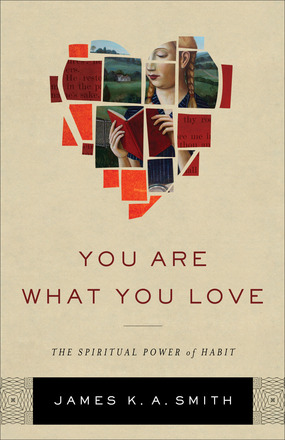
Review of You Are What You Love by James K.A. Smith

You Are What You Love
The Spiritual Power of Habit
James K.A. Smith
Grand Rapids: Brazos Press
Hbk; 224pp; £12.99.
ISBN 9781587433801
Publisher’s web page here 


The nature of idolatry is that we are shaped into the idol’s image: we become like what we worship (Ps 115:8).  A graphic illustration of this is provided by the Daily Mirror headline some years ago regarding a young computer hacker:


COMPUTERS TURNED MY SON INTO A ROBOT

Those who make idols will be like them. We image what we worship. This theme is taken up in Smith’s latest book.The book serves as a summary to two of his previous cultural liturgies books: Desiring the Kingdom (Baker Academic, 2009) and Imagining the Kingdom (Baker Academic, 2013). 

According to Smith ‘This book articulates a spirituality for culture-makers, showing (I hope) why discipleship needs to be centered in and fueled by our immersion in the body of Christ. Worship is the “imagination station” that incubates our loves and longings so that our cultural endeavors are indexed toward God and his kingdom’ (loc 70-72) Smith argues for the need for a change in our discipleship model, a shift in praxis from a Descartian ‘brain-on-a-stick’ model to a view where discipleship is more than information transfer. 

He rightly notes that all models presuppose a view of what it means to be human; how we answer that questions shapes our praxis. The ‘I am what I think’ banking model is flawed. Of course, this is not to be seen as a rejection of thinking, Smith is, after all, a professor of philosophy at Calvin College. Neither is he setting up a head/ heart dualism. He advocates an ‘I love therefore I am’ model. We are what we desire and so we are defined not by knowledge but by what we desire. And this is where worship fits in. As Smith puts it: ‘To be human is to be a liturgical animal, a creature whose loves are shaped by our worship.’ We are what we love and discipleship needs to be seen as a rehabituation of our loves rather than the acquisition of knowledge, this can come through worship. However, the worship needs to embrace liturgies:
‘Christian worship, we should recognize, is essentially a counterformation to those rival liturgies we are often immersed in, cultural practices that covertly capture our loves and longings, miscalibrating them, orienting us to rival versions of the good life. This is why worship is the heart of discipleship’ (Loc 438-441).

What Smith is calling for is not a return to traditional worship and a turning away from contemporary Christian worship - he wants so much more than that. Liturgy is needed to re-orientate our hearts:
‘Our hearts, we’ve said, are like existential compasses and embodied homing beacons: our loves are pulled magnetically to some north toward which our hearts have been calibrated. Our action and behavior—indeed, a whole way of life—are pulled out of us by this attraction to some vision of the good life. Liturgies, then, are calibration technologies. They train our loves by aiming them toward a certain telos’ (889-892)
And importantly:
‘Recognizing worship as the heart of discipleship doesn’t mean sequestering discipleship to Sunday; it means expanding worship to become a way of life.’

The book is iconoclastic - exposing the idols that often lie behind the seeker-sensitive movement,  the youth ministry movement and even marriage and the family.  Smith makes an excellent case for keeping the youth in with the rest of the congregation and not keeping them apart. He cogently argues that we have ‘created youth ministry that confuses extroversion with faithfulness’. 
'And the sad fact is that our youth ministries have treated them as thinking things that need to be entertained when, in fact, what they really crave is not liberation from ritual but rather liberating rituals.'
This is an important book - not only does it makes accessible his cultural liturgies books but provides a framework for rethinking discipleship.

Contents
1. You Are What You Love: To Worship Is Human
2. You Might Not Love What You Think: Learning to Read "Secular" Liturgies
3. The Spirit Meets You Where You Are: Historic Worship for a Postmodern Age
4. What Story Are You In? The Narrative Arc of Formative Christian Worship
5. Guard Your Heart: The Liturgies of Home
6. Teach Your Children Well: Learning by Heart
7. You Make What You Want: Vocational Liturgies
Epilogue
For Further Reading


Saturday, 26 March 2016

A History of the Reformational Movement in Britain: The Pre-World War II Years in Koers 80(4)

My paper on the history of the Reformational movement in Britain beofre WWII has now been published in Koers.
It is available here.

Bishop, S., 2015. "A History of the Reformational Movement in : The Pre- World War II Years".
KOERS — Bulletin for Christian Scholarship, 80(4).
Available at: http:// dx.doi.org/10.19108/ koers.80.4.2216


Friday, 18 March 2016

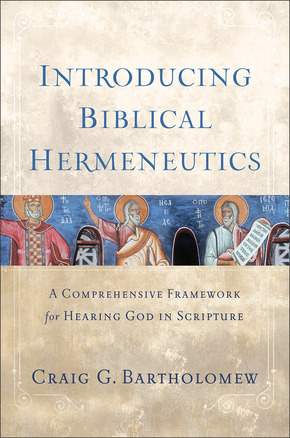
Review of Introducing Biblical Hermeneutics by Craig Bartholomew

Introducing Biblical Hermeneutics
A Comprehensive Framework for Hearing God in Scripture

Craig G. Bartholomew
Grand Rapids: Baker Books
ISBN 978-0-8010-3977-5
640pp; Hbk; £21.75.
Publisher's website here. 

This is perhaps the best book on hermeneutics yet written! In the first chapter Bartholomew sets out his main thesis – he wants to develop a Trinitarian hermeneutic. A Trinitarian hermeneutic, according to Bartholomew, is one which:

1. Approaches the Bible as authoritative Scripture
2. Approaches the Bible as a whole
3. Views ecclesial receptions of Scripture as primary
4. Exists and humbles academic interpretation
5. Will attend to the discrete witness of the Testaments
6. Rightly discerns the goal of reading the Bible
7. Does not close down but opens up interpretation of the Bible
8. Takes up God’s address for all of life seriously

It is perhaps point 8 that mark this introduction out as being different. Bartholomew writes out of a Kuyperian tradition and this permeates all of his approach. This is particularly seen in the inclusion of two chapters - not usually seen in a hermeneutics book - one on the Bible and scholarship and the other on preaching. But also in two key themes that reoccur the role of philosophy and the emphasis on the goodness of creation. As regards the latter point he rightly points out that:
‘Methods are never philosophically and theologically neutral, and we should avoid uncritically importing methods of interpretation that at root are in epistemological conflict with the epistemic primacy of the Trinity.’
And 
'A distinctive of this volume is its insistence that theology and philosophy cannot be bracketed out of biblical interpretation.'
Though, this does not mean that all biblical scholars have to have philosophy degrees! (Though one might help!)

Sadly, it has become common over the past 150 years for Christian scholars to inhabit two unrelated worlds: the world of the church, and the world of their study and lecture room. In the one, Christ is acknowledged; but in the other, Christ is unwelcome, since in the latter domain so-called reason and neutrality reign.

This sort of approach has led to dualism and a privatisation of faith. 

The book is divided into 5 parts: Approaching Biblical Interpretation, Biblical interpretation and biblical theology, the story of biblical interpretation, Biblical interpretation and the academic disciplines, the Goal of biblical interpretation. 

What is refreshing about this book is that it takes seriously the need to listen as well as analyse and interpret. The emphasis is on listening to God; he proposes Mary, Martha’s sister as the patron saint for biblical interpretation –she quietly and attentively listened to Jesus. Listening is part of us ‘being creaturely’. Listening provides an antidote the Enlightenment legacy of the emphasis on rational analysis. He notes that: ‘prior to analysis comes listening’.

Bartholomew draws on a wide range of sources in one chapter we have a range of quotes from as diverse authors as John Stott, Martyn Lloyd-Jones, Karl Barth, George Steiner, Herman Bavinck, Lesslie Newbigin, Tocqueville, Mariano Magrassi and Jean Leclercq. This does not mean that Bartholomew takes a pick and mix approach – he is not ashamed to draw upon resources from other traditions and there is richness in such diversity. 
He identifies that one issue has been that academic scholars compartmentalise – so that in the church the lordship of Christ is acknowledged, but in academic study he is not, as reason and neutrality reign. This dichotomy, Bartholomew is right, is unsustainable. What is needed and is a full integration of the ecclesiastical and academic interpretation. This can only come from seeing the Scripture as God’s Word.

The book has a plethora of references over 2300 and a massive bibliography - about 40% of the book is taken up with references and bibliography. That shows the scope of Bartholomew’s research. It also serves to show that this is no mere introduction but is comprehensive.

This book shows that hermeneutics does not need to be a dry and dusty subject - Bartholomew shows that it can be helpful and engaging. The penultimate chapter is particularly inspiring as here Bartholomew plus together most of the threads and shows how in they can be applied to the book of Hebrews in an inspiring and insightful way. This chapter alone is worth the price of the book - and to reiterate my first sentence: this is probably the best book on hermeneutics yet written.


Contents

Part 1: Approaching Biblical Interpretation
1. Biblical Interpretation Coram Deo
2. Listening and Biblical Interpretation
Part 2: Biblical Interpretation and Biblical Theology
3. The Story of Our World
4. The Development of Biblical Theology
Part 3: The Story of Biblical Interpretation
5. The Traditions within Which We Read
6. Early and Medieval Jewish Biblical Interpretation
7. Renaissance, Reformation, and Modernity
8. Canon
Part 4: Biblical Interpretation and the Academic Disciplines
9. Philosophy and Hermeneutics
10. History
11. Literature
12. Theology
13. Scripture and the University: The Ecology of Christian Scholarship
Part 5: The Goal of Biblical Interpretation
14. The "Epistle" to the Hebrews: But We Do See Jesus
15. Preaching the Bible for All It's Worth: The Resurrection of the Sermon and the Incarnation of the Christ

Indexes

Tuesday, 15 March 2016

Review of Church's Social Responsibility ed. by Ballor and Joustra

The Church’s Social Responsibility
Reflections on Evangelism and Social Justice
Edited by Jordan J. Ballor and Robert Joustra
Grand Rapids, MI: Christian’s Library Press, 2015.
ISBN 978-1-942503-26-2
pbk; 119pp; £9.87.
Publisher's website here.

The church matters. Neo-Calvinists are often accused of not taking the church seriously. But now many are waking up to the notion that church as an institution is important. The great Dutch statesman, newspaper publisher, prime minister and theologian, introduced an important distinction between church as an institute and being organic.

Kuyper uses many metaphors to illustrate this distinction, particularly in his recently translated Rooted and Grounded. The church as an organism is a body and it grows, as an institute, it is a house that is built. It is from the organism of church that the institution is born. The institution is the church organisation, its sacraments, its priests; the organism is the church in the world, Christians at work in society, the body of Christ. The organism is strengthened and served by the church as institute. The church as institute does not run schools, universities, coffee shops or trade union; that is the role of the church as organism. This, in essence, is the theme developed in this great little book. 
Most of the essays here take up Kuyper’s useful distinction. There has been a tendency in the past to play down the institution side of church. This is partly as a reaction against ecclesiasticisation of Christianity — an approach often manifested in the idea that full-time Christian ministry is church work. Now we are beginning to realise that ministry is more than church work.  It is more than what the ‘laity’ do on Sundays: there are no part-time Christians!

The book begins with three essays setting the scene. Carl Henry’s essay is  from his important and ground-breaking book of the time.  written during the rise of neo-evangelicalism. As Ockenga, one of the father’s of neo-fundamentalism, wrote in 1956:  
Nevertheless—unlike fundamentalism—evangelicalism realizes the church has a prophetic mission to society…. We must…make evangelicalism more relevant to the political and sociological realities of our time…unless conservative Christian theologians take more time to point out the relevance of Christ and the Bible to important (social) issues conservatism will be neglected by the rising generation.
“Is Evangelical Theology Changing?” Christian Life, March, 1956, p. 4.

It was this call for relevancy that was taken up by Carl Henry. There was an increasing realisation that the church had a social responsibility. For Henry, the church’s role was to say No to moral and political issues, such as  abortion, slavery, apartheid, rather than to say yes to party-political approaches or actions. This approach is endorsed by Richard Mouw, who tells the story of his wrangling over a few phrases of an essay he submitted to Christianity Today when Henry was the editor. Mouw wanted to advocate that the church should say a ‘bold yes to specific policy-like solutions’; Henry wanted him to change the sentence. Mouw now sees he was wrong and Henry’s no-saying approach as being correct. Although Mouw has slight misgivings of the way Henry presented his case, to remedy this Mouw draws on Kuyper’s church as institute and as organism. Kuyper would agree with Henry that the church (as institute) is limited in what it can say about issues in public life, however, the church (as organism) as the body of Christ has a responsibility to go out and form organisations to engage in areas of cultural involvement and policy formation.

Kuyper’s theme is also taken up in Part 2, Principles of responsibility, with essays from Driessenga, Koyzis and Wagenman. All three endorse Kuyper's institute and organism approach. Driessenga also uses the metaphors of pearl and leaven taken from Kuyper’s contemporary Herman Bavinck. Koyzis introduces an important point from one of Kuyper’s successors, Herman Dooyeweerd. Dooyeweerd makes a distinction between institutional communities and voluntary associations. The church is the former and not the latter. This has implications for the way we see the church as institution; church is not ‘a mere association of converted individuals’ (50). Church is called into being by a divine covenant, not by common interests, being member son the church is not like joining a club for its own ends. Koyzis ends his chapter with an important point: ‘We dare not neglect the institutional church and the meaning of grace which offer such nourishment’ (53).

Wagemann also develops Kuyper’s distinction. He also warns against asserting that the institutional church has no relationship to social issues - as the church is to proclaim the gospel. As Wagenman wisely puts it:
‘… Kuyper taught that the unique calling of the institutional church was the contextualised and comprehensive proclamation of the gospel. The gospel doesn’t dictate a particular government policy but the gospel has some applicability  to every issue of human life’ (57)
If the church fails to do this than it is only preaching part of the gospel and thus failing in its institutional role. It is important to realise that church as institution/ organism doesn’t set up a new form of dualism.

Part 3, Practices of Responsibility, looks at the church’s role in social justice. Van Reken maintains that ‘The primary work of the institutional church is not to promote social justice, it is to warn people of divine justice’ (67). He also follows Henry’s approach: 
‘My view is that the institutional church should speak out against preventable poverty, but in most cases, must not recommend exactly which social justice will best reduce poverty’ (68).  
Vander Meulen’s thesis is that: ‘the institutional church needs to vigorously encourage — at personal and corporate levels…—faithfulness in doing justice’ (72). Hogenterp acknowledges that silence over issues can be ambiguous.

The Church and Society, part 4, contains essays by Den Dulk, Summer and Bacote. Den Dulk returns to the important theme of social justice and argues that the church ought to pursue its claims, but their role is limited - but it is within these limitations that ‘the churches will find their strongest voice’ (93). The issue of what is and what isn’t a Christian think tank is the subject of Summers, the CEO of the Centre for Public Justice a prominent Christian think tank. She sees them playing an important role. She identifies three wrong answers to the question why do we need distinctively Christian think tanks and then three right responses. She makes an important point:
‘The wrong answer — that there is no need for distinctively Christian think tanks if the church just does its job — is wrong because it conflates the task of the church as institute and the church as organism’ (97).
Bacote looks at social justice and Christian obedience. He examines some present and future challenges; these are: marriage; religious liberty; race; gender; abortion; and environmental concerns; economic life and poverty. He ends by noting that talk alone will not suffice; it’s time for action. 

In closing, in the historical afterword, Kevin Flatt examines some important lessons from the United Church of Canada.


This book contains a diverse range of short articles - it can be read in under two hours and yet it is packed with insight and wisdom. What is perhaps most remarkable is the agreement of most of the authors of the importance of the distinction between the church as organism and the church as institute. It was a distinction that Kuyper made first in his ‘Rooted and grounded’ sermon in 1870, yet as can be seen from these essays it is still relevant; and indeed more than relevant it can help to frame the role of the church in the public square today. This book is an important contribution to the debate regarding the role of the church in society.

Monday, 14 March 2016

The hermeneutics and exegesis of a stop sign


Suppose you're travelling to work and you see a stop sign. What do you do? That depends on how you exegete the stop sign.

A postmodernist deconstructs the sign with his bumper, ending forever the tyranny of the north-south traffic over the east-west traffic.

Similarly, a Marxist sees a stop sign as an instrument of class conflict. He concludes that the bourgeoisie use the north-south road and obstruct the progress of the workers on the east-west road.

A serious and educated Catholic believes that he cannot understand the stop sign apart from its interpretive community and their tradition. Observing that the interpretive community doesn't take it too seriously, he doesn't feel obligated to take it too seriously either.

An average Catholic doesn't bother to read the sign, but he'll stop if the car in front of him does.

A fundamentalist, allowing the text to interpret itself, stops at the stop sign and waits for it to tell him to go.

A suburban preacher looks up “STOP” in his lexicons of English and discovers that it can mean: 
1) something which prevents motion, such as a plug for a drain, or a block of wood that prevents a door from closing;
2) a location where a train or bus lets off passengers. 
The main point of his sermon the following Sunday on this text is: when you see a stop sign, it is a place where traffic is naturally clogged, so it is a good place to let off passengers from your car.

An orthodox Jew does one of two things:
Take another route to work that doesn't have a stop sign so that he doesn't run the risk of disobeying the Law.
Stop at the stop sign, say “Blessed art thou, O Lord our God, king of the universe, who hast given us thy commandment to stop,” wait 3 seconds according to his watch, and then proceed. 
Incidentally, the Talmud has the following comments on this passage: R[abbi] Meir says: He who does not stop shall not live long. R. Hillel says: Cursed is he who does not count to three before proceeding. R. Simon ben Yudah says: Why three? Because the Holy One, blessed be He, gave us the Law, the Prophets, and the Writings. R. ben Isaac says: Because of the three patriarchs. R. Yehuda says: Why bless the Lord at a stop sign? Because it says: “Be still, and know that I am God.” R. Hezekiel says: When Jephthah returned from defeating the Ammonites, the Holy One, blessed be He, knew that a donkey would run out of the house and overtake his daughter; but Jephthah did not stop at the stop sign, and the donkey did not have time to come out. For this reason he saw his daughter first and lost her. Thus he was judged for his transgression at the stop sign. R. Gamaliel says: R. Hillel, when he was a baby, never spoke a word, though his parents tried to teach him by speaking and showing him the words on a scroll. One day his father was driving through town and did not stop at the sign. Young Hillel called out: “Stop, father!” In this way, he began reading and speaking at the same time. Thus it is written: “Out of the mouth of babes.” R. ben Jacob says: Where did the stop sign come from? Out of the sky, for it is written: “Forever, O Lord, your word is fixed in the heavens.” R. ben Nathan says: When were stop signs created? On the fourth day, for it is written: “let them serve as signs.” R. Yeshuah says: ... [continues for three more pages]
A Karaite does the same thing as an orthodox Jew, except that he waits 10 seconds instead of 3. He also replaces his brake lights with 1000 watt searchlights and connects his horn so that it is activated whenever he touches the brake pedal.

A Unitarian concludes that the passage “STOP” undoubtedly was never uttered by Jesus himself, but belongs entirely to stage III of the gospel tradition, when the church was first confronted by traffic in its parking lot.

A divinity professor notices that there is no stop sign on Mark street but there is one on Matthew and Luke sstreets, and concludes that the ones on Luke and Matthew streets are both copied from a sign on a completely hypothetical street called “Q”. There is an excellent 300-page discussion of speculations on the origin of these stop signs and the differences between the stop signs on Matthew and Luke street in the scholar's commentary on the passage. There is an unfortunate omission in the commentary, however; the author apparently forgot to explain what the text means.

A tenured divinity professor points out that there are a number of stylistic differences between the first and second half of the passage “STOP”. For example, “ST” contains no enclosed areas and 5 line endings, whereas “OP” contains two enclosed areas and only one line termination. He concludes that the author for the second part is different from the author for the first part and probably lived hundreds of years later. Later scholars determine that the second half is itself actually written by two separate authors because of similar stylistic differences between the “O” and the “P”.

A rival scholar notes in his commentary that the stop sign would fit better into the context three streets back. (Unfortunately, he neglects to explain why in his commentary.) Clearly it was moved to its present location by a later redactor. He thus exegetes the intersection as though the stop sign were not there.

Because of the difficulties in interpretation, a later scholar emends the text, changing “T” to “H”. “SHOP” is much easier to understand in context than “STOP” because of the multiplicity of stores in the area. The textual corruption probably occurred because “SHOP” is so similar to “STOP” on the sign several streets back that it is a natural mistake for a scribe to make. Thus the sign should be interpreted to announce the existence of a shopping area.

Author unknown. [HT Luke Plant]