An accidental blog

"If God is sovereign, then his lordship must extend over all of life, and it cannot be restricted to the walls of the church or within the Christian orbit." Abraham Kuyper Common Grace 1.1.

Wednesday, 25 June 2014

Interview with Harry Van Belle

Harry, thanks for taking the time for this interview. Could you start by telling us something about yourself?


I was born in The Netherlands and immigrated to Canada when I was 13 in 1951. I attended Calvin College in Michigan, USA from 1961-1965, where I earned a BA degree in philosophy and the classics. I married Jenny soon after graduating. In 1967 I enrolled at the Free University of Amsterdam in a Clinical Psychology program. I earned a doctorandus degree in 1971 and a PhD degree in 1980 in Clinical Psychology. Upon our return to Canada I worked as a psychologist at the Brockville Ontario Psychiatric Hospital. In 1977 we moved to British Columbia where I founded the Cascade Christian Counseling Centre in Surrey and served as its first psychotherapist for 5 years. From 1982 -1992 I taught psychology at Redeemer University College in Ancaster, Ontario and did the same at The Kings University College in Edmonton, Alberta from 1992- until my retirement in 2000. After my retirement I mainly kept busy writing, public speaking and continued to maintain a private therapy practice. I have been married to Jenny for nearly 50 years. We have 3 children and 4 grandchildren. You can access my website for more information via all of life redeemed

How did your interest in psychology start? 

While at Calvin I took an Introduction to Psychology course. I have been a Christian all my life, so I naturally asked the instructor about the relation between Christianity and psychology. He could not give me a satisfactory answer but promised to give me extra credit if I were to write a paper on it. After writing 4 or 5 successive drafts on the relation between religion and psychology in my spare time over a number of years I realised that this is an exceedingly difficult and complex question which would take a life time to answer. By then I had decided to make psychology my life work.

 Who are the major influences on you?

 Philosophically my main influence was through the Calvin prof. Dr. H. Evan Runner, who was the convenor of the Groen (Van Prinsterer) Club, in which students wrote and discussed papers on the relation between religion and life. He introduced me to the Christian- neo Calvinist philosophies of Vollenhoven, Dooyeweerd, Mekkes, Zuidema a.o. In clinical psychology it was my mentor and friend Prof. Dr. Henk Wijngaarden and through him Carl Rogers who had the most influence on me, not so much in what they taught, but more in who they were. It was Henk’s humanity that impressed me, and Rogers’ ability to really listen to his clients in therapy. Through them, I suppose, I was more generally influenced by phenomenological and existentialistic psychologists, for the most part because they took the subjective experience of clients in therapy seriously. Runner was also instrumental in my decision to study at the Free University of Amsterdam. The program at the Free was unique in that whenever a new psychological concept or therapeutic technique was introduced it always was presented with its historical origin in and the philosophical background that gave rise to the insight or the technique. It instilled in me a habit to do the same in my research and teaching.

 You have had your book recently published by Dordt Press, could you tell us a little about it? 

Yes, it is a book on the history of psychology. It is called, Explorations in the History of Psychology: Persisting Themata and Changing Paradigms. This book traces the history of psychology from its roots in Greek philosophy onward and includes a description of the later influence of the Hebraic-Christian mindset on that history. Subsequently, it follows the journey of philosophy/psychology through the Middle Ages and the Enlightenment of the sixteenth century. The book describes the latter historical-philosophical movement as the development of Scientific Rationalism, (British Empiricism, French Sensationalism, and Positivism) which forms the philosophical background for experimental psychology and the development of Metaphysical Rationalism, (Continental Rationalism, Idealism, and Romanticism) which forms the philosophical background for clinical psychology. Next, the book describes the birth and trajectory of psychology proper during the nineteenth century and closes with a description of a number of the more contemporary schools of psychological thought.

The underlying thesis of the text is that the history of psychology gives evidence of both continuity and discontinuity in interaction with one another. Thus, to do justice to the actual history of psychology one must take note of both persisting themata and changing paradigms The text is available from the following sources:

 Dordt College Press, Heart and Minds Bookstore, or from the author  (harryvanbelle@hotmail.com) at $17.00 US retail/ ISBN: 978-0-932914-99-6/ paperback.

This book is the product of many years of teaching the history of psychology to university students in North America and Africa. The book is unique in that it uses an adaptation of “the problem-historical approach” to historical research. This method was developed by D. H. Th. Vollenhoven (1892-1978) who was professor of philosophy at the Free University of Amsterdam from 1926-1963. Vollenhoven developed this method in his study of the history of philosophy to locate and catalogue the various philosophical conceptions found in the history of Western thought from Ancient Greece to the present Each chapter of the book ends with a series of issues, culled from the material of the chapter. These are designed as discussion topics for students taking a course. Their intent is to turn the course into a dialogue rather than a lecture-and-note taking exercise. This text can be assigned as the main source, or as added required reading for a course in the history of psychology. In view of the fact that a big portion of the text is devoted to the philosophical background to the history of psychology proper this text lends itself equally well as required reading for a course on the history of philosophy, and has already been used as such.

The emphasis in the book as the title suggests is on the history of psychology. Why is history so important in psychology? 

There are two courses taught in a psychology program that are essentially perspectival in nature. Those are Theories of Personality and The History of Psychology. They functions as ‘brown paper bags’, so to speak, that contain the facts of the discipline. Personality theories explore and expose the underlying views of human life usually hidden in psychological research. Histories of psychology lay bare the meaning of concepts psychologists use today in terms of their historical origin. The essential function of both is to elucidate the vocabulary of psychology.

Are there any particular psychology paradigms that comport better with a Christian worldview than others?

I suppose that phenomenological paradigms resonate more with a Christian worldview than cognitive or behavioural ones because they are less reductive in nature. However, because most theories in psychology are empirical in nature, they all contain at least some kernel of truth, or limited insight that can be mined as a valuable ingredient for a Christian view of psychology. The trick is to identify this insight without adopting the non-Christian ideological paradigm in which it is contained. So, how do faith and psychology relate? All psychological theories are faith based, if by “faith” we mean that which psychologists live out of and unto. We can learn from non-Christians theories something other than what a given theory may be trying to teach us. My first book, Basic Intent and Therapeutic Approach of Carl R. Rogers, a study of his view of man in relation to his view of therapy, personality and interpersonal relations (available from my website) illustrates my method of analyzing and interacting with the theories of therapy down to their religious depth, or basic intent. This requires a patient reading and re-reading of a theory over long periods of time until one knows in one’s bones so to speak what the author is up to with his/her theory. It is at that religious depth level that one can engage other theorists in a dialogue about differences in religious/idiological paradigm. This approach also allows one to distinguish the therapeutic insights from the (non-Christian) perspectives which contain such insights.

 What advice would you give to Christians who want get involved psychology?

Someone once gave me the greatest compliment of my career. She said:” You are not much of a psychologist, but you are a real human being.” My advice is, “ Psychology, is a great field to study because it deals with human beings and they are fascinating. But make sure you do not become a psychologist.”

Are there any other projects in the pipeline?

 Last year I published a small book entitled, Intergeneration Lost and Found, why suits
and skirts don’t talk with jeans, why they should and how they can. The thesis of the book is that because of globalisation and information technology there is a disconnect between younger people and older people today. They do not understand one another because they are not like one another. The book is my attempt to explain younger people to older people. I am currently working on another book, which attempts to explain older people to younger people. It is tentatively called, Everything you wanted to know about adult life, but have not bothered to ask, a book for people under thirty about life after thirty.

 What do you do for fun?

I love talking with young people in their teens and twenties because they are not like me. I also love traveling to strange places. This is because I love the otherness of others. Beyond that, I like to paint, to make and to drink (red) wine, to fish, to smoke and eat salmon, to hike and to bike (not so much), and to play with my grandchildren. Apart from the occasional aches and pains, life at 77 is good, kind of like being on vacation before I am allowed to go Home.

Tuesday, 24 June 2014

British Calvinists: William Kiffin (1616-1701)

William Kiffin (1616-1701) was born in London. His parents both died in the Great Plague of 1625 when he was nine. In his early life he showed 'a small talent' for business and soon became wealthy. He was able then to devote himself to the pastoral ministry and help those less well off than himself.

In 1638 Kiffin joined an independent congregation and was unpersuaded by Laud's policies and thought them unbiblical. How he became a particular baptist is unclear. One view is that it was through contact with Henry Jessey's church. What is clear is that he adopted adult baptism for Christians and a closed (strict) view of communion. His debates with John Bunyan, who was an open Baptist, helped to shape the open and closed boundaries of the Baptists. He was married to his wife, Hannah, for 44 years.


He was the pastor of a church in Devonshire Square, London and remained there for the rest of his life. In 1644 he was one of the signatories of the 1644 First London Confession of Faith. As well as being a pastor Kiffin was also involved in politics and often used his influence to help fellow Baptists. He was MP for Middlesex in 1656, and a master of the Leathersellers' Company. He was appointed Alderman of the Ward of Cheap in the City of London in 1687. Wilson describes him as 'an active but reluctant, participant in the political affairs of the day' (p 70). 

Thursday, 19 June 2014

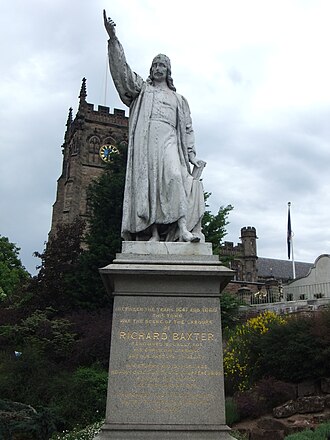
British Calvinists: Richard Baxter (1615-1691)

Richard Baxter (1615-1691) was known as 'Scribbling Dick' because of his prodigious writings. He was born Rowton, Shropshire. When a teenager he was influenced by the works of William Perkins, Richard Sibbes and Edmund Bunny. 

In 1638 he became the master at the free gramme school in Dudley, here he was ordained by the bishop of Worcester, John Thornborough. The main part of his ministry took place in Kidderminster at St Mary and All Saint's Church. While at Kidderminster he wrote The Reformed Pastor. During the Civil War he left Kiddermister for Gloucester, but later returned to Kidderminster. While ill he wrote The Saint's Everlasting Rest (1650).


In 1662 he married and retired to Middlesex after being part of the Great Ejection bought about by the Act of Uniformity.

He was prolific writer and wrote over 140 books. He held to a view known as neo-nomianism, held in response to antinominaism.  

Many of his writings are available here: http://www.prdl.org/author_view.php?a_id=133


Monday, 16 June 2014

British Calvinists: Thomas Adams (1612-1653)

Little is known about Thomas Adams (1612-1653) what we do can has to be gleaned form his won writings. He was a Calvinist who remained with in the Established Church. He was described by Robert Southey as 'the prose Shakespeare of Puritan theologians . . . scarcely inferior to Fuller in wit or to Taylor in fancy.' 


Adams was a minister at Willington, Wingrave, and London, and “observant chaplain” to Sir Henry Montague, the lord chief justice.

Thursday, 12 June 2014

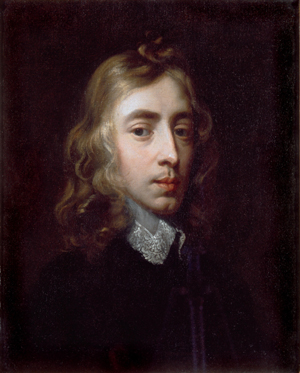
British Calvinists: John Milton (1608-1674)

John Milton (1608-1674) was born in London. He is best known for his poems Paradise Lost (1667) and Paradise Regained (1671).  He graduated from Christ's College, Cambridge in 1629. He was increasingly uneasy about the high church influence of the Established Church and described himself as 'church-outed' by the bishops.

During a European tour he met Hugo Grotius and Galileo. In 1639 he returned to England and began to work on more poetry. He also took in private pupils, his Of Education (1644) reflected his experiences and his ideas.

He married Mary Powell in 1642 - they were separated for three years but reconciled in 1645 and had four children.

In 1649 he was appointed Secretary for Foreign Tongues to the Council of State. His first wife died in 1652 and later married Katherine Woodcock in 1656. Katherine died in 1658 and he then married Elizabeth Minshull in 1663.


He died in London from heart failure.

Monday, 9 June 2014

British Calvinists: Thomas Brooks (1608-1680)

Little is known of the life of Thomas Brooks (1608-1680). He was a graduate of Emmanuel College, Cambridge. He spent some time at sea, possibly as a chaplain.  He was a minister at Thomas Apostle's, London. 

He moved to St Margaret's Fish-street Hill, London and adopted a closed position on baptism and communion.


Many of his writings are available here: http://www.prdl.org/author_view.php?a_id=168


Many of them are still in print today: http://banneroftruth.org/uk/store/author/brooks-thomas/

Thursday, 5 June 2014

British Calvinists: Samuel Bolton (1606-1654)

Samuel Bolton (1606-1654) was born in Lancashire and graduated from Christ's, Cambridge in 1629 with a BA and in 1632 with an MA. He was a curate in Harrow, Middlesex and then minister of St Martin Ludgate in London. He subsequently became a minister at St Saviour's, Southwark and a lecture at St Anne and St Agnes in Aldersgate.

He was one of the Westminster Assembly delegates. He became master of Christ's College and then Vice-Chancellor of the University from 1650-1652. 


One of his writings  is available here: http://www.prdl.org/author_view.php?a_id=1389


Monday, 2 June 2014

British Calvinists: Isaac Ambrose (1604-1662)

Isaac Ambrose (1604-1662) was the son of Richard Ambrose of Ormskirk, Lancashire. Isaac graduated from Brasenose in 1624 and became the minister of Castleton, Derbyshire. He then became one of the king's itinerant preachers and became a vicar in Preston. In 1654 he became minister at Garstang. In the 1662 Great Ejection he was ejected from Garstang. He died soon after in Preston.


Some of his writings are available here: http://www.prdl.org/author_view.php?a_id=1385

Thursday, 29 May 2014

British Calvinists: John Lightfoot (1602-1675)

John Lightfoot (1602-1675) was an Erastian member of the Westminster Assembly. He was the son of Thomas Lightfoot of Stoke-on-Trent. Lightfoot graduated from Christ's College, Cambridge in 1621 with a BA. He was ordained in 1623 and for a while was a curate in Shropshire where he met (Sir) Rowland Cotton. In 1626 he became the rector of Stone, Staffordshire. There he was married to Joyce Crompton. In 1628 they moved to Hornsey, Middlesex. In 1630 he became rector at Ashley, Staffordshire. He moved to London and in 1643 he became Lecturer at St Bartholomew's and then in 1644 rector at Great Munden, Hertfordshire.

The first part of his Harmony of the Evangelists was published in 1644. 

He kept a record of the deliberations of the Westminster Assembly in his Journal of the Proceedings of the Assembly of Divines. This shows that he was favourable towards the Presbyterians but opposed to the Independents.

He was appointed Master of St Catherine's, Cambridge in 1650, in 1654 he became the Vice-Chancellor of the University. 

He sided with the Presbyterians at the Savoy Conference in 1661. 

Some of his writings are available here: http://www.prdl.org/author_view.php?a_id=395


Tuesday, 27 May 2014

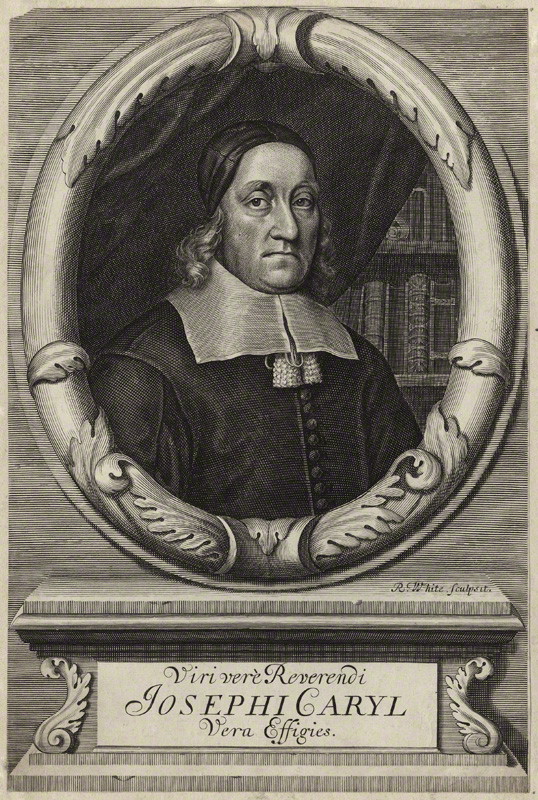
British Calvinists: Joseph Caryl (1602-1673)

Joseph Caryl (1602-1673) was born in London and was graduate of Exeter College, Oxford. He is best known for his commentary on Job. He was often asked to preach before the Long Parliament and was one of the Westminster Assembly 'divines'. 

After the restoration he was ejected from his church, St Magnus near London Bridge, but he continued to minister as an Independent (Conegationalist) in London.  

Some of his writings are available here: http://www.prdl.org/author_view.php?a_id=196


Friday, 23 May 2014

British Calvinists: John Trapp (1601-1669)

John Trapp (1601-1669) was born in Croome d'Abitot and graduated from Christ Church,
Oxford in 1622 with a BA and in 1624 with an MA. By 1624 he was the headmaster of the free school of Stratford-on-Avon.

He sided with the government in the Civil War. During the Civil War he was the chaplain to the parliamentary troops in Stratford for two years. He was the minister at Welford-on-Avon from 1636-1660 and then from 1660 until his death. 

Some of his writing can be found here:


Tuesday, 20 May 2014

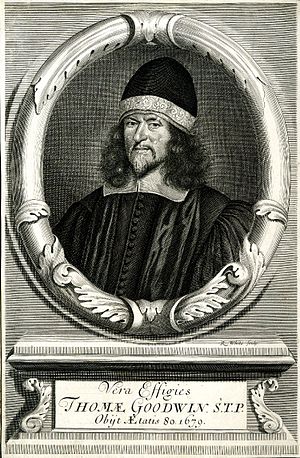
British Calvinists: Thomas Goodwin (1600-1680)

Thomas Goodwin (1600-1680) born in Rollesby, Norfolk, graduated from Christ's College, Cambridge in 1616 with a BA. At Emmanuel he was influenced by the preaching of John Preston and Richard Sibbes. During this time he wrestled with doubts about his faith, the lessons of  which are contained in his A Child of Light Walking in the Darkness. 

In 1633 he resigned his clergy posts in Cambridge and became aligned with the independent congregationalist principles of church government. After marrying Elizabeth Prescott in 1638 he went to Arnhem and worked with Philip Nye (1596-1672) to make the church there a model of congregationalism. 

In 1640 Goodwin returned to London and set up an independent congregation in the parish of St Dunstan's-in-the-East. 

He was with Nye one of the independent representatives at the Westminster Assembly in 1643-52. Goodwin, Nye, Jeremiah Burroughes, William Bridge and Siddrach Simpson (1600-1655) were known as the 'Five Dissenting Brethren'.

Oliver Cromwell appointed him as one of his chaplains and appointed him as president of Magdalen College, Oxford.

Together with John Owen he helped to draw up the Savoy Declaration of Faith and Order. 

Many of his writings are available here: http://www.prdl.org/author_view.php?a_id=311


Saturday, 17 May 2014

Recent Kuyperania (May 2014)

Bruce Wearne's review of Kuyper's Kuyper in America and two of Mouw's books Cultural Discipleship and Abraham Kuyper from Zadok Perspectives is now online at Platforma C

Peter J. Leithart takes a brief look at Kuyper's common grace

Another republished version of Kuyper's Lectures on Calvinism is available from GLH and on Kindle.

Darryl L. Bock looks at Kuyper's book on Common Grace:
This is my first read of Kuyper, a famous Reformed theologian of the late 19 and early 20th century. His style is clear. His address of issues is direct. He raises and pursues questions that many do not even raise. He reasons in detail, sometimes one senses he infers to answer questions that may not have an answer. Still it is a worthy read. If one has ever wondered why there is so much discussion of covenants to Adam and Noah in the Reformed tradition, this text will help to explain why the topic is raised.
Robert Covolo's review of Bratt's biography of Kuyper is now online at academic.edu, as is his 2013. "Faith in a Fashionable Age: Abraham Kuyper and Charles Taylor on the Secular Nexus Between Mode and Modernité"  International Journal of Public Theology 7: 297–314.

And as has been mentioned before John Boer's translation of Abraham Kuyper's The Ascent of the Son - The Descent of the Spirit is available from lulu.com.

Friday, 16 May 2014

British Calvinists: William Bridge (c. 1600-1671)

William Bridge (c. 1600-1671) was born in Cambridgeshire and graduated form Emmanuel College with an MA in 1626. 

For a while he was a vicar in Norwich. He was one of the main Puritan influences in East Anglia. However, he came into conflict with the bishop of Norwich, Matthew Wren he went 'to Holland rather than conform'. He returned to England in 1642 and was an independent (Congregationalist) representative at the Westminster assembly.  


Some of his writings are available 


Abraham Kuyper The Ascent of the Son - The Descent of the Spirit

John Boer has translated Abraham Kuyper's The Ascent of the Son The Descent of the Spirit. It is now available for free from lulu.com. It comprises 26 Meditations on Ascension and Pentecost.

It is a translation of  Op den Pinksterdag (met Hemelvaart), volume 3 of his series Dagen van Goede Boodschap (Kampen: Kok, 1923. It was originally written in 1888 and published posthumously.


Monday, 12 May 2014

British Calvinists: Edmund Calamy (1600-1666)

Edmund Calamy (1600-1666) was born in London and graduated from Pembroke Hall with a BA in 1620 and MA in 1623; he was a key Presbyterian leader. He is often known as 'the elder' his son was also called Edmund Jr(1634-1685) (the younger) and his grandson, the son of Edmund (III) was also called Edmund (1671-1732), this Edmund was a historian; all of them were nonconformists. 

Father  and son (Jr)  were both ejected from their parishes during the Great Ejection in 1662. All three were educated at Merchant Taylors' School. 
Edmund the elder was a chaplain to Nicholas Felton, the bishop of Ely and became vicar of St Mary's Swaffam Prior in Cambridgeshire. It was here worked with Jeremiah Burroughes. 

In 1639 he became the perpetual curate of St Mary Aldermanbury in London. He became involved in arguments against the Episcopacy. He was part of the  amalgam "Smectymnus' (the others were Stephen Marshall, Thomas Young, Mathew Newcomen and William Spurstowe) who wrote against the Episcopacy. 

He was an active member of the Westminster assembly particularly in the debates regarding church government. 

Some of his writings are available here: http://www.prdl.org/author_view.php?a_id=1532


Thursday, 8 May 2014

British Calvinists: Samuel Rutherford (1600-1661)

Samuel Rutherford (1600-1661) was born near Jedburg in the Scottish Borders. He graduated with an MA from Edinburgh University in 1621. In 1623 he became the Regent Professor of Humanity, teaching Latin. During bis time at Edinburgh he was involved with radical presbyterians. He had to resign his Edinburgh post when he got his future wife pregnant. 


He became the minister of Anworth in 1627. Here he was involved with and organised presbyterian campaigns against royal ecclesiastical policy for which he was deprived of his charge in 1636. He was forbidden to preach and confined to the city of Aberdeen. 

In 1638 the National Covenenat was signed and Rutherford became a leading Covenanter. he was appointed professor of Divinity at New College. St Andrews. 

He was one of the main Scottish representatives at the Westminster Assembly (1643-1647). Other Scots included: Alexander Henderson, Robert Bailie, George Gillespie and John Maitland. During this time Rutherford wrote  Lex, Rex: or the Law and the Prince (1644)  The Due Right of Presbyteries (1644) and The Divine Right of Church Government and Excommunication (1646)

On return to Scotland he sided with the more radical Covenanters, the 'Remonstrants', against the more moderate 'Engagers'. 

In 1650 when Charles II came to Scotland Rutherford addressed him on the duty of kings. In 1660 with the restoration of the monarchy under Charles II copies of Rutherford's Lex, Rex were burned, he was deprived of his university post and confined to his home. In 1661 he fell ill and died. His Letters were published posthumously. 

Some of his writings are available here: http://www.prdl.org/author_view.php?a_id=484

Tuesday, 6 May 2014

British Calvinists: Tobias Crisp (1600-1643)

Tobias Crisp (1600-1643) obtained a BA from Christ's, Cambridge and his MA from Balliol, Oxford in 1629. He married Mary Wilson at this time and had thirteen children. He was ordained and became the parson at Brinkworth, Wiltshire after a short time at Newington Butts, Surrey. He began his ministry as an arminian but became a high Calvinist;  he was a controversial figure and was accused of antinomianism. 

During the Civil war he was forced to leave his parish and fled to London. It was in London he met with opposition from other Calvinists. Some have suggested this was die in part to Crisp's popularity as a preacher. He died in 1643 of smallpox.

His Christ Alone Exalted  was published posthumously by Robert Lancaster. John Gill, in 1765, published the complete Works. 


Some of his works are available here: http://www.prdl.org/author_view.php?a_id=1330

Friday, 2 May 2014

British Calvinists: Hanserd Knollys (1599-1691)

Hanserd Knollys (1599-1691) was born in Cawkwell, Lincolnshire. He studied at Catherine Hall, Cambridge where his contemporaries included John Arrowsmith, Thomas Goodwin. He was a school master at Gainsborough before being ordained. He became a minister at Humberston in. Lincolnshire. 

During his time there he prayed for a widow who was at death's door - she was healed. In 1631 he married Anne Cleney. He became increasingly concerned about many Anglican practices and eventually gave up his living. He then doubted the validity of his ordination. During this time he met the Puritan John Wheelwright and Knollys came to a saving faith. 

In 1633 Knollys was arrested for being a dissenter. He was let released and then made his way to Boston in Massachusetts in 1691. On the 12 week sail his only child died.

In 1641 he returned to England to care for his ageing father and returned to teaching. When the civil war broke out he briefly joined the army but soon became disillusioned and returned to London where he joined the Henry Jessey's congregation. There became convinced that infant baptism wasn't biblical. This led to the formation of the Particular Baptists. Two Particular Baptist congregations developed one led by Knollys and the other by William Kiffin. 

Knollys rejected the Presbyterian model of church and adopted a congregational model. Knollys advocated a High Calvinism and a closed communion. He was unjustly accused of being an antinomian after signing the reprint of Tobias Crisp's sermons. 

During this time the Particular Baptists experienced much growth. Knollys travelled around the country helping to set up many local churches.

After the restoration of the monarchy and Charles II came to the throne it meant persecution for many non-Conformists, Knollys included. He was imprisoned many times. He spent some time in Holland and in Germany but returned to London after two or three years. 

In the late 1660s he wrote several books advocating a historical approach to Revelation. He became convinced that mystical Babylon was papal Rome. He was a post millennialist. 
In 1670 he was again put into prison but was allowed to preach to the prisoners. 

In 1677 the Knollys and the London Particular Baptists published a new confession of faith - it was published in 1689 when William and Mary ascended the throne. Knollys and Kiffin were the only two that signed both the first and second London Confessions. 

He died in 1691 and was buried in bunhill Fields, London.


Further reading

Michael A. G. Haykin (1996) Kiffin, Knollys, Keach: Rediscovering our English Baptist Heritage. Leeds: Reformation Today Trust.

Barry H. Howson (1998)  'Hanserd Knolleys (c. 1598-1691)' In Michael A. G. Haykin The British Particular Baptists 1638-191 Volume 1. Springfield, MI: Particular Baptist Press. 

Thursday, 1 May 2014

Recent Kuyperania (April 2014 - part 2)

Kuyper's Scholarship is now available from CLP 

Stephen Williams reviews John Halsey Wood Jr's Going Dutch in the Modern Age at Reformation 21.

My article on kuyperania will soon appear in Koers, the full reference is:
Bishop, S., 2014, ‘Kuyperania in recent years’, Koers – Bulletin for Christian Scholarship 79(1), Art. #2138, 6 pages.  http://dx.doi.org/10.4102/koers.v79i1.2138 [NB link not yet working]