An accidental blog

"If God is sovereign, then his lordship must extend over all of life, and it cannot be restricted to the walls of the church or within the Christian orbit." Abraham Kuyper Common Grace 1.1.

Monday, 14 April 2014

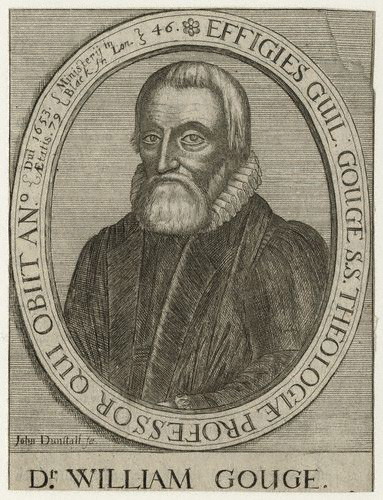
British Calvinists: William Gouge (1578-1653)

William Gouge (1578-1653) was one of the "Westminster divines". Born in Stratford-le-Bow, Middlesex, he graduated from King's College, Cambridge with a BA in 1598 and an MA in 1601.  He was the nephew of Laurence Chadderton and William Whitaker. He was a fellow and lecturer at Cambridge in logic before he moved to St Anne's, Blackfriars when he was ordained in 1608.

He was a regular attender at the Westminster Assembly and was chair in 1644 of the Westminster Confession draft committee. Two of his key works were The Whole Armour of God (1615) and Of Domesticall Duties (1622). The latter was a rejection of the view, popular at the time, that husbands should beat their wives - but still stressed female subjection of wives.  


Some of Gouge's works are available here: http://www.prdl.org/author_view.php?a_id=314


Friday, 11 April 2014

Recent Kuyperania (April 2014)


Christian's Scholars Press have announced a new translation of two addresses by Kuyper: Scholarship: Two Convocation Addreses on University Life. It is edited an translated by Harry van Dyke.
ISBN: 978-1-938948-85-5. 51 pages.
Details here.

Daniel José Camacho "Common Grace and Race" The Twelve.
Looks at Kuyper, common grace and racism.

Six new books by Calvin Seerveld from Dordt College Press

A new book from Calvin Seerveld is cause for celebration. Dordt College Press have released six - each edited by John Kok.


Normative Aesthetics
Redemptive Art in Society
Cultural problems in Western Society
Art History Revisited
Cultural Education and History Writings
Biblical Studies and Wisdom of Living

Further details here: http://www.dordt.edu/publications/dordt_press/

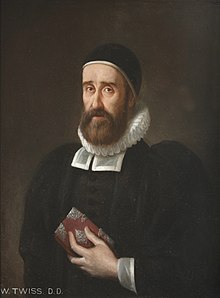
British Calvinists: William Twisse (1578-1646)

William Twisse (1578-1646) was born at Speenlands, near Newbury. He became a fellow of New college, Oxford and graduated with a BA in 1600 and an MA in 1604.

For a short while he was appointed as by James I as chaplain to his daughter, Elizabeth of Bohemia.He became the vicar of Newbury in 1620. 

He opposed Laud and was a premillennialist and a supralapsarian. He favoured Reformed Episcopasy and held strong sabbatarian views.

He was one of the delegates at the Westminster Assembly. He was unanimously appointed as the Prolocutor of the Assembly.


Some of his writings are available here: http://www.prdl.org/author_view.php?a_id=52


Wednesday, 9 April 2014

British Calvinists: Richard Sibbes (1577-1635)

Richard Sibbes (1577-1635), "the heavenly doctor", was born in Tostock, Suffolk, he was a conforming Puritan.  He graduated from St John's, Cambridge with a BA in 1599. He was elected a fellow in 1621. He was converted in 1603, he called Paul Baynes his "Father in the Gospel". Sibbes was ordained and became a lecturer at Holy Trinity Church, Cambridge. In 1617 he was appointed preacher for Gray's Inn, London. He then, in 1626, became the master of St Catherine's, Cambridge and was awarded a DD. In 1633 he was also appointed to the "perpetual curacy" of Holy Trinity. He died at Gray's Inn. 

Most of his influential works were published posthumously.


Further reading
Mark E. Dever 2000. Richard Sibbes: Puritanism and Calvinism in Late Elizabethan and Early Stuart England, Mercer University Press.

Many of his works are available form here: http://www.prdl.org/author_view.php?a_id=503


l

Monday, 7 April 2014

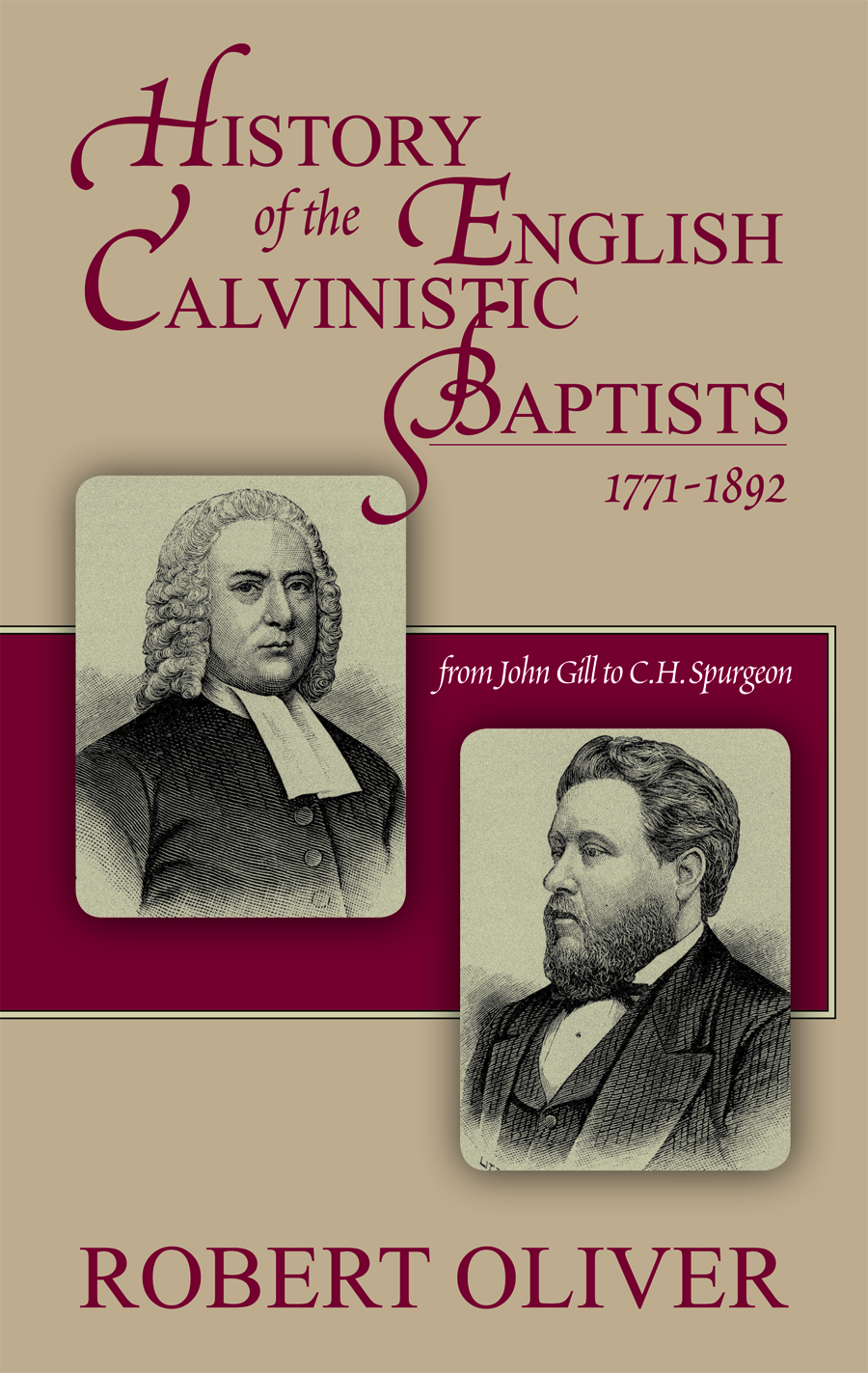
Robert W. Oliver History of the English Calvinistic Baptists

History of the English Calvinistic Baptists 1771-1892
From John Gill to C. H. Spurgeon
Robert W. Oliver 
Edinburgh: Banner of Truth Trust, 2006
ISBN 978 0 85151 920 3; Hbk; 410 + xxi pp; £16.50

This is a fascinating book. Unfortunately, it doesn't do what the title suggests. If it were then the history of the Calvinistic baptists would be one dispute after another. 

There were a number of debates among the Calvinistic Baptists. These were over: the nature of communion: open or closed (chapter 4); Andrew Fuller’s The Gospel Worthy of All Acceptance (1785) and its challenge to the dominant Hyper-Calvinism. Fuller maintained that gospel preaching must include exhortations to all to repent and believe (chapter 5); and the Antinomian controversy: the relationship of the Christian to the moral law (Chapter 6). The book ably covers the key disputants in the controversies that marked out the Particular Baptists from the General Baptists. 

The second part of the book looks more specifically at four key players: Andrew Fuller (Chapter 8), Abraham Booth (Chapter 8), William Gadsby (Chapter 9) and John Stevens  (Chapter 10).

In part three the proliferation of Strict Baptist magazines are examined as well as the different organisations. The final chapter on Spurgeon feels more like an add on rather than an integral part of the book. 

As I was reading the book I kept wondering what Oliver’s views were - they are not obvious form the text. I wish he had made his own views more explicit, that way any possible (and inevitable) bias can more easily be detected. 

Oliver’s book was originally his 1985 London Bible College PhD thesis - but it took some time to be published - primarily to overcome his reluctance to publish. I am glad that it was as it provides a much needed insight into the Calvinistic Baptists. 


The following two-way table - I’ve compiled it  from Oliver’s information - shows clearly that the debate over strict baptism and hyper-Calvinism wasn’t straightforward.


British Calvinists: John Davenant (1576-1641)

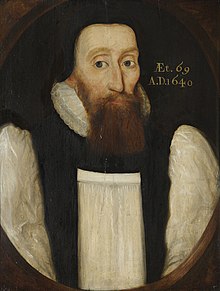
John Davenant (1576-1641) was Lady Margaret Professor of Divinity at Cambridge and later bishop of Salisbury. 
He was born in London and died in Salisbury. He graduated from Queen's College Cambridge and became a fellow in 1597. From 1614-1621 he was its president. He was one of the British Anglican representatives at the Synod of Dordt in 1618. He was not an advocate of limited atonement, though he was not a supporter of Moses Amyraut and his Amaryraldianism.

He was appointed bishop of Salisbury by James I in 1621. 

He is the author of a commentary on Colossians which is available from the Banner of Truth. 


Some of his writings are available here: http://www.prdl.org/author_view.php?a_id=232

Friday, 4 April 2014

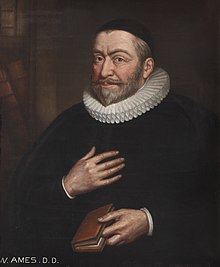
British Calvinists: William Ames (1576-1633)

William Ames  (1576-1633) born at Ipswich and graduated in 1598 from Chrst's College, Cambridge. He was greatly influenced by William Perkins and Perkins' successor Paul Baynes. Ames refused to wear a surplice, this cost him the mastership of Christ's - it was awarded to Valentine Carey - and led to Ames being suspended from his ecclesiastical duties. In 1610 he translated William Bradshaw's English Puritanism from Latin into English. 

He then travelled with Robert Parker to the Netherlands. In the Netherlands he was involved with a number of disputes with the Arminians. He also promoted the autonomy of the local church congregation. He wrote against the catholicism of Robert Bellarmine, the Laudianism of the English church, and the separatism of John Robinson, a Leiden pastor. 

He taught theology form 1622-1632 at Franeker University. He was unable to join the Puritan migration to New England because of his ill health.  His The Marrow of Sacred Divinity (1643) was his most influential work.


Many of his writings are accessible from here: http://www.prdl.org/author_view.php?a_id=113


Wednesday, 2 April 2014

British Calvinists: Joseph Hall (1574-1656)

Joseph Hall (1574-1656) was an Anglican bishop. He was born at Ashby-de-la-Zouch, Leicestershire and graduated from Emmanuel College, Cambridge. His family were Puritans. 

In 1608 he became chaplain to Henry, the Prince of Wales. He was one of the English delegates to the Synod of Dordt in 1618. He became the bishop of Exeter in 1627. He trod a path mid-way between the Puritans and the church establishment. He thought that episcopacy was a divine right. He then was made the bishop of Norwich. 

He was described by Thomas Fuller as "our English Seneca". 


Many of his writings are available from here: http://www.prdl.org/author_view.php?a_id=329

Tuesday, 1 April 2014

A broadly Calvinist timeline from Elizabeth I - James II

Under Elizabeth I we had the settlement of Calvinism. However, the tensions between crown and church were growing and this resulted in a separation and growing fragmentation among Calvinists. It was during this period that we had the increasing privatisation of Puritanism. As D. G. Hart puts it a "vein of introspective piety" replaced "the zeal for a throughly reformed church". Some wanted to stay in the Established church, but others separated to form presbyterianism, congregationalism and other branches. Though Philip Schaff, in his Creeds of Christendom, wrote: "It is not too much to say that the ruling theology of the Church of England in the latter half of the sixteenth and the beginning of the seventeenth century was Calvinistic". (I, 604) 


1558 Elizabeth I 
1558 Act of Uniformity (passed in 1559): Book of Common Prayer reinforced and legal obligation to attend church service weekly
1558 (Second) Act of Supremacy: Elizabeth declared Supreme Governor of the Church of England 
1559 John Knox returns to Scotland
1559 Elizabeth I appoints Matthew Parker as Archbishop of Canterbury
1560 Scots Confession and the first Book of Discipline
1561 English translation, by Thomas Norton, of Calvin’s Institutes published
1563 39 Articles approved by Convocation as the doctrinal creed of the CoE
1564 John Calvin dies
1566 Start of separatists movements in response to vestment controversies (dating back to John Hooper during Edward VI’s reign)
1570 Thomas Cartwright’s Cambridge lectures - the foundations of presbyterianism
1571 The 39 Articles approved by Parliament
1572 Presbytery of Wandsworth
1574 Cartwright translates Walter Travers's A Full and Plaine Declaration of Ecclesisaticall Discipline Owt Off the Word Off God - a presentation of nonconforming Calvinism
1575 Geneva Bible completed
1576 Edmund Grindal Archbishop of Canterbury
1577 ABp Grindal suspended for refusing to stop Puritan “prophesyings”
1580 Jesuit missionaries sent to England
1581 Robert Browne’s Treatise of Reformation without Tarrying for Any
1582 Act makes all Catholic clergy in England liable to execution
1583 John Whitgift becomes Archbishop of Canterbury
1584 The "Black Acts" in Scotland
1587 Walter Travers's Book of Discipline
1587 Cope's "Bill and Book"
1588 Marprelate Tracts published
1592 'The Golden Acts" passed in Scotland
1593 Execution of Greenwood and Barrow
1595 Lambeth Articles 

1603 James I (cousin of Elizabeth I)
1603 Millenary petition
1604 Hampton Court Conference
1604 Book of Common Prayer Revised
1604 Richard Bancroft Archbishop of Canterbury
1605 Gunpowder plot - Romans seek to blow up Parliament
1608 Separatists leave for the Netherlands
1610 Episcopacy restored in Scotland
1611 George Abbot Archbishop of Canterbury
1611 King James Version of Bible published
1617 Irish Articles promulgated
1618 Book of Sports - games allowed on Sundays
1618-1619 Synod of Dordt
1620 Mayflower sets sail for Massachusetts

1625 Charles I
1625 Bubonic plague
1626 Charles I prohibits predestinarian teaching at Cambridge
1626 York House Conference
1628 William Laud becomes bishop of London
1629 Parliament dissolved by Charles I
1630 Arbella sets sail for Massachusetts
1633 William Laud Archbishop of Canterbury
1633 Book of Sports renewed
1637 New Scottish Prayer Book - causes riot in Edinburgh
1638 Scottish National Covenant
1640 April “Short Parliament”
1640 November “Long Parliament” 
1642 English Civil War
1643 Solemn League and Covenant
1643 Westminster Assembly (to 1646)
1643 Split between Presbyterians and congregationalists in the Westminster Assemby
1644 Book of Common Prayer replaced with Directory of Worship
1644 First London Baptist Confession of Faith
1645 Feb New Model Army
1645 William Laud executed (no Archbishop until 1660)
1645 June Battle of Naseby - Cromwell defeats Charles I
1647 Society of Friends formed by George Fox (Quakers)
1648 Start of Thirty Years War in Europe
1649 Charles I is executed
1649 Last numbered plenary session of the Westminster Assembly
1653 Dissolution of 'Rump' of Long Parliament
1653 Cromwell becomes Lord Protector
1658 Savoy Conference; Savoy Declaration of Church and Order
1658 Cromwell dies, succeeded by son Richard

1660 Restoration of Monarchy: Charles II
1660 William Juxton Archbishop of Canterbury
1662 Act of Uniformity passed - almost 2000 clergy forced out of parishes (Great Ejection)
1663 Gilbert Sheldon Archbishop of Canterbury
1664 First Conventicle Act
1665 Great Plague in London begins
1665 Five Mile Act
1666 Great Fire of London
1672 Declaration of Indulgences - dissenters are permitted to hold services 
1673 First Test Act - Catholics are prevented from remaining in public offices
1678 Bunyan's Pilgrim Progress published


1685 James II

Monday, 31 March 2014

British Calvinists: Thomas Gataker (1574-1654)

Thomas Gataker (1574-1654) was born in London and graduated from St John's College, Cambridge in 1590. He was preacher to the society of Lincoln's Inn from 1601-1611. 

He was a member of the Westminster assembly, though ill health meant that he had to withdraw in 1645. He was in favour of the episcopacy. 


Some of his writings are available here: http://www.prdl.org/author_view.php?a_id=303

Saturday, 29 March 2014

British Calvinists: Arthur Hildersham (1563-1632)

Arthur Hildersham (1563-1632) was born in Stetchworth and graduated from Christ's College, Cambridge. He was the vicar of St Helen's, Asby-de-la-Zouch. 

He was one of the key Puritans behind the Milenary Petition presented to James I in 1603 which protested against the state of the Anglican church. It was supported by around 1000 Puritans. The petition led to the Hampton Court Conference. Hildersham was prevented from attending the conference. 

A biography of Hildersham has been recently published: The Life and Times of Authur Hilderham: Prince Among Puritans


British Calvinists: John Forbes (1568 – 1634)

John Forbes  (1568 – 1634) was born in Corse Castle he graduated from St Andrew's University in 1583.  He was the moderator of the Aberdeen assembly which met in defiance of the king. For this he was imprisioned. He was then exiled and in 1608 became the pastor of an English-speaking congregation of the Merchant Adsventurers in Middelburg. He then pastored a church in Delft.

In his book Certain Records touching the Estate of the Kirk in 1605 and 1606 he described the decay of reformed polity in Scotland. 

He was the brother of Patrick an Episcopal who became the bishop of Aberdeen. 

Friday, 28 March 2014

British Calvinists: Henry Jacob (1563-1624)

Henry Jacob (1563-1624) was born in Cheriton, Kent, he graduated with an MA from St Mary Hall, Oxford in 1586. In 1603 and 1605 he was imprisoned for his Puritan views. He was an exile in Leiden with William Ames and Robert Parker. There he formed his ideas on the need for the local church to be independent. hHe wanted to see a pure church but not complete secession for the Established church. He has been described as a non-separating Congregationalist and as a semi-Separatist and was associated with the Brownists.

He returned to London in 1616 and formed a local congregation at Southwark. He emigrated to the US in 1622 where he died.


The Jacob-Lathrop-Jessey Church

Two other  important figures associated with Jacob were John Lathrop (1584-1653) and Henry Jessey (1601-1663). All three were pastors of the same church, which became known as the Jacob-Lathrop-Jessey Church.

This is an extract from Michael Haykin's Kiffin, Knowlys and Keach:


Now, there is one church in particular which lies at the fountainhead, of the Calvinistic Baptists and that is the London-based congregation known to historians as the Jacob-Lathrop-Jessey church, so-called because of the names of its first three pastors. Henry Jacob (1563-1624) and a group of like-minded believers in London had established the congregation in 1616. To what extent Jacob and his congregation were influenced by Separatists like Francis Johnson, and John Robinson remains an open question - Jacob met both of these men Johnson in 1599 and Robinson in 1610. What is clear, however, is the fact that Jacob’s congregation was determined not to cut itself off from all fellowship with Puritans who had stayed within the Church of England. In the statement of faith that this congregation published when it was first established, it was clearly stated that attendance at services conducted in local parish churches was permissible as long as “neither our assent, nor silent presence is given to any mere human tradition”. Unlike the Separatists, Jacob and his congregation refused to deny that the Church of England still possessed “true visible churches”, and thus it was not at all ‘ wrong to continue fellow shipping with them where this did not involve countenancing what Jacob’s congregation regarded as definite error. It is not surprising that the authorities in the Church of England harassed the congregation as a Separatist body, and that the Separatists dubbed them “idolaters”.
Due to this harassment and persecution, Jacob decided to leave England for Virginia in 1622, where he died two years later. His successor was John Lathrop (1584-1653). During Lathrop’s 'pastorate at least two groups amicably withdrew from the church to found Separatist congregations, one of which came to be pastored by a certain Samuel Eaton (d. 1639). Eaton had problems with the legitimacy of the baptism of infants by ministers in the Church of England, though it does not appear to be the case that he had actually come to embrace believer’s baptism as the only basis for membership in the church.
In the early 1630s, when William Laud (1573-1645), the Arminian Archbishop of Canterbury, was seeking to rid England of Puritanism, Lathrop also decided to emigrate to the New World. He left in 1634, and it was not until 1637 that a new pastor was found in the person of Henry Jessey (1601-1663). Jessey had become a Puritan while studying at Cambridge in the early 1620s. Ordained a priest in the Church of England in 1626, he grew increasingly uneasy with the liturgy and worship of the Established Church over the next eight or so years. In 1635 he came into contact with the Jacob-Lathrop church, presumably began to worship with the congregation, and two years later was called to be the church’s pastor. An ironic individual, Jessey continued to uphold the “Jacobite” tradition, that is, the policy established by Henry Jacob of keeping in fellowship with Puritans within the Church of England.

Thursday, 27 March 2014

British Calvinists: Paul Baynes (c.1560-1617)

Paul Baynes (c.1560-1617) was a radical Puritan. Born in London, he graduated from Cambridge in 1593 and was elected a fellow of Christ's College, Cambridge in 1600. He was a student of William Perkins and he succeeded Perkins as lecture at St Andrew's the Great, Cambridge in 1602.

Richard Sibbes was converted under Baynes' preaching and he was a key influence on William Ames.

He was silenced for preaching without a licence in 1608. He was a Congregationalist  but disliked the separatism of the Brownists. 

His commentary on Ephesians is a defence of Calvinism. He died in Cambridge and is buried in St Andrew's.

Further Reading
Andrew Atherstone (2007) The Silencing of Paul Baynes and Thomas Taylor, Puritan Lecturers at Cambridge, Notes and Queries 54, pp. 386-389.
Some of his writings can be found here: http://www.prdl.org/author_view.php?a_id=136


Wednesday, 26 March 2014

British Calvinists: Walter Travers (c. 1548–1635)

Walter Travers (1548?–1635) was born in Nottingham and graduated from Christ's College, Cambridge in 1560. He obtained an MA from Trinity College and was made a senior fellow in 1567.

In 1570 he went to Geneva, he was forced to leave by John Whitgift who was the master of Trinity. There he became friends with other Marian exiles and with Thomas Beza. He wrote his main work Ecclesiasticae disciplinae et Anglicanae ecclesiae ab illa aberrationis, plena e verbo Dei, et dilucida explicatio in Geneva. This was subsequently translated by Thomas Cartwright in 1574 as A Full and Plaine Declaration of Ecclesisaticall Discipline Owt Off the Word Off God - it was a major presentation of nonconforming Calvinism.

Travers went back to England in 1576 but returned to the continent in 1578 where he became chaplain to the English Merchant Adventurers in Antwerp. 

In 1580 he once again returned to England and became chaplain to Lord Burghley, WilliamCecil.. In 1581 he became deputy to the master of the Temple Church in London. Richard Hooker became the master of the Temple in 1585 and this brought conflict. Travers disliked what he viewed as Hooker's leaning towards Rome.

Travers had hoped to reform the church from the inside, he with others sought to set up a form of presbyterian church within the Established church. To help towards this they produced a Book of Discipline. Later Travers wrote Defence of the Ecclesiastical Discipline. During this time many of the presbyterian Puritans were being hounded by the Established church, many were imprisoned and brought before the Star Chamber. Though Travers had managed to avoid arrest.  With Lord Burghley's help Travers was able to find sanctuary at the newly formed Trinity College in Dublin. Travers became the provost in 1594.

Alan Ford summarises Travers's contribution thus:
Although Walter Travers exerted a considerable influence on the development of English presbyterianism, decisively tying the movement to the strict position that their Calvinist framework was the sole biblical church polity, and seeking to Anglicize the presbyterian system of church government, he signally failed in his major aim—to create an established presbyterian church in England. Indeed, his main achievement was probably, and ironically, his role as the irritant that may have stimulated Hooker to produce one of the few great works of English theology, the Treatise on the Laws of Ecclesiastical Polity.


Further reading

Alan Ford, ‘Travers, Walter (1548?–1635)’, Oxford Dictionary of National Biography, Oxford University Press, 2004 [http://www.oxforddnb.com/view/article/27673]

Tuesday, 25 March 2014

British Calvinists: John Bradford (1510-1555)

John Bradford (1510-1555) was born in Manchester. He started to study law but when he was converted he switched to study theology at Cambridge. He was ordained by Nicholas Ridley. Under Mary I he was arrested and martyred, being burnt at the stake on 31st January 1555. 


Some of his writings are available form here:  http://www.prdl.org/author_view.php?a_id=1464


Monday, 24 March 2014

Interview with David Koyzis

David Koyzis has recently had his latest book We Answer to Another published - he kindly agreed to this interview. (David also blogs here.)


David, could you please tell us a little bit about yourself?


I am an American-born Canadian political scientist teaching at Redeemer University College since 1987. My mother was born in Michigan and my father in Cyprus, where I still have relatives living. I sometimes call myself a Franco-Greek-Cypriot-Finno-Anglo-American-Canadian, one of the smallest ethnic groups in North America!
I am married and have a high-school-age daughter. We live at the top of the Niagara Escarpment overlooking the lovely city of Hamilton, Ontario, Canada, the gem of the Great Lakes. We have a bilingual (Greek and English) pet budgie who absolutely adores our daughter.


Who or what have been the main influences in your life?
Well, obviously my parents were a huge influence on me, and my new book is dedicated to them. I was raised in a Christian home and grew up knowing in no uncertain terms that God loves me and sent his Son to die for my sins. I've been reading the Bible ever since I can remember, and this has almost certainly been the biggest influence in my life. For nearly 40 years I have read through the Bible regularly in the course of a daily prayer regimen based on the historic Daily Office, as practised by the Benedictines and other monastic communities. To live the life in Christ calls for immersing oneself in God's Word and, as Lesslie Newbigin so aptly puts it, indwelling the biblical narrative, that is, finding one's own place within the larger drama of creation, fall and redemption.

I suppose I could also mention certain events that had an impact as well. In my youth, two developments moved me towards the study of political science after I had originally intended to pursue the arts. These were the Watergate scandal and the Cyprus crisis of 1974. I was indignant at the spectacle of a president abusing his office and attempting to subvert the constitution. Right around the time Nixon resigned the presidency, most of my relatives in Cyprus, including my elderly grandparents, became refugees in their own country as a result of an attempted Athens-instigated coup d'état, subsequent Turkish invasion, and forcible partition of the island. I've often found that students become interested in studying politics, not because they are inspired by the evident benefits of just governance, but because of concrete injustices they become passionate about correcting. This was my experience as well.

I was also inspired by my professors at what was then called Bethel College in Minnesota to think through the implications of the life in Christ for public life. Initially this moved me in an Anabaptist direction, but I didn't stay with this for very long.

Am I correct in assuming the work of Kuyper and Dooyeweerd have shaped your approach and writings?

Yes. Absolutely.

How did you get "introduced" to them?
Well, this takes me back to Bethel once again. I was around 20 years old at the time. A friend and fellow student named Doug Johnson, who lived in my dormitory, introduced me to them. I had never heard of them before, but I was quite taken with the notion that there are no sacred and secular spheres and that all of life belongs to God in Christ. Redemption in Jesus Christ covers, not just our so-called spiritual life, but everything we do. This is definitely a biblical insight, as we read in such passages as 1 Corinthians 10:31 and Colossians 3:17. We do not follow Christ in church and then follow the gods of the age in the rest of life. Properly speaking, our lives are fully integrated into the service of God and neighbour, not divided into disconnected compartments. I began to read everything I could by and about Abraham Kuyper and ordered a number of books from the old Wedge Publishing Foundation in Toronto, including published lectures of Calvin College professor H. Evan Runner. This interest took me to the Institute for Christian Studies in the late 1970s where I studied under the late Bernard Zylstra and wrote a master's thesis on Hannah Arendt. Eventually I would come to write a dissertation at Notre Dame on Dooyeweerd and Neothomist philosopher Yves René Simon, who wrote thoughtful books on the nature and functions of authority.

Decades later I came to recognize that I had returned to something with which I had grown up as a small child, namely, the Reformed tradition of Christianity. Until age 11 I was raised in an Orthodox Presbyterian Church congregation near Chicago and was accustomed to the many Dutch and Frisian surnames of our fellow parishioners, such as Auwerda, Bosgraaf and Dykema. In fact, historian Mark Noll was a member of this congregation long after our family left, and he once told the story of an elderly member with whom I was familiar from childhood. As Noll was talking about Kuyper at a church function, she spoke up and said that her father had delivered Kuyper's groceries back in the Netherlands. I hope I am remembering this story correctly. If so, it is ironic that, although I knew nothing of Kuyper during my first two decades, someone I knew from childhood of my grandmother's generation already had a personal connection with him.

Your new book, We Answer to Another, has recently been published. Could you tell us a little about it?

Yes, certainly. I think I can best answer this by quoting the description from the back of the book:
The quest to escape authority has been a persistent feature of the modern world, animating liberals and Marxists, Westerners and non-Westerners alike. Yet what if it turns out that authority is intrinsic to humanity? What if authority is characteristic of everything we are and do as those created in God's image, even when we claim to be free of it? What if kings and commoners, teachers and students, employers and employees all possess authority?
This book argues that authority cannot be identified with mere power, is not to be played off against freedom, and is not a mere social construction. Rather it is resident in an office given us by God himself at creation. This central office is in turn dispersed into a variety of offices relevant to our different life activities in a wide array of communal settings. Far from being a conservative bromide, the call to respect authority is foundational to respect for humanity itself.

So, why should we read it?
Because it treats a phenomenon that is absolutely central to human life in God's world. Even when we think we are evading authority, we really do nothing of the sort. Each chapter begins with a story relevant to its subject matter. The introductory chapter starts with a day in the life of Michael, a university undergraduate who is engaged in all of the typical activities of the student. I've read this story to classrooms and audiences and asked them to describe each encounter Michael has with some manifestation of authority. It quickly becomes apparent that authority is ubiquitous. It is apparent at every turn, for example, in the calendar that governs his life, the professor's teaching authority and even in his own authority as student.

In our contemporary society, it is almost automatically assumed, primarily under Immanuel Kant's influence, that the mature adult must attain moral autonomy and question critically every directive that authority makes. When I was much younger, I think I would have found this a persuasive position, especially in the wake of the civil rights revolution, the Vietnam War and, of course, Watergate. Yet in the real world this is impossible. It is impossible to question authority in general. If we see fit to question specific manifestations of authority – as indeed we must – then we necessarily do so based on some other authority which we accord priority. This is what the apostles did in the book of Acts when they claimed to be obeying God rather than mere human beings (e.g., Acts 5:27-29).

Sometimes I'll ask my students who they think has authority in the classroom. Invariably they will point to me. Yes, I tell them, but I'm not the only one; you have authority too! Not the same authority, but authority no less. Everyone has an authoritative office within the classroom. Koyzis has the office of professor, while those responding to my question possess the office of student. Each office bears authority and is worthy of respect accordingly.

What prompted to you write on this topic?
The ideas in this book had been percolating since the mid-1980s when I was a student at Notre Dame. My final year there I taught four first-year seminar courses devoted to authority in which I had students reading a number of books and writing on the ideas therein. Then I put the topic aside for a number of years as I wrote my first book, Political Visions and Illusions, which was published in 2003. But my interest in authority never really went away, and I returned to it for my inaugural lecture at Redeemer later that year. That lecture eventually became this new book after seven sometimes difficult years of work.
As I researched the topic, I was surprised to discover, among other things, that everyone seems to give lip service to the distinction between authority and power. Authority and power are not the same. So far so good. Nevertheless, when they start to elaborate their understanding of authority in more detail, they still tend to identify it with some capacity at our disposal, such as psychological power, persuasive ability, superior knowledge or some such. In other words, as soon as they tell us that authority is different from power, they proceed to define authority as, well, some form of power! I knew this couldn't be right. This is when I began to conclude that authority must have something to do with office. An office is a calling, a commission, a task given us in fulfilling our duties before God. A Dutch Reformed minister, the Rev. Cornelis Sietsma, wrote a brief book on office before the Second World War and paid with his life at Dachau during the nazi occupation for living out his convictions. His story appears at the beginning of chapter 5 of my book.
Although theories of authority generally don't account for office very well, it occurred to me that virtually everyone already understands intuitively the relationship between authority and office. David Cameron's authority comes from his occupying the office of Prime Minister. People may – and do – question his ability, but no one questions his office. This is what many theoretical accounts of authority tend almost inevitably to ignore.

I mentioned Yves Simon a moment ago. He wrote three books on authority during his too brief life: The Nature and Functions of Authority, Philosophy of Democratic Government, and (posthumously) A General Theory of Authority. Since then a lot of books have been written on leadership, but very few on authority as such. It's almost as if we are afraid of it in some fashion. Simon himself began one of his books by writing of the “bad reputation” authority has acquired since the French Revolution. Simon too has been a major influence on me, as he seemed better able than most to understand that, although some functions of authority properly diminish with time, other functions are needed indefinitely for a flourishing society. Parental authority, for example, rightly recedes with the maturity of the child subject to it, but what I call the communal coordinative function of authority is needed even in a community composed of mature and virtuous adults, and it doesn't go away. Simon wrote his works more than half a century ago, but his insights are not as well known or understood as they deserve to be.

What was the highlight in writing the book?
That's a hard question to answer. I did have a bit of an epiphanic experience nearly a decade ago as I was sketching out the plan of the book. This occurred when the relationship amongst power, authority and office suddenly became clear to me. It hit me like a bolt from the blue as I was sitting with my preschool daughter in our dining room.
That said, I am more aware of the low points. My momentum was broken for a few years by a series of medical setbacks, beginning with a couple months of an environmentally-related illness in late 2005 (during construction on the main academic building), followed by a spell of depression, then a burst appendix, quickly followed by a bout with a potentially deadly case of C. Difficile, the after-effects of which took three years to run their course. Most unpleasant. I finally recovered my momentum in 2010-11 and was able to complete the book fairly quickly after that. But while it was going on, it seemed that so many obstacles were getting in the way of my completing it, and it was all rather discouraging for a time. That's now past, thank God.

How does a kuyperian/ reformational approach to authority differ from the usual Calvinist or evangelical approach?
Well, I'm not sure there is a “usual” Calvinist or evangelical approach to authority. Evangelicals are an extremely diverse lot, so their approaches – in the plural – are likely to take different forms. But let me mention one approach that has recently been in the news.

Without mentioning names and other specifics, there is a Christian organization that has been around for some four decades whose approach to family and social life is based on a chain of command or umbrella of protection. This is based on an excessively top-down view of authority, that is, the assumption that, within a particular communal context, only the higher-ups have authority while those under them simply defer to that authority. That's wrong. All of the members of a community bear an office relative to that community, even if it is limited to membership. Ordinary citizens bear no less of an authoritative office than a president or prime minister, even if it is not the same office with an identical mandate. A well-organized community will ensure that those at the top be accountable for their actions in some fashion. In particular, they must respect the offices of those who are under them. Chain-of-command language is unhelpful in this respect.
On the other hand we find those evangelicals who so emphasize mutuality in community that they ignore the necessary differentiation of offices within it and may even downplay office itself. Communities attempting to realize equality and mutuality at the expense of office too frequently find themselves subject in practice to self-appointed charismatic leaders unwilling to recognize limits to their competence. This too is unhealthy and, in many cases, results in situations not unlike the chain-of-command approach. History has demonstrated time and again that those who despise legitimate authority tend themselves to become tyrannical.

A focus on office I believe will enable us to steer between the Scylla and Charybdis of authoritarianism on the one hand and an excessive egalitarianism on the other.

Are there any other projects in the pipeline?
Yes, indeed. I am currently involved in co-editing with a friend and colleague an anthology of essays relating the creation-fall-redemption narrative to the various academic disciplines. Most of the authors are colleagues at Redeemer University College. We've provisionally titled the volume, Academy Regained, a tribute to my esteemed emeritus colleague, Al Wolters, whose Creation Regained has become a classic since it was first published three decades ago.

I have also recently determined to write something of my personal pilgrimage through the Psalms. This grows in part out of a 30-year-old project devoted to the Genevan Psalter. I've discovered so many wonderful things about the liturgical use of the Psalms – including, of all things, a 17th-century Turkish translation of the first 14 Genevan Psalms – that I think they would make a wonderful book accessible to a popular audience.
Since September of last year I have begun a second psalter project, in which I have written metrical texts for more than 40 of the Psalms and have composed original music for them to be sung to. I've not posted most of these on my website, and I may try to get them published as a single collection separate from my proposed book on the Psalms.

What do you do for fun?
Hmm. Good question. Music has long been considerably more than an avocation for me. I play classical guitar (albeit completely self-taught) and I love to sing and compose music as well. Collecting bow ties is definitely fun. I love old books as well. The jewel of my collection is a King James Bible dating back to 1637 – just before the outbreak of the English Civil War.

What books are you reading at the moment?
Well, I've not started reading them yet, but high in my list are three books: Jan de Bruijn, Abraham Kuyper: A Pictorial History; David L. Schindler, Ordering Love: Liberal Societies and the Memory of God; and my colleague Kevin Flatt, After Evangelicalism: The Sixties and the United Church of Canada. Recently I've been rereading Aleksandr Solzhenitsyn's Rebuilding Russia to get his take on Ukraine's uneasy relationship with Russia. My favourite most recent read has got to be Jim Bratt's wonderful biography of Kuyper.

I'm not much of a fiction reader, but I did recently read Booth Tarkington's Pulitzer Prize-winning novel, The Magnificent Ambersons, about how the automobile reshapes an Indiana city in the first years of the 20th century. Orson Welles made it into a famous film in 1942.

If you were on a desert island what two luxuries would you take with you?
Well, I think I'd take my computer, along with internet access, so I could summon help!