An accidental blog

"If God is sovereign, then his lordship must extend over all of life, and it cannot be restricted to the walls of the church or within the Christian orbit." Abraham Kuyper Common Grace 1.1.

Monday, 30 June 2014

Sandford: Blueprint for Theocracy: The Christian Right's Vision for America

Blueprint for Theocracy: The Christian Right's Vision for America
Examining a Radical "Worldview" and its Roots
James C. Sanford
Providence, Rhode Island: Metacomet Books
ISBN 978-0-9747042-0-3; 278 pp; hbk; £15.34


Sanford wrote this book originally out of curiosity, the book then evolved into a ‘history and role of Christian rightists ideology, or Christian Worldview.’ He looks at the origins of worldview, its development into an ideology by the Christian Right and finally, the agenda of the RR. It is a fascinating and well researched book. He looks at the term Christian Worldview as it has been used by the Religious Right (RR) in the States (the capital's are Sandford's).

The term Christian Worldview is obviously not the prerogative of the Christian right and is not univocal. Sadly Sandford - despite his protestations to the contrary - seems to treat it as if it were. How Abaraham Kuyper and Herman Dooyeweerd used the term worldview and how Francis Schaeffer and Charles Coulson and how the Christian Right use it are not the same. Sanford maintains that 'The Calvinist prototype developed by Kuyper was eventually to become the gold standard for today's Christian Worldview'.

Sandford sees the development something like this:


He  maintains that 'The historical record shows that Christian Worldview was formulated by doctrinaire theologians reacting with hostility to the rise of empirical science, secularism and popular democracy.' (The historical record - as David Naugle has shown - shows nothing of the sort.)

Sandford also writes:  'The concept [of worldview] was first developed by conservative theologians in Europe who wished to restore a more doctrinaire form of Christianity to a position of dominance'. That may be what it is used for now by the RR, but certainly was not the idea behind James Orr's (1844-1913) and Kuyper's development of it. Sanford rightly notes worldview is subject to 'different shades of meaning' but tends to treat it as if it weren’t.

He is right that 'Kuyper's ideas of antithesis and sphere sovereignty were critical in shaping his political views' but these views do not necessarily lead to a right wing manifesto. Reading Kuyper's own political programme, recently translated into English, soon lays that misconception to rest. Kuyper also had a strong view of the role of common grace that 'tempered' the antithesis.

Sandford recognises that he is not neutral and has a bias in favour of ‘pluralism, tolerance, and evidence-based thinking, and against the absolutist agendas in the political sphere.’ The irony is that it was pluralism and tolerance that was the outworking of Kuyper’s worldview and sphere sovereignty in his own political programme.The blame of the Christian Right in the sates can’t then be placed at Kuyper’s door.

The term worldview evolved over time from a pre-theoretical concept to an ideology. In a sense Francis Schaeffer popularised it and the Reconstructionists, such as Rushdoony,  politicised it. I would have liked to have seen more in the way the term worldview has morphed into an ideology.

In the book Sandford makes some interesting observations; for example, ‘it wasn't until communism was perceived as a threat to American society ... did evangelicals gradually begin to show a renewed interest in political.’  Political activity it seems was reactionary. Regarding VanTil he has this to say: 'When he published articles and books, he did so almost always in non-refereed publications, whose editors offered little critical challenge to his ideas', and 'Dooyeweerd invented his own unique vocabulary and was renowned for his lack of transparency'.

As this book shows the (mis)use of worldview has become an ideology in the hands of the Religious Right. What Sandford fails to see is how his own worldview is operating in his own writing. If there is a God who is concerned with redeeming all of life, who has laws and norms for every area of life then these will also apply to mathematics, science, architecture, art, sociology, business, … and even politics. When it comes to politics God is not silent.

Christians may well disagree with the way it has been outworked in the RR - I would share many of the concerns Sandford highlights - but it does not mean that we should, as Sandford seems to want, ignore those God-given laws and norms. The issue is whose laws and norms do we obey - humanity’s or God’s? Sandford it seems want Christianity to change minds but not institutions, to be private but not public. 


Saturday, 28 June 2014

Block's Obadiah: The Kingship Belongs to YHWH

Obadiah
The Kingship belongs to YHWH
(Hearing the Message of Scripture: A Commentary on the Old Testament)
Daniel I. Block
Grand Rapids: Zondervan, 2014
ISBN 9780310942405

Obadiah at just under 300 words is the shortest book of the Bible. There are not many one volume commentaries devoted to it, so this book is a welcome addition.

There have been a proliferation of new commentary series recently - well at least two! This commentary on Obadiah is part of a new series from Zondervan. The emphasis in this series is the place given to understanding the role of the biblical authors as rhetoricians. Block examines not only the message of the author but also what strategies he used to get over his message. As the series editors put it:
The primary goal of this commentary series is to help serious students of Scripture, as well as those charged with preaching and teaching the Word of God, to hear the messages of Scripture as biblical authors intended them to be heard . While we recognize the timelessness of the biblical message, the validity of our interpretation and the authority with which we teach the Scriptures are related directly to the extent to which we have grasped the message intended by the author in the first place . Accordingly, when dealing with specific texts, the authors of the commentaries in this series are concerned with three principal questions: (1) What are the principal theological points the biblical writers are making? (2) How do biblical writers make those points? (3) What significance does the message of the present text have for understanding the message of the biblical book within which it is embedded and the message of the Scriptures as a whole . The achievement of these goals requires careful attention to the way ideas are expressed in the OT, including the selection and arrangement of materials and the syntactical shaping of the text.
And as the author has it:
With this volume we are launching a new commentary series, whose goal is to help readers of the Scriptures hear the messages that the human and divine authors in- tended to communicate. 
Each part of the commentary is split into five main sections: 
  1. The main idea 
  2. The literary context
  3. Translation and outline - here the author provides his own translation
  4. Structure and literary form 
  5. An explanation of the text.
This forms a helpful framework. 

The final chapter: ‘Canonical and practical significance’ is very useful and interesting. Here the exegetical detail is supplemented by a broad overview. As Block notes: ‘The brevity of the book masks its profundity.’ Block develops the idea of Edom as a representative of the nations and as a representative of humanity. He also highlights the key idea behind the book as ‘The dominion belongs to YHWH.’ Here he leaves us rightly with a Christological perspective: 
The dominion belongs to YHWH incarnate in Jesus Christ! To him be the glory and dominion for ever and ever. Amen!

Block is no stranger to commentary writing he has produced major commentaries on Ezekiel, Judges and Deuteronomy, this book is a welcome addition to his corpus. 

Wednesday, 25 June 2014

Interview with Harry Van Belle

Harry, thanks for taking the time for this interview. Could you start by telling us something about yourself?


I was born in The Netherlands and immigrated to Canada when I was 13 in 1951. I attended Calvin College in Michigan, USA from 1961-1965, where I earned a BA degree in philosophy and the classics. I married Jenny soon after graduating. In 1967 I enrolled at the Free University of Amsterdam in a Clinical Psychology program. I earned a doctorandus degree in 1971 and a PhD degree in 1980 in Clinical Psychology. Upon our return to Canada I worked as a psychologist at the Brockville Ontario Psychiatric Hospital. In 1977 we moved to British Columbia where I founded the Cascade Christian Counseling Centre in Surrey and served as its first psychotherapist for 5 years. From 1982 -1992 I taught psychology at Redeemer University College in Ancaster, Ontario and did the same at The Kings University College in Edmonton, Alberta from 1992- until my retirement in 2000. After my retirement I mainly kept busy writing, public speaking and continued to maintain a private therapy practice. I have been married to Jenny for nearly 50 years. We have 3 children and 4 grandchildren. You can access my website for more information via all of life redeemed

How did your interest in psychology start? 

While at Calvin I took an Introduction to Psychology course. I have been a Christian all my life, so I naturally asked the instructor about the relation between Christianity and psychology. He could not give me a satisfactory answer but promised to give me extra credit if I were to write a paper on it. After writing 4 or 5 successive drafts on the relation between religion and psychology in my spare time over a number of years I realised that this is an exceedingly difficult and complex question which would take a life time to answer. By then I had decided to make psychology my life work.

 Who are the major influences on you?

 Philosophically my main influence was through the Calvin prof. Dr. H. Evan Runner, who was the convenor of the Groen (Van Prinsterer) Club, in which students wrote and discussed papers on the relation between religion and life. He introduced me to the Christian- neo Calvinist philosophies of Vollenhoven, Dooyeweerd, Mekkes, Zuidema a.o. In clinical psychology it was my mentor and friend Prof. Dr. Henk Wijngaarden and through him Carl Rogers who had the most influence on me, not so much in what they taught, but more in who they were. It was Henk’s humanity that impressed me, and Rogers’ ability to really listen to his clients in therapy. Through them, I suppose, I was more generally influenced by phenomenological and existentialistic psychologists, for the most part because they took the subjective experience of clients in therapy seriously. Runner was also instrumental in my decision to study at the Free University of Amsterdam. The program at the Free was unique in that whenever a new psychological concept or therapeutic technique was introduced it always was presented with its historical origin in and the philosophical background that gave rise to the insight or the technique. It instilled in me a habit to do the same in my research and teaching.

 You have had your book recently published by Dordt Press, could you tell us a little about it? 

Yes, it is a book on the history of psychology. It is called, Explorations in the History of Psychology: Persisting Themata and Changing Paradigms. This book traces the history of psychology from its roots in Greek philosophy onward and includes a description of the later influence of the Hebraic-Christian mindset on that history. Subsequently, it follows the journey of philosophy/psychology through the Middle Ages and the Enlightenment of the sixteenth century. The book describes the latter historical-philosophical movement as the development of Scientific Rationalism, (British Empiricism, French Sensationalism, and Positivism) which forms the philosophical background for experimental psychology and the development of Metaphysical Rationalism, (Continental Rationalism, Idealism, and Romanticism) which forms the philosophical background for clinical psychology. Next, the book describes the birth and trajectory of psychology proper during the nineteenth century and closes with a description of a number of the more contemporary schools of psychological thought.

The underlying thesis of the text is that the history of psychology gives evidence of both continuity and discontinuity in interaction with one another. Thus, to do justice to the actual history of psychology one must take note of both persisting themata and changing paradigms The text is available from the following sources:

 Dordt College Press, Heart and Minds Bookstore, or from the author  (harryvanbelle@hotmail.com) at $17.00 US retail/ ISBN: 978-0-932914-99-6/ paperback.

This book is the product of many years of teaching the history of psychology to university students in North America and Africa. The book is unique in that it uses an adaptation of “the problem-historical approach” to historical research. This method was developed by D. H. Th. Vollenhoven (1892-1978) who was professor of philosophy at the Free University of Amsterdam from 1926-1963. Vollenhoven developed this method in his study of the history of philosophy to locate and catalogue the various philosophical conceptions found in the history of Western thought from Ancient Greece to the present Each chapter of the book ends with a series of issues, culled from the material of the chapter. These are designed as discussion topics for students taking a course. Their intent is to turn the course into a dialogue rather than a lecture-and-note taking exercise. This text can be assigned as the main source, or as added required reading for a course in the history of psychology. In view of the fact that a big portion of the text is devoted to the philosophical background to the history of psychology proper this text lends itself equally well as required reading for a course on the history of philosophy, and has already been used as such.

The emphasis in the book as the title suggests is on the history of psychology. Why is history so important in psychology? 

There are two courses taught in a psychology program that are essentially perspectival in nature. Those are Theories of Personality and The History of Psychology. They functions as ‘brown paper bags’, so to speak, that contain the facts of the discipline. Personality theories explore and expose the underlying views of human life usually hidden in psychological research. Histories of psychology lay bare the meaning of concepts psychologists use today in terms of their historical origin. The essential function of both is to elucidate the vocabulary of psychology.

Are there any particular psychology paradigms that comport better with a Christian worldview than others?

I suppose that phenomenological paradigms resonate more with a Christian worldview than cognitive or behavioural ones because they are less reductive in nature. However, because most theories in psychology are empirical in nature, they all contain at least some kernel of truth, or limited insight that can be mined as a valuable ingredient for a Christian view of psychology. The trick is to identify this insight without adopting the non-Christian ideological paradigm in which it is contained. So, how do faith and psychology relate? All psychological theories are faith based, if by “faith” we mean that which psychologists live out of and unto. We can learn from non-Christians theories something other than what a given theory may be trying to teach us. My first book, Basic Intent and Therapeutic Approach of Carl R. Rogers, a study of his view of man in relation to his view of therapy, personality and interpersonal relations (available from my website) illustrates my method of analyzing and interacting with the theories of therapy down to their religious depth, or basic intent. This requires a patient reading and re-reading of a theory over long periods of time until one knows in one’s bones so to speak what the author is up to with his/her theory. It is at that religious depth level that one can engage other theorists in a dialogue about differences in religious/idiological paradigm. This approach also allows one to distinguish the therapeutic insights from the (non-Christian) perspectives which contain such insights.

 What advice would you give to Christians who want get involved psychology?

Someone once gave me the greatest compliment of my career. She said:” You are not much of a psychologist, but you are a real human being.” My advice is, “ Psychology, is a great field to study because it deals with human beings and they are fascinating. But make sure you do not become a psychologist.”

Are there any other projects in the pipeline?

 Last year I published a small book entitled, Intergeneration Lost and Found, why suits
and skirts don’t talk with jeans, why they should and how they can. The thesis of the book is that because of globalisation and information technology there is a disconnect between younger people and older people today. They do not understand one another because they are not like one another. The book is my attempt to explain younger people to older people. I am currently working on another book, which attempts to explain older people to younger people. It is tentatively called, Everything you wanted to know about adult life, but have not bothered to ask, a book for people under thirty about life after thirty.

 What do you do for fun?

I love talking with young people in their teens and twenties because they are not like me. I also love traveling to strange places. This is because I love the otherness of others. Beyond that, I like to paint, to make and to drink (red) wine, to fish, to smoke and eat salmon, to hike and to bike (not so much), and to play with my grandchildren. Apart from the occasional aches and pains, life at 77 is good, kind of like being on vacation before I am allowed to go Home.

Tuesday, 24 June 2014

British Calvinists: William Kiffin (1616-1701)

William Kiffin (1616-1701) was born in London. His parents both died in the Great Plague of 1625 when he was nine. In his early life he showed 'a small talent' for business and soon became wealthy. He was able then to devote himself to the pastoral ministry and help those less well off than himself.

In 1638 Kiffin joined an independent congregation and was unpersuaded by Laud's policies and thought them unbiblical. How he became a particular baptist is unclear. One view is that it was through contact with Henry Jessey's church. What is clear is that he adopted adult baptism for Christians and a closed (strict) view of communion. His debates with John Bunyan, who was an open Baptist, helped to shape the open and closed boundaries of the Baptists. He was married to his wife, Hannah, for 44 years.


He was the pastor of a church in Devonshire Square, London and remained there for the rest of his life. In 1644 he was one of the signatories of the 1644 First London Confession of Faith. As well as being a pastor Kiffin was also involved in politics and often used his influence to help fellow Baptists. He was MP for Middlesex in 1656, and a master of the Leathersellers' Company. He was appointed Alderman of the Ward of Cheap in the City of London in 1687. Wilson describes him as 'an active but reluctant, participant in the political affairs of the day' (p 70). 

Thursday, 19 June 2014

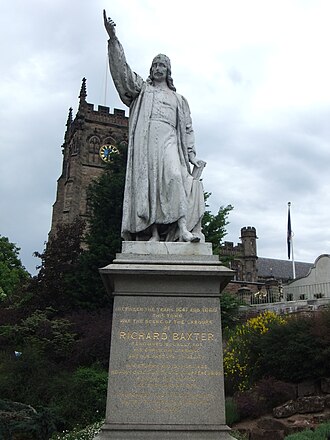
British Calvinists: Richard Baxter (1615-1691)

Richard Baxter (1615-1691) was known as 'Scribbling Dick' because of his prodigious writings. He was born Rowton, Shropshire. When a teenager he was influenced by the works of William Perkins, Richard Sibbes and Edmund Bunny. 

In 1638 he became the master at the free gramme school in Dudley, here he was ordained by the bishop of Worcester, John Thornborough. The main part of his ministry took place in Kidderminster at St Mary and All Saint's Church. While at Kidderminster he wrote The Reformed Pastor. During the Civil War he left Kiddermister for Gloucester, but later returned to Kidderminster. While ill he wrote The Saint's Everlasting Rest (1650).


In 1662 he married and retired to Middlesex after being part of the Great Ejection bought about by the Act of Uniformity.

He was prolific writer and wrote over 140 books. He held to a view known as neo-nomianism, held in response to antinominaism.  

Many of his writings are available here: http://www.prdl.org/author_view.php?a_id=133


Monday, 16 June 2014

British Calvinists: Thomas Adams (1612-1653)

Little is known about Thomas Adams (1612-1653) what we do can has to be gleaned form his won writings. He was a Calvinist who remained with in the Established Church. He was described by Robert Southey as 'the prose Shakespeare of Puritan theologians . . . scarcely inferior to Fuller in wit or to Taylor in fancy.' 


Adams was a minister at Willington, Wingrave, and London, and “observant chaplain” to Sir Henry Montague, the lord chief justice.

Thursday, 12 June 2014

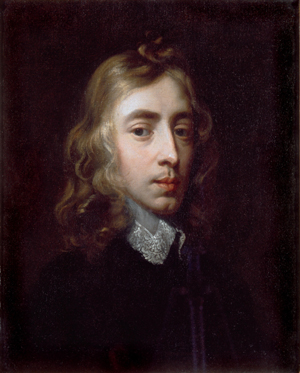
British Calvinists: John Milton (1608-1674)

John Milton (1608-1674) was born in London. He is best known for his poems Paradise Lost (1667) and Paradise Regained (1671).  He graduated from Christ's College, Cambridge in 1629. He was increasingly uneasy about the high church influence of the Established Church and described himself as 'church-outed' by the bishops.

During a European tour he met Hugo Grotius and Galileo. In 1639 he returned to England and began to work on more poetry. He also took in private pupils, his Of Education (1644) reflected his experiences and his ideas.

He married Mary Powell in 1642 - they were separated for three years but reconciled in 1645 and had four children.

In 1649 he was appointed Secretary for Foreign Tongues to the Council of State. His first wife died in 1652 and later married Katherine Woodcock in 1656. Katherine died in 1658 and he then married Elizabeth Minshull in 1663.


He died in London from heart failure.

Monday, 9 June 2014

British Calvinists: Thomas Brooks (1608-1680)

Little is known of the life of Thomas Brooks (1608-1680). He was a graduate of Emmanuel College, Cambridge. He spent some time at sea, possibly as a chaplain.  He was a minister at Thomas Apostle's, London. 

He moved to St Margaret's Fish-street Hill, London and adopted a closed position on baptism and communion.


Many of his writings are available here: http://www.prdl.org/author_view.php?a_id=168


Many of them are still in print today: http://banneroftruth.org/uk/store/author/brooks-thomas/

Thursday, 5 June 2014

British Calvinists: Samuel Bolton (1606-1654)

Samuel Bolton (1606-1654) was born in Lancashire and graduated from Christ's, Cambridge in 1629 with a BA and in 1632 with an MA. He was a curate in Harrow, Middlesex and then minister of St Martin Ludgate in London. He subsequently became a minister at St Saviour's, Southwark and a lecture at St Anne and St Agnes in Aldersgate.

He was one of the Westminster Assembly delegates. He became master of Christ's College and then Vice-Chancellor of the University from 1650-1652. 


One of his writings  is available here: http://www.prdl.org/author_view.php?a_id=1389


Monday, 2 June 2014

British Calvinists: Isaac Ambrose (1604-1662)

Isaac Ambrose (1604-1662) was the son of Richard Ambrose of Ormskirk, Lancashire. Isaac graduated from Brasenose in 1624 and became the minister of Castleton, Derbyshire. He then became one of the king's itinerant preachers and became a vicar in Preston. In 1654 he became minister at Garstang. In the 1662 Great Ejection he was ejected from Garstang. He died soon after in Preston.


Some of his writings are available here: http://www.prdl.org/author_view.php?a_id=1385

Thursday, 29 May 2014

British Calvinists: John Lightfoot (1602-1675)

John Lightfoot (1602-1675) was an Erastian member of the Westminster Assembly. He was the son of Thomas Lightfoot of Stoke-on-Trent. Lightfoot graduated from Christ's College, Cambridge in 1621 with a BA. He was ordained in 1623 and for a while was a curate in Shropshire where he met (Sir) Rowland Cotton. In 1626 he became the rector of Stone, Staffordshire. There he was married to Joyce Crompton. In 1628 they moved to Hornsey, Middlesex. In 1630 he became rector at Ashley, Staffordshire. He moved to London and in 1643 he became Lecturer at St Bartholomew's and then in 1644 rector at Great Munden, Hertfordshire.

The first part of his Harmony of the Evangelists was published in 1644. 

He kept a record of the deliberations of the Westminster Assembly in his Journal of the Proceedings of the Assembly of Divines. This shows that he was favourable towards the Presbyterians but opposed to the Independents.

He was appointed Master of St Catherine's, Cambridge in 1650, in 1654 he became the Vice-Chancellor of the University. 

He sided with the Presbyterians at the Savoy Conference in 1661. 

Some of his writings are available here: http://www.prdl.org/author_view.php?a_id=395


Tuesday, 27 May 2014

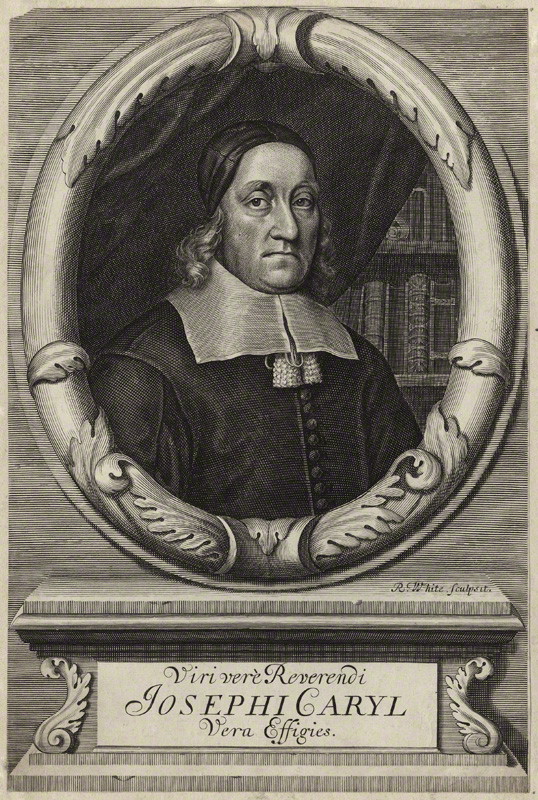
British Calvinists: Joseph Caryl (1602-1673)

Joseph Caryl (1602-1673) was born in London and was graduate of Exeter College, Oxford. He is best known for his commentary on Job. He was often asked to preach before the Long Parliament and was one of the Westminster Assembly 'divines'. 

After the restoration he was ejected from his church, St Magnus near London Bridge, but he continued to minister as an Independent (Conegationalist) in London.  

Some of his writings are available here: http://www.prdl.org/author_view.php?a_id=196


Friday, 23 May 2014

British Calvinists: John Trapp (1601-1669)

John Trapp (1601-1669) was born in Croome d'Abitot and graduated from Christ Church,
Oxford in 1622 with a BA and in 1624 with an MA. By 1624 he was the headmaster of the free school of Stratford-on-Avon.

He sided with the government in the Civil War. During the Civil War he was the chaplain to the parliamentary troops in Stratford for two years. He was the minister at Welford-on-Avon from 1636-1660 and then from 1660 until his death. 

Some of his writing can be found here:


Tuesday, 20 May 2014

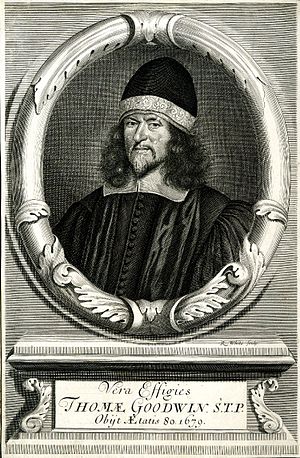
British Calvinists: Thomas Goodwin (1600-1680)

Thomas Goodwin (1600-1680) born in Rollesby, Norfolk, graduated from Christ's College, Cambridge in 1616 with a BA. At Emmanuel he was influenced by the preaching of John Preston and Richard Sibbes. During this time he wrestled with doubts about his faith, the lessons of  which are contained in his A Child of Light Walking in the Darkness

In 1633 he resigned his clergy posts in Cambridge and became aligned with the independent congregationalist principles of church government. After marrying Elizabeth Prescott in 1638 he went to Arnhem and worked with Philip Nye (1596-1672) to make the church there a model of congregationalism. 

In 1640 Goodwin returned to London and set up an independent congregation in the parish of St Dunstan's-in-the-East. 

He was with Nye one of the independent representatives at the Westminster Assembly in 1643-52. Goodwin, Nye, Jeremiah Burroughes, William Bridge and Siddrach Simpson (1600-1655) were known as the 'Five Dissenting Brethren'.

Oliver Cromwell appointed him as one of his chaplains and appointed him as president of Magdalen College, Oxford.

Together with John Owen he helped to draw up the Savoy Declaration of Faith and Order. 

Many of his writings are available here: http://www.prdl.org/author_view.php?a_id=311


Saturday, 17 May 2014

Recent Kuyperania (May 2014)

Bruce Wearne's review of Kuyper's Kuyper in America and two of Mouw's books Cultural Discipleship and Abraham Kuyper from Zadok Perspectives is now online at Platforma C

Peter J. Leithart takes a brief look at Kuyper's common grace

Another republished version of Kuyper's Lectures on Calvinism is available from GLH and on Kindle.

Darryl L. Bock looks at Kuyper's book on Common Grace:
This is my first read of Kuyper, a famous Reformed theologian of the late 19 and early 20th century. His style is clear. His address of issues is direct. He raises and pursues questions that many do not even raise. He reasons in detail, sometimes one senses he infers to answer questions that may not have an answer. Still it is a worthy read. If one has ever wondered why there is so much discussion of covenants to Adam and Noah in the Reformed tradition, this text will help to explain why the topic is raised.
Robert Covolo's review of Bratt's biography of Kuyper is now online at academic.edu, as is his 2013. "Faith in a Fashionable Age: Abraham Kuyper and Charles Taylor on the Secular Nexus Between Mode and Modernité"  International Journal of Public Theology 7: 297–314.

And as has been mentioned before John Boer's translation of Abraham Kuyper's The Ascent of the Son - The Descent of the Spirit is available from lulu.com.

Friday, 16 May 2014

British Calvinists: William Bridge (c. 1600-1671)

William Bridge (c. 1600-1671) was born in Cambridgeshire and graduated form Emmanuel College with an MA in 1626. 
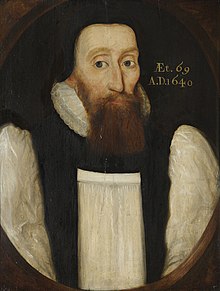
For a while he was a vicar in Norwich. He was one of the main Puritan influences in East Anglia. However, he came into conflict with the bishop of Norwich, Matthew Wren he went 'to Holland rather than conform'. He returned to England in 1642 and was an independent (Congregationalist) representative at the Westminster assembly.  


Some of his writings are available 


Abraham Kuyper The Ascent of the Son - The Descent of the Spirit

John Boer has translated Abraham Kuyper's The Ascent of the Son The Descent of the Spirit. It is now available for free from lulu.com. It comprises 26 Meditations on Ascension and Pentecost.

It is a translation of  Op den Pinksterdag (met Hemelvaart), volume 3 of his series Dagen van Goede Boodschap (Kampen: Kok, 1923. It was originally written in 1888 and published posthumously.


Monday, 12 May 2014

British Calvinists: Edmund Calamy (1600-1666)

Edmund Calamy (1600-1666) was born in London and graduated from Pembroke Hall with a BA in 1620 and MA in 1623; he was a key Presbyterian leader. He is often known as 'the elder' his son was also called Edmund Jr(1634-1685) (the younger) and his grandson, the son of Edmund (III) was also called Edmund (1671-1732), this Edmund was a historian; all of them were nonconformists. 

Father  and son (Jr)  were both ejected from their parishes during the Great Ejection in 1662. All three were educated at Merchant Taylors' School. 
Edmund the elder was a chaplain to Nicholas Felton, the bishop of Ely and became vicar of St Mary's Swaffam Prior in Cambridgeshire. It was here worked with Jeremiah Burroughes. 

In 1639 he became the perpetual curate of St Mary Aldermanbury in London. He became involved in arguments against the Episcopacy. He was part of the  amalgam "Smectymnus' (the others were Stephen Marshall, Thomas Young, Mathew Newcomen and William Spurstowe) who wrote against the Episcopacy. 

He was an active member of the Westminster assembly particularly in the debates regarding church government. 

Some of his writings are available here: http://www.prdl.org/author_view.php?a_id=1532


Thursday, 8 May 2014

British Calvinists: Samuel Rutherford (1600-1661)

Samuel Rutherford (1600-1661) was born near Jedburg in the Scottish Borders. He graduated with an MA from Edinburgh University in 1621. In 1623 he became the Regent Professor of Humanity, teaching Latin. During bis time at Edinburgh he was involved with radical presbyterians. He had to resign his Edinburgh post when he got his future wife pregnant. 


He became the minister of Anworth in 1627. Here he was involved with and organised presbyterian campaigns against royal ecclesiastical policy for which he was deprived of his charge in 1636. He was forbidden to preach and confined to the city of Aberdeen. 

In 1638 the National Covenenat was signed and Rutherford became a leading Covenanter. he was appointed professor of Divinity at New College. St Andrews. 

He was one of the main Scottish representatives at the Westminster Assembly (1643-1647). Other Scots included: Alexander Henderson, Robert Bailie, George Gillespie and John Maitland. During this time Rutherford wrote  Lex, Rex: or the Law and the Prince (1644)  The Due Right of Presbyteries (1644) and The Divine Right of Church Government and Excommunication (1646)

On return to Scotland he sided with the more radical Covenanters, the 'Remonstrants', against the more moderate 'Engagers'. 

In 1650 when Charles II came to Scotland Rutherford addressed him on the duty of kings. In 1660 with the restoration of the monarchy under Charles II copies of Rutherford's Lex, Rex were burned, he was deprived of his university post and confined to his home. In 1661 he fell ill and died. His Letters were published posthumously. 

Some of his writings are available here: http://www.prdl.org/author_view.php?a_id=484

Tuesday, 6 May 2014

British Calvinists: Tobias Crisp (1600-1643)

Tobias Crisp (1600-1643) obtained a BA from Christ's, Cambridge and his MA from Balliol, Oxford in 1629. He married Mary Wilson at this time and had thirteen children. He was ordained and became the parson at Brinkworth, Wiltshire after a short time at Newington Butts, Surrey. He began his ministry as an arminian but became a high Calvinist;  he was a controversial figure and was accused of antinomianism. 

During the Civil war he was forced to leave his parish and fled to London. It was in London he met with opposition from other Calvinists. Some have suggested this was die in part to Crisp's popularity as a preacher. He died in 1643 of smallpox.

His Christ Alone Exalted  was published posthumously by Robert Lancaster. John Gill, in 1765, published the complete Works


Some of his works are available here: http://www.prdl.org/author_view.php?a_id=1330

Friday, 2 May 2014

British Calvinists: Hanserd Knollys (1599-1691)

Hanserd Knollys (1599-1691) was born in Cawkwell, Lincolnshire. He studied at Catherine Hall, Cambridge where his contemporaries included John Arrowsmith, Thomas Goodwin. He was a school master at Gainsborough before being ordained. He became a minister at Humberston in. Lincolnshire. 

During his time there he prayed for a widow who was at death's door - she was healed. In 1631 he married Anne Cleney. He became increasingly concerned about many Anglican practices and eventually gave up his living. He then doubted the validity of his ordination. During this time he met the Puritan John Wheelwright and Knollys came to a saving faith. 

In 1633 Knollys was arrested for being a dissenter. He was let released and then made his way to Boston in Massachusetts in 1691. On the 12 week sail his only child died.

In 1641 he returned to England to care for his ageing father and returned to teaching. When the civil war broke out he briefly joined the army but soon became disillusioned and returned to London where he joined the Henry Jessey's congregation. There became convinced that infant baptism wasn't biblical. This led to the formation of the Particular Baptists. Two Particular Baptist congregations developed one led by Knollys and the other by William Kiffin. 

Knollys rejected the Presbyterian model of church and adopted a congregational model. Knollys advocated a High Calvinism and a closed communion. He was unjustly accused of being an antinomian after signing the reprint of Tobias Crisp's sermons. 

During this time the Particular Baptists experienced much growth. Knollys travelled around the country helping to set up many local churches.

After the restoration of the monarchy and Charles II came to the throne it meant persecution for many non-Conformists, Knollys included. He was imprisoned many times. He spent some time in Holland and in Germany but returned to London after two or three years. 

In the late 1660s he wrote several books advocating a historical approach to Revelation. He became convinced that mystical Babylon was papal Rome. He was a post millennialist. 
In 1670 he was again put into prison but was allowed to preach to the prisoners. 

In 1677 the Knollys and the London Particular Baptists published a new confession of faith - it was published in 1689 when William and Mary ascended the throne. Knollys and Kiffin were the only two that signed both the first and second London Confessions. 

He died in 1691 and was buried in bunhill Fields, London.


Further reading

Michael A. G. Haykin (1996) Kiffin, Knollys, Keach: Rediscovering our English Baptist Heritage. Leeds: Reformation Today Trust.

Barry H. Howson (1998)  'Hanserd Knolleys (c. 1598-1691)' In Michael A. G. Haykin The British Particular Baptists 1638-191 Volume 1. Springfield, MI: Particular Baptist Press. 

Thursday, 1 May 2014

Recent Kuyperania (April 2014 - part 2)

Kuyper's Scholarship is now available from CLP 

Stephen Williams reviews John Halsey Wood Jr's Going Dutch in the Modern Age at Reformation 21.

My article on kuyperania will soon appear in Koers, the full reference is:
Bishop, S., 2014, ‘Kuyperania in recent years’, Koers – Bulletin for Christian Scholarship 79(1), Art. #2138, 6 pages.  http://dx.doi.org/10.4102/koers.v79i1.2138 [NB link not yet working]

Monday, 28 April 2014

British Calvinists: John Davenport (1597-1670)

John Davenport (1597-1670) was born in Coventry. He attended Merton College and Magdalen Colleges in Oxford, but never received a degree. He ws ordained and became a curate in London and then the vicar of St Stephen's, Coleman Street. Initially Davenport conformed to liturgical practices but as anti-Calvinism and ceremonialism spread in the Established church he became a non-Conformist. In 1626 he helped to organise the Feoffees for Impropriations - the buying of church livings so that could be given to those with puritan leanings. 


He eventually left England for the Netherlands in 1633. In 1637 he left for the New World. He was invited to the Westminster Assembly in 1642; other New Englanders that were invited included John Cotton and Thomas Hooker. He was unable to attend as he was the only minister of New Haven. 

One of his works is available here: http://www.prdl.org/author_view.php?a_id=4883

Friday, 25 April 2014

British Calvinists: John Spilsbury (1593-c.1668)

John Spilsbury (1593-c. 1668) is one of the pioneers and prominent leaders of the Particular Baptists. Particular Baptists were so-called because of their belief in particular, or limited atonement.

Spilsbury was originally a London cobbler. He became involved with Henry Jessey's church in London, probably the first Particular Baptist church. He was one of the main - if not only - author of the First London Confession of Faith (1644). 

His main theological contributions, other than the First London Confession of Faith were defending believers' baptism and the defence of particular redemption. He sought to distance the particular Baptists from the paedobaptists and the General Baptists. 

Further reading

Reniham, James M. (1998) "John Spilsbury(1593-c. 1662/8) In Michael A. G. Haykin The British Particular Baptists 1638-191 Volume 1. Springfield, MI: Particular Baptist Press. 


Wednesday, 23 April 2014

British Calvinists: John Forbes (1593-16448)

John Forbes (1593-1648) of Corse attended the universities of Aberdeen and Heidelberg. He was ordained by his father in Aberdeen. He became the first synod professor of divinity at King's College, Aberdeen in 1620. He died at Corse Castle (left).

Some of his writings are available here: http://www.prdl.org/author_view.php?a_id=291

Monday, 21 April 2014

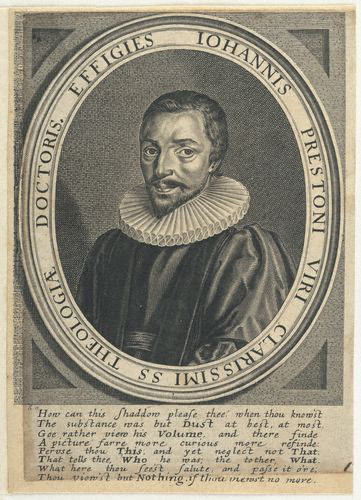
British Calvinists: John Preston (1587-1628)

John Preston (1587-1628) was born in Northamptonshire. He obtained a BA from King's College, Cambridge and then MA in 1611 from Queens' College, Cambridge. He was converted under the preaching of John Cotton. He then became ordained around 1611. Jonathan Moore describes him as "perhaps the most influential and esteemed leader of the godly in both church and state." 

He obtained his BD in 1620 and held numerous high level posts including dean of Queens',chaplain to Prince Charles and master of Emmanuel College, Cambridge. He attended the York House Conference in 1626 set up to bring a rapprochement between Arminians and Calvinists. 

Preston adopted a form of hypothetical universalism some time after 1615. He was a moderate and non-separating Calvinist, though he did much to help foster the growth of Puritanism during his time as master of Emmanuel.


Some of Preston's works are available here: http://www.prdl.org/author_view.php?a_id=466

Saturday, 19 April 2014

British Calvinists: John Cotton (1585-1652)

John Cotton (1585-1652) was born in Derby. He received his BA from Trinity College, Cambridge in 1603 and an MA from Emmanuel College, Cambridge in 1606. At Cambridge he was influenced by William Perkins. He was ordained in 1610 and became the rector at St Botolph's in Boston, Lincs. He was anti-Catholic and pro-Puritan. He became increasingly concerned with the Established Church and he favoured presbyters over bishops. He attempted to follow Anglican practices while at St Botolph's but his conscience and convictions eventually prevented him from doing so.

When Charles I came to the throne in 1625 the Anglican church became more hostile to the Puritans. Archbishop Laud was ruthless in his attempts to put down puritan tendencies in the Established church. During this time many left England for the New World. Cotton was summoned to appear before laud, this was the catalyst that led Cotton in to hiding and eventually to  New England in September 1633.

He is reputed to have said "I have read the fathers, and the schoolmen and Calvin too, but I find that he that has Calvin has them all."

Some of his works are available here: http://www.prdl.org/author_view.php?a_id=216


Thursday, 17 April 2014

British Calvinists: John Ball (1585-1640)

John Ball (1585-1640) born in Oxfordshire, he graduated from St Mary's Hall, Oxford in 1607/08. He was for a while a tutor in the home of Lady Cholmondeley where he became introduced to puritanism. He was ordained by an Irish Bishop and became curate at Whitemore, Staffordshire. he remained there for the rest of his life. 


He was an opponent of episcopal government and was imprisoned twice for his views. He also attacked the separatists. For him the Church of England was flawed but basically sound. 

Wednesday, 16 April 2014

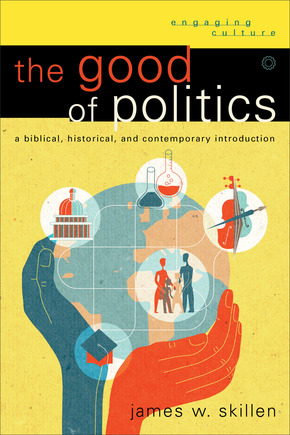
Skillen's The Good of Politics - a Review

The Good of Politics
A Biblical, Historical, and Contemporary Introduction
James W. Skillen
Grand Rapids: Baker Academic, 2014.
ISBN 978-0-8010-4881-4
Pbk, xxi + 214pp, £13.89

It's often said that religion and politics don't mix. It's also said that politics and religion should be avoided in polite conversation. In an interview for Vanity Fair magazine Tony Blair was asked about his Christian faith, Alistair Campbell, Blair's former communications Chief (aka spin doctor), immediately interrupted and said "I'm sorry, we don't do God".

Contrast this with a scene in the film Amazing Grace. William Wilberforce when considering giving up his political career for one in religion was visited by members of the Clapham Sect and Thomas Clarkson. Clarkson says to Wilberforce ‘We understand you are wondering whether to pursue politics or religion’. Hannah More responds: ‘We humbly suggest you can do both’.

That is the reformational response. We can serve God and do politics – in fact we can serve God in doing politics. Religion and politics do mix! In part this is why Skillen has written this excellent book, the title of which may seem to some Christians to be outrageous - how can politics be good?  

His main aim is to show the creational role of politics and thus politics can be good. The current Christian consensus is that politics is a necessary evil. Skillen exposes this misunderstanding and ably shows the creational role of politics.

This misunderstanding has been prevalent since Augustine. Augustine suggested that institutions of government are unnatural and are permitted by God only in response to sin as both a punishment and a remedy for our sinful condition. If this is the case, as Skillen points out, then natural law cannot provide a basis for unnatural institutions. This Augustinian-perpetuated error stems from not having a strong enough view of creation. God created humans for political life and thus it can be good and it is ‘not a neutral terrain’ (p. 118).

Skillen shows the deficiency of the Augustinian perspective in the first two sections - biblical and historical. In the third and final section he looks at what Christian political involvement might look like. Here he surveys important topics such a economics, the environment, education, family and citizenship as vocation.


This is an important book, it should be read widely - and not just by Christians who have an interest in politics - but by every Christian who is touched by politics. 


For my interview with Jim Skillen see here
The book is available in the States from Byron Borger's Heart and Minds Bookstore

David Gay: Septimus Sears A Victorian Injustice - a review

 
Septimus Sears
A Victorian Injustice and its Aftermath
David H. J. Gay
Biggleswade: Bracchus, 2010, pbk, 70pp, £2.75
ISBN 9780956023827

The content of this book was originally presented as a paper to the annual meeting of Strict Baptist Historical Society in 2009. It still bears the marks of a conversational lecture format and at times this does grate - but fortunately, content triumphs over style.

This book provides a brief introduction to the little-known Septimus Sears (1819-1877) - I would have like more biographical information - but the main topic is the debate between him and John Gadsby, the editor of the Gospel Standard (1870 - 1877) over the nature of the free offer of the Gospel.

Sears moved from a hyper-Calvinist position to a free-offer of the gospel position, however Gay feels he didn’t move far enough. Gay maintains that Sears held to an “incipient hyper-Calvinism”.

Gay examines three main primary sources: Sears’ 1841 letter to J C Philpott, his Memoirs and his preaching. Sears originally agreed with Philpott that although the first-century apostles preach and invited sinners we shouldn’t: we have no basis for copying the biblical examples. Sears somewhere between 1841 and 1865 changed his mind and thought that we should. 

In his memoirs Sears advocates warning sinners, inviting seekers and exhorting saints. Yet Gay’s examination of Sears’ preaching post 1865 shows that Sears told his hearers of the gospel invitation but offered no invite. It was more you are invited rather than I invite you to respond to the gospel. Despite this Sears was repeatedly taken to task by John Gadsby in the pages of the Gospel Standard for supposedly being too free in the way he addressed sinners. 

The issue seems to focus around the question of whether we should copy the apostles in the way they presented the gospel to sinners. In an Appendix Gay suggests that the first person to suggest that we shouldn’t wasn’t a Puritan but rather Revd Robert Hawker (1735-1823) of Plymouth in his The True Gospel: No Yea and Nay Gospel (1818), this idea was taken up and developed by J. C. Philpott. 

In this short book Gay has packed a lot of research. This not an issue that has gone away the debate still continues, many of the arguments are the same though the arguers have changed. 


Tuesday, 15 April 2014

British Calvinists: James Ussher (1581-1656)

James Ussher (1581-1656) was a scholar, a politician and a Church of Ireland bishop. He was born in Dublin and graduated from Trinity College, Dublin. He became a professor of theology at Trinity College until 1617. He was ordained in 1601.

He was strongly anti-Catholic, one of of his works was An answer to a challenge made by a Jesuit in Ireland (1624). In his A discourse of the religion anciently professed by the Irish and British (1631) he made that the Church of Ireland was the rightful heir of St Patrick. 

He opposed the imposition of the 39 Articles upon the Church of Ireland and argued that the terms Puritan and Reformed were synonymous. 

From 1625-1656 he was the Archbishop of Armagh and Primate of All Ireland. His work on chronology concluded that the earth was created in 4004 BC.

Oliver Cromwell ensured that Ussher's funeral was paid for by the state and held in Westminster Abbey.


Several of Ussher's works are available here: http://www.prdl.org/author_view.php?a_id=55


Monday, 14 April 2014

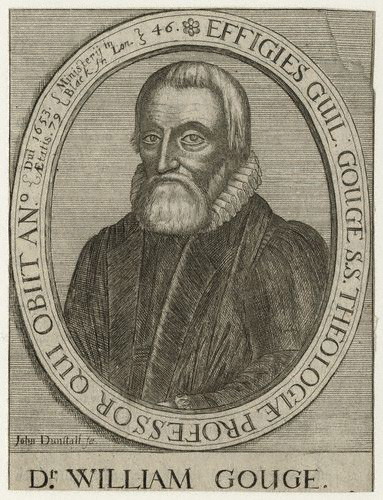
British Calvinists: William Gouge (1578-1653)

William Gouge (1578-1653) was one of the "Westminster divines". Born in Stratford-le-Bow, Middlesex, he graduated from King's College, Cambridge with a BA in 1598 and an MA in 1601.  He was the nephew of Laurence Chadderton and William Whitaker. He was a fellow and lecturer at Cambridge in logic before he moved to St Anne's, Blackfriars when he was ordained in 1608.

He was a regular attender at the Westminster Assembly and was chair in 1644 of the Westminster Confession draft committee. Two of his key works were The Whole Armour of God (1615) and Of Domesticall Duties (1622). The latter was a rejection of the view, popular at the time, that husbands should beat their wives - but still stressed female subjection of wives.  


Some of Gouge's works are available here: http://www.prdl.org/author_view.php?a_id=314


Friday, 11 April 2014

Recent Kuyperania (April 2014)


Christian's Scholars Press have announced a new translation of two addresses by Kuyper: Scholarship: Two Convocation Addreses on University Life. It is edited an translated by Harry van Dyke.
ISBN: 978-1-938948-85-5. 51 pages.
Details here.

Daniel José Camacho "Common Grace and Race" The Twelve.
Looks at Kuyper, common grace and racism.

Six new books by Calvin Seerveld from Dordt College Press

A new book from Calvin Seerveld is cause for celebration. Dordt College Press have released six - each edited by John Kok.


Normative Aesthetics
Redemptive Art in Society
Cultural problems in Western Society
Art History Revisited
Cultural Education and History Writings
Biblical Studies and Wisdom of Living

Further details here: http://www.dordt.edu/publications/dordt_press/

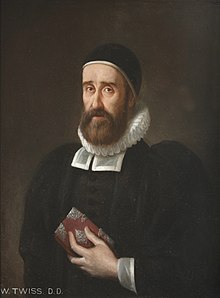
British Calvinists: William Twisse (1578-1646)

William Twisse (1578-1646) was born at Speenlands, near Newbury. He became a fellow of New college, Oxford and graduated with a BA in 1600 and an MA in 1604.

For a short while he was appointed as by James I as chaplain to his daughter, Elizabeth of Bohemia.He became the vicar of Newbury in 1620. 

He opposed Laud and was a premillennialist and a supralapsarian. He favoured Reformed Episcopasy and held strong sabbatarian views.

He was one of the delegates at the Westminster Assembly. He was unanimously appointed as the Prolocutor of the Assembly.


Some of his writings are available here: http://www.prdl.org/author_view.php?a_id=52


Wednesday, 9 April 2014

British Calvinists: Richard Sibbes (1577-1635)

Richard Sibbes (1577-1635), "the heavenly doctor", was born in Tostock, Suffolk, he was a conforming Puritan.  He graduated from St John's, Cambridge with a BA in 1599. He was elected a fellow in 1621. He was converted in 1603, he called Paul Baynes his "Father in the Gospel". Sibbes was ordained and became a lecturer at Holy Trinity Church, Cambridge. In 1617 he was appointed preacher for Gray's Inn, London. He then, in 1626, became the master of St Catherine's, Cambridge and was awarded a DD. In 1633 he was also appointed to the "perpetual curacy" of Holy Trinity. He died at Gray's Inn. 

Most of his influential works were published posthumously.


Further reading
Mark E. Dever 2000. Richard Sibbes: Puritanism and Calvinism in Late Elizabethan and Early Stuart England, Mercer University Press.

Many of his works are available form here: http://www.prdl.org/author_view.php?a_id=503


l

Monday, 7 April 2014

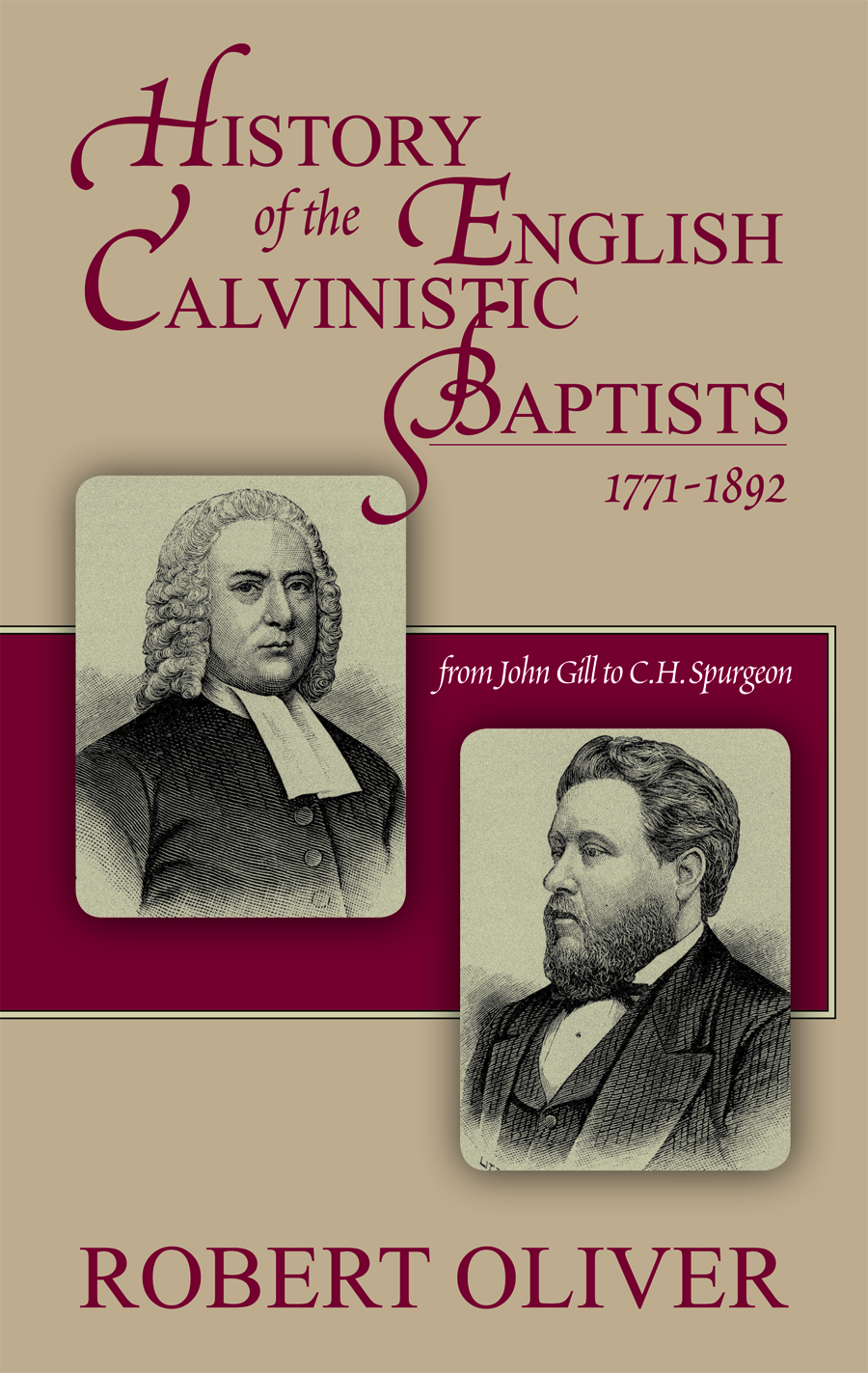
Robert W. Oliver History of the English Calvinistic Baptists

History of the English Calvinistic Baptists 1771-1892
From John Gill to C. H. Spurgeon
Robert W. Oliver 
Edinburgh: Banner of Truth Trust, 2006
ISBN 978 0 85151 920 3; Hbk; 410 + xxi pp; £16.50

This is a fascinating book. Unfortunately, it doesn't do what the title suggests. If it were then the history of the Calvinistic baptists would be one dispute after another. 

There were a number of debates among the Calvinistic Baptists. These were over: the nature of communion: open or closed (chapter 4); Andrew Fuller’s The Gospel Worthy of All Acceptance (1785) and its challenge to the dominant Hyper-Calvinism. Fuller maintained that gospel preaching must include exhortations to all to repent and believe (chapter 5); and the Antinomian controversy: the relationship of the Christian to the moral law (Chapter 6). The book ably covers the key disputants in the controversies that marked out the Particular Baptists from the General Baptists. 

The second part of the book looks more specifically at four key players: Andrew Fuller (Chapter 8), Abraham Booth (Chapter 8), William Gadsby (Chapter 9) and John Stevens  (Chapter 10).

In part three the proliferation of Strict Baptist magazines are examined as well as the different organisations. The final chapter on Spurgeon feels more like an add on rather than an integral part of the book. 

As I was reading the book I kept wondering what Oliver’s views were - they are not obvious form the text. I wish he had made his own views more explicit, that way any possible (and inevitable) bias can more easily be detected. 

Oliver’s book was originally his 1985 London Bible College PhD thesis - but it took some time to be published - primarily to overcome his reluctance to publish. I am glad that it was as it provides a much needed insight into the Calvinistic Baptists. 


The following two-way table - I’ve compiled it  from Oliver’s information - shows clearly that the debate over strict baptism and hyper-Calvinism wasn’t straightforward.


British Calvinists: John Davenant (1576-1641)

John Davenant (1576-1641) was Lady Margaret Professor of Divinity at Cambridge and later bishop of Salisbury. 
He was born in London and died in Salisbury. He graduated from Queen's College Cambridge and became a fellow in 1597. From 1614-1621 he was its president. He was one of the British Anglican representatives at the Synod of Dordt in 1618. He was not an advocate of limited atonement, though he was not a supporter of Moses Amyraut and his Amaryraldianism.

He was appointed bishop of Salisbury by James I in 1621. 

He is the author of a commentary on Colossians which is available from the Banner of Truth. 


Some of his writings are available here: http://www.prdl.org/author_view.php?a_id=232

Friday, 4 April 2014

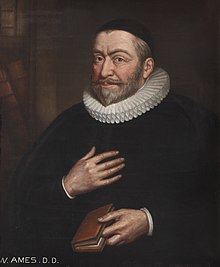
British Calvinists: William Ames (1576-1633)

William Ames  (1576-1633) born at Ipswich and graduated in 1598 from Chrst's College, Cambridge. He was greatly influenced by William Perkins and Perkins' successor Paul Baynes. Ames refused to wear a surplice, this cost him the mastership of Christ's - it was awarded to Valentine Carey - and led to Ames being suspended from his ecclesiastical duties. In 1610 he translated William Bradshaw's English Puritanism from Latin into English. 

He then travelled with Robert Parker to the Netherlands. In the Netherlands he was involved with a number of disputes with the Arminians. He also promoted the autonomy of the local church congregation. He wrote against the catholicism of Robert Bellarmine, the Laudianism of the English church, and the separatism of John Robinson, a Leiden pastor. 

He taught theology form 1622-1632 at Franeker University. He was unable to join the Puritan migration to New England because of his ill health.  His The Marrow of Sacred Divinity (1643) was his most influential work.


Many of his writings are accessible from here: http://www.prdl.org/author_view.php?a_id=113


Wednesday, 2 April 2014

British Calvinists: Joseph Hall (1574-1656)

Joseph Hall (1574-1656) was an Anglican bishop. He was born at Ashby-de-la-Zouch, Leicestershire and graduated from Emmanuel College, Cambridge. His family were Puritans. 

In 1608 he became chaplain to Henry, the Prince of Wales. He was one of the English delegates to the Synod of Dordt in 1618. He became the bishop of Exeter in 1627. He trod a path mid-way between the Puritans and the church establishment. He thought that episcopacy was a divine right. He then was made the bishop of Norwich. 

He was described by Thomas Fuller as "our English Seneca". 


Many of his writings are available from here: http://www.prdl.org/author_view.php?a_id=329

Tuesday, 1 April 2014

A broadly Calvinist timeline from Elizabeth I - James II

Under Elizabeth I we had the settlement of Calvinism. However, the tensions between crown and church were growing and this resulted in a separation and growing fragmentation among Calvinists. It was during this period that we had the increasing privatisation of Puritanism. As D. G. Hart puts it a "vein of introspective piety" replaced "the zeal for a throughly reformed church". Some wanted to stay in the Established church, but others separated to form presbyterianism, congregationalism and other branches. Though Philip Schaff, in his Creeds of Christendom, wrote: "It is not too much to say that the ruling theology of the Church of England in the latter half of the sixteenth and the beginning of the seventeenth century was Calvinistic". (I, 604) 


1558 Elizabeth I 
1558 Act of Uniformity (passed in 1559): Book of Common Prayer reinforced and legal obligation to attend church service weekly
1558 (Second) Act of Supremacy: Elizabeth declared Supreme Governor of the Church of England 
1559 John Knox returns to Scotland
1559 Elizabeth I appoints Matthew Parker as Archbishop of Canterbury
1560 Scots Confession and the first Book of Discipline
1561 English translation, by Thomas Norton, of Calvin’s Institutes published
1563 39 Articles approved by Convocation as the doctrinal creed of the CoE
1564 John Calvin dies
1566 Start of separatists movements in response to vestment controversies (dating back to John Hooper during Edward VI’s reign)
1570 Thomas Cartwright’s Cambridge lectures - the foundations of presbyterianism
1571 The 39 Articles approved by Parliament
1572 Presbytery of Wandsworth
1574 Cartwright translates Walter Travers's A Full and Plaine Declaration of Ecclesisaticall Discipline Owt Off the Word Off God - a presentation of nonconforming Calvinism
1575 Geneva Bible completed
1576 Edmund Grindal Archbishop of Canterbury
1577 ABp Grindal suspended for refusing to stop Puritan “prophesyings”
1580 Jesuit missionaries sent to England
1581 Robert Browne’s Treatise of Reformation without Tarrying for Any
1582 Act makes all Catholic clergy in England liable to execution
1583 John Whitgift becomes Archbishop of Canterbury
1584 The "Black Acts" in Scotland
1587 Walter Travers's Book of Discipline
1587 Cope's "Bill and Book"
1588 Marprelate Tracts published
1592 'The Golden Acts" passed in Scotland
1593 Execution of Greenwood and Barrow
1595 Lambeth Articles 

1603 James I (cousin of Elizabeth I)
1603 Millenary petition
1604 Hampton Court Conference
1604 Book of Common Prayer Revised
1604 Richard Bancroft Archbishop of Canterbury
1605 Gunpowder plot - Romans seek to blow up Parliament
1608 Separatists leave for the Netherlands
1610 Episcopacy restored in Scotland
1611 George Abbot Archbishop of Canterbury
1611 King James Version of Bible published
1617 Irish Articles promulgated
1618 Book of Sports - games allowed on Sundays
1618-1619 Synod of Dordt
1620 Mayflower sets sail for Massachusetts

1625 Charles I
1625 Bubonic plague
1626 Charles I prohibits predestinarian teaching at Cambridge
1626 York House Conference
1628 William Laud becomes bishop of London
1629 Parliament dissolved by Charles I
1630 Arbella sets sail for Massachusetts
1633 William Laud Archbishop of Canterbury
1633 Book of Sports renewed
1637 New Scottish Prayer Book - causes riot in Edinburgh
1638 Scottish National Covenant
1640 April “Short Parliament”
1640 November “Long Parliament” 
1642 English Civil War
1643 Solemn League and Covenant
1643 Westminster Assembly (to 1646)
1643 Split between Presbyterians and congregationalists in the Westminster Assemby
1644 Book of Common Prayer replaced with Directory of Worship
1644 First London Baptist Confession of Faith
1645 Feb New Model Army
1645 William Laud executed (no Archbishop until 1660)
1645 June Battle of Naseby - Cromwell defeats Charles I
1647 Society of Friends formed by George Fox (Quakers)
1648 Start of Thirty Years War in Europe
1649 Charles I is executed
1649 Last numbered plenary session of the Westminster Assembly
1653 Dissolution of 'Rump' of Long Parliament
1653 Cromwell becomes Lord Protector
1658 Savoy Conference; Savoy Declaration of Church and Order
1658 Cromwell dies, succeeded by son Richard

1660 Restoration of Monarchy: Charles II
1660 William Juxton Archbishop of Canterbury
1662 Act of Uniformity passed - almost 2000 clergy forced out of parishes (Great Ejection)
1663 Gilbert Sheldon Archbishop of Canterbury
1664 First Conventicle Act
1665 Great Plague in London begins
1665 Five Mile Act
1666 Great Fire of London
1672 Declaration of Indulgences - dissenters are permitted to hold services 
1673 First Test Act - Catholics are prevented from remaining in public offices
1678 Bunyan's Pilgrim Progress published


1685 James II