Saturday, 5 May 2012
WYSOCS: Religious Roots for Secular Law
PROGRAMME
10.15 Registration and coffee
10.45 On being a Christian in Law
Christians worship a law-giving God who is faithful and just, as revealed throughout the Bible and supremely in the wisdom of Jesus of Nazareth. How, then, might a relationship with Jesus influence our study and practice of
law? What does it mean to be called to work in law?
11.45 Refreshments
12.00 Shari’a in the West
In a multicultural society, we may find communities living by principles that conflict with the established legal system.
How should true justice be administered in such situations? Prof. Aroney will share perspectives from his co-edited book (copies of which will be on sale).
13.00 Close
NICHOLAS ARONEY is professor of law at the University of Queensland and an Australian Research Council Future Fellow at its Centre for Public, International and Comparative Law. This year he is in the U.K. as a MacCormick Fellow at Edinburgh University's Europa Institute and a Visiting Fellow at the Institute of European and Comparative Law at Oxford
University. He has published widely on constitutional law and is co-editor, with Rex Ahdar, of Shari'a in the West (2010).
Tuesday, 1 May 2012
Philosophia Reformata volume 77 (2012), no. 1
The most recent issue of Philosophia Reformata is out, included is my review of E. M. Conradie's book:
Articles
Lambert Zuidervaart, How Not To Be an Anti-realist: Habermas, Truth, and Justification
Sander Griffioen, On worldviews
Jacob Klapwijk, Nothing in Evolutionary Theory Makes Sense Except in the Light of Creation
Lambert Zuidervaart, How Not To Be an Anti-realist: Habermas, Truth, and Justification
Sander Griffioen, On worldviews
Jacob Klapwijk, Nothing in Evolutionary Theory Makes Sense Except in the Light of Creation
Andrew Basden, Philosophical Frameworks for Understanding Information Systems (Marc J. de Vries)
Ernst M. Conradie (editor), Creation and Salvation: Dialogue on Abraham Kuyper’s Legacy for Contemporary Ecotheology (Steve Bishop)
Daniel Strauss, Philosophy: Discipline of the Disciplines (Alan M. Cameron)
Monday, 30 April 2012
Exploring the World of Mathematics by John Hudson Tiner
Exploring the World of Mathematics
From Ancient Record keeping to the Latest Advances in Computing
John Hudson Tiner
Master Books, 2004 (third printing 2008)
ISBN 978-0-89051-412-2
157pp, pbk
This book is part of a series by Tiner "Exploring the world of ..."; others are on Medicine, Planet Earth, Chemistry, Physics and The World Around You. The book is obviously written for the Christian market and the American market.
In a sense this book aims to do too much. It covers a wide historical period and a wide range of mathematical concepts for 'students of several different ages and skill levels'.
Tiner starts off by looking at measuring the years and then the hours. Measurement is dependent upon number, so I would have thought a better first place to start would be the numerical aspect but that isn't dealt with until chapter 7.
There are one or two math errors: eg 'Every time a number is multiplied by 1,000, three zeros are added, and a new name is given'. Not if the number is 1.3! Such an approach destroys place value concepts - not a great idea in an introductory maths book!
Bible verses are interspersed - sometimes without apparent reason. This approach tends to view Christianity as an icing on the mathematics cake. There are side boxes on topics such as Hebrew and Jewish Calandar of the Old Testament and Cubit in the Bible. Peter's catch of 153 fish (Jn 21:11) is examined - 153 = 1^3 + 5^3 + 3^3. However, little attempt is made to fully integrate Christianity and mathematics.
There are a number of missed opportunities. For example, on the decimal system, Tiner applauds the United States for being the first country to adopt a decimal money system and showed its advantages and yet they haven't embraced full metrification - it would have been interesting to have explored why not. And in the context of decimals how are we, in light of a Christian worldview, to interpret Tobias Dantzig's assertion in Number The Language of Science (1930):
There is a helpful discussion on the Golden ratio - Tiner noted that the dimensions of Noah's Ark in (Gn 6:15) and the Ark of the Covenant are close to the Golden ratio; but why is 1.618 so prevalent in creation?
Pythagras' absolutisation of number and the Greek rationalisation of proof are not really explored - this would have been a good opportunity to show how worldviews shape mathematics.
The Christian faith of mathematicians is also largely absent. Some mathematicians who are Christians are mentioned, but little is made of their faith and in the portrayal of Newton one could be forgiven for thinking that Newton was an orthodox evangelical rather than a unitarian.
I have perhaps been a little over critical; and it is undoubtably much better than the Christian maths book I haven't written!! There is much of use in this book and it may provide the Christian teacher with some useful ideas. It is well laid out and illustrated with line drawings and photographs. It would make for a good resource for the school library or Christian teacher.
From Ancient Record keeping to the Latest Advances in Computing
John Hudson Tiner
Master Books, 2004 (third printing 2008)
ISBN 978-0-89051-412-2
157pp, pbk
This book is part of a series by Tiner "Exploring the world of ..."; others are on Medicine, Planet Earth, Chemistry, Physics and The World Around You. The book is obviously written for the Christian market and the American market.
In a sense this book aims to do too much. It covers a wide historical period and a wide range of mathematical concepts for 'students of several different ages and skill levels'.
Tiner starts off by looking at measuring the years and then the hours. Measurement is dependent upon number, so I would have thought a better first place to start would be the numerical aspect but that isn't dealt with until chapter 7.
There are one or two math errors: eg 'Every time a number is multiplied by 1,000, three zeros are added, and a new name is given'. Not if the number is 1.3! Such an approach destroys place value concepts - not a great idea in an introductory maths book!
Bible verses are interspersed - sometimes without apparent reason. This approach tends to view Christianity as an icing on the mathematics cake. There are side boxes on topics such as Hebrew and Jewish Calandar of the Old Testament and Cubit in the Bible. Peter's catch of 153 fish (Jn 21:11) is examined - 153 = 1^3 + 5^3 + 3^3. However, little attempt is made to fully integrate Christianity and mathematics.
There are a number of missed opportunities. For example, on the decimal system, Tiner applauds the United States for being the first country to adopt a decimal money system and showed its advantages and yet they haven't embraced full metrification - it would have been interesting to have explored why not. And in the context of decimals how are we, in light of a Christian worldview, to interpret Tobias Dantzig's assertion in Number The Language of Science (1930):
... man counts by tens, his ten fingers will remind him of the human origin of this most important phase of his mental life. So may the decimal system stand as a living monument to the proposition: Man is the measure of all things."
There is a helpful discussion on the Golden ratio - Tiner noted that the dimensions of Noah's Ark in (Gn 6:15) and the Ark of the Covenant are close to the Golden ratio; but why is 1.618 so prevalent in creation?
Pythagras' absolutisation of number and the Greek rationalisation of proof are not really explored - this would have been a good opportunity to show how worldviews shape mathematics.
The Christian faith of mathematicians is also largely absent. Some mathematicians who are Christians are mentioned, but little is made of their faith and in the portrayal of Newton one could be forgiven for thinking that Newton was an orthodox evangelical rather than a unitarian.
I have perhaps been a little over critical; and it is undoubtably much better than the Christian maths book I haven't written!! There is much of use in this book and it may provide the Christian teacher with some useful ideas. It is well laid out and illustrated with line drawings and photographs. It would make for a good resource for the school library or Christian teacher.
Sunday, 29 April 2012
Saturday, 28 April 2012
With by Skye Jethani
With: Reimagining the Way You Relate to God
Skye JethaniThomas Nelson, 2011
ISBN 978-1595553799
The Barna group recently did an extensive survey and found that the youth are leaving the church. What has previously happened is that they then come back when they get married and have children, however, that trend doesn’t seem to be happening. Nothing we didn’t previously know! But they identified several reasons why. One of which is that their experience of Christianity is shallow and another is that the churches seem overprotective.
This book may well present something of a solution for these issues.
Skye Jethani, editor of Leadership Journal, in this book makes an interesting observation: he sees all religions are based on the idea that the world is a dangerous place. Because it is a dangerous place, this leads to fear. We want to protect ourselves, so this means some sort of control. However, control leads to conflict and so more danger. This may explain why churches want to protect. All religion, Jethani claims is some sort of control based on fear.
In different ways we try and control God. This leads to four postures. In the first half of the book Jethani explains these four postures. Each of the postures contain an element of truth but are parasitic on the truth of the Gospel. But many are passing them off as gospel, which may be why the experience of Christianity for many is shallow.
The first posture is life under God. The best way to maintain control is to try and control the God who created the world. This posture looks to rituals and morality to do that. If we do the right things then God will cooperate. If we obey, God will bless.
It’s the drop the virgin in the volcano approach to religion. We adhere to the rules and rituals, but God won’t cooperate. Christianity then doesn’t seem to work.
The second posture is life over God. In this posture we don’t need to follow divine commands, rituals or morality, we don’t even need God we can get control through science, through laws and principles. The more extreme version of this posture is atheism – we can take God out of the picture. A god-version is deism, god is a clockmaker – he’s set the world up so now it runs according to laws.
For Christians who adopt this posture the principles in the Bible, rather than science, can give us control and help us find success. What happens is that we then have a relationship not with the God of the Bible but with the Bible as god.
Life from God is the third posture. This is perhaps the most popular today, it sees the issue as unmet desires and pleasures. It’s a consumerist gospel, a gospel that’s all about me. God is there to give us our needs and desires, to give us what we want.
We’ve made God into a divine butler or a divine cosmic therapist.
What happens to Christians who adopt this posture when God doesn’t meet our desires? They walk away form the shallow alternative to the gospel, mistakenly thinking that they have tried the real thing.
The fourth posture reverses this approach – rather than life from God it’s life for God. It puts mission or transformation at the centre. God doesn’t exist for us; we exist to serve God. We need to figure out what God’s purpose is for us and do more for God. The more we do for God the better we feel about ourselves.
Jethani points out have produced an activist generation – we want to end world poverty, we want to reach the lost, we want to go out on the streets to heal, we want to see people saved, we want to see culture transformed. But why are we doing it? We are driven not out of compassion but out of a search for significance.
This is a brilliant analysis of false gospels often promulgated as the Gospel. It is no longer people’s experience of Christianity is so shallow – they have been inoculated against the truth.
The second part of the book looks at the posture of the Gospel: life with God.
In all the other postures we use God to achieve some end: it may be success, wealth or it may be significance. But once we get a revelation of who Jesus is – we no longer want to use God. He isn’t the means to an end – he is the end, He’s the beginning and the end, the all and in all.
I found the first half of the book fascinating and insightful – the second less so, it’s hard to write about how we can get a revelation of God, it’s something that’s ‘caught rather than taught’. This is an important book. It may well change your view of God and the Gospel.
Friday, 27 April 2012
Odds and sods
Here are some recent links worth visiting:
- Grooveshark - much better than Spotify - for most of your music needs
- Gregory Baus Sanctifying the common 2
- Scot Miller on Reading Gagnon
- Preaching Christ in Genesis
- Jon Swales on Leviticus 1
- Christian mathematicians: Bernhard Riemann
- Dr Erik Hoekestra is the new Dordt College President
- Dropbox - a brilliant cloud storage and sharing system
Thursday, 26 April 2012
Kuyper's works online
The Digital Library of Abraham Kuyper is now freely online. The digital library contains most of his published works as well as his unpublished archives.

Monday, 23 April 2012
Sunday, 22 April 2012
Saturday, 21 April 2012
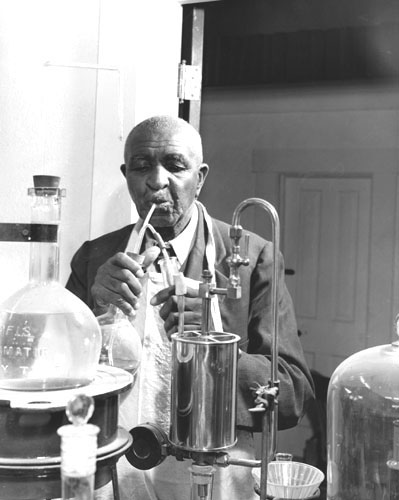
George Washington Carver by John Perry
George Washington Carver
Christian Encounters Series
John Perry
Thomas Nelson, 2011
vii + 161 pp
ISBN 978-1-59555-026-2
This book is one in a series of short biographies in the Christian Encounter series published by Thomas Nelson. Others include familiar subjects such as Tolkein, Bach, D L Moody, Jane Austen and Galileo; others more unfamiliar such as William F. Buckley, Anne Bradstreet and George Washington Carver.
The two previous volumes I've reviewed were ebooks, this was a hard copy. I was pleased to see the small format and the well-designed book covers, including flaps.
Perry is well placed to write this short, accessible biography as he has previously written Unshakable Faith (Multnomah Books, 1999) - a 400 page biography of Carver and his Booker T. Washington. He has also written biographies of General Lee, Mrs Robert E. Lee, Sargent York, Charles Colson and for this Christian Encounter series Sargent York and Winston Churchill.
Carver is best known as the 'peanut man'. (He discovered over 265 uses for peanuts.) But as this biography shows he was so much more. Franklin D Roosevelt described him as “One of world’s most significant scientists”.

Carver was born into slavery as the son of a slave woman, but after his mother was kidnapped was bought up by his owner Moses Carver. Brought up in a Christian environment he soon found faith and often taught Bible at the Sunday school. He also showed great aptitude for geology and botany. Through much hardship and subsistence living he manage to work his way through school - but because of his exceptional ability soon out grew his teachers.
He found a post at Tuskegee Institute, Alabama, where he met Booker T. Washington. Washington encouraged Carver, but there was often friction and tension, despite the great mutual respect, between the two. Despite many threats to resign Carver remained at Tuskegee all his teaching years.
Carver excelled at teaching and research but administration was his shortfall. Perry presents us with Carver wart and all.
What shines through in this biography is Carter's love for and dependence upon his Lord. He credited all his 'admirable characteristics accomplishments to God' (p. 116). He believed that his scientific discoveries 'were a product of divine revelation' (p. 105). He wrote: "I didn't make these discoveries, God worked through me to reveal to his children some of his wonderful providence". Carter never let his colour hold him back - despite living in a place where segregation was legalised. Carver had the ear of government and the president, but was unable to dine in the same room as whites. He dealt with such injustices with kindness, patience and humility. He let his work speak for itself and demonstrated he was 'the white man's equal' (p. 104).
This is an excellent and highly readable introduction to the life and times of Carver. Perry ably places Carver in his cultural context and shows how Carver's faith helped him through and shaped his science:
It is an inspiring and inspirational story well told by Perry.
Christian Encounters Series
John Perry
Thomas Nelson, 2011
vii + 161 pp
ISBN 978-1-59555-026-2
This book is one in a series of short biographies in the Christian Encounter series published by Thomas Nelson. Others include familiar subjects such as Tolkein, Bach, D L Moody, Jane Austen and Galileo; others more unfamiliar such as William F. Buckley, Anne Bradstreet and George Washington Carver.
Perry is well placed to write this short, accessible biography as he has previously written Unshakable Faith (Multnomah Books, 1999) - a 400 page biography of Carver and his Booker T. Washington. He has also written biographies of General Lee, Mrs Robert E. Lee, Sargent York, Charles Colson and for this Christian Encounter series Sargent York and Winston Churchill.
Carver is best known as the 'peanut man'. (He discovered over 265 uses for peanuts.) But as this biography shows he was so much more. Franklin D Roosevelt described him as “One of world’s most significant scientists”.
Carver was born into slavery as the son of a slave woman, but after his mother was kidnapped was bought up by his owner Moses Carver. Brought up in a Christian environment he soon found faith and often taught Bible at the Sunday school. He also showed great aptitude for geology and botany. Through much hardship and subsistence living he manage to work his way through school - but because of his exceptional ability soon out grew his teachers.
He found a post at Tuskegee Institute, Alabama, where he met Booker T. Washington. Washington encouraged Carver, but there was often friction and tension, despite the great mutual respect, between the two. Despite many threats to resign Carver remained at Tuskegee all his teaching years.
Carver excelled at teaching and research but administration was his shortfall. Perry presents us with Carver wart and all.
What shines through in this biography is Carter's love for and dependence upon his Lord. He credited all his 'admirable characteristics accomplishments to God' (p. 116). He believed that his scientific discoveries 'were a product of divine revelation' (p. 105). He wrote: "I didn't make these discoveries, God worked through me to reveal to his children some of his wonderful providence". Carter never let his colour hold him back - despite living in a place where segregation was legalised. Carver had the ear of government and the president, but was unable to dine in the same room as whites. He dealt with such injustices with kindness, patience and humility. He let his work speak for itself and demonstrated he was 'the white man's equal' (p. 104).
This is an excellent and highly readable introduction to the life and times of Carver. Perry ably places Carver in his cultural context and shows how Carver's faith helped him through and shaped his science:
Binding all the threads of his life into one cord was carver's overarching belief in a Creator who has made everything he studied so intently, and gave him and his students the insights to understand and appreciate them". (p. 75)
It is an inspiring and inspirational story well told by Perry.
Friday, 20 April 2012
"The Last Enemy" by Michael Wittmer
Mike Wittmer discusses the topic of his recent book The last Enemy
Kuyper's Wisdom & Wonder @ Patheos Book club
Abraham Kuyper's recently translated wisdom and Wonder has been the subject of the Patheos Book Club.
Brief pieces on the book have included:
- Wisdom and Wonder by James McGrath
- Common Grace and Saving Revelation by Bruce Epperlyhas
- Wisdom, Wonder and the Nature of Creation by Joanne Brokaw
- Wisdom & Wonder: Engaging Science, Art & Grace by David Swartz
Tuesday, 17 April 2012
Christian mathematicians
My series on Christian mathematicians has another post over at Josh Wilkinson's God and Math
The series so far has included:
Friday, 13 April 2012
Kuyper in America: "This is where I was meant to be"
Kuyper in America: "This is where I was meant to be" is a new book from Dordt College Press. Edited by George Harinck.
ISBN: 978-0932914934
100 pages.
Details are here.
ISBN: 978-0932914934
100 pages.
Details are here.
In 1898, Abraham Kuyper (1837-1920) travelled from the Netherlands to the United States to deliver the Stone Lectures at Princeton Theological Seminary. He was gone for more than four months; during which time he wrote twenty-two letters to his wife Jo (and seven children) back home. These sometimes hastily penned personal letters allowed his wife and children to share his adventures, and also his thoughts and feelings while traveling. These are typical travel letters. For Kuyper scholars and students of American history and culture these letters contain fascinating details, and for the lover of the epistolary genre and the petit histoire this publication offers the opportunity to get close to the enigmatic figure of Abraham Kuyper.
Wednesday, 11 April 2012
Monday, 2 April 2012
Saturday, 31 March 2012
Friday, 30 March 2012
Sunday, 25 March 2012
Sunday, 18 March 2012
Neo-Calvinism and the French Revolution Conference, Paris August 2012
Theme
The French Revolution was the scene of much intellectual and social upheaval. Its impact touched a wide range of subjects: the relationship of the church to the state, social relationships, science, literature, fashion, philosophy and theology. Although the French Revolution’s momentum was felt across Europe and North America, it met a particularly interesting response in the Netherlands, at that time the scene of a burgeoning neo- Calvinist movement. In that context, the likes of Groen van Prinsterer, Abraham Kuyper and Herman Bavinck responded to the French Revolution’s ideals and influence in a variety of intellectual and practical ways.
This conference will focus on the historical and theological aspects of this neo-Calvinist response to the French Revolution.
Call for Papers
The conference organisers welcome proposals for short papers. Proposals (approximately 300 words) should be sent to jeglintontukampen.nl by May 4th. Conference papers will be in English.
Registration
The conference registration fee is €40. Conference places must be reserved by email (jeglintontukampen.nl ) by May 30th.
Location and Accommodation
The conference will be held at:
The Library The American Church in Paris 65 quai d’Orsay 75007 Paris France
Participants are responsible for finding their own accommodation. The organisers suggest the Adveniat Youth Hostel (http://www.adveniat-paris.org/) as a well-priced, comfortable and convenient option.
For further details see here.
Friday, 16 March 2012
Christian mathematicians on Godandmath.com
Over at the God and math website, maintained by Josh Wilkinson, I have begun a sereis on Christin mathematicians.
Appeared so far are short biographies on:
Thursday, 15 March 2012
Abraham Kuyper from George H. Dryer History of the Christian Church Vol. V
Abraham Kuyper, born in 1837, is the other evangelical leader in Holland. He was educated at Leyden - under Scholten and Kuenen. He knew from personal experience the lack of vitality and spiritual power in their teachings, and he represents the strongest reaction against them. This came from his finding, studying, and winning a prize for an edition of the works of John a Lasco, the Polish Reformer of the sixteenth century. From that time he has been a sturdy Calvinist. As pastor at Beest and Utrecht he stood by the side of Groen as leader of the Old Reform party in the State Church from 1869. On Groen's death in 1876, he succeeded to the leadership of the party. He became editor of the Standard in 1870, and later founded the Herald.
Since 1874 he has been Deputy in the National Legislature. In 1878 he founded a Union to support free Christian schools. It has an income of $50,000 a year. In 1880 he founded a free university, independent of the State. Preachers who followed him were excluded from the National Synod; but in 1885 one hundred and fifty Churches followed the example of Amsterdam in welcoming these preachers as their pastors. They have their independent organization but there is no formal breach with the State Church.
These Churches, under the lead of Kuyper, have entered into an alliance with the Roman Catholics. Their point of contact is religious instruction in the schools of the land. The opening of the new century saw this leader of the Calvinistic reaction against the naturalism and Free Religion of Scholten and Kuenen the Prime Minister of Holland.
Tuesday, 13 March 2012
Monday, 12 March 2012
Sunday, 11 March 2012
Michael Schutt: Vocation the Mask of God
Mike Schutt on Vocation the mask of God
Schutt looks at why Luther called vocation the 'mask of God' and how we can be disciples over all of life.
How do we know what we are called to? "Listen to the Caller. It's not about being fulfilled or self-actualisation. It's about following a Caller".
Well worth checking out.
Mike blogs regularly here.
Schutt looks at why Luther called vocation the 'mask of God' and how we can be disciples over all of life.
How do we know what we are called to? "Listen to the Caller. It's not about being fulfilled or self-actualisation. It's about following a Caller".
Well worth checking out.
Mike blogs regularly here.
Friday, 9 March 2012
More of Kuyper's children
Jan Frederik Hendrik Kuyper 1866-1933
Fredrick moved to Michigan and attended Hope College. He became a dentist and practised dentistry in the Badung and Padang in the East Indies.


Abraham Kuyper Jr. b. 1872
Married Miss H. Van Oort in March 1899. He was a Reformed Church pastor in Makkum (1899-1906), Vlissingen (1906-1910) and Rotterdam (1910-1939).
He wrote a book on Johannes Maccovius (Leyden: D. Donner, 1899), a Polish reformed theologian.
Hendrika Johanna Kuyper (1875-1948)
Became a nurse.
Catharina Maria Eunice Kuyper (1876-1955)
A nurse and became director of nursing at the Vrije Universiteit (1927-1932).
She wrote a short piece on her father Abraham Kuper’s early years.
Guillaume Kuyper (1878 -1941)
Guillaume was named after Guillaume Groen Van Prinsterer. He married Henrietta van Leeuwen Storm. They had three daughters. The second daughter was named Johanna (b. 29 Dec 1909).
Guillaume became a major in the Dutch army (1902-1932) and then became mayor of Stedum (1932-1941).
Wilhelm (1883-1892)
Willy died aged 9. According to Praamsma, he was named after Levinus Wilhelminus Keuchenius.
Fredrick moved to Michigan and attended Hope College. He became a dentist and practised dentistry in the Badung and Padang in the East Indies.


Abraham Kuyper Jr. b. 1872
Married Miss H. Van Oort in March 1899. He was a Reformed Church pastor in Makkum (1899-1906), Vlissingen (1906-1910) and Rotterdam (1910-1939).
He wrote a book on Johannes Maccovius (Leyden: D. Donner, 1899), a Polish reformed theologian.
Hendrika Johanna Kuyper (1875-1948)
Became a nurse.
Catharina Maria Eunice Kuyper (1876-1955)A nurse and became director of nursing at the Vrije Universiteit (1927-1932).
She wrote a short piece on her father Abraham Kuper’s early years.
Guillaume Kuyper (1878 -1941)
Guillaume was named after Guillaume Groen Van Prinsterer. He married Henrietta van Leeuwen Storm. They had three daughters. The second daughter was named Johanna (b. 29 Dec 1909).
Guillaume became a major in the Dutch army (1902-1932) and then became mayor of Stedum (1932-1941).
Wilhelm (1883-1892)
Willy died aged 9. According to Praamsma, he was named after Levinus Wilhelminus Keuchenius.
Source: Source: Jan de Bruijn Abraham Kuyper—leven en wek in beeld ((Amsterdam: Passage, 1987)
See also H. H. Kuyper
and Henrietta Kuyper
For a diagram of the Kuyper family tree.
The three sisters:
See also H. H. Kuyper
and Henrietta Kuyper
For a diagram of the Kuyper family tree.
The three sisters:
Kuyper's family
Kuyper’s seventieth birthday photograph
Sitting from left to right: Henriëtte S. S. Kuyper, C. M. J. Kuyper-Heyblom (wife of H. H. Kuyper), C. M. E. (Cato) Kuyper. Standing from left to right: J. H. (Jo) Kuyper, Abraham Kuyper (son of H. H. Kuyper), Adriana Kuyper (daughter of A. Kuyper Jr.), Guillaume Kuyper, Abraham Kuyper, Willem Kuyper (son of H. H. Kuyper), H. H. Kuyper, Abraham Kuyper Jr., and his wife, the writer H. Kuyper-van Oordt.
Tuesday, 6 March 2012
Sunday, 4 March 2012
Saturday, 3 March 2012
Revealing Arithmetic - a review
Math Concepts from a Biblical Worldview
Katherine A. Loop
2009
Fairfax, VA: Christian Perspective
In a sense this book fills out some details and builds upon Loop's earlier book Beyond Numbers . This is not quite a full-blown Christian mathematics curriculum but it provides hints and helps towards a Christian approach to mathematics education. Loop describes it as 'a supplemental handbook', it focuses on elementary arithmetic. It will be invaluable to home-schoolers and Christian educators.
Four main 'tactics' are used to develop a Christian approach:
- Rewording the presentation
- Sharing the history of the concept
- Applying the concept in a real-life situation
- Using the concepts to explore an aspect of creation.
Each chapter follows a similar format. There is an introduction, usually looking at historical examples and thus emphasising, rightly, that the symbols or names we give concepts are only one way to express things. This helps undermine the idea that maths is a human creation. The emphasis is continually on the idea that we can only do mathematics because God has created a consistent universe and that God is faithful in keeping his covenant. Maths is seen as a God-given tool, dependent upon God and not as independent facts.
The teaching suggestions and ideas have an objective and specific points to communicate. Usually one of these is to stress the idea that mathematics is dependent upon God and not independent of him.
An example from a textbook is shown and then reworded so that the children see maths as a language system to describe aspects of creation.
Ideas are then provided. These usually contain some real-life example and historical aspects to look at.
Two key points pervade this approach: mathematics is dependent upon God and that we can do mathematics only because God has created a consistent universe. As she states:
Counting, written numbers, comparing and grouping numbers, addition, subtraction, multiplication, division, fractions, decimals, percents, ratios, proportions, number sets, exponents, roots—all the concepts we refer to as “arithmetic” are useful methods to help us count and work with quantities! These methods only work because a faithful, all-powerful God holds all things together predictably.
The book is aimed at Christian home schoolers and so these points need no justification. She rightly states that:
Teaching math from a biblical worldview means so much more that saying over and again "God created and sustains a consistent universe and math records it".And yet at times, there is a tendency for Loop to do exactly that.
Occasionally she overstates the point; for example: "Most modern math books present fractions exclusively as ways of representing partial quantity, without letting students know they also represent division." This is certainly not the case in the UK. Here the emphasis has been on a connectionist approach to maths that stresses the connections between different areas of maths (see for example Mike Askew et al. Effective Teachers of Numeracy in Primary Schools: Teachers' Beliefs, Practices and Pupils' Learning).
The use of manipulatives are continually encouraged here, particularly the abacus and Napier's bones. Worksheets on using and making an abacus are included as well as on using and constructing Napier's bones.
I was particulalry pleased to see that a number of different approaches to the four rules were discussed and advocated. For example, eight different methods for multiplication were examined. This book provides a great starting point for all those who want to think Christianly about mathematics education. It is explicitly Christian and is aimed at Christian homeschoolers and for those working in Christian schools. The ideas will take some adapting and modifying to make it applicable for Christian teachers in schools that are not explicitly Christian.
Reflecting on the book it did make me wonder how much of this approach is distinctively Christian - would a Jews or Muslim happily concur with the approaches here (and does that matter)? What difference does Jesus make to mathematics? As G. K. Chesterton so brilliantly put it:
You cannot evade the issue of God, whether you talk about pigs or the binomial theory, you are still talking about Him. Now if Christianity be. . . a fragment of metaphysical nonsense invented by a few people, then, of course, defending it will simply mean talking that metaphysical nonsense over and over. But if Christianity should happen to be true - then defending it may mean talking about anything or everything. Things can be irrelevant to the proposition that Christianity is false, but nothing can be irrelevant to the proposition that Christianity is true.Mathematics is relevant because in Jesus everything matters.
Contents
Preface
Acknowledgements
Math Concepts from a Biblical Worldview?
Counting
Written Numbers
Place Value
Comparing Numbers
Addition: Foundational Concept
Subtraction: Foundational Concept
Addition & Subtraction: Multi-Digit Operations
Multiplication: Foundational Concept
Division: Foundational Concept
Multiplication: Multi-Digit Operations
Division: Multi-Digit Operations
Fractions: Foundational Concept
Fractions: Operations
Decimals
Percents
Ratios & Proportions
Types of Numbers (Number Sets)
Exponents & Roots
Conclusion
Math & the Gospel
Worksheets
Answer Key
Appendix A: Mathematicians
Appendix B: Different Number Systems
Appendix C: Abacuses
Appendix D: Math Methods
Appendix E: Resources for Further Study
Bibliography
Index
Mathematics and the Divine - a brief review
Mathematics and the Divine
A Historical Study
Edited by Teun Koetsier, Vrije Universiteit, Amsterdam, The Netherlands and
Luc Bergmans, University of Paris IV Sorbonne, Paris, France
Amsterdam: Elsevier, 2004
hbk, 716 Pages
ISBN 978-0-444-50328-2
In 35 chapters, with 34 authors and 716 pages this is book explores history, philosophy, theology and the metaphysics of mathematics. I know of no other book that does just that.
Most of the usual suspects are here: Descartes, Pascal, Kepler, Galileo, Euler and Cantor. Others less 'usual' are Nicomachus of Gerasa, Nicholas of Cusa, Johannes Faulhaber, Athanasius Kircher, John Wallis, Gerrit Mannoury and René Guénon. The emphasis is on people and movements rather than topics in maths - except where individuals are involved, e.g. infinity in the context of Cantor. The one exception is on 'divined proportion' which takes a look at the Golden ratio. The chapters are in topic chronological order.
It is good to see that it is not only Western mathematicians that are included; so we have chapters on Chinese number mysticism, mathematical models in Indian cosmology and geography in Islam.
Contents
Introduction
1. Ho Peng-Yoke, Chinese Number Mysticism
2. Kim Plofker, Derivation and Revelation: the Legitimacy of Mathematical Models in Indian Cosmology
3. Reviel Netz, The Pythagoreans
4. Ian Mueller, Mathematics and the Divine in Plato
5. Jean-François Mattei, Nicomachus of Gerasa and the Divine Arithmetical Ladder
6. Dominic J. O'Meara, Geometry and the Divine in Proclus
7. Marie-Pierre Terrien, Religious Architecture and Mathematics during Late Antiquity
8. David A. King, The Sacred Geography of Islam
9. Faith Wallis, 'Number Mystique' in early medieval computus texts
10. Maurice-Ruben Hayoun, Is the Divine Universe Divisible
11. Charles Lohr, Mathematics and the Divine: Ramon Lull
12. Hugue Garcia, Christian Gnosis
13. Edith Dudley Sylla, Swester Katrei and Gregory of Rimini: Angels, God and Mathematics in the Fourteenth Century
14. Jean-Michel Counet, Mathematics and the Divine in Nicholas of Cusa
15. Teun Koetsier and Karin Reich, Michael Stifel and his Numerology
16. Ivo Schneider, Between Rosicrucians and Kabbala - the Mathematics of the Biblical Numbers of Johannes Faulhaber
17. Eberhard Knobloch, Mathematics and the Divine: Athanasius Kircher
18. Volker R. Remmert, Galileo, God and Mathematics
19. André Charrak, The Mathematical Model of Creation According to Kepler
20. Jean-Marie Nicolle, The Mathematical Analogy in the Proof of God's Existence by Descartes
21. Donald Adamson, Pascal's Views on Mathematics and the Divine
22. Ger Harmsen, Spinoza and the Geometrical Method of Proof
23. Philip Beeley and Siegmund Probst, John Wallis (1616-1703): Mathematician and Divine
24. Kees de Pater, Newton and the Ocean of Truth
25. Herbert Breger, Leibniz: Mathematics and the Divine
26. Wolfgang Breidert, Berkeley's Defence of the Infinite God in Contrast to the Infinite in Mathematics
27. Ruediger Thiele, Leonhard Euler and the Divine
28. Ruediger Thiele, Georg Cantor and the Divine
29. Luc Bergmans, Gerrit Mannoury and his Fellow Significians on Mathematics and Mysticism
30. Teun Koetsier, Arthur Schopenhauer and L. E. J. Brouwer: A Comparison
31. Sergei S. Demidov and Charles E. Ford, On the Road to a Unified View: Priest Pavel Florensky - Theologian, Philosopher and Scientist
32. François De Gandt, Husserl and Impossible Numbers: a Sceptical Experience
33. Bruno Pinchard, Symbol and Space According to René Guénon
34. Teun Koetsier, Eddington: Science and the Unseen World
35. Albert van der Schoot, The Divined Proportion
Tuesday, 28 February 2012
Everything matters
Gordon Spykman: "Nothing matters but the kingdom, but because of the kingdom everything matters".
Monday, 27 February 2012
Kuyper on Science
In this way, then, we obtain three truths that fit together. First, the full and rich clarity of God’s thoughts existed in God from eternity. Second, in the creation God has revealed, embedded, and embodied a rich fullness of his thoughts. And third, God created in human beings, as his image-bearers, the capacity to understand, to grasp, to reflect, and to arrange within a totality these thoughts expressed in the creation.
The essence of human science rests on these three realities.
Abraham Kuyper 2011. Wisdom & Wonder: Common Grace in Science & Art. Grand Rapids: Christian's Library Press (translated by Nelson Kloosterman)
Sunday, 26 February 2012
Journal of Markets & Morality Vol 14 (2) Fall 2011
This issue contains articles by and on Kuyper - as well as one on Bavinck and Dooyeweerd:
(For the full contents click on the image above):
Eduardo J. Echeverria "Review Essay: The Philosophical Foundations of Bavinck and Dooyeweerd"
David W. Hall "Review of "The Kuyper Center Review, Volume 1: Politics, Religion, and Sphere Sovereignty" edited by Gordan Graham"
John Halsey Wood Jr. "Review of "Abraham Kuyper: A Short and Personal Introduction" by Richard Mouw"
Harry Van Dyke "Abraham Kuyper and the Continuing Social Question"
Abraham Kuyper "Christ and the Needy (1895)"
(For the full contents click on the image above):
Eduardo J. Echeverria "Review Essay: The Philosophical Foundations of Bavinck and Dooyeweerd"
David W. Hall "Review of "The Kuyper Center Review, Volume 1: Politics, Religion, and Sphere Sovereignty" edited by Gordan Graham"
John Halsey Wood Jr. "Review of "Abraham Kuyper: A Short and Personal Introduction" by Richard Mouw"
Harry Van Dyke "Abraham Kuyper and the Continuing Social Question"
Abraham Kuyper "Christ and the Needy (1895)"
Sunday, 19 February 2012
Saturday, 18 February 2012
Henriëtte Sophia Suzanna (Jetta) Kuyper (1870-1933)
Henriëtte
Sophia Suzanna (Jetta) Kuyper (1 October 1870- 12
October 1933), was the eldest daughter of Abraham Kuyper. She was born when Kuyper was
minister of the Reformed church in Amsterdam.
She was the author of several travel books. She was partly
raised in Nice, France and spoke fluent French. As well as attending school in
France she attended a Swiss finishing school. She was raised with a great love
for the Dutch language.
After the death of her mother in 1899 she took on the
running of the Kuyper household. During this time she translated several works into
Dutch including a biography of the poet and hymnwriter Frances Ridley Havergal (1900) and A Lily of France by
Caroline Atwater Mason (1902).
She visited Russia and in 1905 America, this visit opened
her eyes to the role of women in society. There she gave lectures and spoke at
meetings. For her time she was an emancipated woman and a proto-feminist.
In 1908 she visited Italy and wrote ‘Letters from Italy’
which became a book.
In 1912 she travelled to Flanders.
She also had the opportunity to visit and write about England
(Vacantie in Engeland [Holidays in England] 1911) and
Hungary (Hongarije in oorlogstijd [Hungary in Wartime] 1918)
She was appointed a member of the Society of Dutch
Literature in 1913.
During World War I she
nursed and worked in the emergency hospital in the Hague, and for the Dutch ambulance
in Hungary. Here she founded orphanages.
Before the war she had hoped to start a Christian women’s
magazine.
After the war she became involved with the Reformed Youth
movement and beame their president.
She became an advisor to the government on women’s issues
and spoke on subject this at the First International Labour Conference in
Washington.
She wrote many articles including those for the Antirevolutionarioe Staatkunde and De Standaard. In De Standaard she wrote a regular column.
She died in 1933 from pneumonia and is buried in the Hague.
She also wrote:
Calvinism: and the Women's Question. London: Sovereign Grace Union, 1930.
Papers read to the S.G.U. Touring Party, at the Hague,
Holland, 1929.
In Dutch
De Pilgrimfathers in
Nederland, 1608-1620 Kampen, J.H. Kok, 1920.
On Abraham Kuyper (with With J. H. Kuyper):
De Levensavond van Dr.
A. Kuyper Kampen :
J.H. Kok, 1921
Herinneringen van de
oude garde aan den persoon en den levensarbeid van Dr. A. Kuyper. Amsterdam,
W. ten Have, 1922.
Friday, 17 February 2012
Herman Huber Kuyper (1864-1945)
Herman Huber [H. H.] Kuyper, Abraham Kuyper's eldest son, was born in Beesd on 22 July 1864. He studied theology
at the VU in 1863, and was later appointed professor of theology at the VU in
1899. He taught the ecclesiastical history of Holland and the encyclopedia of
theology. When F. L. Rutgers retired he also taught church polity.
He wrote De post-acta
of nahandelingen van de Nationale Synode von Dordrecht in 1618 en 1619 gehouden
Amsterdam: Höveker & Wormser, 1899.
He was evacuated from Arnhem in 1945 and died at Groningen
in 1945.
He wrote a number of articles in The Herald that were perceived to be ‘Nazi friendly’. (Ron Gleason,
2010, Herman Bavinck, p 333). He thought that the German occupation
forces represented the legitimate government.
Wednesday, 15 February 2012
Abraham Kuyper's family tree
Very little is mentioned about Kuyper's family in the biographies that exist. This is what I've gleaned regarding Kuyper's family:
If you know more please let me know.
(Updated 18 Feb 2012)
If you know more please let me know.
(Updated 18 Feb 2012)
Saturday, 11 February 2012
Friday, 10 February 2012
Wednesday, 8 February 2012
KLICE colloquium on Burnside's God, Justice and Society
News from KLICE:
A Colloquium on 'Biblical Law' will take place on 19-20 March 2012 at the Divinity Faculty, University of Cambridge, based around a new book by Jonathan Burnside entitled God, Justice and Society: Aspects of Law and Legality in the Bible (Oxford University Press, 2011). The Cambridge Inter-Faith Programme (CIP) and the Kirby Laing Institute for Christian Ethics (KLICE) are joining together to present this colloquium. The Colloquium will consist of five sessions. In the first three, plenary speakers from each of the three Abrahamic faiths will engage with themes raised in the book, followed by responses from Dr. Burnside and others. In the final two, panellists will address specific ethical issues raised by the book. For the programme of events please click here.
Tuesday, 7 February 2012
Calculus in the Bible
Chapter 3 of the Book of Ecclesiastes begins with a poem, ‘For everything there is a season: a time to be born and a time to die;’ and concludes ‘a time of war and a time of peace’.
This is very thought-provoking and clear, but verse 5 is not; ‘A time to scatter stones and a time to gather them’.
After puzzling over this I saw that ‘calculus’ is Latin for stones and things became clear. The second half of the verse must mean the collecting of small stones into a heap. Since integration is the summation of many small elements, the second half can be translated ‘there is a time for integral calculus’, so the first half must mean ‘there is a time for differential calculus’.
Ecclesiastes was a teacher of mathematics!
Seen in The Mathematical Gazette November 1998 Volume 82 Number 495
Monday, 6 February 2012
Sunday, 5 February 2012
Saturday, 4 February 2012
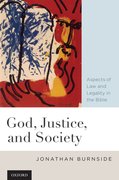
God, Justice, and Society by Burnside
God, Justice, and Society
Aspects of Law and Legality in the Bible
Jonathan Burnside
ISBN: 978-0-19-975921-7
Oxford: Oxford University Press, December 2010
£60.00, Hardback, xl +542pp.
Burnside, professor of Law at Bristol University, takes a legal approach to biblical law in this magisterial work. He adopts a canonical, 'final form' view of the scriptural texts.
English law draws extensively upon biblical law and Burnisde is able to draw out the resonances and parallels. He sees Torah as 'an expanding horizon' - it has a wide range of meanings (p. xxxii)
He characterises biblical law:
Biblical law is 'a journey into wisdom' (p xxxix), this theme is picked up in Chapter 1, where he looks at 'ten top laws' and uses them to draw out the similarities and differences between biblical law, ancient near eastern law and contemporary law. Biblical law is bound up with God's involvement with Israel, it is integral to Israel's vocation it is didactic, relies upon rhetoric and literary art, it is dynamic, relational and an expression of wisdom.
He begins his analysis of biblical law with the concept of covenant, which he describes as the DNA of biblical law. Chapter 2, 'A deal with God', then looks at how covenants were used in the Bible, it takes a synoptic overview. The Sinai event comes under close scrutiny - rightly so. I found the distinction between the old and new covenants illuminating. God does not change , it is the same Torah, the content is the same but what is different is its acceptance and realisation. God's presence is now also extended to all nations and not restricted to Israel.
Chapter 3 looks 'Beyond Sinai'. Here the concept of natural law is examined. He makes a case for natural law in the bible. I have some minor quibbles with this, my concerns may be more than a neo-Calvinst reaction to the term 'natural law'. The term 'natural' raises several questions:
He agrees that natural law means many things to different lawyers/ theologians - a useful table on p. 93 provides examples of its diverse meanings. This prompts the question why use the term? Isn't common grace or creational law better categories and terms to work with?
The book is low on application - how do we apply the laws to today? But perhaps that's another book. It is high on comparison of OT with contemporary law - each time it seems that the OT law is better! Time and again the idea that biblical law emphasises the relational order comes across. For example, in the chapter on Sexual offences, he writes:
There is a 16-page index; 21-page biblical index and a 25-page bibliography - though surprisingly Christopher J H Wright's work is absent.
One oddity is the use of capitals to denote book and journal titles in the footnotes - journal article title are italicised; this took some adjusting to.
This is a book to savour, to return to again and again. There is much rich insight and wisdom. Law has often been neglected, but hopefully this tome will help rectify that situation.Anyone studying OT law will neglect this book at their peril!
A website www.seekjustice.co.uk provides excellent resources to support the book - including a study guide and podcasts.
Aspects of Law and Legality in the Bible
Jonathan Burnside
ISBN: 978-0-19-975921-7
Oxford: Oxford University Press, December 2010
£60.00, Hardback, xl +542pp.
Burnside, professor of Law at Bristol University, takes a legal approach to biblical law in this magisterial work. He adopts a canonical, 'final form' view of the scriptural texts.
English law draws extensively upon biblical law and Burnisde is able to draw out the resonances and parallels. He sees Torah as 'an expanding horizon' - it has a wide range of meanings (p. xxxii)
He characterises biblical law:
as an integration of different instructional genres of the Bible which together express a vision of society ultimately answerable to God. (p. xxxii)
Biblical law is 'a journey into wisdom' (p xxxix), this theme is picked up in Chapter 1, where he looks at 'ten top laws' and uses them to draw out the similarities and differences between biblical law, ancient near eastern law and contemporary law. Biblical law is bound up with God's involvement with Israel, it is integral to Israel's vocation it is didactic, relies upon rhetoric and literary art, it is dynamic, relational and an expression of wisdom.
He begins his analysis of biblical law with the concept of covenant, which he describes as the DNA of biblical law. Chapter 2, 'A deal with God', then looks at how covenants were used in the Bible, it takes a synoptic overview. The Sinai event comes under close scrutiny - rightly so. I found the distinction between the old and new covenants illuminating. God does not change , it is the same Torah, the content is the same but what is different is its acceptance and realisation. God's presence is now also extended to all nations and not restricted to Israel.
Chapter 3 looks 'Beyond Sinai'. Here the concept of natural law is examined. He makes a case for natural law in the bible. I have some minor quibbles with this, my concerns may be more than a neo-Calvinst reaction to the term 'natural law'. The term 'natural' raises several questions:
- What is meant by it?
- Is everything 'natural'? Isn't all created by God?
- How has the fall affected what is perceived of as 'natural'? Could the fall has distorted what we mean by 'natural'? Does sin has no noetic effect?
- Is something that is all-embracing 'natural'?
- What is the relation of 'natural' to revelation? Isn't all (biblical) law revelation?
- Isn't the use of the term 'natural' setting up a dualism of 'natural' and revealed? And yet Burnside claims that he is not (cf p. 79).
He agrees that natural law means many things to different lawyers/ theologians - a useful table on p. 93 provides examples of its diverse meanings. This prompts the question why use the term? Isn't common grace or creational law better categories and terms to work with?
The book is low on application - how do we apply the laws to today? But perhaps that's another book. It is high on comparison of OT with contemporary law - each time it seems that the OT law is better! Time and again the idea that biblical law emphasises the relational order comes across. For example, in the chapter on Sexual offences, he writes:
'Biblical law makes a helpful contribution because it illustrates an alternative developed, integrated model that is based on relational order. This holds the modern, consent-based approach up to the light and poses questions and challenges' p. 376.As such there is an apologetic strand to the book.
There is a 16-page index; 21-page biblical index and a 25-page bibliography - though surprisingly Christopher J H Wright's work is absent.
One oddity is the use of capitals to denote book and journal titles in the footnotes - journal article title are italicised; this took some adjusting to.
This is a book to savour, to return to again and again. There is much rich insight and wisdom. Law has often been neglected, but hopefully this tome will help rectify that situation.Anyone studying OT law will neglect this book at their peril!
A website www.seekjustice.co.uk provides excellent resources to support the book - including a study guide and podcasts.
Friday, 3 February 2012
Augustine on mathematics?
"The good Christian should beware of mathematicians, and all those who make empty prophecies. The danger already exists that the mathematicians have made a covenant with the devil to darken the spirit and to confine man in the bonds of Hell" (St. Augustine, De Genesi ad Litteram, Book II, xviii, 37).
This quote made 'famous' by Morris Kline - it's on the back of the Pelican version of his Mathematics and Western Culture - should read 'astrologers' rather than mathematicians.
A better translation by J. H. Taylor SJ is:
This quote made 'famous' by Morris Kline - it's on the back of the Pelican version of his Mathematics and Western Culture - should read 'astrologers' rather than mathematicians.
A better translation by J. H. Taylor SJ is:
37. Hence, we must admit that when astrologers speak the truth, they are
speaking by a mysterious instinct that moves a man's mind without his
knowing it. When this happens for the purpose of deceiving men, it is the
work of evil spirits. To these spirits some knowledge of the truth about
the temporal order has been granted, partly by reason of their keen and
subtle senses, since they possess bodies of a much more subtle nature than
ours, partly because of their shrewdness due to the experience they have had
over the long ages they have lived, partly because the good angels reveal to
them what they themselves have learnt from Almighty God, at the command of
Him who distributes man's merits by the right principles of His hidden
justice. But sometimes these wicked spirits also feign the power of
divination and foretell what they themselves intend to do. Hence, a devout
Christian must avoid astrologers and all impious soothsayers, especially
when they tell the truth, for fear of leading his soul into error by
consorting with demons and entangling himself with the bonds of such
association.
Subscribe to:
Posts (Atom)