An accidental blog

"If God is sovereign, then his lordship must extend over all of life, and it cannot be restricted to the walls of the church or within the Christian orbit." Abraham Kuyper Common Grace 1.1.

Thursday, 29 June 2023

Findings 5 is now out


Findings 5 - June 2023 - now published.


Contents:

Chris Gousmett. Editorial – Seeking Exemptions from Legislation

Bruce Wearne. Reformational scholarship: current position and prospects

Alan Cameron. Dooyeweerd and Feldenkrais on the Human Body

Léonardo Balena and Ney Maranhão. Faith and sustainability: A Christian Contribution to the Issue of Environmental Preservation

Maaike Eline Harmsen and Gijsbert van den Brink. The Great Filter and Space Exploration: A Dooyeweerdian Response

Bruce Wearne. The Philosophy of the Cosmonomic Idea and the Chapters of Sociology’s 20th Century Story

Chris van Haeften. The Riddle of Reality

https://www.thumbwidthpress.net/product-page/findings-5-june-2023

Tuesday, 27 June 2023

The Evangelical Imagination by Karen Swallow Prior

The Evangelical Imagination: How Stories, Images, and Metaphors Created a Culture in Crisis 


 Karen Swallow Prior

Hi, 304pp, Brazos, 2023 

ISBN 9781587435751


Prior is a reader, writer, and professor of English and Christianity and culture at Southeastern Baptist Theological Seminary. In this  book she draws upon her evangelical background and her academic speciality, to examine evangelical sensibilities. She writes as a critical friend,  and as an insider. As she puts it, “In a way, what follows in these pages is simply my testimony. It is a picture of the evangelical imagination as I have found it over the course of years of researching, studying, reading, worshiping, and living and grappling with my own imagination—what fills it and fuels it.”

In many ways it is an iconoclastic book - in it she shows how evangelical culture has been shaped by Victorian values and ethos as much as it has by biblical ones. Drawing on her academic research she examines Victorian literature:

You will notice a pattern emerging from all this Victorian literature. You will see in both the texts and their surrounding historical contexts qualities strangely similar to many of the defining characteristics of modern American evangelical culture. And by seeing in that literature many of the values and beliefs prominent within American evangelicalism today, you might find yourself wondering whether some of the ideas that characterize today’s evangelical culture are Christian as much as they are Victorian.

She provides an excellent critique, and one that deserves close attention. She ably exposes contemporary evangelicalism’s overemphasis on patriotism, self-improvement, achievement, marketing, business techniques, triumphalism, and consumerism.  Two quotations will serve to illustrate:

Evangelicalism’s infatuation with secular notions of social progress and self-improvement is marked throughout the nineteenth and twentieth centuries. While evangelicals initially opposed nineteenth-century movements that emphasized the possibility that human effort could bring physical healing, mind cures, victory over sin—movements such as New Thought, the Keswick movement, and the Victorious Life—the influence of these popular teachings could not be entirely stemmed: therapeutic culture snaked its way into evangelicalism. Nineteenth-century revivalists such as D. L. Moody and Billy Sunday were among those whose teachings blended evangelicalism with notions of social progress and transformation through personal purity and piety. 

And:

This triumphalist spirit of empire was cultivated on an individual level too. “Do great things for God!” was for a generation (or two) of evangelicals not just an encouragement but an expectation that became a mandate. One younger friend who grew up evangelical told me she had the sense that if she didn’t grow up to do something great or radical, then she would have failed as a Christian.


Components of evangelicalism see examines include: Conversion, Testimony, Improvement, Sentimentality, Materiality, Domesticity, Empire, Reformation, and Rapture. For each one she shows how these are integral to evangelicalism and how each one has been shaped by the Victorian ethos. Her analysis is nuanced and profound. The literature she discusses includes work by well-known authors such as Dickens, Swift, Defoe, Bunyan, Alcott, Hardy along with the currently less popular works including Pamela; or Virtue Rewarded,  by Samuel Richardson. Works of “art” by Thomas Kinkade and Warner Sallman’s Head of Christ are also examined, both as examples of evangelical sentimentality.


In short, The Evangelical Imagination is an engaging, well-written, and thought-provoking read; it may disturb, but it will disturb those that need to be disturbed. Her main concern is that evangelicalism becomes more focused on Jesus and the scriptures rather than exemplify a Victorian ethos.  


Contents
Introduction: Victorians, Evangelicals, and the Invitation
1. Made in His Image
Imagination, Imaginaries, and Evangelicalisms
2. Awakening
Mumford, MLK, Hurston, Hughes, and Other Poets
3. Conversion
Language, Dr. Pepper, and Ebenezer Scrooge
4. Testimony
Grace Abounding and "Evangelically Speaking"
5. Improvement
The Puritan Work Ethic, Paradise Lost, and the Price of Progress
6. Sentimentality
Sweet Jesus, Uncle Tom, and Public Urination
7. Materiality
Jesus in the Window, the Virgin Mary on Grilled Cheese, Gingerbread Houses, and the Sacramentality of Church Space
8. Domesticity
Angels and Castles and Prostitutes, Oh My!
9. Empire
"The White Man's Burden," His Man Friday, the Jesus Nobody Knows, and What Johnny Cash Really Knew
10. Reformation
Pardon Me, Reckoning or Rip Van Winkle?
11. Rapture
Or How a Thief Came in the Night but Left My Chick Tracts Behind


Thursday, 27 April 2023

Concept/mind maps of Bavinck's Personality & Worldview


Review of J.H. Bavinck's Personality and Worldview


 Personality & Worldview

J. H. Bavinck

Translated by James Eglinton

208pp, hbk, 

Crossway Books

ISBN: 978-1-4335-8483-1


J.H. Bavinck (1895–1964) was the nephew of Reformed theologian Herman Bavinck (1854–1921) and a professor of missiology at Kampen Theological School and the Free University of Amsterdam. He had also been a pastor and missionary in Indonesia, so, he was no armchair missiologist. In this book, a translation of Bavinck’s 1928 book Persoonlijkheid en wereldbeschouwing. This was originally a set of lectures for engineering students. The book is thus not overly technical, it is clear, accessible, and straightforward in its approach.

"Worldview" is a concept that is starting to go out of fashion. Keller, in his Foreword, notes some key reasons for this - particularly in North America; it is seen as being: 

Individualistic

Rationalistic

Simplistic 

Triumphalistic

To this, we could add that it has recently lost favour due to concerns about its ambiguity, and connection to Western-centric and imperialist methods of analysing culture and society. Bavinck’s approach provides an important correction to these misconceptions regarding worldviews, not least because Bavinck was fully acquainted with East Asian culture as a pastor. 

By "personality", Bavinck means “an organized soul that has come to consciousness of itself.” 

One of Bavinck’s main theses is the intriguing distinction he makes between a worldview and a worldvision. He maintains that we all have a worldvision but only a few move to a worldview. 

A person without a worldview is a person without a firm foundation, without a compass, without a vista. He may have a worldvision; he might live, for example, as though there are no norms. But such a worldvision proceeds from himself and is rooted in his nature. He cannot pull himself upward on it, and with it he always remains on the same plane. A person with a worldview, in all cases, has light, sees more widely, more broadly, more deeply. And however much deeper and more objective that worldview is, the more it gives him stability to leave this maze of subjective inclinations and climb up to the height of the life that is grounded in the truth.

 Unfortunately, this insight is left largely undeveloped - it would be interesting to trace what mileage this distinction had in Bavinck’s further writings. 

In exploring the relationship between personality and worldview, he notes two positions that must be guarded against: that they are one and that they are utterly different.

In chapter 3 especially, we can see in Bavinck two important neo-Calvinist themes: the distinction between creator and creation, and a disdain for dualism. He makes some important points regarding dualism: it disjoints personality, it means that salvation is only possible through world flight and that it leads to mysticism and asceticism.

Chapter 4 provides some fascinating insights into the distinction between Eastern and Westen thinking and an overview of the impact of the Renaissance on British empiricism particularly. Here he provides a devastating critique of the poverty of empiricism in that it devours itself.

Chapter 5 exposes the problems with rationalism, Descartes, and Spinoza. He makes the interesting point that pantheism is a presupposition of rationalism: “Pantheism is not the conclusion of rationalism, but it is its presupposition. Reason only has such power when it is itself god.” 

Chapters 4 and 5 show that neither empiricism nor rationalism have explored the depths of personality.

Kant attempted to reconcile empiricism and rationalism, but as Chapter 6 shows, this project was unsuccessful. 

Mysticism, a topic Bavinck studied for his doctorate and while he was in Java, comes under scrutiny in Chapter 7. As he observes, mysticism is difficult to define as it is not a single worldview. It is an emphasis on the being of God, and yet he is a formless and utterly other divinity. There is no comfort or salvation in such a god. It results in self-withdrawal from life and groping after eternity. He notes that Christian mysticism is differently focused and maintains the boundary between God and creation.

The final Chapter provides an overview of the main themes. Most people live as if there is no worldview, although it is there in seed form, worldview is the revelation of the personality, although there is often tension between the two. We all need a worldview, as it provides norms, direction, and unity in living. He contrasts two common Western worldviews, atheistic materialism and positive Christianity. Atheistic materialism is never accepted unreservedly, and Christianity, a relationship with the living God, depends not on us but on revelation.

This book is certainly well worth buying. The introduction by Eglington alone is worth the price of the book. 


Foreword by Timothy Keller

Acknowledgments

Editor’s Introduction

Chapter 1: The Struggle for a Worldview

Chapter 2: The Essence of Personality

Chapter 3: The Problem of Unity

Chapter 4: Passive Knowing

Chapter 5: The Power of Reason

Chapter 6: The Reaction of the Conscience

Chapter 7: Mysticism and Revelation

Chapter 8: Personality and Worldview

General Index

Scripture Index


Saturday, 18 February 2023

Abraham Kuyper and some of his critics

 My paper looking at some of Kuyper's critics has now been published:

Bishop, S. (2023). Abraham Kuyper and some of his Critics. Tydskrif Vir Christelike Wetenskap | Journal for Christian Scholarship58(3&4), 57 - 93. Retrieved from https://pubs.ufs.ac.za/index.php/tcw/article/view/785


Wednesday, 1 February 2023

Findings 4 is out

 Findings 4 has now been published - Theme issue on "Theology." 

Available free (PDF) to download from https://www.thumbwidthpress.net/ 

Go to "Shop" to select items.


Contents:

Kerry Hollingsworth: H Evan Runner – The heart of his vision

Chris Gousmett: What is theology?

Jim Skillen: What is public theology?

Raymundo Mendiola: Are we all theologians? Definition and contours of theology

D F M Strauss: How can we talk scientifically about God?

O. C. Broek Roelofs: Popma’s Philosophical Approach to Theology

Chris van Haeften: Divine reality

Alida Leni Sewell: Paul at Athens: An Examination of His Areopagus Address in the Light of its Historical and Philosophical Background

Thursday, 26 January 2023

A Kuyper Book Club - Reading through Pro Rege 3

 KUYPER BOOK CLUB! Kuyper's Pro Rege Vol. 3 


A group are going to read Kuyper's Pro Rege Vol. 3 over the next 6 months (starting Feb). 

Jason of the Laymen's Lounge, has created a Facebook Group so we can throw up quotes, thoughts, questions, etc.

To join use this QR code


The provisional reading plan is:

Feb. 1-5: pp. 1-18

Feb. 6-12: pp. 19-43

Feb. 1319: pp. 44-68

Feb. 20-26: pp. 69-94

Feb. 27-Mar. 5: pp. 95-119

Mar. 6-12: pp. 120-143

Mar. 13-19: pp. 144-167

Mar. 20-26: pp. 168-186

Mar. 27-April 2: pp. 187-215

April 3-9: pp. 216-241

April 10-16: pp. 242-270

April 17-23: pp. 271-288

April 24-30: pp. 289-315

May 1-7: pp. 316-340

May 8-14: pp. 341-364

May 15-21: pp. 365-380

May 22-28: pp. 381-406

May 29-June 4: pp. 407-431

June 5-11: pp. 432-449

June 12-18: pp. 450-467

June 19-25: pp. 468-475

June 26-July 2: pp. 479-480

Thursday, 22 December 2022

Paul Tyson's A Christian Theology of Science


A Christian Theology of Science: Reimagining a theological vision of natural knowledge
Paul Tyson
Baker Academic £17.99
978-1-5409-6551-6


Tyson, a Senior Research Fellow at the Institute for Advanced Studies in the Humanities at the University of Queensland, explores the role of science as the "first truth discourse" in "secular academic modernity." He suggests that science has replaced theology as a first truth discourse. However, this is not always the case - there is a distrust of theology but also a distrust of science - even though during the Covid pandemic we were told: “we are following the science”. Yet there is a distrust not only of scientists but also experts.
Tyson in this book attempts to understand science theologically. He “seeks to presuppose Christian theology as a first truth discourse when thinking about science; it seeks to recover and reimagine the theology of science.” 

We might well as the question: Why a theology of science? Why not a philosophy of science? Isn’t theology just as much an academic discipline as science? 

The book is written in an academic style as so won’t be accessible to the “layperson in the pew”. It presupposes some knowledge at least of philosophy.

There is much in this book that is good - for example, he shows how “modern science is the love child of Christian theology and a devotion to the Creator by means of understanding the wonders of creation.” He shows the false presuppositions that underlie much of the science and religion debate which sees them in conflict. He exposes the reliance of modern science on “three foundational philosophical and methodologically applied commitments: empiricism, rationalism, and physical reductionism”. And the absence of focus on specific scientific results or ideas is the book's most notable flaw. Instead, the book deals with how science affects our thinking. His development of a Christian theological epistemology is to be applauded.

There is a helpful glossary of key terms and a 9-page bibliography.

My thanks to Baker Academic for supplying an ARC.

Friday, 18 November 2022

Justin Bailey’s Interpreting Your World - a review

 Interpreting Your World

Five Lenses for Engaging Theology and Culture

Justin Ariel Bailey

Grand Rapids: Baker Academic, 2022

ISBN-13: 9781540965066


Justin Bailey is an assistant professor at Dordt College. This is a book about culture and theology, a lived-out everyday life. He wrote this book in part “in part because I am troubled by the dismissive tone with which many of my fellow Christians (and particularly my fellow Calvinists) approach culture”. 

 Karl Marx’s eleventh of his Theses on Feuerbach is: “Philosophers have hitherto only interpreted the world in various ways; the point is to change it.” Here Bailey writes on ways to interpret the world but as Marx observes interpretation must move on to engagement and where needed transformation. But then before transformation must come interpretation.

 Culture is an elastic term. Bailey is rightly concerned that we do not adopt a thin view of culture or a reductive view of culture. To avoid that he discusses five lenses or “penta-focal lenses” through which culture can be observed and interpreted. He doesn’t define exactly what he means by culture – perhaps that is deliberate? One of the best definitions is that of Christian philosopher Herman Dooyeweerd – who is surprisingly absent from Bailey’s writings. Dooyeweerd in his Roots of Western Culture describes culture as “… the term culture refers to whatever owes its existence to human formation in contrast to whatever develops in ‘nature’.

 Bailey’s five lenses are:

 1.         The Meaning Dimension: Culture as Immune System

2.         The Power Dimension: Culture as Power Play

3.         The Ethical Dimension: Culture as Moral Boundary

4.         The Religious Dimension: Culture as Sacred Experience

5.         The Aesthetic Dimension: Culture as Poetic Project


For each of the dimensions, he identifies a practice. For the meaning dimension the practice is hosting; for the power dimension the practice is iconoclasm; for the ethical dimension the practice is servant hood; for the religious dimension the practice is discernment; and for the aesthetic dimension the practice is making. These provide constructive and interesting insights into how we respond to, approach, and shape culture. 

He correctly realises that cultural participation must go beyond resistance and critique. It also needs to include the cultivation of beautiful things. And helpfully identifies some “characteristic flaws” in Christians’ approach to culture:

intellectualism (overreliance on analysis), triumphalism (overestimation of our ability to “transform the culture”), and parochialism (underappreciation of the gifts on the outside).

Sadly, these have often marred a distinctly Christian approach. Hopefully, Bailey’s book will go towards helping alleviate these unbiblical traits.

Bailey notes that


I was attracted to the Dutch “Reformational” tradition because of the way it trained me to recognize the multifaceted glory of creation and the beauty of ordinary life. This tradition has trained me to oppose reductionism at every turn.

 And there are obvious echoes of this tradition in what Bailey writes, but, surprisingly, there is no interaction with Dooyeweerd – though Kuyper, Herman and J.H. Bavinck do get some mentions. Dooyeweerd identifies fifteen different modal aspects, and it would have been good to see all of these aspects explored concerning culture. 

 The book is well written and provides some excellent questions for reflection and discussion at the end of each chapter. The appendix also has a set of thought-provoking questions. Even though this book doesn’t have all the answers to Christian cultural interaction it does pose important questions and offers some wisdom into how we approach culture.


My thanks to Baker Academic for supplying an ARC.

Tuesday, 27 September 2022

Christian Atheists?

Christian Atheist: Belonging Without Believing


Brian Mountford


ISBN 978-1-84694-439-0


John Hunt Publishing, 2011


The term Christian Atheist is something of an oxymoron. It could be described as “Christianity - good, God - a bit iffy”. This book was written when Mountford - who by his own admission is a liberal Christian - a Vicar of the University Church, Oxford. It seeks to explore why there are atheists who attend church services and appreciate Christian aesthetics, liturgy, values, morals and so forth without any belief in God. This is an interesting phenomenon that Mountford explores through interviews. Unfortunately, the “research” method is flawed as it is based on opportunity sampling - he interviews those he knows. Nevertheless, he makes some interesting points based on the interviews he has conducted. All those interviewed are “Anglican” in disposition, so the book might better be titled Anglican Atheists. It would be interesting to do a much broader study of those in different denominations. Could there be Calvinist Atheists?


Friday, 2 September 2022

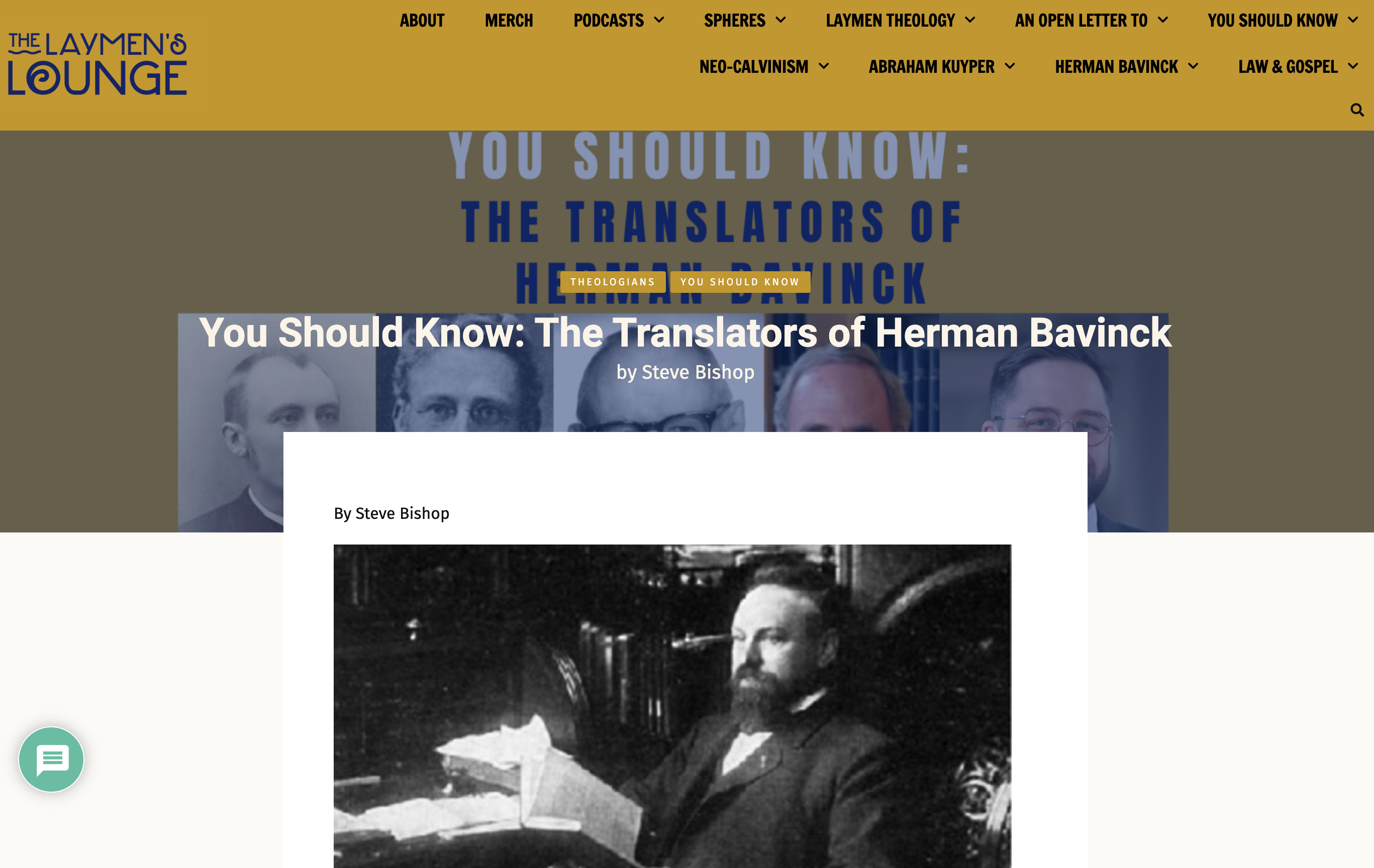
The translators of Herman Bavinck

My piece on "You should know: the translators of Bavinck" is now on line at the Laymen's Lounge


Have I missed anyone?

What needs to be translated into English by Bavink?

Saturday, 27 August 2022

Thursday, 25 August 2022

Neo-Calvinist doctoral theses: On Vollenhoven, on Dooyeweerd, & on Schilder

Theses on Vollenhoven


Garrood, A. P. 1982 Forming Karl Marx's Philosophical Conception: A Transcendental Argument Concerning D. H. T. Vollenhoven's Christian Philosophy University of Kent.
Ive, Jeremy 2012 A Critically Comparative Kuyperian Analysis and A Trinitarian, 'Perichoretic' Reconstruction of The Reformational Philosophies of Dirk H. Th. Vollenhoven And Herman Dooyeweerd King's College London.
Kok, John Henry 1992 Vollenhoven: His Early Development VU Amsterdam.
Tol, A. 2010 Philosophy In the Making: D. H. Th. Vollenhoven And The Emergence Of Reformed Philosophy, Together With The Text-Critical Edition Of His Isagoge Philosophiae. VU Amsterdam.


Theses on Dooyeweerd


Brümmer, Vincent 1961 Transcendental Criticism and Christian Philosophy: A Presentation and Evaluation of Herman Dooyeweerd's "Philosophy of The Cosmonomic Idea." Stellenbosch
Chaplin, Jonathan 1993 Pluralism, Society and the State: the neo-Calvinist Political Theory of Herman Dooyeweerd (1894-1977). London School of Economics
Choi, Yong-Joon 1999 Dialogue and Antithesis: A Study of Dooyeweerd's Critique of Culture Potchefstroom University for Christian Higher Education.
Clouser, Roy A. 1972 Transcendental Critique, Ontological Reduction and Religious Belief in The Philosophy Of Herman Dooyeweerd University of Pennsylvania
Conradie, A.L. 1957 The Neo-Calvinistic Concept of Philosophy with Special Reference To H. Dooyeweerd: A Study In The Problem Of Philosophic Communication University of Cape Town
Henderson, Roger D. 1994.     Illuminating Law: The Construction of Herman Dooyeweerd's Philosophy 1918-1928.     VU Amsterdam.
Marcel, Pierre 1956 Translated and published as: The Christian Philosophy of Herman Dooyeweerd Vol 1 And 2 (Wordbridge, 2013). The Original Was in French Montpellier
Skillen, James 1973 The Development of Calvinistic Political Theory in the Netherlands with Special Reference to the Thought of Herman Dooyeweerd Duke University
Steen, Peter 1970 The Idea of Religious Transcendence in The Philosophy of Herman Dooyeweerd, With Reference To Its Significance For Reformed Theology WTS
Verburg, Marcel E. 1989 Translated and published as: Herman Dooyeweerd: The Life and Work of a Christian Philosopher (Paideia, 2015) VU Amsterdam
Young, William 1943 The Development of a Protestant Philosophy in Dutch Calvinist Thought Since the Time Of Abraham Kuyper. 
Union Theological


Utilising Dooyeweerd

Aiyenitaju, O. T. 2017 Understanding ICT Classroom Issues Encountered by Teachers: The Application Of Dooyeweerd's Philosophy University of Salford
Berenyi, Robert Otto 2001 The Conservation of Buildings: A Philosophical Examination University of Salford.
De Luliis, Manila 2010 A Dooyeweerdian Approach to Time In Sustainable Development University of Salford.
Joneidy, S. 2015 Making Sense of The Information Systems Use Field University of Salford.
Jones, Gareth Owen 2007 Dooyeweerdian Philosophy, Knowledge-Based Systems, And Sustainability University of Salford.
Kane, Suzanne Colette 2005 Multi-Aspectual Interview Technique (M.A.I.T.) University of Salford
Khojah, Ghadah M. A 2018 Using Dooyeweerd's Aspects to Understand Down To Earth Issues In Use Of Medical Records University of Salford
Kimani, A. G. 2017 A New Framework for Defining, Identifying and Explicating Tacit Knowledge: Qualitative Research Using Aspectual Analysis on SMEs University of Salford
Lombardi, Patrizia Lucia 1999 Understanding Sustainability in the Built Environment: A Framework For Evaluation In Urban Planning And Design University of Salford.
McGibbon, S. 2018 Towards An Aspectual Conception of Trust University of Salford
Winfield, Michael James 2000 Multi-Aspectual Knowledge Elicitation University of Salford

Theses on Schilder


De Jong, A. C. 1954.  The Well-Meant Gospel Offer: The Views of H. Hoeksema and K. 
Schilder. Franeker: T. Wever.
DeJong, Jackobus 1990 Accommodatio Dei: A Theme in K. Schilder's Theology of Revelation, (Kampen: Mondiss, 1990). TU Kampen
Douma, Jochem 2017. Common Grace in Kuyper, Schilder, and Calvin: Exposition, 
Comparison, and Evaluation.  Hamilton: Lucerna, 2017.
De Jong, Marinus 2019 The church is the means, the world is the end: the development of Klaas Schilder's thought on the relationship between the church and the world. TU Kampen


Tuesday, 23 August 2022

Abraham Kuyper and evolution

 My article on Kuyper and evolution has now been published:


Bishop, S., 2022. Abraham Kuyper and evolution. KOERS — Bulletin for Christian Scholarship, 87(1). Available at: https://doi.org/10.19108/KOERS.87.1.2510


Monday, 22 August 2022

Doctoral Theses on Abraham Kuyper

 Here are some of the doctoral dissertation on Kuyper

In English


Bacote, Vincent 2002 The role of the Holy Spirit in creation and history with special reference to Abraham Kuyper Drew University. 

Campbell-Jack, Walter Campbell 1992 Grace without Christ? The doctrine of common grace in Dutch-American neo-Calvinism University of Edinburgh.

Casey, Ramon J. 1988 Abraham Kuyper’s Political Worldview Regent University, Virginia.

Chiu, Agnes S.  2016.   Common Grace and Common Good For China: An Exposition Of Abraham Kuyper And Leo Xiii On Labor Struggles In Twenty-First Century China Fuller Theological Seminary.

Dagley, Logan  2018 The Missional Church As An Institution And Organism: How Abraham Kuyper’s Ecclesiological Distinction Clarifies The Church’s Mission In Relation To Selected Contemporary Missiological Challenges. Southeastern Baptist Theological Seminary. 

Duk, Kwang 1999 Ecclesiology and social ethics: A comparative study of the social and ethical role of the Church in the views of Abraham Kuyper and Stanley Hauerwas Kampen.

Douma, Jochem   1966   Common Grace in Kuyper, Schilder, and Calvin: Exposition, Comparison, and Evaluation.    Lucerna: Crts Publications, 2017.

Greeson, Dennis 2021 Common Grace, Providence, and the Saeculum: Abraham Kuyper’s Theology of Culture Revisited. Southeastern Baptist Theological Seminary

Harefa, Surya Hadianto 2020 A free church in a free state: the possibilities of Abraham Kuyper's ecclesiology for Japanese evangelical Christians. Kampen. 

Heslam, Peter S. 1993 Abraham Kuyper’s lectures on Calvinism: an historical study Oxford University Published as Creating a Christian Worldview, Paternoster, 1998.

Himes, Brant Micah 2015. For a better worldliness: The theological discipleship of Abraham Kuyper and Dietrich Bonhoeffer. Fuller Theological Seminary, Center for Advanced Theological Study. 

Jones, Timothy 2022 Saving Common Grace: Kuyper and Present Possibilities for Public Theology in the UK.   King’s College London.

Kaemingk, Matthew 2013 “Mecca and Amsterdam: Christian Ethics between Islam and Liberalism Vrije Universiteit and Fuller Seminary. 

Kobes, Wayne A. 1993 Sphere sovereignty and the university: theological foundations of Abraham Kuyper’s view of the university and its role in society Florida State University.

Langley, McKendree R. 1995. Emancipation and apologetics: the formation of Abraham Kuyper’s Anti-Revolutionary Party in the Netherlands, 1872–1880 Westminster Theological Seminary.

Naylor, Wendy Fish 2006 Abraham Kuyper and the emergence of neo-calvinist pluralism in the Dutch school struggle University of Chicago.

Park, Jae-Eun              2016 Driven By God: Active Justification and Definitive Sanctification in the Soteriology of Bavinck, Comrie, Witsius, and Kuyper. Calvin Theological Seminary. Published by V&R, 2018.

Porter, Jacob         2011 Abraham Kuyper’s Sphere Sovereignty: Theological Comparisons And Application To Poverty. Southern Baptist Theological Seminary 

Prideaux, Louise 2020 Approaching the Complex, Cultural Other: Towards a Renewal of Christian Cultural Engagement in the Reformed Tradition University of Exeter.

Rooy, Sidney H. 1956 Kuyper vs. Warfield: an historical approach to the nature of apologetics. Union Theological Seminary.

Un, Steven A.   2020 Theology of the Public Sphere: An Interpretation of the Philosophy of Hannah Arendt and Jürgen Habermas from the Perspective of the Theology of Abraham Kuyper with Implications for Public Theology and the Indonesian Context. VU Amsterdam.

Van Heukelom, Raymond R. 1952/53 Abraham Kuyper's view of the function of the church in the world. Northern Baptist.

Wagenman, M.R. 2017. The Power of The Church: The Ecclesiology of Abraham Kuyper. Bristol University and Trinity College. Published by Pickwick Publications, 2020.

Westra, John 1972 Confessional political parties in the Netherlands, 1813–1949 University of Michigan. 

Wood, John Halsey, Jr. 2010 Going Dutch in the modern age: Abraham Kuyper’s struggle for a free church in the nineteenth-century Netherlands. Published by Oxford University Press, 2013.

Young, William 1943. The development of a Protestant philosophy in Dutch Calvinist thought since the time of Abraham Kuyper. Union Theological.

In chronological order

Young, William 1943 The development of a Protestant philosophy in Dutch Calvinist thought since the time of Abraham Kuyper. Union Theological.

Van Heukelom, Raymond R. 1952/53 Abraham Kuyper's view of the function of the church in the world. Northern Baptist.

Rooy, Sidney H. 1956 Kuyper vs. Warfield: an historical approach to the nature of apologetics. Union Theological Seminary.

Douma, Jochem   1966   Common Grace in Kuyper, Schilder, and Calvin: Exposition, Comparison, and Evaluation.    Lucerna: Crts Publications, 2017.

Westra, John 1972 Confessional political parties in the Netherlands, 1813–1949. University of Michigan. 

Casey, Ramon J. 1988 Abraham Kuyper’s Political Worldview Regent University, Virginia.

Campbell-Jack, Walter Campbell 1992 Grace without Christ? The doctrine of common grace in Dutch-American neo-Calvinism University of Edinburgh.

Heslam, Peter S. 1993 Abraham Kuyper’s lectures on Calvinism: an historical study Oxford University.

Kobes, Wayne A. 1993 Sphere sovereignty and the university: theological foundations of Abraham Kuyper’s view of the university and its role in society Florida State University.

Langley, McKendree R. 1995 Emancipation and apologetics: the formation of Abraham Kuyper’s Anti-Revolutionary Party in the Netherlands, 1872–1880 Westminster Theological Seminary.

Duk, Kwang 1999 Ecclesiology and social ethics: A comparative study of the social and ethical role of the Church in the views of Abraham Kuyper and Stanley Hauerwas Kampen.

Bacote, Vincent 2002 The role of the Holy Spirit in creation and history with special reference to Abraham Kuyper Drew University. 

Naylor, Wendy Fish 2006 Abraham Kuyper and the emergence of neo-calvinist pluralism in the Dutch school struggle University of Chicago.

Wood, John Halsey, Jr. 2010 Going Dutch in the modern age: Abraham Kuyper’s struggle for a free church in the nineteenth-century Netherlands. Published by Oxford University Press, 2013.

Porter, Jacob 2011 Abraham Kuyper’s Sphere Sovereignty: Theological Comparisons And Application To Poverty. Southern Baptist Theological Seminary. 

Kaemingk, Matthew 2013 “Mecca and Amsterdam: Christian Ethics between Islam and Liberalism Vrije Universiteit and Fuller Seminary. 

Himes, Brant Micah 2015 For a better worldliness: The theological discipleship of Abraham Kuyper and Dietrich Bonhoeffer. Fuller Theological Seminary, Center for Advanced Theological Study. 

Himes, Brant Micah. 2015 For a Better Worldliness: The theological discipleship of Abraham Kuyper and Dietrich Bonhoeffer. PhD Thesis Fuller Theological Seminary, Center for Advanced Theological Study. Published by Wipf & Stock.

Chiu, Agnes S. 2016 Common Grace and Common Good For China: An Exposition Of Abraham Kuyper And Leo Xiii On Labor Struggles In Twenty-First Century China Fuller Theological Seminary

Park, Jae-Eun 2016 Driven By God: Active Justification and Definitive Sanctification in the Soteriology of Bavinck, Comrie, Witsius, and Kuyper.

Wagenman, M. 2017 The Power of The Church: The Ecclesiology of Abraham Kuyper. Bristol University and Trinity College. Published by Pickwick Publications, 2020.

Dagley, Logan  2018 The Missional Church As An Institution And Organism: How Abraham Kuyper’s Ecclesiological Distinction Clarifies The Church’s Mission In Relation To Selected Contemporary Missiological Challenges. Southeastern Baptist Theological Seminary. 

Harefa, Surya Hadianto 2020 A free church in a free state: the possibilities of Abraham Kuyper's ecclesiology for Japanese evangelical Christians. Kampen. 

Prideaux, Louise 2020 Approaching the Complex, Cultural Other: Towards a Renewal of Christian Cultural Engagement in the Reformed Tradition University of Exeter.

Un, Steven A. 2020 Theology of the Public Sphere: An Interpretation of the Philosophy of Hannah Arendt and Jürgen Habermas from the Perspective of the Theology of Abraham Kuyper with Implications for Public Theology and the Indonesian Context VU Amsterdam

Greeson, Dennis 2021 Common Grace, Providence, and the Saeculum: Abraham Kuyper’s Theology of Culture Revisited. Southeastern Baptist Theological Seminary

Jones, Timothy 2022 Saving Common Grace: Kuyper and Present Possibilities for Public Theology in the UK. King’s College London.


Non-English theses (thanks to Marinus de Jong @jmarinusdejong) and George Harinck


Praamsma, Louis          1945 Abraham Kuyper als kerk historicus. Kampen Ridderbos, Simon Jan 1947. De theologische cultuurbeschouwing van Abraham Kuyper Kampen Dengerink, Jan Dirk      1948. Critisch-historisch onderzoek naar de sociologische ontwikkeling van het beginsel der "souvereiniteit in eigen kring" Kampen. de Ru, Cornelis              1953. De strijd over het hoger onderwijs tijdens het ministerie-Kuyper, Kampen Velema, Willem H.         1957. De leer van de Heilige Geest bij Abraham Kuyper, ‘s-Gravenhage. Sutarno [Boedisoesetya, Soetarno] 1970. Het kuyperiaanse model van een christelijke politieke organisatie, Baarn.
Douma, Jochem              1966.   Algemene Genade
van Keulen, Dirk 2003. Bijbel en dogmatiek: schriftbeschouwing en schriftgebruik in het dogmatisch werk van A. Kuyper, H. Bavinck en G.C. Berkouwer (2003)


Additions courtesy of @EricSungminKong Vogel, Leroy. Die Politischen Ideen Abraham Kuypers und seine Entwicklung als Staatsmann. Würzburg: Mayr, 1937. [PhD diss., Heidelberg University, 1937. 108 pages]
Kasteel, Petrus Albertus. “Abraham Kuyper.” PhD diss., Katholieke Universiteit Leuven, 1938.
Leeuwen, Petrus Antonius van. Het kerkbegrip in de theologie van Abraham Kuyper. Franeker: Wever, 1946. [PhD diss., Roomsch Katholieke Universiteit Nijmegen, 270 pages]
Langman, Harm Jan. Kuyper en de Volkskerk: Een Dogmatisch-ecclesiologische Studie. Kampen: Kok, 1950. [PhD diss., University of Groningen, 1950. 294 pages]
Rosenboom, Enno Edzard. “Die Idee einer Christlichen Universität im Theologischen Denken von Abraham Kuyper.” PhD diss., University of Göttingen, 1950. [219 pages + Endnotes 107 pages]
Voerman, Jan. “Het Conflict Kuyper-Heemskerk.” ThD diss., Rijksuniversiteit te Utrecht, 1954. [134 pages]
Treurnicht, Andries Petrus. “Die Verhouding van die Staat tot die Kerk by dr. Abraham Kuyper, 1843-1920.” PhD diss., University of Cape Town, 1956.
Rooyen, Jan Hendrik Petrus van. Kerk en Staat: 'n Vergelyking tussen Kuyper en van Ruler. Groningen: V. R. B. Kleine, 1964. [ThD diss., Rijksuniversiteit te Utrecht, 1964. 372 pages]
Weringh, Jacobus van. Het Maatschappijbeeld van Abraham Kuyper. Assen: Van Gorcum, 1967. [PhD diss., University of Groningen, 1967.]
Koppen, Christiaan Anthonius Jozef van. Abraham Kuyper en Zuid-Afrika: Noten. Bunnik: [s.n.], 1981. [ThD diss., Rijksuniversiteit te Utrecht, 1981. 273 pages] ———. De Geuzen van de Negentiende Eeuw: Abraham Kuyper en Zuid-Afrika. Wormer: Inmerc, 1992. [320 pages]
Petersen, C. J. “Verbreek die Kettings!: 'n Analities Barthiaans-Marxistiese Religiekritiek op die Teologiese Model van Abraham Kuyper.” PhD diss., PThU., 1982. [84 pages]
Langbroek, C. Een Onderzoek naar de Laïkale Vakken binnen de Diakonologische Groep bij Abraham Kuyper en Enkele Volgelingen. Veenendaal: [s.n.], 1983. [PhD diss., Apeldoorn ThU CGK, 1983]
Koornhof, Johannes J. E. “Woord en Heil: die Woord as Heilsmiddel in die Teologie van Abraham Kuyper.” ThD diss., University of Stellenbosch, 1985. [ix, 380 pages]
Olivier, Mieder Johannes Palm. 'n Kritiese Bespreking van die Eskatologie van Abraham Kuyper. Potchefstroom: [s.n.], 1986. [PhD diss., Universiteit van die Witwatersrand, Johannesburg, 1986. 344 pages]
Schaeffer, Johannes Christianus. “De Plaats van Abraham Kuyper in ‘De Vrije Kerk’.” PhD diss., Apeldoorn ThU CGK, 1994. [170 pages] ———. De Plaats van Abraham Kuyper in "De Vrije Kerk”. Amsterdam: Buijten & Schipperheijn, 1997. [219 pages]
Janssens, Rienk. “De Opbouw van de Antirevolutionaire Partij 1850-1888.” PhD diss., VU Amsterdam, 2001. [411 pages]
Baarssen, Dirk. Sporen van Comries rechtvaardigingsleer. Apeldoorn: Labarum Academic, 2021. [PhD diss., VU Amsterdam, 2021. Supervisor: W. van Vlastuin, Co-supervisor: A. Goudriaan. About A. Kuyper, H. Bavinck, A. G. Honig, A. Kuyper, Jr. G. C. Berkouwer, CGK, G. Bond(NHK), G. Gemeenten, G. Gemeenten in Nederland]


Friday, 19 August 2022

Doctoral Theses on Herman Bavinck

 Recent years have seen an increase in interest in the work of Herman Bavinck. One indicator of this is the number of doctoral theses written on Bavinck. 


Jaarsma, Cornelius R.     1935            The Educational Philosophy of Herman Bavinck. Published by Eerdmans, 1935.
Hoekema, A. A.         1953     Bavinck’s Doctrine of the Covenant. Princeton Theological Seminary.
Kruithof, B                 1955     Relaxation of Christianity and culture in the teaching of Herman Bavinck. University of Edinburgh.
Heideman, Eugene. 1959     The Relation of Revelation and Reason: E. Brunner and H. Bavinck. Assen: Van Gorcum, 1959. 
Bolt, John.                 1982     The Imitation of Christ Theme in the Cultural-Ethical Ideal of Herman Bavinck. Published as A Theological Analysis of Herman Bavinck’s Two Essays on the Imitatio Christi. Lewiston, NY: Edwin Mellen Press, 2013. 
Heilema, Syd.          1998     Herman Bavinck’s Eschatological Understanding of Redemption. Toronto School of Theology. 
Gleason, Ron                 2001     The Centrality of the Unio Mystica in the Theology of Herman Bavinck. Westminster Theological Seminary.
Van den Belt, Henk 2006     The Authority of Scripture in Reformed Theology: Truth and Trust. Studies in Reformed Theology. University of Leiden. Published by Brill, 2008.
Hans Burger,                 2008     Being in Christ: A biblical and systematic investigation in a reformed perspective. Published by Wipf & Stock
Mattson, Brian.         2008     Restored to Our Destiny: Eschatology & the Image of God in Herman Bavinck's Reformed Dogmatics. University of Aberdeen. Published by Brill, 2011. 
Eglinton, James.         2010     Trinity and Organism: Towards a New Reading of Herman Bavinck's Organic Motif. The University of Edinburgh. Published by Bloomsbury T&T Clark, 2012. 
De Wit, Willem J.         2011     On the Way to the Living God: A Cathartic Reading of Herman Bavinck and An Invitation to Overcome the Plausibility Crisis of Christianity. Amsterdam: VU University.
Price, Timothy S.         2013     Pedagogy as Theological Praxis : Martin Luther and Herman Bavinck as sources for engagement with classical education and the liberal arts tradition.  University of Aberdeen.
Huttinga, Wolter          2014     Participation and Communicability: Herman Bavinck and John Milbank on the Relation Between God and the World. Amsterdam: Buijten en Schipperheijn Motief.
Chiew, S. S.                2015 You Know It Completely: The Concept of Middle Knowledge and Biblical Interpretation in Luis de Molina, Herman Bavinck, and William Lane Craig. Vrije Universiteit Amsterdam
Park, Jae-Eun                 2016.        Driven By God: Active Justification and Definitive Sanctification in the Soteriology of Bavinck, Comrie, Witsius, and Kuyper. Calvin Theological Seminary. Published by V&R, 2018.
Brock, Cory.                 2018     Orthodox yet Modern: Herman Bavinck’s Use of Friedrich Schleiermacher. The University of Edinburgh. Published by WA: Lexham, 2020. 
Sutanto, N. Gray         2018     Organic Knowing: The Theological Epistemology of Herman Bavinck.  dissertation, The University of Edinburgh. Published by T&T Clark, 2020.
Bintsarovskyi, Dmytro 2019     God Hidden and Revealed: A Reformed and an Eastern Orthodox Perspective. Published by Lexham Press, 2021
Joustra, Jessica         2019     Following the Way of Jesus: Herman Bavinck and John Howard Yoder in Dialogue on the Imitation of Christ. Fuller Theological Seminary. 
Pass, Bruce                  2019     ‘The Heart of Dogmatics’: The Place and Purpose of Christology in the Theological Method of Herman Bavinck. The University of Edinburgh. Published by Bril.
Tae, Dong-Yaul.             2019          Human Freedom and the invisible Church From the Viewpoint of Bavinck's Pneumatology. Calvin Theological Seminary.
Doornbos, Gayle            2019          Herman Bavinck’s Trinitarian Theology: The Ontological, Cosmological, and Soteriological Dimensions of the Doctrine of the Trinity. University of St Michael's College, Toronto.
Ximian Xu                 2020     Theology as the Wetenschap of God: Herman Bavinck's scientific theology for the modern world. The University of Edinburgh.
Changjun Choi         2021     Herman Bavinck and John Calvin on The Doctrines of the Trinity and the Image Of God: A Comparison. Theologische Universiteit Apeldoorn.
Clausing, Cameron 2021     ‘Christian dogmatic does not yet exist': the influence of the nineteenth century Historical Turn on the theological methodology of Herman Bavinck. University of Edinburgh. 
Kim, Eundeuk               2021          Herman Bavinck as a public theologian Calvin Theological Seminary.
Bertrand Rickenbacher 2021 Towards a Realist Conception of Theology: An Argument Based on the Works of Bavinck and Plantinga VU Amsterdam.
Parker, Gregory Jr.         2022     Theological Thinking and Loving: Dogmatics and Ethics in the Theology of Herman Bavinck. University of Edinburgh.
Schrock, Daniel.   2022. “The Internal Word Is the Principal Word:” the Work of the Spirit in Herman Bavinck’s Theological Epistemology Westminster Theological Seminary PhD Thesis.

Updates

Torseth, Robb. 2023.“Word-to-Word: A Constructive Account of Speech between God and Humanity in the Theologies of Herman Bavinck and John Webster,” August 8, 2023. University of Edinburgh. https://doi.org/10.7488/era/3608.

Leiva, Guerrero, and Israel José. 2023. “Piety in the Theology of Herman Bavinck: Trinitarian, Covenantal and Holistic,” December 1, 2023. University of Edinburgh. https://doi.org/10.7488/era/3986.


Other language theses include:


Bremmer, R. H.        1961              Herman Bavinck en zijn tijdgenoten. Kampen
Veenhof, Jan       1968  Revelatie en Inspiratie: De Openbarings- en Schriftbeschouwing van Herman Bavinck in vergelijking met die der ethische theologie. Amsterdam: Buijten & Schipperheijn.
van Keulen, Dirk         2003. Bijbel en dogmatiek. Schriftleer en schriftgebruik bij A. Kuyper, H. Bavinck en G.C. Berkouwer. Vrije Universiteit Amsterdam.
Strebel, Henniel  2014. Eine Theologie des Lernens: Systematisch-theologische Beiträge aus dem Werk von Herman Bavinck [A theology of learning: systematic-theological contributions from the work of Herman Bavinck] (Bonn: VKW, 2014).
Goedvree, A.                 2018     Een ondoordringbaar mysteries: wedergeboorte volgens Herman Bavinck. Protestantse Theologische Universiteit.