This will be brilliant!

https://wordbridge.net/books/van-dyke/the-legacy-of-abraham-kuyper


"If God is sovereign, then his lordship must extend over all of life, and it cannot be restricted to the walls of the church or within the Christian orbit." Abraham Kuyper Common Grace 1.1.
My paper on Gordon Spykman has now been published:
Bishop, Steve (2024) "Everything Matters: Gordon Spykman - A Neo-Calvinist Theologian," Pro Rege: Vol. 52: No. 3, 1 - 15.
Available at: https://digitalcollections.dordt.edu/pro_rege/vol52/iss3/1

Herman Bavinck from The Problem of War:
But it is all the more striking that Christianity is devoid of all asceticism and from its very beginning took on a positive relationship to the world at large. This fact is principally found in the statement that God loved the world and that Christ came not to destroy the world but to save it. From this focal point lines are drawn in all directions to indicate the place Christians are to occupy and the attitudes they are to have in this sinful world. They must not withdraw from the world, but being in the world they are to keep themselves from the evil one. Nothing is unclean of itself. All God's creation is good and nothing is to be rejected if it be accepted with thanksgiving. Marriage is honorable among all. The government is God's servant and is entitled to obedience and respect. Whoever becomes a Christian is to remain in the calling to which he was called. The prayer of Jesus' disciples is that God's name be hallowed, that His kingdom come, that His will be done on earth as it is in Heaven. All this points, not to an avoidance, but to a sanctification of the world.
Translated by Stephen Voorwinde. The Banner of Truth (July-August 1977): 46–53.
Yeadon, M. & Roques, M., 2023. Mr Dooyeweerd, Modal Aspects and Dynamic Evangelism. KOERS — Bulletin for Christian Scholarship, 88(1). Available at: https://doi. org/10.19108/KOERS.88.1.2528

The term neo-Calvinism is becoming more and more popular as this ngram of the number of usages of the term in books in the Google database shows:

The earliest known use of the noun neo-Calvinism is in the 1850s according to the Oxford English Dictionary. It suggests that it stems from 1854, in the writing of J. Guthrie.
The reference it gives is J. Guthrie in Evang. Union Worthies
The Revd John Guthrie had died in 1839, so the article is a brief biography of him, not by him as the OED suggests.
I couldn’t find an 1854 version, but the 1883 The Worthies of the Evangelical Union Being the Lives and Labours of Deceased Evangelical Union Ministers; Illustrated with Portraits has this:

However, the first mention cannot have been in 1883 as a paper by a Mr Rutherford with the title “Calvinism and Neo-Calvinism, or the Divine intention in the Atonement” is mentioned.
This is from The Evangelical Repository - Volumes 1-2 - Page 106 published in 1855. Presumably by a Mr Guthrie.

This, of course pre-dates Kuyper and how the term is used today. The first mention of the term applying to the approach of Kuyper and Bavinck et al appears to be in an 1887 review of Wilhelm Geesink’s Calvinisten in Holland by by J. Reitsma (George Harinck, “Herman Bavinck and the Neo-Calvinist Concept of the French Revolution,” in James Eglinton and George Harinck (eds) Neo-Calvinism and French Revolution (London: Bloomsbury, 2016), 21 fn 43. The term originally had negative connotations, but Anne Anema (1872-1966) used it as a convenient term to describe the movement and the term stuck. (Anne Anema, Calvinisme en rechtswetenschap: een studie (Amsterdam, 1897), p. xvi.)


A fantastic new resource for GCSE RE and Philosophy, and foryouth workers
https://thinkfaith.net/windows/

The pack comprises:
• Six short story films (about five minutes each) exploring worldviews
https://youtube.com/playlist?list=PLfgTxb7HTGsXSPTyZNTGWiD6Bw4-o2Uj-
• Six accompanying ‘Boffin Slots’: explanatory videos (about five minutes each) opening up
philosophical thinkers and roots of commonly held beliefs where teacher, philosopher and author Mark Roques plays ‘professor’ - undergirding the learning points in the story films
https://youtube.com/playlist?list=PLfgTxb7HTGsVGzrgMmZMHDLH9EY8dM1gs

https://doi.org/10.19108/KOERS.88.1.2554
Articles and books discussed include:
Beck, Michael and Falconer, Robert 2022. Toward a Substructural Cartography of Reformed Cultural Engagement: Key Areas in Confessional Reformed and Covenantal Thought. The South African Baptist Journal of Theology (2022):153-181.
Bishop, Steve 2022a. Abraham Kuyper’s Critics. Tydskrif vir Christelike Wetenskap/Journal for Christian Scholarship 58(3&4), 57 - 93. Retrieved from https://pubs.ufs.ac.za/index.php/tcw/article/view/785.
Bishop, Steve 2022b. Abraham Kuyper and evolution. Koers - Bulletin for Christian Scholarship 87(1) https://doi.org/10.19108/KOERS.87.1.2510.
Harefa, Surya 2022. “The State of Neo-Calvinism in Japan”.
Online: https://thelaymenslounge.com/the-state-of-neo-calvinism-japan/
Intan, B.F. 2022, Kuyper’s Sphere Sovereignty and the Restriction on Building Worship Places in Indonesia. HTS Teologiese Studies/ Theological Studies 78(1), a7309. https://doi.org/10.4102/hts. v78i1.7309.
Joustra J.R. and Joustra R.J. 2022 Calvinism for a Secular Age: A Twenty-First-Century Reading of Abraham Kuyper’s Stone Lectures. Downers Grove: IVP.
Kristanto, David 2022. Sovereignty of God and Religious Tolerance: A Kuyperian Perspective. Advances in Social Science, Education and Humanities Research 669:124-127. https://doi.org/10.2991/ assehr.k.220702.029.
Kuyper, Abraham 2022. On Charity and Justice. Abraham Kuyper Collected Works in Public Theology. Bellingham, WA: Lexham Press.
Li, Jin (李晋) 2022. Meaning, Objectivity and Universality: Bavinck and Pannenberg on History and Revelation. Journal of Chinese Theology 8(2): 220–249. https://doi.org/10.1163/27726606-20220011.
McIlhenny, Ryan 2022. Contact and Conflict: Integral Experience in Classical Chinese and Reformational Philosophies. Journal of Chinese Theology 8(2): 186–219. https://doi.org/10.1163/27726606-20220012.
Pass, Bruce 2022. Review of Common Grace by Abraham Kuyper. Journal of Reformed Theology 16(1- 2):164-165. https://brill.com/view/journals/jrt/16/1-2/article-p164_16.xml
Salurante, Tony, Kristanto, David, Malik, Malik, Bora, Lewi Nataniel, and Nelly, Nelly 2022. A Virtual Sacred Space Some Theological Considerations. Advances in Social Science, Education and Humanities Research 645:144-148. https://doi.org/10.2991/assehr.k.220207.023.
Schilder, Klaas 2022. Schilder Reader: The Essential Theological Writing. G. Harinck, M. de Jong, and R. Mouw (ed.). Bellingham, WA: Lexham Press.
Sidharta, Leonard (戴永富) 2022. How to Make Athens Closer to Jerusalem: Construing a Neo-Calvinist Model of the Relationship between Philosophy and Theology. Journal of Chinese Theology 8(2): 135– 162. https://brill.com/view/journals/jct/8/2/article-p135_2.xml
Tseng, Shao Kai (曾劭愷) 2022. Editorial. Journal of Chinese Theology 8(2): 129–134. https://brill.com/view/ journals/jct/8/2/article-p129_1.xml
Un, A. S. 2022. Ideological Uniformity and Political Integralism in Europe and Indonesia: A Kuyperian Critique. Philosophia Reformata 87(2), 129-150. https://doi.org/10.1163/23528230-bja10049.
Vásárhelyi Bálint Márk 2022. Common Grace in Abraham Kuyper’s Lectures on Calvinism. British Reformed Journal 71: 14-24.
Wisse, Maarten 2022. Holy Supper: Retrieving Abraham Kuyper. In Reinventing Christian Doctrine: Retrieving the Law-Gospel Distinction. London: T&T Clark, 2022. 165–184. https://www.bloomsburycollections. com/book/reinventing-christian-doctrine-retrieving-the-law-gospel-distinction/ch8-holy-supper- retrieving-abraham-kuyper
Xu, Ximian 2022. How to Make Sino-Reformed Theology Possible? Retrieving Abraham Kuyper’s Proto-Reformed Contextual Theology. Journal of Chinese Theology 8(2): 163–185. https://doi. org/10.1163/27726606-20220010.
This Earthly Life Matters: The Promise of Arnold A. van Ruler for Ecotheology
Arnold Van Ruler
Ernst M. Conradie (Editor), Dirk van Keulen (Introduction), Douglas G. Lawrie (Translator)
Pickwick Publications, 2023, 381 pp, hbk.
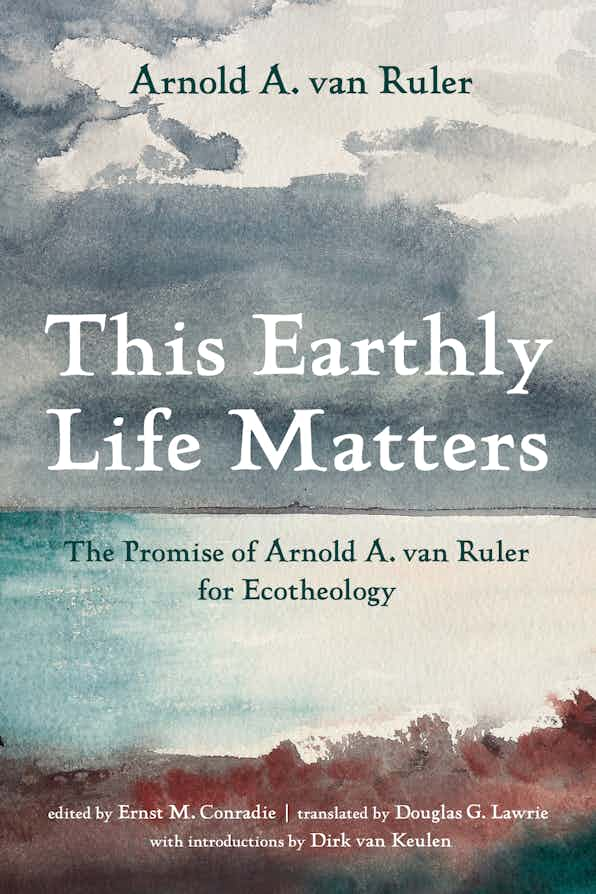
Van Ruler's approach has been described as "creation theology" by W.H. Velema, and he himself has been called "a theologian of earthly reality" by L.J. Van den Brom. It is exciting to see this volume dedicated to Van Ruler's approach to ecotheology. His thinking was largely influenced by theocratic ideas and his involvement with the "Protestantse Unie", which aimed to promote the theocratic vision of P.J. Hoedemaker (1839-1910), a writer who greatly influenced Van Ruler, especially in his views on a State church. Although this volume only provides glimpses of Van Ruler's theocratic notions.
Dirk van Keulen, who provides an introduction and a brief biography in this volume, has edited Van Ruler's Collected Works in Dutch. The selected translations by Douglas G. Lawrie included in this volume cover various topics such as God, creation, providence, being human, sin, earthly life, and animal protection. These chosen topics highlight Van Ruler's significance for ecotheology.
Van Ruler's writings are not easy to read, and some of the selections in this volume consist mainly of bullet points. However, he does offer some insightful aphorisms. Here are a few examples:
• God did not create me in order to get me down on my knees and to extend grace to me as a sinner.
• The Creator is revealed in creation—that is the mystery that evokes worship.
• Not only Holy Scripture is the Word of God; the entire created reality is that too.
• Heaven is created reality. Just as much as the earth is.
• Our knowledge of God is never direct and unmediated. It is always mediated.
• Even when we question anthropologically—and question thoroughly—we automatically question theologically.
• the Creator ≠ creation
• The world is indeed a “cosmos” but in the sense that it is a jewel, a bracelet on the arm of the Creator.
Conradie's essay in this volume provides an excellent overview of Van Ruler's approach. Conradie observes that Van Ruler's polemical intention is to affirm creation as good, even eschatologically, without the need to add or replace anything in creation. He emphasizes the importance of recognizing ourselves as creatures and the concept of re-creation. This notion of re-creation aligns with Herman Bavinck's understanding of restoration rather than repristination. Van Ruler's work can in some sense be seen as an extrapolation and eschatological radicalization of Bavinck's position. Van Keulen has described Van Ruler's approach as a radicalized reception of Bavinck's central thought that "grace does not abolish nature, but affirms and restores it."
Van Ruler's emphasis on re-creation and his strong doctrine of creation provides valuable insights for ecotheology. He firmly believes that the world was intentionally created by God and, therefore, belongs to God. Creation is not divine or demonic; it is a good thing that came into existence ex nihilo, from nothing. Van Ruler contrasts Christianity with paganism philosophy, noting that in Christianity, the world is not necessary but is good, while in paganism, the world is seen as necessary but not good.
In addition to his focus on creation, Van Ruler stresses the importance of eschatology. He stresses “God will not create a new world to put it in the place of the present world. God will renew this old world of ours and this renewed world will be the new world.”.
Overall, this volume serves as an excellent introduction to Van Ruler's work and provides valuable insights into a Christianity that not only affirms but embraces creation.


