An accidental blog

"If God is sovereign, then his lordship must extend over all of life, and it cannot be restricted to the walls of the church or within the Christian orbit." Abraham Kuyper Common Grace 1.1.

Friday, 19 August 2022

Doctoral Theses on Herman Bavinck

 Recent years have seen an increase in interest in the work of Herman Bavinck. One indicator of this is the number of doctoral theses written on Bavinck. 


Jaarsma, Cornelius R.     1935            The Educational Philosophy of Herman Bavinck. Published by Eerdmans, 1935.
Hoekema, A. A.         1953     Bavinck’s Doctrine of the Covenant. Princeton Theological Seminary.
Kruithof, B                 1955     Relaxation of Christianity and culture in the teaching of Herman Bavinck. University of Edinburgh.
Heideman, Eugene. 1959     The Relation of Revelation and Reason: E. Brunner and H. Bavinck. Assen: Van Gorcum, 1959. 
Bolt, John.                 1982     The Imitation of Christ Theme in the Cultural-Ethical Ideal of Herman Bavinck. Published as A Theological Analysis of Herman Bavinck’s Two Essays on the Imitatio Christi. Lewiston, NY: Edwin Mellen Press, 2013. 
Heilema, Syd.          1998     Herman Bavinck’s Eschatological Understanding of Redemption. Toronto School of Theology. 
Gleason, Ron                 2001     The Centrality of the Unio Mystica in the Theology of Herman Bavinck. Westminster Theological Seminary.
Van den Belt, Henk 2006     The Authority of Scripture in Reformed Theology: Truth and Trust. Studies in Reformed Theology. University of Leiden. Published by Brill, 2008.
Hans Burger,                 2008     Being in Christ: A biblical and systematic investigation in a reformed perspective. Published by Wipf & Stock
Mattson, Brian.         2008     Restored to Our Destiny: Eschatology & the Image of God in Herman Bavinck's Reformed Dogmatics. University of Aberdeen. Published by Brill, 2011. 
Eglinton, James.         2010     Trinity and Organism: Towards a New Reading of Herman Bavinck's Organic Motif. The University of Edinburgh. Published by Bloomsbury T&T Clark, 2012. 
De Wit, Willem J.         2011     On the Way to the Living God: A Cathartic Reading of Herman Bavinck and An Invitation to Overcome the Plausibility Crisis of Christianity. Amsterdam: VU University.
Price, Timothy S.         2013     Pedagogy as Theological Praxis : Martin Luther and Herman Bavinck as sources for engagement with classical education and the liberal arts tradition.  University of Aberdeen.
Huttinga, Wolter          2014     Participation and Communicability: Herman Bavinck and John Milbank on the Relation Between God and the World. Amsterdam: Buijten en Schipperheijn Motief.
Chiew, S. S.                2015 You Know It Completely: The Concept of Middle Knowledge and Biblical Interpretation in Luis de Molina, Herman Bavinck, and William Lane Craig. Vrije Universiteit Amsterdam
Park, Jae-Eun                 2016.        Driven By God: Active Justification and Definitive Sanctification in the Soteriology of Bavinck, Comrie, Witsius, and Kuyper. Calvin Theological Seminary. Published by V&R, 2018.
Brock, Cory.                 2018     Orthodox yet Modern: Herman Bavinck’s Use of Friedrich Schleiermacher. The University of Edinburgh. Published by WA: Lexham, 2020. 
Sutanto, N. Gray         2018     Organic Knowing: The Theological Epistemology of Herman Bavinck.  dissertation, The University of Edinburgh. Published by T&T Clark, 2020.
Bintsarovskyi, Dmytro 2019     God Hidden and Revealed: A Reformed and an Eastern Orthodox Perspective. Published by Lexham Press, 2021
Joustra, Jessica         2019     Following the Way of Jesus: Herman Bavinck and John Howard Yoder in Dialogue on the Imitation of Christ. Fuller Theological Seminary. 
Pass, Bruce                  2019     ‘The Heart of Dogmatics’: The Place and Purpose of Christology in the Theological Method of Herman Bavinck. The University of Edinburgh. Published by Bril.
Tae, Dong-Yaul.             2019          Human Freedom and the invisible Church From the Viewpoint of Bavinck's Pneumatology. Calvin Theological Seminary.
Doornbos, Gayle            2019          Herman Bavinck’s Trinitarian Theology: The Ontological, Cosmological, and Soteriological Dimensions of the Doctrine of the Trinity. University of St Michael's College, Toronto.
Ximian Xu                 2020     Theology as the Wetenschap of God: Herman Bavinck's scientific theology for the modern world. The University of Edinburgh.
Changjun Choi         2021     Herman Bavinck and John Calvin on The Doctrines of the Trinity and the Image Of God: A Comparison. Theologische Universiteit Apeldoorn.
Clausing, Cameron 2021     ‘Christian dogmatic does not yet exist': the influence of the nineteenth century Historical Turn on the theological methodology of Herman Bavinck. University of Edinburgh. 
Kim, Eundeuk               2021          Herman Bavinck as a public theologian Calvin Theological Seminary.
Bertrand Rickenbacher 2021 Towards a Realist Conception of Theology: An Argument Based on the Works of Bavinck and Plantinga VU Amsterdam.
Parker, Gregory Jr.         2022     Theological Thinking and Loving: Dogmatics and Ethics in the Theology of Herman Bavinck. University of Edinburgh.
Schrock, Daniel.   2022. “The Internal Word Is the Principal Word:” the Work of the Spirit in Herman Bavinck’s Theological Epistemology Westminster Theological Seminary PhD Thesis.

Updates

Torseth, Robb. 2023.“Word-to-Word: A Constructive Account of Speech between God and Humanity in the Theologies of Herman Bavinck and John Webster,” August 8, 2023. University of Edinburgh. https://doi.org/10.7488/era/3608.

Leiva, Guerrero, and Israel José. 2023. “Piety in the Theology of Herman Bavinck: Trinitarian, Covenantal and Holistic,” December 1, 2023. University of Edinburgh. https://doi.org/10.7488/era/3986.


Other language theses include:


Bremmer, R. H.        1961              Herman Bavinck en zijn tijdgenoten. Kampen
Veenhof, Jan       1968  Revelatie en Inspiratie: De Openbarings- en Schriftbeschouwing van Herman Bavinck in vergelijking met die der ethische theologie. Amsterdam: Buijten & Schipperheijn.
van Keulen, Dirk         2003. Bijbel en dogmatiek. Schriftleer en schriftgebruik bij A. Kuyper, H. Bavinck en G.C. Berkouwer. Vrije Universiteit Amsterdam.
Strebel, Henniel  2014. Eine Theologie des Lernens: Systematisch-theologische Beiträge aus dem Werk von Herman Bavinck [A theology of learning: systematic-theological contributions from the work of Herman Bavinck] (Bonn: VKW, 2014).
Goedvree, A.                 2018     Een ondoordringbaar mysteries: wedergeboorte volgens Herman Bavinck. Protestantse Theologische Universiteit.


Tuesday, 9 August 2022

Thursday, 5 May 2022

Johanna Francis, Fields of Orange: A True Welsh Love Story (Aberystwyth: Ylofa, 2022)

 Herman Dooyeweerd's daughter, Johanna (Hanny), married a Welsh man and wrote a book about her life:

ISBN: 9781800991460


image.png

It is a fascinating read - she married Bob Francis, a Welsh farmer, and lived in near poverty as a farmer's wife in Wales.

It has one or two photographs of Dooyeweerd.

This one shows Dooyeweerd on his one visit to Wales in the Welsh hills looking down on the farm owned by Bob and Johanna.


Saturday, 23 April 2022

Interview with Harry Van Dyke


It was in 2019 since I last interviewed you with the publication of Kuyper's On Education - what's been happening since then?

My wife and I  have moved to a gated community where I no longer need to mow the lawn or shovel snow from the driveway.

You have recently edited M.C. Smit's Writings on God and History (Dordt Press, 2022) - could you tell us a little about Smit and your interest in him?

After earning my Bachelor's at Calvin College in 1964 I enrolled at the VU University Amsterdam in order to "read" Theory and Philosophy of History with Professor Meyer Smit (1911-1981). In 1965 I became his assistant, which I remained till his death in 1981. From Smit, I learned a view of history that I believe I could not have learned anywhere else: how God is present in history and how the historian must take that into account: with awesome wonder and deep reverence and a humble spirit.

Why the republication of this book now? 
Smit remains in demand. He is the only philosopher of history who explicitly works in the reformational tradition. The first edition of his Writings (1987; 316 pp.) had very limited circulation; only a score were marketable, the other 980 copies all had false folds in them and were destroyed after the printer went bankrupt. Thus this first edition was almost instantly sold out. I later incorporated its contents in M. C. Smit, Towards a Christian Conception of History (2002; 426 pp.), which has meanwhile also gone out of print. The Towards book contained the whole of Writings plus a translation of Smit's doctoral dissertation. The new edition of Writings this year republishes the first edition. Unlike Towards, it omits the dissertation except for two lengthy appendices (pp. 255-304) for which I gleaned Smit's positive (thetical) elucidation of his own, reformational views and conceptions of history (the rest of his dissertation dealt with Roman Catholic philosophers and historians and their approach to historical science, largely shaped by the nature-grace ground-motive).

What are the main themes of his approach to history?
That history is not self-sufficient but receives life and meaning from the Creator. Historians cannot explain events solely in terms of their antecedents but must take into account the underlying and primary active presence of God in history.

What does Smit offer that is relevant for today?
He is a better antidote than Dooyeweerd for historicism and historical relativism.


Who should read this book and why?
University students and university instructors; preachers and teachers. Smit's ideas open our minds to the divine mystery in history.

You have been busy with the Abraham Kuyper Translation Project - are there more plans to translate more of Kuyper?
Not that I am aware of. There are treasures in his E Voto (a 3-vol. commentary on the Heidelberg Catechism). Craig Batholomew also believes that Kuyper's Encyclopedia (an extensive introduction to the loci of theology) is anything but outdated and deserves to be translated, perhaps in abridged form. However, projects like this are costly and the generous patron of the more recent Kuyper translations has gone to be with the Lord. I am still available for any of this work, but by God's grace hope to turn 82 next month.

What advice would you give to budding reformational scholars?
(1) Read widely. 
(2) Get in touch with the Neo-Calvinist research centres in Kampen, Edinburgh, Fuller Seminary, and Redeemer University.
(3) If you have any talent at all in languages, master Dutch. 
(4) "In all your ways, acknowledge Him."

What challenges do you see facing the reformational movement at the moment?
To bring itself into rapport with the needs of our time, both academically and more broadly socially and culturally.

When you are not translating what do you like to do for fun?
Do word puzzles, grow a kitchen garden, and play Bach on the harmonium pump organ.

Monday, 18 April 2022

You Should Know Reformational Philosophy

 My Introduction to Reformational Philosophy is now on Laymen's Lounge.


Reality is multi-aspectual. Consider a garden and a gardener. 

A gardener is faced with many decisions when beginning to garden. How many plants will be planted (numerical), what space will the garden take up (spatial), what changes will need to take place – what seasonal elements will need to be considered (kinematic). Will fertilisers or pesticides need to be used – will these be chemical or organic (physical)? Will the relationship between plants and insects be considered? 

What flowers are best for bees that will be required to pollinate plants (biotic)? Plants have different fragrances (sensitive). Consideration will need to be given to how different parts of the garden fit together and if the type of soil is suitable for the plants (analytical). Plants have names and horticulture has its own terminology (lingual). 

Will there be space in the garden to entertain friends (social)? Will the garden be too expensive to maintain (economic)? Are some plants becoming rare and need to be protected? How will the garden look? Is it pleasing in terms of being well proportioned, does it show beauty and harmony (aesthetic)? Will planning permission be needed to add or remove walls or outbuildings (juridical)? 

Will any changes made offend the neighbours? Does the garden show love for plants and animals as well as humans (ethical)? The overriding question is why do we garden? Is it to produce a symbol of wealth and expertise, or is it to bring glory to God (confessional)?

The idea of the multifacetedness of reality is to be found in the thought and writings of the Dutch lawyer and philosopher Herman Dooyeweerd (1894-1977). Dooyeweerd was one of the major architects of what is known as Reformational philosophy.

Dooyeweerd is one of several Dutch Calvinists who were associated with philosophy. The notable others were his brother-in-law Vollenhoven, Antheunis Janse (1890-1960), S.U. Zuidema (1906-1975), K. J. Popma (1905-1986), the S. African H. G. Stoker (1899-1993), J.P.A. Mekkes (1898-1987), and Hendrik Van Riessen (1911-2000).

Friday, 8 April 2022

You Should Know Common Grace

 My article on Common Grace is now online at the Laymen's Lounge - courtesy of Jason Estiponal. 


Thursday, 24 March 2022

Review of God, Technology and the Christian Life

 God, Technology, and the Christian Life
Tony Reinke

Crossway Books

9781433578274

320pp, pbk

Book website here


Recent years has seen Christians are becoming aware of the impact of technology on cultural life. Although technology has always been with us, from the time Adam used a branch to reach fruit on a tree (as Calvin Seerveld observes) it is good to see books written on a Christian view of technology (see a list here). The 1986 book Responsible Technology was one of the first in recent decades to take it seriously. They pointed out that technology was not a neutral activity and that it must be done under the Lordship of Christ. One of the authors of that book Egbert Schuurman has written extensively on the impact of technology.


It is good to see that Christians are taking this issue seriously and in the last 12 months has seen several books on this topic. One of them is this book by Tony Reinke. Reinke is no stranger to technology he has previously written on 12 Ways Your Phone Is Changing You. In this book, he examines the border effects of technology ostensibly drawing on the insights of John Calvin, Charles Spurgeon, Abraham Kuyper, Herman Bavinck, Jacques Ellul, Wendell Berry, Kevin Kelly, Elon Musk, and Yuval Noah Harari. 


He identifies and debunks 12 common myths regarding faith and technology. These are:


Myth 1: Human innovation is an inorganic imposition forced onto the created order. 

Myth 2: Humans set the technological limits and possibilities over creation. 

Myth 3: Human innovation is autonomous, unlimited, and unchecked. 

Myth 4: God is unrelated to the improvements of human innovation. 

Myth 5: Non-Christian inventors cannot fulfill the will of God. 

Myth 6: God will send the most beneficial innovations through Christians. 

Myth 7: Humans can unleash techno-powers beyond the control of God. 

Myth 8: Innovations are good as long as they are pragmatically useful. 

Myth 9: God governs only virtuous technologies. 

Myth 10: God didn’t have the iPhone in mind when he created the world. 

Myth 11: Our discovery of atomic power was a mistake that God never intended. 

Myth 12: Christian flourishing hinges on my adoption or rejection of the technium.


Each chapter ends with a numbered list of take-always. 

I was hoping to see more on Kuyper and Bavinck - but they like to other authors mentioned are only utilised in passing. It is a shame that the two (unrelated) Schuurman’s are not drawn upon mere extensively - as both Schuurman’s provide some of the best Christian insights int technology. This is no academic book but provides a good introduction to the subject.


One point I found stimulating was Reinke’s observation in Chapter 3 he makes an interesting observation: Cutting-edge advances will mostly come through God rejectors. 


Of course, this is not always the case - most of the early scientists were Christian. And we have the Christian Faraday to thank for discovering electromagnetism. Reinke’s point does however show the effect of common grace. It begs the question is this descriptive or prescriptive?


Why is it the case? Is it because Christians are too heavenly minded to be if earthy use? Is it because technological involvement takes second place to church-based activities? Of course, it shouldn’t be the case - that it is is an indictment on dualistic Christianity.


Contents:

Chapter 1: What Is Technology?

 Chapter 2: What Is God’s Relationship to Technology?

 Chapter 3: Where Do Our Technologies Come From?

 Chapter 4: What Can Technology Never Accomplish?

 Chapter 5: When Do Our Technologies End?

 Chapter 6: How Should We Use Technology Today?

General Index

 Scripture Index


My thanks to Crossway for a review copy.


Friday, 18 February 2022

The State of neo-Calvinism in Wales

 My piece on neo-Calvinism in Wales is now up here


Feeding the Earth - seminars


 Climate change, population growth and movement, cost of living pressures, animal welfare, seed monopolies, supply chain shortages, consumption and health… the list of challenges around food seems endless. Yet there is much thoughtful and positive work taking place to improve the health and sustainability of our food systems worldwide.

In this four-part seminar series, an international platform of researchers will speak on their work in this area from a range of perspectives that ‘use research to do good for all’.

The seminars take place on Fridays, from 12:00-14:00 BST.

Presented in partnership with All of Life Redeemed.

The full series: 20/05 | 27/05 | 03/06 | 10/06


Details available here

Tuesday, 25 January 2022

Thursday, 6 January 2022

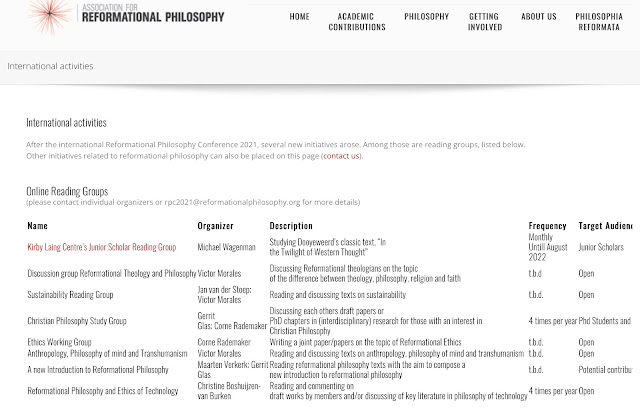
Reformational reading groups

International activities


After the international Reformational Philosophy Conference 2021, several new initiatives arose. Among those are reading groups, listed below.

Details here


Wednesday, 5 January 2022

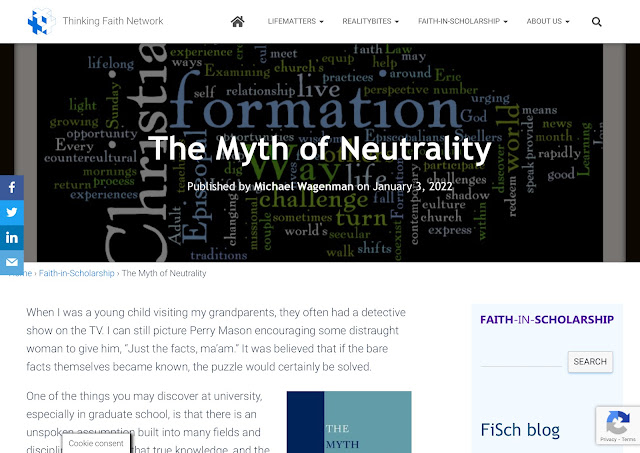
Wagenman on Dooyeweerd’s In the Twilight of Western Thought

 Mike Wagenman as part of an initiative for the Kirby Laing Centre is beginning a reading group looking at Dooyeweerd’s In the Twilight of Western Thought.

He will blog through each chapter on Thinking Faith Network’s FiSCh blog

Details of the reading group are here


Thursday, 16 December 2021

The Relevance of Kuyper to Asia Zoom Seminar


This event is sponsored by the Hwapyung Sujik church and supported by Arastamar Evangelical Seminary in Indonesia.

To register, please click the link below:


Saturday, 11 December 2021

Digital Initiatives for Reformational Philosophy

 My slides for the Reformational Philosophy Conference Panel 8: Digital initiatives for Reformational philosophy:

AoLRDec2021Conf by stevebishop

Wednesday, 8 December 2021

The Asia Kuyper Institute


 The Asia Kuyper Institute is now online: https://www.asiakuyper.org/home

Their aim is:

is to develop research on the possibilities of Kuyper’s thoughts for contemporary Asian Christians and appropriations of his ideas while pondering the uniqueness of each country in Asia.

Friday, 12 November 2021

Another variation on Dooyeweerd's modal aspects from John Paul Roberts Haine


Thanks to Eliel Morales
https://twitter.com/eliel_morales/status/1458564303842422795

Ref: Ramírez-Catalán, Jorge. 2003. Cosmovisión bíblica. Nociones esenciales. México: Seminario Teológico Juan Calvino International

Wednesday, 27 October 2021

Findings issue 2 published


 Thumbwidth Press and the All of Life Redeemed International Seminars Project is pleased to announce the publication of Findings, Issue 2. This is available free from

https://www.thumbwidthpress.net/shop

Contributions to this issue are:

Editorial: Bruce Wearne – Inspiration and Update

Isaac Njaramba Mutua – In Search of My True African Christian Identity: Journey from a dualistic to a holistic view of reality

Egbert Schuurman – Enlightenment of the Enlightenment

Mark Roques and Steve Bishop – Stewardship Epistemology

Chris Gousmett – Researching all that is “under the sun.” Creation order, the limits of science and the error of speculation in the thought of Antheunis Janse

Antheunis Janse – Translation: “The work of God that happens under the sun”

Bruce Wearne – Book Review: “The Frog and the Fish: Reflections on Work, Technology, Sex, Stuff, and Happiness.”


Issue 1 is still available, free at the same website.


Saturday, 23 October 2021

Reformational Scholarship Discussion List

If you are interested in discussing the Reformational approach to philosophy and other academic disciplines, you are welcome to join the email list: 

https://groups.google.com/g/refoscholarship

Circa 1998 the Mythnet/Thinknet group was formed for such discussion. The Reformational Scholarship Discussion [RSD] list continues its purpose.


Important:

1) If you want to access the email list's google group website, you need to join with a gmail/google account.

2) Those using a non-gmail address can still join, be members of the list, send messages and replies, etc... but they can only do so from their email, not from the group website.

3) If you want to join with a non-gmail email address, contact RSD list admins <refoscholarship+managers@googlegroups.com>

4) A day or so after joining, if you don't otherwise see it, check your spam/junk folder for the welcome message or confirmation.


More information is here:

Thursday, 23 September 2021

Recent Kuyperania

 Mike Wagenman has a great piece in the Banner:

 “Abraham Kuyper: Cancel or Celebrate?”


W. Robert Godfrey has a presentation on Kuyper 


Abraham Kuyper did not ignore the realities that the church faced in the modern world. In this last lesson, Dr. Godfrey maps out Kuyper's vision of a pluralistic society that would not hinder our freedom to be Christians.


Mark Roques utilising some Kuyperian insights looks at: 

Check it out here


Wednesday, 8 September 2021

Faith in Democracy – A series of webinars with Jonathan Chaplin


 We invite you to participate in a series of interactive seminars with Dr Jonathan Chaplin, Associate Fellow at the British public theology think tank Theos, a member of the Cambridge Divinity Faculty and former Director of the Kirby Laing Institute for Christian Ethics. He has recently published “Faith in Democracy: Framing a politics of deep diversity” (SCM Press, 2021), a discussion of how religious citizens can participate in society with integrity, and how secularism needs to recognise its own faith commitments which seek to exclude those of other faiths. Chaplin seeks to present a vision for how those of various (and conflicting) commitments can find a way of life together which does justice to everyone and allow for expression in public life of the many and varied faith convictions which make up today’s pluralist society.

Schedule: 

Thursday 30 September “Why Faith in Democracy?”

Thursday 14 October,  “Christianity and Secularism”

Thursday 28 October “Political Engagement by Faith Communities

8.00 am UK time

Full details and booking are available here

More details here [pdf]