An accidental blog

"If God is sovereign, then his lordship must extend over all of life, and it cannot be restricted to the walls of the church or within the Christian orbit." Abraham Kuyper Common Grace 1.1.

Saturday, 15 April 2017

An interview with John Van Sloten

John Van Sloten's new book Every Job a Parable will be published in June. My review is here. I caught up with him and he kindly agreed to answer a few questions about the book.


Could you say a little about yourself, where you are from and where you are coming from and what you do?

I am a 55 year old Canadian who grew up near Toronto, studied architecture, became a land developer, had a spiritual awakening at 29, had a son with Down syndrome, went to seminary, planted a church in Calgary, was given a big new idea, (which was really a big old idea), and who has, ever since, been passionately unpacking that idea via my preaching, teaching and writing.


Which thinkers or resources have you found most helpful in your Christian walk?

15 years ago I sat in a Fuller Theological Seminary boardroom and spoke with Dr. Richard Mouw and Dr. Neal Plantinga about the idea of engaging general revelation as text; whether one even could do that and about how authoritative God’s word via creation really was. I’ve read everything these two have written and have been deeply formed by the worldview they espouse. Sitting in behind them (historically) were theologians John Calvin, Abraham Kuyper and Herman Bavinck. I continue to be shaped by these reformed thinkers (and others who have been shaped by them). Comment Magazine and Books and Culture have also been big influences over the years.


How did the book Every Job a Parable come about? What was the catalyst for it?

As I was finishing up my first book, The Day Metallica Came to Church; Searching for the Everywhere God in Everything (Square Inch, 2010), my publisher Mark Rice planted the seed; suggesting I write a different kind of book on the topic of work, one that builds on the big view of revelation I’d been leaning into. At that same time the concept of jobs being parables was starting to break through in my preaching. While researching a sermon I planned to preach on a newly ‘discovered’ stress reducing mechanism in the brain, I noticed the passions and aptitudes of the neuroscientist I was interviewing; how she uniquely imaged God’s empirical mind. It felt like I could see a bit of God through her. 

Then, one Easter, I was contemplating the nature of resurrection and trying to imagine what it might have been like for the Father to raise his Son. This brought to mind the life resuscitating work of emergency department physicians. I then interviewed four ER doctors and asked them what it was like to bring someone back to life. Through their responses saw God’s urgent heart to save. This vocational awareness continued to grow for years. It dawned on me that our image bearing is very much borne out through the work we do. We are made in the image of a working God. God speaks our working lives. Our jobs are parables, spoken in, through and for Jesus.


In recent years a number of books on a Christian approach to work and vocation have been published, which is an encouraging trend. How does your book differ from others? 

I’d say the revelatory angle would be the big difference; that our jobs really are parables within which and through which God is speaking. They are vocational stories that we’re a part of; that we’re protagonists in. The parable of a person’s job has meaning because God is speaking it. And because God is speaking it, God can be known through it, in moments of flow, satisfaction, achievement, pushing though, or enduring. I think God made work to be a means by which we can experience him. In the book of Genesis God gave us a cultural mandate to fill the earth. Part of that filling included the tending of a garden… as Dr. Rich Mouw would say, somebody started raking. And that work was good. Even now, post-fall, work is good. And I firmly believe that we’ll have a lot of good work to do on the new heaven-on-earth when that time comes. And we’ll then know God through our work perfectly. The premise of Every Job a Parable is that our present day experiences of work can offer a foretaste of that one-day perfectly working world.


In the book, you mention icons - particularly the work of Andrei Rublev. Some Christians may be a little suspicious of icons. Could you say something about how you understand the use of icons and how they can provide insight?

Icons, for me, are things through which God speaks; like how God speaks through the bible, the lilies of the field, the nature of a supernova, or the corrective words of a parent. In a very real sense I believe that all that is can be iconic; can be something through which we see, hear or sense something of the nature of God. If the poet Gerard Manley Hopkins was right in asserting that “Christ plays in ten thousand places”, then I think it is reasonable to assume that Christ speaks ten thousand languages. Jesus speaks particle physics, impressionist brush stroke, shrewd management methods, good agricultural practice, knee surgeon and WalMart greeter. I know this is a bit mystical for some, but think about what Calvin said, that “All truth is inspired by the Holy Spirit”, and what Kuyper affirmed, that “The whole creation is nothing but the visible curtain behind which radiates the exalted working of [God’s] divine thinking.” (italics mine), and what Bavinck wrote, that “Revelation, while having its centre in the Person of Jesus Christ, in its periphery extends to the uttermost ends of creation. It does not stand isolated in nature and history, does not resemble an island in the ocean, nor a drop of oil upon water. With the whole of nature, with the whole of history, with the whole of humanity, with the family and society, with science and art it is intimately connected. The world itself rests on revelation; revelation is the presupposition, the foundation, the secret of all that exists in all its forms. The deeper science pushes its investigations, the more clearly it will discover that revelation underlies all created being. In every moment of time beats the pulse of eternity; every point in space is filled with the omnipresence of God; the finite is supported by the infinite, all becoming is rooted in being.” If these three had it right, then surely everything has iconic potential. I believe that those parts of the church that have specialized in icons have a lot to teach us reformed theological types. How can we hold such a high view of creation, revelation, and the Holy Spirit and not believe that God speaks in iconic ways through the things he’s made? Until I read Fr. Gabriel Bunge’s book on Rublev’s Holy Trinity, I had no idea how icons worked. In my book I took some of the concepts he outlined in relation to a painting and applied them to creation.

Could you say something about the term lectio vocatio which is one you use in the book. 

It’s kind of a play on the more common term lectio divina (a Benedictine practice of scriptural reading that aims to enhance communion with God). At the end of each chapter of EJAP are questions, exercises or stories that are designed to help the reader better orient themselves to God’s on the job presence. God is already there - in the stories of the bible and at everybody’s work. What might it look like to pay more attention, to have a better theology of God’s vocational presence, to listen for God’s work words like you listen for God’s scriptural words?  

You didn’t mention anything about undertakers or the unemployed in your book. How do those speak of God?

Ha! My editor at Navpress, David Zimmerman, made a similar observation in relation to those with disabilities. He asked me, “What about a person with Down syndrome?” (not knowing I had a 25 year old son with DS!). Big omission on my part! So I added a story about my son Edward to the book. And while unemployment is not dealt with in the book (nor is retirement) I did preach on the topic last year. And as for an undertaker… I haven't gotten to that vocation yet. Which is why I’m hoping this book will inspire ten thousand preachers to take up the exegesis of ten thousand jobs, so that the whole counsel of God’s vocational revelation can be proclaimed.

Are there any other projects in the pipeline?

Yes. I’m currently building a preaching course for Ambrose Seminary here in Calgary - ‘Preaching Science, Film, Sport, Music, Work, Art and Nature as Text’ - which will probably run next year (Spring 2018). I’m also working on a second Templeton Foundation grant - looking at the intersection of a scientist as parable and their field of study as icon. I’ve started a third book on the human body as text. To date I’ve preached sermons on the kidney, knee, neurons, hearing, epigenetics, wound healing, biological interdependence and more. You can view these sermons here. All of the vocation-based sermons that led to the writing of EJAP can also be watched here.  


What do you do for fun?
I love macro photography (seeing unseen worlds), recreating Rembrandt etchings (currently working on Christ at Emmaus), and going on long walkabouts and getting lost.


Friday, 14 April 2017

Every Job a Parable by John Van Sloten

Every Job a Parable
What Walmart Greeters, Nurses & Astronauts Tell Us About God
John Van Sloten
ISBN 978-1-63146-548-2
Nav Press
Pbk, £12.13, 208pp

Publisher's website here


John Calvin stressed that the everyday activity of Christians has religious significance. The first and third verse of George Herbert’s poem ‘The Elixir’ expresses this insight:

Teach me, my God and King,
 In all things thee to see;
 And what I do in anything
 To do it as for thee.
A servant with this clause
 Makes drudgery divine;
 Who sweeps a room, as for thy laws,
 Makes that and the action fine.

We spend ten times more hours at work than we do at church. And yet most of the sermons in church are about church and church activities. However, not at John Van Sloten’s church. This book arose out of a sermon series he did looking at different vocations and what they can tell us about God. Van Sloten is a church pastor, before that he has worked as a real estate developer. In this book, he draws upon his own experience in the workplace as well as conducting extensive research into other people’s jobs, by visiting them in their workplace.

Van Sloten provides a succinct summary of this book: it is about ‘understanding how Jesus is speaking directly to you (via your personal experience of work) and how he is speaking through you (to the broader world)’. What he wants to do is to ‘kindle a new kind of vocational imagination’. To this end, he develops a lectio vocatio - a seeing of God in and through our work. And the end of each chapter is a short series of exercise that will help to shape this.

He sees jobs as parables and draws biblical insights from a wide range of careers. What is God saying to you and others through your job? This is an important question and one that this book sets about to answer. He also explores how we can be icons of grace in our work. Here he applies some insights of Rublev's work 'Holy Trinity' and applies them to the workplace.

Obviously not all jobs or careers are covered, for example no mention of undertakers or the unemployed, but there is an extremely wide range covered - almost fifty of them ranging from accountant to Walmart worker.

For many a job is a way of earning money and not much more; ministry is something done in church at the weekend. And for others church is where there is ‘a tacit obligation to turn up, sit up, pay up and shut up’. This book will help with a paradigm shift, it shows that God is concerned with our daily job and, not only that, is able to speak in an through it.

As someone commented to Van Sloten: ‘I think I see what you are doing. I’ve spent my entire life connecting the Jesus of the New Testament to the Jesus of the Old Testament. You are connecting the Jesus of the New Testament to the resurrected Jesus today.’ This is exactly what this book does. It endorses jobs as ministry. Van Sloten shows that God speaks through our careers.

It is an important book. It provides a model for pastors in relating church to work, and for labourers in whatever field to show that God is working in and through our labours.


Tyndale House Publishers, Inc., has provided me with a complimentary copy of this book.
The book will be released in June.

Thursday, 13 April 2017

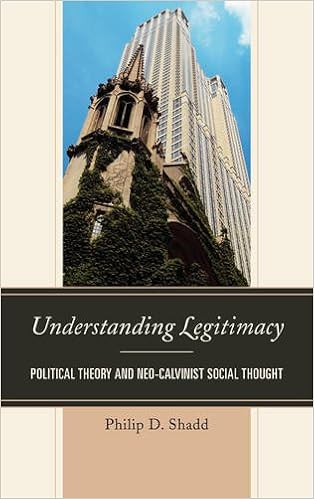
Understanding Legitimacy by Philip Shadd

Understanding Legitimacy
Political Theory and Neo-Calvinist Social Thought
Philip D. Shadd
Lanham, MD: Lexington Books
ISBN: 9781498518963
Hbk, £54.95, pp viii+207

Publisher's website 

This book addresses an important but the often ignored question of the legitimacy of political power. Shadd examines it from a philosophical perspective. By legitimacy, he means, in part, what constitutes the use of political power legitimate even if it is imperfectly implemented?
One approach to legitimacy is justificatory liberalism as epitomised by the work of John Rawls. Justificatory liberalism grounds legitimacy in a version of popular sovereignty. In essence, justificatory liberalism holds that coercive power is legitimate if it is based on reasons that all reasonable people can accept.

Shadd critiques justificatory liberalism and develops a fresh perspective utilising the fruitful approach of neo-Calvinism. He proposes that political theorists ‘mine neo-Calvinist through for conceptual insights’ (4). He sees the neo-Calvinist approach as a ‘reservoir of conceptual insights and resources from which political theorists can, and should, draw’. I agree - but I’m not sure that in the current highly polarised political climate such views would be welcomed. It certainly provides a more biblical approach than the almost consensus of justificatory liberalism.

Shadd’s key question that he seeks to answer is 'what is the right framework for thinking about political legitimacy?' (76). He finds justificatory liberalism wanting and looks towards the rich resources of neo-Calvinism. He expertly shows the flaws in justificatory liberalism and that it leads to unacceptable consequences. He aims to provide a better philosophical framework from which to understand the conditions that provide for political legitimacy (77, 181).

He provides a helpful general overview of the neo-Calvinist perspective in nine tenets. These provide a useful outline for a neo-Calvinist political framework. The nine tenets are as follows.

Tenet 1 all people are equal, naturally free, and ultimately accountable only to God.
Tenet 2 All are commissioned to sociocultural development, renewal, and transformation
Tenet 3 There is something unnatural about coercive political power. It is only necessary "by reason of sin."
Tenet 4 Sociological renewal ought be pursued along the lines of divine creation order
Tenet 5 The normative creation principles for culture and society are accessible to all (not only believers).
Tenet 6 Society is composed of different spheres, and each ought be free within its respective domain.
Tenet 7 The state ought be superset from the church (and other religious institutions).
Tenet 8 The purpose of the state is public justice.
Tenet 9 All reality is ultimately ordered by God and all human authority ultimately delegated by God.

From these tenets he begins to develop a neo-Calvinist approach to legitimacy and shows that such an approach provides a better understanding of political legitimacy than the one offered by justificatory liberalism. The state is to uphold laws that protect the basic dignity and interests of all, to prevent basic wrongs, but also to enable basic human flourishing and to represent a normative standard.

This book works on many levels. It provides a brilliant critique of justificatory liberalism, exposing its many flaws, and it illustrates the rich resources of the neo-Calvinist perspective for politics. It provides a great example of how to debate with political theories from a Christian perspective. I hope it will be widely read and not just by neo-Calvinists.

Wednesday, 12 April 2017

Pro Rege: Living Under Christ the King Volume 2 - a review


Pro Rege: Living Under Christ the King. 
Volume 2: The Kingship of Christ in Its Operations 
Abraham Kuyper Collected Works in Public Theology
Edited by John Kok with Nelson D. Kloosterman
Bellingham, WA, Lexham Press 2017. 
ISBN 978-1-57-799671-2
Hbk, £40.00, pp xxxvi+ 488


This volume, translated by Albert J. Gootjes, follows on from the first volume published in 2016 (see my review of that in Bishop, 2017). Govert Buijs in his introduction writes ‘So what Kuyper sets out to develop is a full-orbed “theology of every-day life,” a theology of incarnation of Christ’s kingship, ranging from politics to philanthropy, from the family to public opinion and the media, from civil society to academia, from economics to the arts’ (xviii). I would want to take issue with the phrase ‘a theology of …’ ; what Kuyper was doing is much broader— but it does give the feel for what the Pro Rege volumes are about. Of course, a Christian approach is far broader than a theological approach —  a Christian approach is one developed from the sovereignty of God and thus from the notion of common grace that Kuyper is developing. 

In this newly translated second volume of the Pro Rege series we catch glimpses of Kuyper’s approach to church and family in particular. This second volume is split into three parts. The first deals with ‘Christ’s kingship and his subjects’, the second ‘Christ’s kingship and his church’ and the third ‘Christ’s kingship and the family’. As Kuyper puts it this volume ‘comprise a much more extensive series of chapters that place us before practical questions regarding the calling, task, and responsibility that Christ’s kingship imposes upon us as his subjects’ (3).

In the first part, he examines the roles and responsibilities of the subjects of the the kingdom. But this is not a programme to be followed, rather it is all about grace. It is reassuring to know that  ‘The kingship of Christ does not depend on us in any way’ (3). This is because ‘The foundation on which the edifice of Jesus’ kingship has been built is not the faith and devotion of his subjects, but rests in God’s good pleasure alone’ (4). Kuyper outlines several duties we have as subjects of the king. These include confessing him, witnessing to him, taking up our cross in obedience, living as pilgrims and being in a battle with Satan and his cohorts. This latter aspect is often forgotten - too often Satan is dismissed as being an irrelevance or an invention. Kuyper is clear the battle is real, it is a battle for the world:

 ‘As King, Christ does not fight against the world but for it. He does not work to try to bring down the human race, but to preserve it. Accordingly, the battle he fights is directed entirely against the spiritual and unholy power that has stolen the human race away from God and that seeks to raise up its own kingdom against the kingdom of Christ’ (51)

And again:

‘It  is against this demonic world that all of Christ’s subjects must unite their forces. Satan alone is the real enemy to be fought, and it is in this battle against him alone that we must persist and persevere—persevere to the bitter end’ (52).

However, the battle also takes place in our own hearts. 

‘To be sure, an altogether distinct set of obligations derives from membership in the visible church. Therefore, now that we have discussed our personal duties, we will go on in the second place to examine our ecclesiastical duties’ (102).

Part 1 looked at Christ’s kingship for our personal lives, in Part 2 Kuyper turns to Christ’s kingship within and through the church. Once again dispelling the notion that neo-Calvinism downgrades or minimises the institutional church. He laments the fact that Christ’s kingship has too often been spiritualised and ‘removed from the reality of the church’ (289). The church, for Kuyper, is a result of grace rather than creation:

‘The church is therefore alien to creation life. It has not come from it, but was added to it. It is an institution of a unique kind and order. It has entered the life of the nations as an institution with a unique origin’ (115).

Christ is the one who institutes, protects, sustains and governs the church. It was instituted as something new (303). Throughout this section, Kuyper is eminently practical. He stresses the need for the church overseers to be personally acquainted with each member of the congregation, if they are not, then it is very difficult for them to admonish and warn them and the congregants could easily stray.

 ‘More is called for than just preaching. Sermons can point to the pasture, but preaching does not and cannot tend to the various individual needs of each sheep in the flock. That kind of care can only be given through personal interaction’ (248).

Kuyper often stresses the global and the local nature of the church. He sees no place for a national church. He goes on to identify three popular views of the church: the individualistic, the independent and the covenantal. The first is what he claims is the Anabaptist position - the members are those who have made a profession of faith out of a personal choice. In this view, he maintains that the church is reduced to a club or association. In the second view, choice is not necessary, all who come are deemed members, no one is turned away and there is no restriction on baptism. The third view, that advocated by Kuyper, focuses on the covenant, this ‘model insists on the truth that the Lord’s mystical body has an organic character, and that the visible church must for that reason also rest on an organic foundation’(226). Although Kuyper’s depiction of the first two positions may be something of a caricature there is much truth in it. Only the third model comports well with the scriptures. It avoids atomism and stresses the need for church discipline.  

The third part of the book Kuyper shows that he was a man of his time. His approach is rather patriarchal. With the changes that have taken place within society since Kuyper wrote it seems rather dated, particularly when both parents — through no fault of their own —have to work to be able to afford the rent or mortgage on a family home. Although Kuyper stresses the origin of the family with the creation, he takes the hierarchical nature of the family from the fall. (There is no basis for a family hierarchy pre-fall.) It may not have been unusual in Kuyper’s time for families to have servants and he discuss their role within the family. In his discussions Kuyper shows that practicality and spirituality are not mutually exclusive.  
The church for Kuyper did not arise out of a creation ordinance, unlike the family:

‘The Christian family, therefore, is not a new creation. It arises from the existing order of affairs and links directly with what came into existence through creation in paradise. In the church, the adjective Christian points us indeed to an entirely new order of affairs. But as soon as you leave the church and return to ordinary life, also what is called Christian in family or in society proceeds from creation’(309).

This among other things sets the family apart from the church. The family is not to be a micro-church. The church does influence the family but the family has an ‘independent and unique life’. He is careful to note that a Christian family means more than being a morally upright good family. For a family to have the adjective Christian it means that it should be constituted and ordered as God requires it to be. As Kuyper excellently puts it:

‘For a family to be Christian, three things must be present in it through the Spirit of Christ and the result of his work. The first is the restoration of what sin and misery have corrupted. The second is the elevation of original family life to its ideal. And  thirdly, in order that this blessing might not be passing but fix its roots in the family and seek to be nourished there, the family must sanctify its communion by establishing a family altar before which the entire family (that is, parents, children, and servants) kneel so as to give to God the honor and worship he is due for what he in his grace has given the family and to ask him to bless its life. Only in this way can Christ exercise his dominion as our King over the family as well’ (307).

Throughout the book, Kuyper’s main drive is for Christ’s kingship to be exercised in and through the church and family. In the third volume - yet to be published - he shows how the kingdom affects other areas of life and society, such as the state, and the spheres of art and science, but he writes, ‘the family takes precedence because every enrichment of personal life begins with the family and arises in part from the family’ (301). 

This book is a great addition to the Kuyper's Collected Works in Public Theology and is worthy of close study for any who want to understand Kuyper’s approach to the kingdom, church and family. 

Varia Americana - George Harinck follows in Kuyper's footsteps


When Kuyper went to America to deliver his Stone Lectures at Princeton in 1898, he took the time to travel around the US. His letters regarding this visit were published by Dordt College Press as Kuyper in America they were edited for publication by George Harinck (available here) (see my review here).


Now George has followed in Kuyper's footsteps in the Dutch TV documentary “Varia Americana – In the Footsteps of Abraham Kuyper in America”. The four-episode series is now available with English subtitles. They provide a fascinating insight into both Kuyper and the contemporary US.


Episode 2: https://vimeo.com/208787800
Episode 3: https://vimeo.com/208792081
Episode 4: https://vimeo.com/208801971


#Kuyperania in 2016

My piece on Kuyperania in 2016 has just been published in Koers

Bishop. S., 2017, ‘Kuyperania in 2016’, Koers – Bulletin for Christian Scholarship 82(1), Available at https://doi.org/10.19108/KOERS.82.1.2285

The pdf is here:http://www.koersjournal.org.za/index.php/koers/article/view/2285/pdf

It reviews most, if not all, that has been published on or by Kuyper in 2016.


Saturday, 8 April 2017

An interview with Mark Roques


Mark Roques is the author of the excellent new book The Spy, the Rat and the Bed of Nails (see my review here and Psalter Mark's review here). I caught up with him to quiz him on his work for RealityBites and about the new book.

Hi Mark, could you tell us something about yourself?


I grew up on the border of Middlesex and Hertfordshire near Watford. My parents did not bring me up in the Christian faith and so when I went to university I was rabidly anti-Christian. I was reading Nietzsche and the Marquis de Sade and I enjoyed mocking and tormenting Christian believers.
In 1977 I had a series of dramatic and miraculous experiences of God and the Holy Spirit which turned my life around. In 1978 I met Richard and Janice Russell and they told me about Dooyewerd and reformational philosophy. After finishing my BA in Philosophy, I completed a PGCE at Bristol University and then I spent 3 years in Toronto at the Institute for Christian Studies. I then became an RE and Philosophy teacher and worked at Prior Park College in Bath for eleven years. In 2005 my wife Anne and I moved from Bristol to Leeds to work for WYSOCS and from this RealityBites emerged.

I am very happily married to Anne and I have a daughter, Hannah and son, Emile. We are also foster carers and currently caring for a young 18-year-old Muslim lad who had to leave the Sudan.


You work for Reality Bites - how would you explain it to someone who has never heard of it?

RealityBites is all about helping Christians to communicate the Christian faith through winsome and engaging storytelling. When I spoke to 100 sixth formers in February of this year I told them lots of stories and got them thinking about worldviews. After my lecture, eight sixth formers stayed behind for twenty minutes to talk about Jesus.


What does a typical week look like for you?

I spend a lot of time thinking up new ways of communicating the Christian faith to cleaners, social workers, students, teenagers and committed heathens. I’m not a natural evangelist and I found a lot of the traditional ways of sharing faith rather awkward and cheesy. However, through my work on worldview I developed a number of faith-related and intriguing stories that captivated people and drew them into wanting to know more about the Christian faith. It was very exciting - as I shared these stories I found people ASKING ME to talk more about my faith.

Over the last five years I’ve been honing this approach in small group sessions, in schools and sixth form colleges, with the Muslim refugees I teach here in Leeds, on the streets with students, in pubs, even with homeless people at St George’s crypt Leeds. It’s always gone very well and I’ve been thrilled with its wide appeal. 

I was also commissioned by a charity called TLG JourneyMakers to turn these stories into a curriculum to be used in primary schools, and the feedback I’ve got has been excellent - youth workers love this approach and the children are far more responsive and engaged. 


Your most recent book, The Spy, the Rat and the Bed of Nails has just been published. Could you explain the purpose of the book?

Talking to many Christians I have discovered that many want to talk about Jesus with their friends and colleagues at work but they do not feel equipped to do this. They are given very little in church to actually share faith in a credible and engaging way. Over the years I have developed a way of doing evangelism that is sensitive to the creation affirming Theology of Tom Wright and the incisive thinking of missiologist Lesslie Newbigin. I reject the platonic way of understanding the gospel which can be very individualistic. My approach challenges secular and pagan worldviews that are often ignored. It also has a much more positive view of 'culture' than the traditional take on evangelism. In my view traditional approaches to evangelism sideline the cultural mandate, the good creation and the reality and power of contemporary worldviews. That is one reason why they fail to inspire both Christians and unbelievers!

Why should someone read it?

This book will revolutionise the way you do evangelism. It will delight you with faith-building, inspiring stories and vignettes. It will help you to understand secular, pagan and eastern worldviews which is vital in Christian communication. It will help you talk meaningfully and engagingly about King Jesus without it sounding like bible bashing.


What's been the reaction to the book so far?

Here are some of the endorsements we have garnered so far:

"Mark is one of the most brilliant gospel communicators I know. He challenges, provokes and inspires us to find creative ways to share with others. I loved this book and you will too!"
Mark Russell, CE, Church Army
"This is a brilliant book. Mark shows us how to communicate the Christian faith in a fresh, original and compelling way."
Mike Hill, Bishop of Bristol
‘I love the style of this book. Stories spark imagination and open up life. Mark Roques gets this and helps us get it. Like Jesus he tells stories which light up what God’s like and about. He makes sharing faith a draw." 
John Thomson, Bishop of Selby
"Storytelling is a vital part of communication - especially in evangelism. Mark’s book goes further and blends story with persuasion and insight. This will be a real resource for many."
Elaine Storkey, Sociologist, Author and Journalist
"This book is a great exemplar of the power of humour and story in sharing the gospel. It winsomely exposes the false worship in the worldviews of others and forces us to examine our own ‘sub-gospel’ ideas."
Ken Dickens, Principal, National Institute for Christian Education, Australia
‘This is a great little book that gives creative insight into how to go about sharing your faith. If you struggle to talk about your faith, then I totally commend it to you.’
Barry Woodward, Director of Proclaim Trust
“Mark is unique in his ability to equip people to ‘preach’ the gospel through real-life stories of folly and faithfulness—this is again demonstrated in this exceptionally helpful book.”
Chris Parker, National Institute for Christian Education, Australia
"Was Jesus' storytelling as zany as Mark Roques? I think maybe it was. Mark is so good at helping us to recapture the storytelling method. It might mean people will enjoy listening to us when we talk about Jesus."

Geoff King, Leader, South Parade Baptist Church, Leeds


How did you come across the reformational perspective?

In 1978 I was studying Philosophy at Bristol University and I hadn't a clue how to integrate my Christian faith with my studies. I was very blessed to meet Richard and Janice Russell who introduced me to Dooyeweerd, Calvin Seerveld and Bob Goudzwaard. I owe them a great deal!


Who are the people or books that have most influenced you and in what ways?

I have found the work of Bob Goudzwaard and Calvin Seerveld enormously helpful. They are, of course, indebted to both Dooyeweerd and Vollenhoven. Bob's incisive and brilliant analysis of idolatry and ideology is fantastic. Seerveld's book Rainbows for the Fallen World is incredibly insightful and moving. I am also very indebted to Albert Wolters and his brilliant book Creation Regained. I should also add that Richard Russell's writing has helped me enormously and inspired my book on education Curriculum Unmasked.

What do you do for fun?

I love football and I have written a book about the beautiful game. I also enjoy reading novels and biographies. I love the possibility of buying a Triumph Rocket III motorbike but this will never happen. It is very expensive!

If you were on a desert island what two luxuries would you take with you?

Shampoo and Dooyeweerd's magnum opus


Saturday, 25 March 2017

Roques: The Spy, the Rat and the Bed of Nails

The Spy, the Rat and the Bed of Nails
Creative Ways of talking about Christian Faith
Mark Roques
Leeds: ThinkingFaith Network
ISBN 978-0-9957572-0-2
Pbk, 182pp, £8.99

For many evangelism is a difficult ask. We often dread talking about our faith. Not because we are ashamed of it but because we are afraid of coming over as sounding a bit naff. However, there is good news - and not only in the Gospel - Mark Roques has written a book that will help us share our faith without being naff.

This book will revolutionise how we evangelise. Roques shows us creative ways in which to share or faith. His basic premise is that we need to tell stories that provoke and ask questions that expose religious beliefs. He takes his cue from Jesus’ approach. Roques shows how Jesus used humour and stories to reveal the heart of God. Roques shows how we can do the same. He draws upon his vast experience as a school teacher and as a speaker to provide a myriad of examples of how this can be done. He gives illustrations of how to communicate awe and wonder, to expose and challenge contemporary idolatries. As suggested by the title of the book Roques makes good use of examples from James Bond films, from rats and from a bed of nails.

If you want to share the good news of Jesus in a way that engages, inspires and brings glory to Jesus - you will do no better than drawing on the resources that Roques provides in this book.

The book can be obtained from here

Kuyper on 'What is a Christian family?'

Abraham Kuyper on what it is to be a Christian family:

"For a family to be Christian, three things must be present in it through the Spirit of Christ and the result of his work. The first is the restoration of what sin and misery have corrupted. The second is the elevation of original family life to its ideal. And thirdly, in order that this blessing might not be passing but fix its roots in the family and seek to be nourished there, the family must sanctify its communion by establishing a family altar before which the entire family (that is, parents, children, and servants) kneel so as to give to God the honor and worship he is due for what he in his grace has given the family and to ask him to bless its life. Only in this way can Christ exercise his dominion as our King over the family as well. Only in this way will he be honored as King in the family and through the family. The good things that happen will proceed from him through his Spirit. And Christian parents who with their baptized children and Christian staff live together in such a family will know that not only their personal salvation, but also the exalted grace they enjoy in family life, comes to them from their God only for the sake of Christ."
Pro Rege: Living Under Christ’s Kingship
Volume 2: The Kingship of Christ in Its Operation. Lexham Press, 2017.  p. 317

Saturday, 11 March 2017

Review of Greidanus Preaching Christ from Psalms

Preaching Christ from Psalms
Foundations for Expository Sermons in the Christian Year
Sidney Greidanus
Grand Rapids: Eerdmans, 2016
ISBN: 978-0-8028-7366-8
Pbk, xx + 595pp, £28.99

Sidney Greidanus is the  Emeritus professor of preaching at Calvin Theological Seminary, Grand Rapids. He has long been concerned with preaching Christ from the Old Testament. His concern dates back over 30 years.  After preaching a sermon from Ecclesiastes a member of the congregation came up to him and asked a provocative question: ‘I like your sermon … But could a rabbi have preached that in a synagogue?’ Was Greidanus’ sermon a Christian sermon? This question stirred him into action and the theme of preaching Christ from the Old Testament was developed in his 1989 book The Modern Preacher and the Ancient Text as well as in his Preaching Christ from the Old Testament (1999). Since then he has produced books on preaching Christ from Daniel, Genesis and Ecclesiastes. And now we have the latest - and what sadly seems to be the last - on Preaching Christ through Psalms.

This book is a brilliant fusion of hermeneutics and homiletics. The opening chapter takes an overview of the issues of preaching from the Psalms - including examining some objections others have from preaching the Psalms. As always with Greidanus there is much wisdom and excellent advice. The rest of the chapters examine different Psalms in detail (ones covered include Pss 122, 72, 146, 80, 96, 29, 2, 51, 32, 121,95, 23, 130, 118, 22, 118, 47, 104, 8, 100). Greidanus has followed the Revised Common Lectionary in selecting these Psalms from year A and has linked them to the Christian feasts.

He looks at ways of seeing Jesus in the text; these include redemptive-historical progress, promise-fulfilment, typology, analogy, longitudinal themes, New Testament references and contrast. These approaches have been explained and justified more fully in his Preaching Christ from the Old Testament. Obviously, not all these are applicable all the times to great variety of Psalms

The remaining chapters, each of which looks at a different Psalm, all follow a similar structure:


  • Text and context
  • Literary interpretation - including parallelisms, imagery, repetitions and structure
  • Theocentric interpretation
  • Textual theme and goal
  • Ways to preach Christ
  • Sermon theme, goal and need
  • Liturgy, scripture reading, sermon outline and PowerPoint
  • Sermon exposition


As can be seen from the structure of each chapter, his approach is one that grapples with the text, its structure and purpose before seeing how a Christological approach arises from it. There is also lots of practical advice, including suggestions for PowerPoint slides. In the sermon exposition, we are shown the fruit of this digging down would look like in a well-crafted sermon (at the end there are even examples of a prayer and song to use). Also included in the Appendices are examples of sermons on Psalms 72 and 80 by a former student of Greidanus, Ryan Faber.

The Bible is often compared to a stick of seaside rock with Jesus’ name written all the way through it. Here, Greidanus breaks open the Psalms and shows us Jesus written all the way through it. This book will be an invaluable resource for any preacher who plans to preach from any of the Psalms and do so in a way that brings glory to Jesus. Greidanus’ Preaching Christ through … books are all a wonderful gift to preachers and to the institutional church.


Wednesday, 25 January 2017

Review of The Mission of the Church

Mission of the Church
Five Views in Conversation
Edited by Craig Ott
Grand Rapids: Baker Academic
ISBN 9780801097409
Pbk, 224pp, £13.99

What do you get when a Catholic, an Eastern Orthodox, a female evangelical and two male evangelicals are asked to discuss the mission of the church? We’d expect sparks, disagreement and fiery arguments - but that’s certainly not what we do get here - there is a real sense of a listening dialogue and understanding. This book’s aim is to explore commonalities and differences. Perhaps there is hope for ecumenical dialogue!
The contributors are Stephen B. Bevans, a Roman Catholic, Darrell L. Guder a mainline Protestant, Ruth Padilla DeBorst a Latina evangelical, Edward Rommen an Orthodox and Ed Stetzer a North American evangelical. The Catholic view advanced here is that of prophetic dialogue, but its not really clear how this is different from other Christian views.
Missing from the discussion is the distinction between church as institute and as organism (but being a good Kuyperian I would say that!). Having said that, however, the Orthodox view seems to focus on the church as an institution with the focus on sacrament as mission, and Padilla DeBorst on the church as an organism with the different social actions taken by the church and her support of integral mission. Both are needed.
After each author has provided their perspective, they each get an opportunity to provide a response to each other. This adds to the value of the book. The introduction by Ott provides a clear overview and justification for the book. 
All the authors endorse a trinitarian view of mission, the concept of missio dei, an awareness of the global nature of the church, a shift from mission to missions and a recognition of the place of the church in mission - even though the authors would all endorse the same ecclesiology.   
The strength of the book is the range of agreement. The book lives up to its aim of a charitable dialogue. That in a way is also its weakness - I would have liked to have seen more on what is most distinctive about mission according to evangelicalism and the same for the other views. The stress here is on the similarities. And that is a good place to start.


Saturday, 21 January 2017

Brief review of James Hamilton's Work and our Labor in the Lord


Work and our Labor in the Lord
James M. Hamilton Jr.
Crossway
Pbk, 128pp, £12.31
ISBN: 978-1433549953

James Hamilton, a professor of biblical theology at The Souther Baptist Union, has produced in this book a brief biblical theology of work. The book is part of a new series from Crossway: Short Studies in Biblical Theology. The four chapters look at work from the perspective of creation, fall, redemption and restoration. In other words, he explores work ‘as it was meant to be, as it is, as it can be, and as it will be’.

I was surprised to see the use of inclusive language - but it soon becomes clear that this is deliberate. Hamilton approaches and interprets the scriptures through the lens of a complementarian position. Unfortunately, this position is assumed and not justified. This is a shame as it limits the usefulness of the book.

‘God put Adam in the garden to work and keep it, and he put the woman in the garden to help the man’ (p. 41).

Woman is  man’s helper:

‘What does the woman’s role of helping entail? Perhaps it would be easier to say what helping does not entail, for helping would seem to involve everything but what the man is to do. God created the woman so that together they could be fruitful and multiply, and God created her to help the man lead, protect, and provide. The jobs were given to the man to do, and the woman was given to help him do them. These roles are established so that together the man and woman can accomplish the tasks set out in Genesis 1:28 and 2:15’ (p.25, man the garden italics).

And this despite that the term helper is used of God (e.g. Ps 70:5; 115:9) but no limits seem to be placed on God’s role as a helper!

There is much own the book which is useful and insightful. But, for me, the complementarian framework through which Hamilton reads the scriptures mars the book. For those who agree with the complementarian position, the book will be well received.


Table of Contents

Introduction
Chapter 1 Creation: Work in the Very Good Garden
God’s Design for Work 
Work in the Garden Genesis 1–2
The Blessings of the Covenant Deuteronomy 28:1–14
Judgment on God-Given Tasks Genesis 3:16–19
Work Outside Eden

Chapter 2 Work After the Fall Fallen, Futile, Flourishing
Introduction
Fallen
Futile 
Flourishing 
Work under the Old Covenant

Chapter 3 Redemption: Work Now that Christ Has Risen
Introduction
Redeemed Work
Renewal of Mind: Work unto the Lord That Adorns the Gospel
Work in Christ

Chapter 4 Restoration: Work in the New Heavens and New Earth
What We Were Made To Do
The Building Materials
The House They Build
Conclusion

Bibliography

Tuesday, 10 January 2017

Review of Mouw's Adventures in Evangelical Civility

Adventures in Evangelical Civility
A Lifelong Quest for Common Ground
Richard J. Mouw
Grand Rapids: Brazos Press
Hbk, 256pp, £15.99
ISBN: 9781587433917

Richard Mouw, former president of Fuller Theological seminary, has produced a number of great little books. Not least his introduction to Abraham Kuyper. This is another one. Sadly though, this is not a biography but a memoir. However, it does contain biographical information, though we learn some things about his upbringing and his parent these insights are tangential to the chapter topics. But what we do have is a commentary on his life and on several of the books he has written. This memoir is more thematic than chronological. Mouw is clear that it’s not can autobiography and it seems he has no plans (as yet) to write one; he is also clear that it is not a detailed report on his ‘intellectual pilgrimage’.

As always with Mouw’s books, this one is packed with perspicacity, perceptivity and propriety. It provides a wonderful insight into the mind of a great philosopher-theologian partitioner and academic. Mouw has spent much of his time in civil dialogue with other Christian traditions as well as non-Christian traditions. He makes an interesting distinction between inter- and intra-faith discussions. These intra and inter dialogues shows Mouw’s concern to find common ground. 

Mouw straddles the gap between the academic and the public. He dislikes the concept of a public intellectual, but it is a fitting description of him. He also straddles the gap between evangelical and Calvinist - he describes refers to himself by both descriptions. His is certainly a life lived on common ground. This is perhaps shown in at one time his two favourite authors, Ralph Waldo Emerson and Cornelius Van Til. Two very different conversation partners. In the book he discusses common grace, the antithesis, the image of God and total depravity - and show how these have provided important theological tools for his engagement with others. 

He traces his moves from his philosophical studies at Chicago to social-political studies at Calvin and his beginning discussions with Yoder and the Anabaptist movement. His developing cultural discipleship linked with civility is the broad topic of chapter 7 but these also characterise his life and attitudes. This is particularly seen in his discussions with Catholics, Anabaptists and Mormons. 

All in all this book presents a portrait of Mouw as a man of wisdom, civility, commitment and a Kuyperian concern that the gospel shapes all of life. It is well worth reading.


Contents
1. Calvinists in an Edinburgh Pub
2. A Tale of Two Authors
3. A Many-Faceted "Imaging"
4. More Than "Calisthenics"
5. Lessons from the Philosophical "Moderns"
6. Commonalities in the Public Square
7. Preaching Civility
8. Depravity: Less Than "Total"?
9. Our "Direction-Setting"
10. Paying Attention to Context
11. Reformed and Evangelical
12. When Truth Is Distorted
13. On Being a "Public Intellectual"
14. Interfaith Engagements
15. Of Hymns and Dialogues
16. Concerns about the Journey
Index

Saturday, 24 December 2016

Kuyper's On the Church - a review


On the Church
Collected Works in Public Theology
Abraham Kuyper
Edited by John Halsey Wood Jr. and Andrew M. McGinnis
General Editors Jordan J. Ballor and Melvin Flikkema
Translators Harry Van Dyke, Nelson D. Kloosterman, Todd M. Rester, Arjen Vreugdenhil
Bellingham, WA: Lexham Press, 2016
Hbk; xxxix+ 495pp; £40
ISBN 978-1577996750


This volume, published by the Abraham Kuyper Translation Project, is a fresh translation into English of seven of Kuyper’s essays on the nature of the Church:

Commentatio (1860)
Rooted and Grounded (1870.25)
A Tract on the Reformation of the Churches (1883.06)
Twofold Fatherland(1887.23)
Lord’s Day 21 (1905.17)
State and Church (1916.06)
Address on Missions (1890.05)

As John Halsey Wood Jr. notes in his introduction, Kuyper’s ‘concern for the church predated and permeated all … other concerns’. Kuyper was a church historian and a church pastor - among other roles and callings - and this is evidenced by the first of the essays translated in this volume. Commentatio is Kuyper’s prize-winning essay, that formed his doctoral thesis, comparing John a Lasco’s and Calvin’s conception of the church. The sections reprinted here are mainly from the third section. In it, in seed thought, are much of Kuyper’s ideas on the nature of the church. It is clear that Kuyper preferred a Lasco’s view over Calvin’s, chiefly because the former’s view was closer to the Dutch spirit. This, of course, was before his conversion to Calvinism. 
Kuyper’s later major contribution to ecclesiology was the distinction between the church as institution and the church as organism. For Kuyper, the church has to do not only with Sunday services or missions but the reforming of all facets of life and culture. Kuyper uses several metaphors to illustrate the church as organism—institute distinction. In essence, the institution is the church organisation, its sacraments, its ministers; the organism is the church in the world, Christians at work in society, the body of Christ, strengthened and served by the church as institute. The church as institute does not run schools, universities, or trade unions; that is the role of the church as organism.
This distinction is to the fore in the second selection in this volume. Rooted and Grounded has previously been published in 2013 in booklet form - see the review in Bishop (2014). In this sermon, Kuyper places an emphasis on the priesthood of all believers. For the church to be truly an institution and organic the role of the institutional leaders is to equip the church as organism to be able to do the works of service in the market square, in the classroom, in the business place, in the political area, in the laboratory and so forth. 
The church as institution is the main focus of the next piece, A Tract on the Reformation of the Churches. This was written three years before the Doleantie secession from the Dutch Reformed Church led by Kuyper. It has been previously translated by Herman Hanko and serialised in The Standard Bearer (1977-1986). Kuyper writes here as a church pastor with a heart for the right functioning of the church. His concern is for a pure church. Kuyper argues for a severing of the church and the State. This text is a basis for a manual for Reformed church government. 
In Twofold Fatherland, an address delivered at the seventh annual meeting of the Free University, Amsterdam just after the Doleantie secession, we have Kuyper as an almost Lutheran:

‘we have a twofold fatherland and live as a twofold people under a twofold King’ (226) 

A cursory read of this piece seems to suggest that Kuyper is promoting a two-realm approach. But digging deeper this is far from the truth. He does suggest that there is a fatherland above and below, but both are given by God’s grace - one by common grace, the other particular grace. Both are to give God the glory. The tension of hyper-spirituality (287), suggests Kuyper, is to devalue the earthly fatherland. He also posits that the earthly fatherland has been disrupted by sin and that there is a distinction between the (sinful) world and the earthly field of common grace. 
The Lord’s Day  21 is taken from Kuyper’s E Voto Dordraceno - his commentary on the Heidelberg Catechism. This selection looks at three questions from the Catechism:

Question 54: What do you believe concerning the ‘Holy Catholic Church’? 
Question 55: What do you understand by the ‘communion of saints’? 
Question 56: What do you believe concerning the ‘forgiveness of sins’? 

The essay State and Church is extracted from a two-volume work written for members of the Anti-Revolutionary Party in 1916, was written by Kuyper for party leaders who had had no formal academic training and was designed to provide clarification to Ons Program.
The final selection, the address on missions, provides a fascinating insight into Kuyper’s attitude to mission. These are verbatim notes taken from an address by Kuyper to a missions conference in January 1890. What we have here are Kuyper’s main theses and then a verbatim report. What is particularly interesting here is Kuyper’s stress that missions should be the work of the church and not of voluntary organisations as was primarily the case at the time.

The book closes with a detailed table of contents a brief section of biographical details on Kuyper and the contributors but not of the translators. There is also an extensive subject/ author index and a scripture index. The essays by Wood and de Bruijne serve as excellent introductions to the context and to the relevance of Kuyper’s essays.

Within these pages, we can see the distinctiveness of Kuyper’s ecclesiology, although not always fully spelled out. Here we can see the distinction between organism and institution, the key role of common grace, sphere sovereignty especially in that the church should be free from state involvement and the state free from church meddling, and the key roles of the church in looking beyond itself in mission, evangelism and philanthropy.


This book is a welcome addition to the ever-expanding publications of the Abraham Kuyper Translation Project. It deserves to be read widely as Kuyper’s conception of the church is not merely of historical interest only; his distinction between organism and institute provides an excellent framework for ecclesiology today.


Bishop, S., 2014, ‘Kuyperania in recent years’, Koers – Bulletin for Chritian Scholarship 79(1), Art. #2138, 6 pages. 
http:// dx.doi.org/10.4102/koers. v79i1.2138

Tuesday, 20 December 2016

Book of the year for 2017

This will undoubtedly be in my book of the year list for next year:


Coming soon:
 Mark Roques James Bond and Rat Worship: Creative Ways of Sharing the Christian Faith. Leeds: Thinking Faith Network.

Monday, 19 December 2016

Books of the year 2016

Books of the year 2016 - the long-awaited list (don't accept any other alternatives):


Bruce Ashford and Chris Pappalardo
B&H Publishing

Jordan J. Ballor and Robert Joustra (eds)
Grand Rapids, MI: Christian’s Library Press.

Craig G. Bartholomew
Grand Rapids: Baker Books

Abraham Kuyper 
General editors Jordan J. Ballor and Melvin Flikkema
Bellingham, WA: Lexham Press

Abraham Kuyper
On the Church
General editors Jordan J. Ballor and Melvin Flikkema
Bellingham, WA: Lexham Press

Keith Sewell 
The Crisis of Evangelical Christianity
Wipf and Stock

James K.A. Smith
Grand Rapids: Brazos Press

Mike Wagenam
Together for the World: The Book of Acts. 
Lexham Press.


Sunday, 18 December 2016

Saving Calvinism by Oliver Crisp


Saving Calvinism
Expanding the Reformed Tradition
Oliver D. Crisp
Downers Grove: IVP Academic
167pp; pbk; £14:39
ISBN: 978-0830851751

The title begs the question - does Calvinism need saving? And if so from who or what? This book is in some ways both a sequel and an introduction to Crisp’s other books Deviant Calvinism: Broadening Reformed Theology (Fortress, 2014), Retrieving Doctrine: Essays in Reformed Theology (IVP Academic, 2011), and Revisioning Christology: Theology in the Reformed Tradition (Ashgate, 2011) - although this one is much shorter and more accessible than its precursors. 

The aim is clearly stated:

‘It is an attempt to provide a Reformed perspective concerning human salvation that seeks to broaden what is thought of as “Calvinistic” when it comes to such matters—not so much by presenting a revision of Calvinism but by attempting to remind modern Calvinists of the breadth of resources at their disposal’ (9)

He uses the analogy of a house - much of modern Calvinism, often depicted as New Calvinism, only uses two rooms downstairs. Crisp’s goal is to open up the house. For Crisp Calvinism is broader than the TULIP five points. Although, he does look at each one of the five points
Calvinism is not the monolith most people assume it is - Crisp shows the diversity of Calvinism. Whether all Calvinists would agree is another issue! It is highly doubtful, for example, that this book would have been published by the Banner of Truth! 
Crisp takes a fresh look at variants of Calvinistic theology. In chapters 2 and 3 he takes a look at election and freewill. Here he considers infra- and supralapsarianism and then draws upon Jonathan Edwards and John Giradeau. Girdeau opposed Edwards’ view of free will. (Crisp has dealt with Girardeau elsewhere (Crisp, 2014).) Crisp comments:

‘Even if Girardeau’s position is in some respects incomplete or underdeveloped, it does show that not all Reformed thinkers have been of one mind on the matter of theological determinism’

Crisp’s  discussion on God permitting evil is particularly stimulating - here he introduces the notion of skeptical theism, by which ‘we don’t know why God permits evil, but we can trust that there is some good reason for doing so’. 
Crisp maintains that it is possible to be a universalist and a Calvinist: 

‘it seems to me that one can be a Calvinist and a universalist. However, even if Scripture does not support universalism, it is still possible to think that the purposes of God in salvation are much more expansive than is sometimes reported’.

Not all Calvinists endorse penal substitution - again Crisp shows penal substitution is the favoured view of most Calvinists not all have adopted this perspective. He examines several other ways of understanding the atonement these include: satisfaction, as developed by Anselm of Canterbury; vicarious penitence; and penal non-substitution. Crisp sensibly advocates not one model but kaleidoscopic meta-model approach. 
He then goes on to look at hypothetical universalism as supported by John Davenant and John Preston. Although Crisp doesn’t endorse it he makes an excellent case for it being consistent with Calvinism. 
The book is eminently readable and deserves a wide readership. Crisp has certainly shown that Calvinism has a wide theological range and is wider than the traditional five points seems to suggest - even though the five points provide a good summary they are not a theological straitjacket. Crisp even suggests that: ‘Holding to all of the five points is not, in fact, a necessary condition for being a Calvinist’. Although I don’t agree with all the points Crisp makes, the book does make for a stimulating and thought-provoking read.


Reference
Crisp, Oliver D 2014. John Girardeau: Libertarian Calvinist? Journal of Reformed Theology 8(3): 284-300.