An accidental blog

"If God is sovereign, then his lordship must extend over all of life, and it cannot be restricted to the walls of the church or within the Christian orbit." Abraham Kuyper Common Grace 1.1.

Sunday, 14 September 2014

The drama of Scripture II: The fall

Here are the slides and notes from my talk on Sunday. It was the second in a series based on the excellent book by Goheen and Bartholomew.


It’s been said that the history of the world can be told with three apples:
The apple Adam ate, the apple that fell on Newton’s head and the Apple Steve Jobs gave us. Of course, that’s not quite true as nothing in the biblical text suggests that it was an apple Adam ate! The apple is a good image for what happened.

…And then there was sin.

One thing is certain sin has tarnished, disrupted and distorted God's good creation.

Because of the "apple" humanity, God and the world are estranged (Gen 3:17; 9:2). This decisive biblical event is well described by Walther Eichrodt:

This event has the character of a "Fall", that of a falling out of line of the development willed by God.

The fall is a falling out of line of the development willed by God. It’s not the way it’s supposed to be. As Romans 8 has it the creation is now groaning. God’s intention in creation was for humans to fill and subdue the earth, to till and to keep it: in other words to build civilisation. When we think of creation we think of solar systems, sun, sea, sky, sharks, starfish and spiders. But creation is more than that; within the creation order there is culture and civilisation. Humans were to develop and help the whole of creation to flourish. This unfolding of creation was to result in institution such as government, education, farming, art and music, business, science and technology.

However, Adam and Eve disobeyed God. They didn’t want to do things God’s way, they wanted to be their own bosses. That is the essence of sin – it wasn’t just what they did it was about the heart, an act of the will, an act of defiance. In essence it’s: We don’t want to be ruled by God we want to rule ourselves.

It might seem odd to suggest that science, technology, government, work and so on were part of creation. But look at the activities that Adam was doing before the fall.

Genesis 2: 19
God bought the animals to Adam – and Adam had to name them. He would have to distinguish between each animal, numbering them – the start of mathematics, he had to name them, observation and classification, the start of science.  We could go on.

Genesis 2: 5
There was no man to work the ground – so humans were created. We were created to work! We don’t work to get money, we work as part of our God-given creational task.

So what went wrong? There was a falling out of line of the development willed by God. It’s not the way it’s supposed to be!

God placed humans in a garden. The Bible ends in a city, the new Jerusalem. That involves development and the production of culture and civilisation. But then came the fall – a falling out of line. That, fortunately, is not the end of the story. God is in the business of redemption.

Structure and direction
The distinction between structure and direction is important here. Structure refers to the form in which things have been created; direction refers to the pull of sin or grace on that structure. The fall means that it is the direction not the structure of the world that has altered.

In Genesis 1:28 we were given what has been called the cultural mandate; it has not been annulled because of the fall.

Be fruitful and increase in number
Fill the earth
Subdue it
Rule over the animals

Genesis 2: 15
Placed in the garden of Eden to
Work it and
Take care of it

That is still our task and our calling.
What has happened, though through the fall, is that it has been made all the more difficult.

Genesis 2: 16
Filling the earth is made all the more painful as childbearing pains are increased.

Rulership becomes deformed: "the husband shall rule over the wife".

Genesis 2:17-18
Subduing is made all the more difficult as work in the garden will be a "painful toil".

Most initiatives of the development of creation such as cities, music and technology (metal working) arise out of the line of Cain (in Genesis 4). The development of clothes also comes as a result of the fall (Gen 3:7, 21). Were humans intended merely to remain in a pristine garden?

If we take the example of cities we cannot declare them inherently evil, because the new heavens and earth are pictured as a city in Revelation. To see all human post-fall development as evil is to confuse the structure and direction of creation. Cities, music, fashion, science, technology, art ... all have a creational structure, the fall has not affected this but has changed their direction of these God-given aspects have been distorted and mis-directed. They can be developed obediently or disobediently to creational norms.

The task of civilisation, however is rooted in the creation narrative. When God created the heavens and the earth he first formed it and then began to fill it. It is this task that humans have to continue. This is what civilisation is about; it is part of the human task to be the image bearers of God.

Ironically it seems that it is a step of rebellion that leads to a development of "civilisation". God works all things together for good. God wasn't taken by surprise.

No area of life is left untainted by sin. Sin affects every area of life.

All relationships are broken: with God, with the world, with other humans and with ourselves.

Adam and Eve are banished from the garden. It appears that out of defiant rebellion God is working out his purposes for the fulfilment of the cultural mandate. Adam's expulsion from the garden means that the rest of the world can be "civilised"; similarly with the tower of Babel it means that humanity is scattered throughout the globe and as they are they take the image of God with them.

We may live in a world that is not the way it’s supposed to be, a world that has fallen out of line of the development willed by God. But God is working on that. The expulsion from the garden is the beginning of redemption. The remainder of the Bible is the story of God redeeming, through Christ, his good but fallen creation.

As sin has affected every area and aspect of life, so too does redemption.

And that’s the story that will be unfolded in the next few weeks.

Saturday, 13 September 2014

Focus: Hocus Pocus

The Dutch show they can make good music as well as Christian philosophy:

Thursday, 11 September 2014

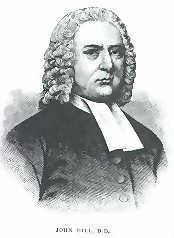
British Calvinists: John Gill (1697-1771)

John Gill (1697-1771) was born Kettering. He started at the local grammar school but the head instead that the students attend the local Anglican church, his parents couldn't agree to this as so removed John form the school. In 1716 he was baptised on confession of his faith at Little Meeting Baptist Church. 

He moved to Higham Ferrerrs, near Rushden, Nothnaptonshire to live with John Davis the Welsh pastor of the newly founded Baptist Church. While there he married Elizabeth Negus who was one of the congregation. In 1719 he became the pastor of Horsleydown Particular Baptist Church in Southwark, a congregation planted by Keach. Gill was the pastor there until his death in 1771. During that time Gill became the foremost Particular baptist theologian and a leader of the London Particular Baptists. 

Gill was good friends with John Skepp and bought many of Skepp's books when he died. He agreed with Skepp over that the free offer of the gospel was not scriptural.

Gill was a controversialist and wrote many books and gave many lectures with the aim of refuting erroneous theological views. Those he took issue were: John Wesley over predestination; Abraham Taylor and Job Burt over the view that eternal justification led to antinomianism; and Daniel Whitby (the Anglican Arminian) over the issue of election. Gill also defended the Baptist cause. He was also the first person to complete a verse by verse commentary in English of the Bible it comprised of nine volumes.

He was also great friends with the Baptist John Collett Ryland (1723-1792), but differed with him over the nature of communion - Ryland was an advocate of open communion - and the Anglican Augustus Toplady (1740-1778).

Peter Toon maintains that Gill was a hyper-Calvinist. Daniel Curt describes Gill's A Body of Doctrinal and Practical Divinity as 'the definitive expression of Hyper-Calvinist Covenant Theology' and Gill as the 'archetypical Hyper-calvinist'. Tom Nettles (By His Grace and for His Glory) and George Ella disagree that Gill was a hyper-Calvinist.

Gill was a supralapsarian.

Many of Gill's writings are available here: http://www.prdl.org/author_view.php?a_id=1996


The one-volume A Body of Doctrinal and Practical Divinity (as are others of Gill's works including a CD of his works) are available from the Christian bookshop, Ossett.

Some of his writings are available here: http://www.prdl.org/author_view.php?a_id=1996


Monday, 8 September 2014

British Calvinists: Anne Dutton (1692-1765)

Anne Dutton (1692-1765) was born in Northampton, her maiden name was Williams. In her teenage years she attended the Baptist congregation pastored by John Moore. She married a Mr Catrell in 1713 and moved with him to London where they attended a Calvinistic Baptist congregation founded by Hansard Knollys.  In 1714 John Skepp became the pastor. It was through Skepp that Anne became influenced by hyper-Calvinsim.

In 1720 her husband died so she returned to her family in Northampton where she married a clothier, Benjamin Dutton (1691-1747). Benjamin Dutton became the pastor of a congregation in Great Gransden, Huntingdonshire. He died at sea in 1747 returning from North America where he gone to raise money.

During her widow years, the wisdom and piety of Anne Dutton became renowned.  Her ministry was mainly in writing letters, poems and tracts. Many looked to her for spiritual direction. Those she had correspondence with many included Howel Harris, Selina Hastings, William Seward, George Whitfield and Philip Doddridge.

Some of Dutton's writings are available here: http://www.gracegems.org/Dutton/Dutton.htm
and here: http://www.prdl.org/author_view.php?a_id=2284

References
Michael Haykin, 2006, A Cloud of Witnesses (ET Perspectives 3), Darlington, Evangelical Times.


Friday, 5 September 2014

British Calvinists: John Skepp (1675-1721)

John Skepp (1675-1721) of Little Wilburn was a miller. He attended John Hussey's congregation in Cambridge where he was converted under John Hussey's ministry.
He became the pastor of a congregation in Curriers' Hall, Cripplegate, London that included Anne Dutton (1692-1765), it was a congregation founded by Hanserd Knolly's. 

Skepp was influential on John Gill, who edited the 1751 edition of Skepp's posthumously published Divine Energy or the Operations of the Spirit of God upon the soul of man in his effectual calling and conversion, stated, proved, and vindicated ... being an antidote against the Pelagian error (original 1721). Skepp took part in the ordination of Gill in 1720. 


Skepp's  influence on the development of hyper-Calvinism was significant.  

Tuesday, 2 September 2014

British Calvinists: Matthew Henry (1662-1714)

Matthew Henry (1662-1714) is almost synonymous with his one-volume commentary. He was born in Broad Oak, Iscoyd on the Wesh Borders. He gave up his legal studies at Gray's Inn to become a presbyterian minister in Chester. 

He moved in 1712 to Mare Street, Hackney but died in 1714 suddenly from apoplexy at Nantwich when travelling from London to Chester.


Some of his writings are available here:

Monday, 1 September 2014

Kuyperania August 2014

The exciting news this month is that Christian's Library Press have announced the imminent publication of Kuyper's Common Grace 1.2. Full details here.


Working Prototype has been running a series on Kuyper's Lectures on Calvinism


David A. Booth2014. 'The Kuyper Center Review edited by Gordon Graham' Ordained Servant Online (August-September).

A damming review of volume 3 of the Kuyper Center Review. He writes: 'Those interested in investigating the relationship between Calvinism and culture, or in this case Neo-Calvinism and culture, will be much better served by reading scholars such as Nicholas Wolterstorff and David VanDrunen.'!

Wordmp3.com has the recordings of James Bratt's presentations on Kuyper at the 2014 Convivium Calvinisticum


Friday, 29 August 2014

British Calvinists: Joseph Hussey (1660-1726)

Joseph Hussey (1660-1726) was born in Fordingbridge, Hampshire. He attended the Newington Green Dissenting Academy founded by Cornishman Charles Morton (1627-1698). God met Hussey when he was reading Charock's Existence and Attributes of God. 

In 1688 he was ordained as a presbyterian and became pastor of a congregation at Hitchin. In 1661 he moved to pastor a congregation in Cambridge which became congregationalist. In 1719 he moved to a pastorate in Petticoat Lane, London.

He wrote two books in particular that were influential in the formation of hyper-Calvinism: The Glory of Christ Unveil'd or the Excellency of Christ Vindicated (1706) and God's Operations of Grace but No Offers of His Grace (1707). In the Glory of Christ he advocated that Jesus' human nature existed in heaven. In God's Operations he rejected the notion that the gospel was an 'offer'. Conversion is a gift of grace and involves the inner working of the Holy Spirit, this is not something that can be offered. There is a need to preach the gospel, but it is God who converts.

He was a supralapsarianism. He was influenced by the congregationalist Thomas Goodwin (1600-1680) and influenced John Skepp (1675-1721), Samuel Stockwell (1704-1753) and Lewis Wayman. 

Peter Toon devotes a chapter to Hussey and Skepp's theology in his The Emergence of Hyper-Calvinism (Quinta Press, Weston Rhyn, 2003). In it he provides the following outline for Hussey's life and ministry:
1. 1660–1694: Years of Preparation.
2. 1694–1705: Years of Reading.
3. 1706–1707: The Birth of Hyper- Calvinism:
   (a) Supralapsarianism;
   (b) God-Man Christology;
   (c) Irresistible Grace;
   (d) Criticism;
   (e) Influence of Hussey’s theology.


Wednesday, 27 August 2014

British Calvinists: Daniel Williams (1643-1716)

Daniel Williams (1643-1716) was born in Wrexham. He was a presbyterian. From 1664-1687 he ministered in Ireland. In 1687 he went to London where he became friends with Richard Baxter and John Howe. He was an opponent of the hyper-Calvinism of Tobias Crisp and Chauncy, and he was accused of having arminian tendencies.

He died from asthma in Hoxton. He left almost 8000 books and money to establish what is now known as Dr Williams's Library. He also gave money for the establishment of several charity schools in Wales and for scholarships for non-Conformists to go to Glasgow University and Camarthen Academy.

Some of his works are available here:

Friday, 22 August 2014

British Calvinists: Robert Trail (1642-1716)

Robert Trail (1642-1716) was born in Elie in Fifeshire and attended Edinburgh University. His father Robert (1603–1678) was a zealous Covenanter and at one time minster of Grey Friar's Church, Edinburgh.

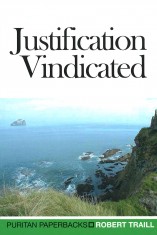
In 1670 Robert Jr. was ordained as a presbyterian in London and went to serve a congregation in Cranbrook, Kent. He published a 'letter' in 1692 entitled 'A Vindication of the protestant Doctrine Concerning Justification and of its Preachers and Professors form the Unjust Charge of Antinominianism'. This was occasioned by the publication of the works of Tobias Crisp. 

On a preaching visit back in Scotland he was arrested for refusing to deny the field coventicles and was put into prison on Bass Rock. he returned to Cranbrook. He then moved to London where he served in an Independent congregation. 

His Works was republished by the Banner of Truth in 1975. 

Some of his writings are available here: 


Wednesday, 20 August 2014

Jacob Klapwijk's Between Historicism & Relativism on AoLR


Last year (2013) the late Donald Morton completed  new translation of Jaap Klapwijk's 1970 doctoral dissertation. It is now available on allofliferedeemed. 


2013. Between Historicism &; Relativism: Dynamics of Historicism and the Philosophical Development of Ernst Troeltsch. Amsterdam: VU University, online. [Translation of Tussen historisme en relativisme, 1970] 


Kuyperania: Common Grace 1:2 is announced


The second part of Abraham Kuyper's Common Grace covering Temptation–Babel has just been announced by Christian's Library Press. 
It will be available shortly.
ISBN: 978-1-938948-20-6


Tuesday, 19 August 2014

British Calvinists: Benjamin Keach (1640-1704)

Benjamin Keach (1640-1704) was born in Stoke Hammond, Buckinghamshire. As a teenager he read the scriptures and came to an understanding that they were 'silent concerning the baptism of infant', he joined a Baptist congregation at Wimslow and was baptised. 

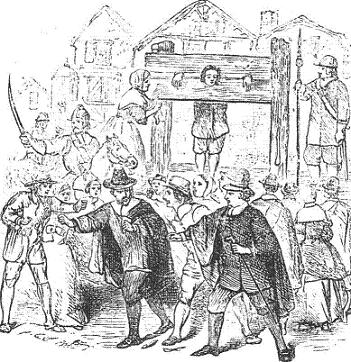
While at the Baptist church he married Jane Grove in 1660 and had a calling to church ministry. In 1664 he was almost killed by troopers and was imprisoned for his advocacy of believers's baptism. He was placed in a wooden pillory and ridiculed, but he took the opportunity to preach the gospel. 

In 1668 he and his family moved to London. He was ordained as an elder in the General Baptist church in Tooley Street, Southwark. It was here he met Hansard Knolleys and William Kiffin and embraced the Calvinist theology of the Particular Baptists. He began a Calvinistic Baptist congregation in Horsleydown, Southwark. He also planted new congregations in the south of England.

One controversy that Keach became embroiled in was regarding hym singing. Keach had introduced hymns in addition to psalm singing in public worship and this was not appreciated by some, notably Isaac Marlowe (1649-1719). 

Some of Keach's writings are available here:


Thursday, 14 August 2014

British Calvinists: Joseph Alleine (1634-1668)


Joseph Alleine (1634-1668) was born in Devizes, he studied at Lincoln College, Oxford and became a scholar of of Corpus Christi. In 1665 he accepted the post of assistant at St Mary's, Taunton. Alleine was one of the 2000 Great Ejectors, 73 were ejected in Somerset alone. After ejection he travelled around taunton continuing his preaching but was imprisoned several times for this. He died when only 34. 

His Alarme to Unconverted Sinners (1672) was very influential and is still in print today, as is his A Sure Guide to Heaven ((1688).

Some of his writings can be found here:  http://www.prdl.org/author_view.php?a_id=1383


References
Braund, Elizabeth, 1969, 'Joseph Alleine', in By Schism Rent Asunder (Papers read at the Puritan and Reformed Studies Conference).


Wednesday, 13 August 2014

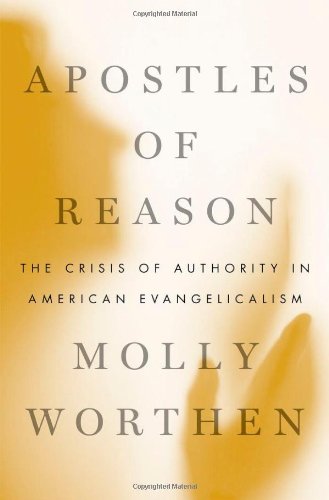
Molly Worthen Apostles of Reason

Apostles of Reason
The Crisis of Authority in American Evangelicalism
Molly Worthen
Oxford: Oxford University Press
ISBN 978-0-19-989646-2
viii + 352pp; hbk; £18.99

Worthen, assistant professor of history at the University of North Carolina at Chapel Hill, paints an interesting picture of North American evangelicalism.

Surprising in a history of evangelicalism there is no mention of Bebbington’s quadrilateral as the defininition of evangelicalism, so then how does Worthen define evangelicalism? In a sense she doesn’t. She presents a wide-ranging consortium of views and these include anabaptists, methodists and pentecostals. She rightly notes that defining it has produced more debate than agreement (p 3) and she sees history as being the best too for ‘pinning down’ evangelicals (p 4). 

She attempts to answer three questions (p 6) which evangelicals seem obsessed with: how to reconcile faith and reason; how to know Jesus; and how act publicly on faith in an increasingly secular public square. An intellectual civil war!

She focuses both on institutions - for example Wheaton College, Fuller Seminary, Biiola, Bob Jones University, Christianity Today - and individuals - J. Gresham Machen, Carl Henry, Francis Schaeffer, Billy Graham, Howard Ockenga,  John Howard Yoder and George Eldon Ladd, James Dobson and Hal Lindsey, Harold Lindsell all get largish parts.

Surprisingly Gordon Clark has more than a bit part. Wheaton College’s (1936-43) Clark is mentioned along with Cornelius Van Til regarding presuppositionalism, which Worthen maintains they developed from Abraham Kuyper (p 30), but also as a mentor for Carl Henry and Edward Carnell, and in relation to the development of the notion of Weltanschauung (world- and life-view)among (neo)evangelicals. See shows how worldview has become a powerful rhetorical strategy; we have worldview academy, worldview initiative, worldview curriculum, worldview studies, for most of them their understanding of worldview is a far remove from the espoused by Kuyper. 

Worthen, as an evangelical outsider, draws a fascinating picture of evangelicalism, her book will help evangelicals see themselves from another’s perspective and help them better contemplate what of evangelicalism is God-given and what is cultural fluff. 

Tuesday, 12 August 2014

British Calvinists: Isaac Chauncy (1632-1712)

Isaac Chauncy (1632-1712) was born in Ware, Hertfordshire. He then moved as a child with his family to New England, USA. He started his undergraduate studies at Harvard and completed them at Oxford on his return to the UK. In 1660 he became the rector of Woodbridge, Wiltshire until the 1662 Act of Uniformity. He then took up the pastorate at a congregational church in Andover, Hampshire.  
While at Andover he became a physician and then moved to London to pursue this vocation and then became the pastor of an independent congregation. He was succeeded there by Isaac Watts, the hymn writer. 
He continued as a physician while pastoring. He then became a divinity tutor at a Dissenting Academy in London.


Some of his writings are available here: http://www.prdl.org/author_view.php?a_id=1626

'Kuyperania in recent years' Koers 79(1) (2014), 6 pages. doi: 10.4102/koers.v79i1.2138

My 'Kuperania in recent years' has now been published in Koers.

It is available as HTML  |  EPUB  |  XML  |  PDF (341KB)

In it I take a look at these six important books:


Rooted and grounded: The church as organism and institution (Abraham Kuyper)
Going Dutch in the modern age: Abraham Kuyper’s struggle for a free church in the Netherlands (John Halsey Wood Jr.)
Kuyper in America: This is where I was meant to be (Abraham Kuyper)
Abraham Kuyper: Modern Calvinist Christian democrat (J.D. Bratt)
Abraham Kuyper: An annotated bibliography 1857–2010 (T. Kuipers)
Wisdom and wonder: Common grace in science and art (Abraham Kuyper)


Monday, 11 August 2014

Surge Network and Surge School

This is a very exciting project - with Mike Goheen involved.It is the outworking a reformational vision.

 The Surge School was developed to offer a year-long program of theological education for lay leaders in the churches in Phoenix.


Surge Promo from Surge Network on Vimeo.

More details on Surge and Surge network are available at missionaltraining.org 

Friday, 8 August 2014

Bishop, S., 2014, ‘The missional impulse of the biblical narrative’, Koers – Bulletin for Christian Scholarship 79(1), Art. #2140, 1 page. http://dx.doi.org/10.4102/koers.v79i1.2140

My review  of Mike Goheen's A Light to the Nations The Missional Church and the Biblical Story is available in Koers as html and pdf.

Bishop, S., 2014, ‘The missional impulse of the biblical narrative’, Koers – Bulletin for Christian Scholarship 79(1), Art. #2140, 1 page. http://dx.doi.org/10.4102/koers.v79i1.2140


Thursday, 7 August 2014

British Calvinists: John Howe (1630-1705)

John Howe (1630-1705) was born in Loughborough, he studied at Christ's College, Cambridge and Brasenose College, Oxford, he then became chaplain of Magdalen, when Thomas Goodwin was the president. He graduated with a BA in 1650 and MA 1652. In 1654 he became the perpetual curate of Great Torrington, Devon. He beam one of Oliver Cromwell's chaplains. He attended the Congregationalist's Savoy Conference as an observer. 

He returned to Great Torrington in when Richard Cromwell dies. In 1662 with the Act of Uniformity he was ejected from his church. he spent most of his time in this period preaching and writing. He eventually went to Ireland but returned to London in 1676 and to the Presbyterian Haberdashers' Hall. He eventually went to Utrecht. He returned to London in 1687. He was widely recognised as one of the leading dissenters and worked hard to unite the Congregationalists and Presbyterians. 

Some of his writings are available here:

Monday, 4 August 2014

Two new excellent books from Bennie van der Walt

Two new books have been published by Bennie van der Walt:

2014. Constancy and Change: Historical Types and Trends in the Passion of the Western Mind.

This looks at Vollenhoven's consistent-problem historical method in a clear and accessible way. It will provide an excellent entry point into Vollenhoven's work. The aim of the book is to provide an elementary, comprehensible introduction to Vollenhoven’s complicated historiographic method. It does that admirably.


CONTENTS
Preface: Prof. Annette Combrink .............................................. ii
Introduction: ........................................................................ iv
Chapter 1: How to portray the history of philosophy: exploring historiographical problems and methodologies ... 1
Chapter 2: A Scripturally oriented perspective on the history of Western intellectual thinking: the origin, contours of and questions about the consistent problem-historical method .............................18
Chapter 3: Flying on the wings of Vollenhoven’s radical Christian worldview: a reconsideration of current typologies of Christian worldviews............................. 38
Chapter 4: The concept “woman”: a feminist historiography of the relation between male and female ..........73
Chapter 5: The implications of a consistent problem-historical method of philosophical historiography for gender differences and relationships........................... 96

Bibliographical references 


2014. At the Cradle of a Christian Philosophy: Calvin, Vollenhoven, Stoker, Dooyeweerd. 

This book examines the roots of reformational philosophy as found in Calvin, Vollenhoven and Dooyeweerd. It is an excellent introduction.


CONTENTS

Preface – Prof. M.F. Heyns 

Introduction 

Chapter 1: The uniqueness of John Calvin’s (1509-1564) Philosophia Christiana ... 1

Chapter 2: The Christian philosophy of D.H.Th. Vollenhoven (1892-1978) ... 47

Chapter 3: The Christian philosopher, H.G. Stoker (1899-1993) ................. 80

Chapter 4: The Christian philosophy of H. Dooyeweerd (1894-1977)........... 116

Bibliographies

Acknowledgments 


As ever with Bennie's work these are clear, accessible and replete with wisdom and insight.

The books can be obtained from the author contact him on:
benniejvanderwalt at gmail.com


British Calvinists: John Flavel (1630-1691)


John Flavel (1630-1691) was born in Bromsgrove and graduated from University College, Oxford. He ministered for most of his life in Devon. First at Dipford near Totnes, then in 1656 moved to Dartmouth. With the passing of the Act of Uniformity he was ejected in 1662 though he continued to preach privately in the Dartmouth area near Salpton. With the granting of indulgence in 1671 he returned to Dartmouth and used a meeting  house but especially for him. He also conducted a small dissenting academy.  

He write a number of books. Many of then can be found here: 


Monday, 28 July 2014

British Calvinists: John Bunyan (1628-1688)

John Bunyan (1628-1688) best known for the classic Pilgrim's Progress was born in Bedford, the son of a tinker. In 1644 after the death of his mother and sister Mary he joined Cromwell's Parliamentary army.

He married a year after being discharged from the army and became interested in the externals of religion. It was hearing some Christian women talk of their faith that promoted him to read the Scriptures. Through this he was converted. He was baptised by full immersion in the river Ouse in 1653. His wife died in 1655 and from the he began to preach the gospel in the Bedforshire countryside. In 1660 he was arrested for preaching without a licence. He was able to support his children while he was in prison by crocheting and selling laces.

On release from prison he became the pastor a church in Bedford. 

He died from pneumonia caught when on an urgent pastoral call during a rain storm. 

He was a prolific writer and wrote over 60 publications. Some of which are available here: 

Saturday, 26 July 2014

British Calvinists: Stephen Charnock (1628-1680)

Stephen Charnock (1628-1680) was born in London and graduated from Emmanuel College, Cambridge. It was during his time at Emmanuel that he became converted. After Cambridge he became a minister in Southwark before becoming senior proctor at New College, Oxford.  

In 1656 he moved to Ireland to become chaplain to Henry Cromwell. After the restoration of the monarchy Charnock was prevented from preaching in public, he continued to do so in private. 

In 1675 until his death he was a co-pastor at Crosby hall, London. All his works were published posthumously and were transcribed after his death. 

Some of his works are available here: 

Friday, 25 July 2014

British Calvinists: Edward Fisher (1627-1656)

Edward Fisher (1627-1656) is best known for his The Marrow of Modern Divinity (1645). He was born in Mickelton, Gloucestershire and graduated from Brasenose, Oxford in 1630. Unusually for a Calvinist he was a Royalist. 

He sold his father's estate in 1656, he got into debt and went to Carmarthen as a school teacher before escaping his debtors by going to Ireland. 

His Marrow book was re-discovered by Thomas Boston (1676-1732) in 1700 and was then reprinted in 1718. The doctrine of unconditional grace in the book was disliked by many in the Church of Scotland, even though it was on Joseph Caryl's list of 'approved' books prepared at the request of the Westminster Assembly. James Haddow accused it of advocating antinomianism. 

Some of his works are available here:

Thursday, 24 July 2014

British Calvinists: Matthew Poole (1624-1679)

Matthew Poole (1624-1679) was born in York, he graduated from Emmanuel College. In 1648 he took the post of minister at St Michael-le-Querens. With the passing of the Act of Uniformity in 1662 he resigned. He then concentrated on writing bible studies. Most notable was his five volume work Synopsis criticorum biblicorum,in which he summarised the views of 150 biblical scholars. 


Some of his works are available here: http://www.prdl.org/author_view.php?a_id=464

Wednesday, 23 July 2014

The Clarendon Code and Declaration of Indulgences

After the restoration of the monarchy in 1660 several Acts of parliament were passed under Charles II that had a direct impact on British Calvinism and non-conformity. Of particular importance were the four Acts that became known as the Clarendon Code. 

1662 Act of Uniformity - The full name of the Act is 'An Act for the Uniformity of Public Prayers and Administration of Sacraments, and other Rites and Ceremonies, and for establishing the Form of making, ordaining and consecrating Bishops, Priests and Deacons in the Church of England.'

Steps were taken after the restoration to reintroduce a revised Prayer Book. The Act meant that clergy had to use, and comply with, the Prayer Book and failure to do so would mean they were deprived of their living. It also meant that all clergy had to have episcopal ordination. As a result almost 2000 clergy forced out of parishes. It is sometimes known as the Great Ejection. Edmund Calamy in 1775 published  The Nonconformist's Memorial: Being an Account of the Lives, Sufferings, and Printed Works, of the Two Thousand Ministers Ejected from the Church of England, Chiefly by the Act of Uniformity, Aug. 24, 1666. This includes a list of the ejected ministers: https://archive.org/details/nonconformistsm00calagoog


1665 Five Mile Act also known as the Oxford Act or Non-conformist Act. Its full title was "An Act for restraining Non-Conformists from inhabiting in Corporations". It meant that clergy expelled by the Act of Uniformity couldn't live within five miles of the parish they were excluded from unless that swore to obey the 1662 Prayer Book.

The other Acts that formed part of the Clarendon Code were: the Corporation Act (1661) and the Coventicle Act (1664). The Corporation Act meant that all municipal officers were Anglicans; and the Conventicle Act forbade the meeting together of five or more - other than of the same family - for unauthorised worship.

The effect of the Clarendon Code meant the privatisation of non-Conformity.


1672 Declaration of Indulgences.  This was an attempt by Charles II to extend religious liberty to Roman Catholics and non-Conformists. It allowed dissenters to hold services in public places. Parliament saw this as an act of sympathy for the Catholics and so it was withdrawn in 1673 and replaced by a number of Parliament Test Acts. The Test Acts required anyone in public serve to denounce Roman Catholic doctrine and be communicant members of the Church of England.


Tuesday, 22 July 2014

British Calvinists: David Clarkson (1622-1686)

David Clarkson (1622-1686) was born in Bradford and graduated in 1645 from Trinity College, Cambridge. In 1645 he became a fellow of Clare College, Cambridge. 

He was the rector (1650-1655) of Crayford in Kent and (1656-1661). After the Great Ejection in 1662 he he preached wherever he could and continued to write. Following The Declaration of Indulgence in 1672 he became the pastor of presbyterian-independent church in Mortlake. He became a co-pastor with John Owen in 1682 and after Owen's death the sole pastor, of a church in Leadenhall St, London. 


Some of his writings are available here: http://www.prdl.org/author_view.php?a_id=203

Thursday, 17 July 2014

British Calvinists: Thomas Watson (c. 1620-1686)


Thomas Watson (c. 1620-1686) was a Yorkshire man, he graduated from Emmanuel College, cambridge with a BA in 1639 and MA in 1642. 

In 1649 he ministered at St Stephen's, Walbrook, London as a lecture and then rector. He married Abigail Beadle in 1647 and they had seven children.

 He held to strong Presbyterian views but was sympathetic to the king. He was imprisoned in 1651 for his part in attempting to restore the monarchy. Christopher Love on elf Watson's fellow imprisonees was executed, but Watson was released and restored to his pastorate at St Stephen's.

The 1662 Act of Uniformity saw Watson ejected from the church, but like many others he continued to preach. In 1672 after the Act of Indulgence he was licensed to preach at Crosby Hall, Bishopsgate. Stephen Charnock was one of his co-workers at Crosby Hall. Watson retired to Barnston, Essex. 


Some of his books can be obtained from The Christian Bookshop Ossett:  http://www.christianbookshopossett.co.uk/catalogue.php?&search=Thomas%20Watson&nd=2&


Tuesday, 15 July 2014

British Calvinists: Thomas Manton (1620-1677)

Thomas Manton (1620-1677) was born in Lydeard St. Lawrence, Somerset. He graduated from Wadham College, Oxford with a BA in 1639, a BD in 1654 and a DD in 1660. 

He was ordained as a deacon in 1640 and ministered at Sowton, Exeter for three years. While in Sowton he married Mary Morgan. He took up the living of St Mary's Stoke Newington. He became a leading Presbyterian and was appointed as a clerk to the Westminster assembly.

Despite disapproving of the the king's execution he remained in favour with Cromwell. He succeeded his father-in-law Obadiah Sedgwick as rector of St Paul's, Covent Garden. 

He favoured the restoration of Charles II and was appointed as one of Charles's chaplains.  In 1662 he was ejected from the Established Church - he continued to preach and was arrested in 1670 and kept in prison for 6 months. The Declaration of Indulgence was granted in 1672 and Manton was licensed as a Presbyterian. 

In 'Thomas Merton: the man and his ministry' J. C. Ryle in 1870 had this to say of Manton:

1. As a man, I am disposed to assign a very high place to the author of these volumes. He strikes me as having been, not merely an ordinary 'good ' man, but one of singularly great grace and consistency of Christian character.
...
2. As a writer, I consider that Manton holds a somewhat peculiar place among the Puritan divines. He has pre-eminently a style of his own, and a style very unlike that of most of his school. …
3. As a theologian, I regard Manton as a divine of singularly well-balanced, well-proportioned, and scriptural views. …
4. As an expositor of Scripture, I regard Manton with unmingled admiration. Here, at any rate, he is 'facile princeps' among the divines of the Puritan school. …


The complete work of Thomas Manton, in 22 volumes, is available here: http://archive.org/search.php?query=thomas+manton+works/

Some of his works are available from the Christian Bookshop Ossett here: http://www.christianbookshopossett.co.uk/catalogue.php?&search=manton&nd=2&


Monday, 14 July 2014

Review of Harry Van Belle's Explorations in the History of Psychology

Explorations in the History of Psychology
Persisting Themata and Changing Paradigms
Harry A. Van Belle
Soux Center, IO: Dordt College Press, 2014
ISBN 978-0-932914–99-6
Pbk; 239+vi pp;  £12.00
Available from Dordt College Bookstore

There are several textbooks that provide an overview of the history of psychology, but none that do it from a Christian perspective, until now. Van Belle, emeritus professor of psychology at The Kings University College in Alberta, Canada, has produced an excellent introduction to, and overview of, the history of psychology utilising the Dutch Christian philosopher Vollenhoven’s approach. It is the fruit of many years teaching university students in North American and in Africa. Now students everywhere can benefit from Van Belle’s wisdom, insight and experience.

History is important it places where we are within a context. A historical perspective is important in showing not only where we have come from but also in revealing the ideologies at work in a subject. Van Belle, in utilising Vollenhoven’s approach, helpfully shows the continuities and discontinuities in the history of psychology: “The history of psychology necessarily consists of both persisting thematas and changing paradigms” (p. i).

The first half of the book is taken up with the Greek and the Middle Ages. Although psychology as a separate discipline, rather than being a sub-discipline of philosophy, didn’t exist until the nineteenth century, the Greek and scholastic roots prove illuminating. The final sections of the book deal with a number of key psychological schools and shifting emphases on consciousness, the unconscious mind, adaptation, functionalism, behaviourism and then cognitive and humanistic psychology. 

Each chapter closes with a list of references and a ‘Some issues to stimulate discussion’, this section provides helpful prompts for discussion and will prove invaluable for those who want to use the book as a college text. For those who want a history of psychology then this is the  book to go to, the added advantage is that it is from a distinctively Christian approach that avoids being simplistic and biblicistic. Van Belle has served us well. 


Saturday, 12 July 2014

British Calvinists: William Gurnall (1617-1679)


William Gurnall (1617-1679) born in Kings Lynn is probably best known for his three-volume book Christian in Complete Armour (1655, 1658, 1662), which is still in print published by Banner of Truth. He graduated from Emmanuel College, Cambridge, with a BA in 1635 and MA in 1639. He then became a curate in Sudbury and subsequently rector of St Peter and Paul's in Lavenham, Suffolk. 

Some of Gurnall's works are here:  http://www.prdl.org/author_view.php?a_id=1403

Some of his books are available to buy from Ossett Christian Bookshop here.