An accidental blog

"If God is sovereign, then his lordship must extend over all of life, and it cannot be restricted to the walls of the church or within the Christian orbit." Abraham Kuyper Common Grace 1.1.

Saturday, 16 July 2005

Genesis and science

There are a number of ways that Christians have attempted to reconcile science and the early chapters of Genesis. Two questions are crucial to the position Christians take on science and Genesis:

1. Is the earth old?

2. Do we have a common ancestor?


(i) Extreme creationists reject the scientific evidence and hold onto a literal six-day creation, they claim that the earth is young and we don’t have a common ancestor e.g Henry Morris (ed.) Scientific Creationism (1974).

(ii) Progressive creationists adopt some sort of age-day or revelatory-day view of Genesis 1 and thus accept an old earth but reject a common ancestor, e.g. Pattle P. T. Pun Evolution (1982).

(iii) Theistic evolutionists would accept that while God created matter and natural laws, life evolved, the earth is old and we do have a common ancestor e.g R. J. Berry (1988).


The nineteenth and early twentieth century saw a number of ways of relating the early chapters of Genesis with science.

Position

Advocates

Work

Date


Flood geology/ creation science

E.G. White

Spiritual Gifts

1864

George McReady Price

The New Geology

1923

Byron Nelson

The Deluge Story in Stone

1931

A.M. Rehwinkel

The Flood in the Light of the Bible

1951

H.W. Clark

The New Diluvialism

1946

Henry M. Morris & John C. Whitcomb

The Genesis Flood

1961

Local creation

John Pye Smith

On the Relation Between the Holy Scriptures and Certain parts of Geological Science

1839

Ideal time view

Philip Henry Grosse

Omphalos

1857

Gap theory

Buckland

Bridgewater Treatises VI

1837

Adam Sedgwick

Discourses on the Studies of the University of Cambridge

Robert Chalmers

The evidence and authority of the Christian Revelation

1817

John H. Pratt

Scripture and Science not at variance

1857

J.H. Kurtz

Bible and astronomy

1842

G.H. Pember

Earth’s Earliest Ages

1876

C.I. Scofield

Scofield Bible

1909

Harry Rimmer

Modern Science and the Genesis Record

1937


Age-day

G. S. Faber

Genius and object

1823

Buffon

Epoques de la Nature

1778

James Dana

Manual of Geology

1863

J.W. Dawson

Origin of the World According to Revelation and Science

1877

Edwin K. Gedeney

in Modern Science and Christian Faith

1948


Pictorial day

J.H. Kurtz

Bible and Astronomy

1857

Hugh Miller

Testimony of the Rocks

1849

A.H. Strong

Systematic Theology

1907

Canon Dorlodot

Darwinism & Catholic Thought

1923

L.F. Gruber

The Six Creative Days

J. Pohle

God: The Author of Nature and the Supernatural

1942

P.J. Wiseman

Creation Revealed in Six Days

1948


Flood geology or creationism, subsumes science with a literal six-day creation reading of scripture.

Local creation. The special act of creation by God was limited to a small area of the ancient near East.

Ideal time view. How old was Adam when God created him? He was apparently created with the appearance of age. The earth could likewise be created with the appearance of age, so this view purports.

Gap theory. In order to reconcile the geologists’ old earth view with the prima facie young earth view of Genesis a gap was inserted in Gen 1:2. God created in Genesis 1:1, this was followed by a catastrophe in Gen 1:2, and was followed by a re-creation in 1:3; 1:2 could provide the geologists with as much time as they required!

Age day. This view holds that the days of creation were periods of time representing the development of the earth.

Pictorial day. The days of creation in Genesis 1 are the days of revelation by God to 'Moses' of the successive acts of creation.

Adapted from Steve Bishop ‘A typology for science and religion’ Evangelical Quarterly 72 (1) (2000) 35-56. When I get time I'll put on some links.

Friday, 15 July 2005

Science and religion quotes 8

The fact is that the doctrine of Evolution does not affect the substance of Paley's argument at all. The marks of design which he had pointed out remain marks of design still even if we accept the doctrine of Evolution to the full. What is touched by this doctrine is not the evidence of design but the mode in which the design was executed. ... He [God] did not make the things, we may say; no, but He made them make themselves.
Frederick Temple, Lord Bishop of Exeter, The Relations Between Religion and Science
(London: MacMillan, 1884) pp. 113-5.

Galileo, Darwin, and Hawking: chapter 2

In Chapter 1 Dowe looked at the hermeneutics of Scripture, in Chapter 2 he examines the hermeneutics of science and religion.

He starts by defining realism and antirealism (aka instrumentalism or fictionalism). He then goes on to looks at Osiander, the preface writer of Copernicus’ On the Revolution of the Celestial Spheres, Pierre Duhem and Bas van Fraassen as advocates of antirealism in science and then Feuerbach, Tillich and Wittgenstein as examples of those who take an antirealist view of religion.

Andreas Osiander (1498–1552) in the controversial preface to Copernicus’ work maintained that the book should be read as mathematical devices for accommodating the astronomical data. Dowe writes: ‘In this case it is science, rather than religion, that gives way in order that the two can be held together’ (p. 42).

Pierre Duhem (1861-1916) maintained that the fault in the ‘Galileo affair’ was Galileo’s inadequate philosphy of science. If Galileo has held to an antirealist view it would have avoided a clash with the papal authorities. For Duhem it is religion- he was a conservative Thomist Catholic - that provides us with ultimate truth, not science.

Bas van Fraassen advocates constructive empiricism: science provides us with empirically adequate theories - i.e. they fit with current data. A theory can be accepted without necessarily believing it literally.


Dowe isn’t impressed with antirealism - and neither are most practising scientists - despite the fact that it circumvents a conflict between science and religion. Antirealism provides us with an independence model of the relationship between science and religion. I felt that here Dowe could have expanded more on why antirealism is unsatisfactory.

He then moves on to answer the question, ‘Can antirealism about religion secure harmony between science and religion?’ To do this he examines the views of Feueurbach, Tillich and the later Wittgenstein.

For Ludwig Feuerbach (1804-1872) the answer is no, his is a conflict view as science shows that earlier forms of religion were false.

Paul Tillich (1886-1965) takes a harmony approach, but neither his approach or Feuerbach’s are as antirealist as Osiander, Duhem or van Fraassen. This though is not the case with the later Wittgenstein (1889-1951). For Wittgenstein ‘religion [unlike science] is not a fact-stating domain' (p 56). Hence science and religion are independent, they belong to different domains. Whereas Osiander has a blanket antirealism for science, Wittegnstien has a blanket antirealism for science; both views enabled a harmony to exist between science and religion. However, Dowe – rightly in my opinion – notes that Wittgenstein’s approach is not satisfactory, his religion is unrecognisable as far as orthodox theism is concerned.


Thursday, 14 July 2005

Recent Catholic views on evolution

Several prominent Catholics have been in the news recently talking about evolution.

The Catholic News wrote:

The influential Cardinal Christoph Schönborn of Vienna has suggested that belief in evolution as accepted by science today may be incompatible with Catholic faith.

In the New York Times op-ed the Cardinal wrote:

Evolution in the sense of common ancestry might be true, but evolution in the neo-Darwinian sense - an unguided, unplanned process of random variation and natural selection - is not. Any system of thought that denies or seeks to explain away the overwhelming evidence for design in biology is ideology, not science.

Now at the beginning of the 21st century, faced with scientific claims like neo-Darwinism and the multiverse hypothesis in cosmology invented to avoid the overwhelming evidence for purpose and design found in modern science, the Catholic Church will again defend human reason by proclaiming that the immanent design evident in nature is real. Scientific theories that try to explain away the appearance of design as the result of "chance and necessity" are not scientific at all, but, as John Paul put it, an abdication of human intelligence.

New York Times 7th July 2005

Cardinal Theodore McCarrick, said that Catholics can believe in evolution - as long as it's understood to have been guided by God rather than chance.

Two prominent Catholic scientists Kenneth Miller, author of Finding Darwin's God and former Dominican Francis Ayala have now written to Pope Bededict XVI to ask him clarify the situation.


Perhaps unsurprisingly, some journalists have resuscitated the conflict model and trotted out the Galileo myth:

In closing, we should note that it is not just Darwin with which the church has difficulty. The church still can’t make up its mind about Galileo. Here is a quote from Benedict XVI when he was still just Cardinal Ratzinger and the head of the Inquisition: “At the time of Galileo the Church remained much more faithful to reason than Galileo himself. The process against Galileo was reasonable and just.” And the Sun goes around the Earth.

Thomas Riggans

Saturday, 9 July 2005

Galileo, Darwin, and Hawking: chapter 1

In 31 pages we are taken on a whirlwind tour of cosmology and Scripture. The breathless tour takes in a brief history of cosmology from Aristotle to Newton, via Copernicus and Galileo, before looking at Genesis and hermeneutics and then going on to examine Augustine and Calvin’s take on Genesis. It concludes by looking at Galileo and Ballarmino’s approach to scripture. We are treated to broad brush strokes and inevitably some of the arguments are over simplified, nevertheless it is a well written and stimulating read.

He raises the important question: When we read Genesis should we read it metaphorically or literally? The issue of hermeneutics is unavoidable. Two interpretation of Genesis are considered the cosmological approach which takes Genesis at face value and the theological which takes the text to be revealed by God but reads it metaphorically.

Augustine’s view of creation is that God created everything in one instantaneous act; the six day structure is a topically ordered revelation to angels. Thus his view, according to Dowe, is theological. He summaries Augustine’s view as “... accept Scripture over against science, if that science has not been proved conclusively. But if the science has been proved, we must show that Scripture is not opposed to it by reading that Scripture metaphorically rather than literally.” This Dowe dubs the ‘relevance principle’. This approach raises the question, whose science? And when is science ever beyond doubt?

Dowe next turns to Calvin’s hermeneutics. Calvin’s approach is one of accommodation. For Calvin the scriptures are written in accommodation to the common people so that they may be understood by all; hence, we have a ‘deaf’ adder (Ps. 58:4). This approach Dowe calls the ‘neutrality principle’; Scripture is concerned with spirituality and salvation rather than cosmology. I like Calvin’s accommodation approach. This view of accommodation has been developed by Paul Seeley – I’ll blog on his approach another time. Though I don’t like the term ‘neutrality principle’, and Dowe’s description of it sounds rather dualistic.

Dowe writes:

Both [Calvin and Augustine] agree that Aristotelian cosmology is true and that scripture should not be taken literally as denying what is proven by Aristotelian cosmology. But Augustine maintains that the Bible can teach the learned about cosmology and metaphysics, whereas Calvin claims that the Bible does not teach us about cosmology. Calvin holds that the whole message of scripture is accessible to all people, a view that is not shared by Augustine. (p. 29)

1543 saw the beginning of a paradigm shift in cosmology – the year Copernicus’ On the Revolution of the Celestial Spheres. Galileo’s Starry Messenger was published in 1610 it purported to show that the heavens are imperfect: the Aristotelian worldview was being challenged. In 1615 Galileo wrote to the Grand Duchess, in it Galileo adopts the ‘neutrality principle’. The ‘neutrality principle seems to fit Galileo more so than Calvin; see for example this quote.

Dowe concludes that Galileo had an assumption of unity between the God of scripture and the God of nature, this led him to a harmony view of properly proved science and correctly interpreted Scripture. The neutrality principle guarantees harmony as scripture is insulated from scientific advances; it holds to an independence model of science and religion. The relevance principle leads to an interactionist view. Dowe concludes:

On either approach – the interactionist, piecemeal relevance principle, or the independence/ global neutrality principle – harmony is ultimately guaranteed by the premise of unity. This premise was never questioned in the sixteenth century.

Friday, 8 July 2005

Thursday, 7 July 2005

Bombs in London

It appears that the bombings in London were the result of Islamic terrorism. My concern is that innocent Muslims will be scapegoated.

Arthur Jones has written a brilliant paper on Understanding Islamic Terrorism - Arthur knows his stuff, he has been a missionary in the Ismaic world and among Muslims in the UK. It is well worth checking out.

He concludes:

We will not destroy Islamic terrorism by destroying Islamic countries. For the world to be freed from Islamic terrorism it must be freed from false beliefs. For us, the call is to pray for our Muslim colleagues and neighbours, and to offer them unconditional friendship and hospitality. On the wider canvas the call is to radical mission and community, not to missiles and mayhem.

The world must also be freed from our culture’s false beliefs. For many Westerners it is also a time of confusion and disillusionment. They are repulsed by the naked greed and materialism of our Western societies and perplexed by the naturalism of Western science. They long for a secure place in the moral void. For us, the second call is to repentance and faith, and to the vibrant life of the community of Christ.

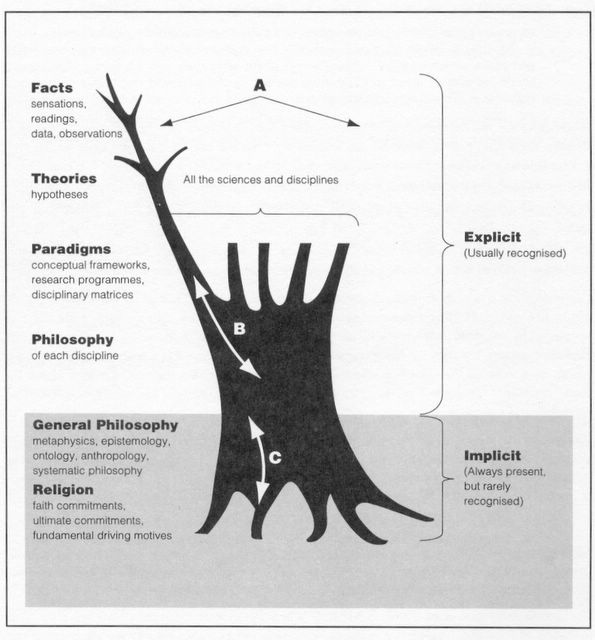
The bush of human knowledge

The diagram below, the bush of human knowledge, was devised by Arthur Jones and Richard Russell. It has appeared in Mark (Fields of God) Roques' first book Curriculum Unmasked and subsequently in Science in Faith edited by Arthur Jones on behalf of the Christian Schools' Trust.

The diagram shows how religion and philosophy relate to the special sciences, such as theology, physics, chemistry, history and so on.

The Bush of Human Knowledge (c) Arthur Jones and Richard Russell. Taken from Christian Schools' Trust Science Curriculum Working Group, Science in Faith, CST 1998.

Top 125 unanswered scientific questions

Science magazine as part of its 125th anniversary lists 125 unanswered questions.

The top 25 questions are:

  • What Is the Universe Made Of?
  • What is the Biological Basis of Consciousness?
  • Why Do Humans Have So Few Genes?
  • To What Extent Are Genetic Variation and Personal Health Linked?
  • Can the Laws of Physics Be Unified?
  • How Much Can Human Life Span Be Extended?
  • What Controls Organ Regeneration?
  • How Can a Skin Cell Become a Nerve Cell?
  • How Does a Single Somatic Cell Become a Whole Plant?
  • How Does Earth's Interior Work?
  • Are We Alone in the Universe?
  • How and Where Did Life on Earth Arise?
  • What Determines Species Diversity?
  • What Genetic Changes Made Us Uniquely Human?
  • How Are Memories Stored and Retrieved?
  • How Did Cooperative Behavior Evolve?
  • How Will Big Pictures Emerge from a Sea of Biological Data?
  • How Far Can We Push Chemical Self-Assembly?
  • What Are the Limits of Conventional Computing?
  • Can We Selectively Shut Off Immune Responses?
  • Do Deeper Principles Underlie Quantum Uncertainty and Nonlocality?
  • Is an Effective HIV Vaccine Feasible?
  • How Hot Will the Greenhouse World Be?
  • What Can Replace Cheap Oil -- and When?
  • Will Malthus Continue to Be Wrong?

Wednesday, 6 July 2005

Science and religion quotes 7

I would say here something that was heard from an ecclesiastic of the most eminent degree: "That the intention of the Holy Ghost is to teach us how one goes to heaven. not how heaven goes."


Galileo, Letter to the Grand Duchess Christina of Tuscany(1615)

Monday, 4 July 2005

Galileo, Darwin, and Hawking: Introduction

In his introduction (pp. 1-8) Dowe poses the question: Harmony or Conflict?

He identifies, largely following Barbour's well-known typology, four (or five?) ways that science and religion can relate: the two conflict models are naturalism ["nature is all there is"] -espoused by James Frazer in his Golden Bough, Hume, Thomas Huxley, Bertrand Russell, John Mackie and, Dowe claims, Stephen Hawking 'fits this camp' (p.3) - and religious science -exponents of this position would be Cardinal Bellarmino (a key figure in Galileo's trial) and the six-day creationist Henry Morris. The two harmony models are: independence (Wittgenstein) and interaction. Interactionists include Francis Bacon, Isaac Newton, William Paley and Einstein. He also identifies a sub-division of the interaction category: dependence; in this model science and religion are not only compatible they are dependent upon one another.

This typology has the strength of being simple and straightforward, though I do wonder whether a category that contains Bacon, Newton, Paley and Einstein is rather too large to be of use.

Dowe then asks a pertinent question: 'How are we to decide which (if any) of these [relationships] is correct? ... What method can we use to determine a resolution to such controversies?'

In an attempt to answer this question he proposes to examine some case studies: primarily - and here the title is a dead give-away! - Galileo, Darwin and Stephen Hawking. The problem that I have with case studes is that they can tell us how science and religion have related, but can they tell us how science and religion should relate? Dowe seems aware of this problem and so it will be interesting to see how he proceeds.

He closes with this:

I will defend the view that religious belief as given in western traditions ... is neither incompatible with nor a hinderance to science: there is no philosophical conflict.
(p. 8)

Philosophy family tree

Josh Dever of University of Texas has compiled a philosophy family tree here. At present there are 700 individuals; it is available in a list format (40 page pdf) and a tree format (78 page pdf file).

Galileo, Darwin and Hawking

I have just bought Phil Dowe's new book Galileo, Darwin, and Hawking (Eerdmans: Grand Rapids, 2005). It looks very interesting, so I shall be blogging my way through it; probably at the rate of a chapter a week.

Phil Dowe is a philosophy lecturer at the University of Queensland and has also written Physical Causation as well as a number of philosophical papers, including this one on 'Chance and providence' Science & Christian Belief Vol. 9, No 1, April 1997, pp.3-20. Here he concludes:

So, should Christians be bothered by the Chance Worldview? Does chance refute providence? No. If chance exists then either it is caused by God (and that is allowed by Bell's Theorem) and this is no problem for providence and there is no conflict with science, or chance is not caused by God, in which case it is compatible with strong Calvinist providence providing it does not lead to meaningful consequences. Insofar as chance does lead to meaningful consequences, strong providence entails that God causes that chance.

Sunday, 3 July 2005

I've been tagged...

... by Gideon Strauss. There is a book meme that is making the rounds: bloggers have to answer four questions:

(i) How many books do I own?
(ii) What's the latest book that I bought?
(iii) What's the last book I read?
(iv) What are the five books that mean the most to me?

Here goes:

(i) How many books do I own?

Well, I have recently had to get rid of about a 100 books to make room on my bookshelves - several shelves had two thicknesess of books on them. I probably own around 2-3000.

(ii) What's the latest book that I bought?

That would have been a secondhand edition of Faith and Rationality edited by Plantinga and Wolterstorff. I got it via the Internet from Gowan Books.

(iii) What's the last book I read?

That is a difficult question as I read several at the same time! Recent books I have finished reading are: Ian Rankin's Fleshmarket Close; Doyeweerd's In the Twilight of Western Thought (for about the third or fourth time); Brian McLaren's A Generous Orthodoxy; and Tony Campolo's Speaking My Mind. I've almost finished Henning Mankell's Fifth Woman and Rodney Holder's God, The Multiverse and Everything; as well as dipping into the the Calvin Seerveld reader In the Field's of the Lord.

(iv) What are the five books that mean the most to me?

The first and most important would be the Bible - 'nuff said!

Others would include Brian Walsh and Richard Middelton's Transforming Vision and Al Wolter's Creation Regained. These two books helped me to escape from dualism and started me on the road to develop a Christian worldview.

Roy Clouser's Myth of Religious Neutrality has perhaps more than any other book helped to shape my thinking. It took me further along the road that Walsh, Middleton and Wolters started me. I can't speak highly enough of it.

Dooyeweerd's Twilight has also been influential - I'm still getting to grips with it; there is so much in it.

Thanks for the tag Gideon. I'll tag Paul Robinson, Macht, Regeneration and Maggi Dawn.

Saturday, 2 July 2005

Anthroposophy, Waldorf and Camphill again

I have recently been getting a number of hits from Waldof-critics list. Dan Duggan kindly posted a comment noting my piece on the anthroposophical worldview.

The Waldorf Critics list is part of PLANS. PLANS describe themselves as:

People for Legal and Non-Sectarian Schools (PLANS) is a world-wide network of former Waldorf parents, teachers, students, administrators and trustees who come from a variety of backgrounds with a common goal: to educate the public about the reality behind Waldorf's facade of progressive, arts-based education. Waldorf is the most visible activity of Anthroposophy, an occultist sect founded by Rudolf Steiner (1861-1925).

Together, we have performed exhaustive research on Waldorf schools and Anthroposophy, the esoteric, occult religion that both guides and inspires Waldorf teachers. PLANS affirms the right of all religious groups to practice and to teach their beliefs. But we expect those groups -- including Anthroposophy -- to tell the truth about their missionary efforts.


There are many resources posted there on Steiner and Waldorf education in particular.

Friday, 1 July 2005

Macht on technology

The Evangelical Outpost has an excellent 'expert witness' article by Macht - who blogs at Prosthesis - on Technology; he quotes from one of my favourite books on technology Responsible Technology. It's a great piece and well worth reading.


Love God with all your mind...

There is no dichotomy between thinking and doing! Thinking is doing

Pete Steen

If God had meant us to think, he'd have given us brains.

Paul Marshall

Monday, 27 June 2005

science and religion quotes 5 and 6

Mathematical truth ultimately depends on an irreducible set of assumptions, which are adopted without demonstration. But to qualify as true knowledge, the assumptions require a warrant for their assertion. There is no valid warrant for mathematical knowledge other than demonstration or proof. Therefore the assumptions are beliefs, not knowledge, and remain open to doubt.

Paul Ernest The Philosophy of Mathematics Education (Falmer, Basingstoke 1991) p. 14.

One would normally define a ‘religion’ as a system of ideas that contains statements that cannot be logically or observationally demonstrated. Rather, it rests either wholly or partially upon some articles of faith. Such a definition has the amusing consequence of including all the sciences and systems of thought that we know; Gödel's theorem not only demonstrates that mathematics is a religion, but shows that mathematics is the only religion that can prove itself to be one!

John Barrow The World Within the World (Oxford University Press, Oxford, 1988) p. 257.

Religion shapes science

It has often been argued that science and religion are independent and each should pursue their own domain. This is fallacious; consider the following:

1. We all have a worldview

2. A worldview is shaped by religious commitments

3. All human activity is shaped by worldviews

4. Science is a human activity

Therefore,

5. Science is shaped by worldviews that are religious commitments.


If this argument is valid then religion shapes science.

Sunday, 26 June 2005

Mixing science and theology?

There is an interesting debate going on at Telic thoughts between Krauze, an intelligent design evolutionist and agnostic, and Lutheran George Murphy. In response to an article by Krauze on 'When mixing science and theology is OK', Murphy responds:

Actually my theology doesn’t rule out the possibility of science finding evidence of design or a designer. What it rules out is using the concept of God as an element of scientific explanation. When ID does that it is not a “result of science” but an importation of a theological concept into science.

But then, isn't Murphy's statement the importation of a theological statement - theology should not be imported into science - into science.

Read the debate - it's fascinating stuff.

Wednesday, 22 June 2005

Science and religion quotes no 4

Suppose we loosely define a religion as any discipline whose foundations rest on an element of faith, irrespective of any element of reason which may be present. Quantum mechanics for example would be a religion under this definition. But mathematics would hold the unique position of being the only branch of theology possessing a rigorous demonstration of the fact that it should be so classified.

F. De Sua cited in H. Eves Mathematical Circles (Boston: Prindle, Weber and Schmidt, 1969).

Tuesday, 21 June 2005

All of life redeemed website update

Danie Strauss, the south African Reformational philosopher, has sent me several of his papers. They have now been uploaded to the Strauss Pages of the All of Life Redeemed website. Several of the papers deal with a Christian approach to mathematics. Thought provoking and mind stretching stuff!

Monday, 20 June 2005

What's a worldview?

I have used the term 'worldview' in a number of posts recently, so I thought it might be worth defining 'worldview'.

Tom Wright defines a worldview thus:

Worldviews are ... the basic stuff of human existence, the lens through which the world is seen, the blueprint for how one should live in it and above all the sense of identity and place which enables human beings to be what they are. To ignore worldviews, either our own or those of the culture we are studying, would result in extraordinary shallowness.

Worldviews provide stories through which humans see reality. These stories in turn provide answers to the basic worldview questions. Questions such as

Who are we?
Why are we here?

Where are we?

What is wrong?

What is the solution?


The answers to these ultimate questions are based on faith, there is no way we can rationally justify the answers we give to them. We can never prove our answers to be wrong or right. They are faith comitments.

The story provided by a worldview and the answers it provides are expressed in the cultural symbols of a society. These symbols can be either events or artifacts - or both. Worldviews as well as providing a way of viewing reality provide a "way-of-being-in-the-world", praxis. Worldviews provide both a vision of life and a vision for life.

A worldview operates like a pair of tinted goggles - all that we see, hear and experience is colured by them - and it acts like a filter, preventing us from seeing anything we don't want to see. Two people can experience the same series of events and yet, because they adhere to different worldviews, interpret them very differently.

Worldviews operate at a pre-theoretical level. Our worldview may even be incoherent and inconsistent, but it will still mould us. Whether or not we are able to articulate our worldview is irrelevant, it will still influence how we think and live in the world: "We know more than we can tell", as Polanyi reminds us.


References and Further Reading

David K. Naugle Worldview: The History of a Concept (Grand Rapid: Eerdmans, 2002).
James H. Olthuis 'On worldviews' Christian Scholars Review 14 (2) 1985: 153-164.
Brian J. Walsh and J. Richard Middleton The Transforming Vision: Shaping a christian World View (Downers Grove: 1984).
N. T. Wright The New Testament as the People of God (London: SPCK, 1992).

Science and religion quotes no 3

Of course, the real reason modern theologians want to keep science divorced from religion is to retain some intellectual territory forever protected from the advance of science. This can only be done if the possibility of scientific investigation of the subject matter is ruled out a priori.


Frank Tipler, The Physics of Immortality, New York: Doubleday, 1994, p. 7 (cited by Glen Morton here)

Sunday, 19 June 2005

science and religion quotes no 2

Let us remember the words of our Savior, “No man can serve two masters.” And let us pray to God, that He will send faithful workmen into the harvest field, which is the entire earth, and which therefore includes also the domain of scientific knowledge.


Herman Dooyeweerd The Secularization of Science (closing paragraph)

What's your theological worldview?

Many bloggers have taken this quiz. So I thought I'd give it a try. I was amazed at what I came out as; it just shows how flawed quizzes like these are and how dependent on the compliler's worldview they are. I admire Wesley -but there is no way I am influenced 'heavly' by him.


You scored as Evangelical Holiness/Wesleyan. You are an
evangelical in the Wesleyan tradition. You believe that God's grace
enables you to choose to believe in him, even though you yourself
are totally depraved. The gift of the Holy Spirit gives you assurance
of your salvation, and he also enables you to live the life of obedience
to which God has called us. You are influenced heavly by John Wesley
and the Methodists.

Evangelical Holiness/Wesleyan


75%

Emergent/Postmodern


68%

Reformed Evangelical


68%

Neo orthodox


61%

Charismatic/Pentecostal


46%

Classical Liberal


36%

Fundamentalist


29%

Roman Catholic


29%

Modern Liberal


18%

What's your theological worldview?
created with QuizFarm.com

Thursday, 16 June 2005

Science and religion quote 1

None but a Christian can read one line of his physics so as to understand it rightly ... Your study of physics and other sciences is not worth a rush, if it be not God by them that you seek after.


Richard Baxter The Reformed Pastor cited in Rodney D. Holder God, the Multiverse, and Everything Ashagte, 2004, p. 155.

Botton and the anthroposophical worldview


Channel 4 this evening showed a programme called 'The strangest village in Britiain' as part of 'Only Human'. It was the story of Botton a village of handicapped people run along Rudolf Steiner's anthroposophical philosophy. (It's now available here.)


At one point in the documentary it suggested that Steiner's perspective was Christian. It is anything but. I dug up some old notes of mine about the anthroposophical worldview and have posted them here. My interest in Steiner stems from the time I stayed at a Camphill community for a weekend to see my youngest brother who was living there get married (he was a co-worker, not a villager).

The four elements of a worldview: story, questions, symbols and praxis are taken from Tom Weright's excellent The New Testament and the People of God (London: SPCK, 1992)


Story

The story of anthroposophy is tied up with Rudolf Steiner’s (1861-1925) personal story.
Steiner has had many influences on him. The most notable being: Catholicism, Goethe, Theosophy and strands of Eastern mysticism.

He was born into a poor family in Feb 1861 on the Austrian side of the Austria-Hungary border. His clairvoyant experiences divide his world in two: one he could talk about the other he couldn’t. He soon developed an interest in science.

The attraction of Goethe for Steiner was that his scientific writings had provided a bridge “between Nature and Spirit”.

Goethe The year book for the Goethe society in 1897 said of Steiner:
What he has achieved through the harmonious working together of his critical and his productive faculties, has won the acclamation of all experts. It is thanks to his self-effacing and untiring effort that we now have in our hands in a well-ordered sequence and unified form a wealth of material which assures Goethe a deeper and more complex appreciation as a natural scientist (cited in Moffat, nd: 81).
Catholicism His connection with Catholicism came during his time in Vienna. Here he met writers and university professors who “gave him an insight into the spiritual traditions of the Church” (Lissau 1987: 7).

From Vienna he moved to Wiemar (1890-1897); there he came into contact with Ernest
Haekel and Freidrich Nietzsche.

Theosophy It was at Vienna he first met theosophists. Though it was at Berlin that this link developed. He eventually became the general secretary of the then recently formed German theosophical society. His links with it were severed as a result of a disagreement with Annie Besant over her view that Krishnamurti was a reincarnation of Christ. Hence on 2 February 1913 the Anthroposophical society was born.


Eastern Mysticism Anthroposophy has much in common with Hinduism, particularly the notions of karma and reincarnation. Anthroposophy though is very much a westernised version.

Steiner has also been very influential. He was not only concerned with education but also developed new approaches to art, architecture, agriculture, medicine and eurhytmy (not to be confused with eurhytmics – or even Annie Lennox!).

Questions

Who are we? Steiner’s anthropology is complex. He describes humans as many-fold entities:
Three fold as body, soul and spirit
Fourfold as four bodies: physical, ethereal, astral and ego
We are the same stuff as the earth and the universe; there are essential connections between all three

Man is not an animal to be trained. He is not an inanimate object to be processed. He is a being of body, soul and spirit, through his physical body he is related to the world of matter. He has a life force in common with the plants. Emotions and sensations he shares with the animals. In his inner core he is an individual possessed of the divine spark. Man is related to all things and is the centre of all things. His evolution is not yet complete. He has the possibility of infinite development. (Wilkinson 1975:7)

Where are we? We are in a mysterious universe, with which we have essential connections

What is wrong? One problem is that we gloss over the mystery; the advances in science have not been matched by a corresponding advance in spirituality.

What is the remedy? There needs to be a refining of the scientific method to overcome its materialism and an increasing self-knowledge. The human spirit needs a full unfolding. The purpose of education is thus the full unfolding of the human spirit.

Symbols

Natural products particularly woollen garments and wooden artefacts. Very few right angles in their architecture. All reflecting a “back to nature” philosophy. Purple and mauve clothes. Much of their art is instantly recognisable.


Praxis

The phrase “building alternatives” perhaps best describes anthroposophical praxis. The alternatives include Waldorf and Camphill schools, biodynamic farming, the use of natural products (particularly wood), colour therapy.


References and bibliography


Rudi Lissau Rudolf Steiner: Life, Work, Inner Path and Social Initiative (Stroud, Glos: Hawthorn Pres, 1987)
Rudolf Steiner Theosophy (London: Kegan Paul, Trench, Trubner & Co., Ltd, 1922)
Roy Wilkinson Commonsense Schooling: Based on the Initiatives of Rudolf Steiner (East Grinstead: Henry Goulden, 1975)

Wednesday, 15 June 2005

Tuesday, 14 June 2005

Nancy Pearcey Interview

There is an interview with Nancey Peacy, author of the great book, Total Truth, here.
My thanks to Diet of Book Worms for pointing it out.

Gifford Lectures On-line

There is now a Gifford Lectures web site:
The online Gifford Lectures database presents a comprehensive collection of books derived from the Gifford Lectures. In addition to the books, the Web site contains biographies of each lecturer as well as a summary of the lecture or book. The Web site also contains a biography of Adam Lord Gifford, a copy of his will bequeathing money to each of the four major Scottish universities to hold the lectures, a brief description of natural theology, an introduction to each of the four universities, and news about upcoming Gifford-related events.
Past Gifford lecturers have included John Polkinghorne, Ian Barbour, Edward Caird, John Hedley Brooke, Antony Flew, Arthur Stanely Eddington and A. N. Whitehead.

Monday, 13 June 2005

Susie's prayer

This is a prayer that my wife wrote after the death of my father in February. It was partly inspired by Adrian Plass’s poem/prayer ‘Woman Behold Your Son’.


Father, today I don’t want to live in obedience,

I don’t want to be different,

I feel the loss of normality,

the pain of disability,

the injustice,

loss is compounded by angst

Today I fancy normality,

today I would like to just be lucky,

not chosen,

not equipped,

just lucky will do fine.

Lord the sorrows and the love that

flows mingled down needs

transforming into something worth

the sword that caused it.

Life, wholeness, joy.

When Lord?

Eternity seems an age away Lord

to sit down for a feast.

Can we have a cuppa now?

The trouble is lord I know too

much about you.

I can’t help but trust and battle

through the storms because you

are my only hope.

THE HOPE

I received much of your

lifegiving to not wait for the next

outpouring.

You’ve got me bent over a barrel Lord!

Trouble is there’s no one quite like you!

And you know it!!

Thanks Lord, for everything.


Susie Bishop © 2005

Twilight Study Guide

Over the last few months I have been slowly going through Dooyeweerd's In the Twilight of Western Thought (Craig Press, 1960). In the process I have been writing a study guide to it - first and foremost to help focus my reading and then in the hope that it might help others.

Paul Robinson has kindly offered to put it on line on his New Critique web site. The first two chapters are on-line already here and others will follow. Any comments and suggestions greatly appreciated! So far I have reached half way through chapter 6.

Twilight provides an excellent introduction to Dooyeweerd's thought. In many ways it is Dooyeweerd's own study guide to his other writings.

Sunday, 12 June 2005

Science and the Study of God

I was asked to write a review of Alan Padgett's Science and the Study of God last year. It was published in Themelios 30 (1) Autumn 2004: 75-6. My original review exceeded the word count and so I had to pare it down. I was much happier with the fuller review, so I thought I'd post it here.

Science and the Study of God: A Mutuality Model for Theology and Science

Alan G. Padgett

Grand Rapids, MI: Eerdmans, 2003,

xiv + 218 pp., p/b., £15.99/ $22


Philosopher and theologian Alan Padgett is a Methodist working at a Lutheran Seminary, he is the author of the fascinating God, Eternity, and the Nature of Time which is the product of his PhD supervised by Richard Swinburne. Such an eclectic and ecumenical background stands him in good stead in tackling the interdisciplinary subject of the relationship of science and theology.

Science and the Study of God provides a significant contribution to the burgeoning science-theology debate. Padgett’s aim is to provide a model for the interaction of science and theology: a model which is characterised by collegiality or mutual respect; somewhere between Ian Barbour’s dialogue and full integration models. Padgett writes for ‘anyone who has done some hard thinking about religion and science and would like to reflect more fully on conceptual issues and theological problems that the current dialogue brings up’ (x). And he does so very well.

What is refreshing about Padgett’s approach is that he takes seriously the idea that theology can inform the physical sciences. This is in stark contrast to many of the science-religion heavyweights who maintain that there is a dialogue between science and theology and yet they only seem to allow for a one-way conversation. As Padgett puts it, ‘science, philosophy, and theology are colleagues. One partner should not dominate the others’ (p. 68).

I also appreciated Padgett’s discussion of worldviews. This is a crucial and yet neglected area of science theology integration. Padgett – rightly, in my opinion – sees the interaction between the two disciplines at the worldview level. Where I would part company with Padgett is that I think he doesn’t take the role of worldviews deep enough!

The first of nine chapters introduces the mutuality model, the second examines the philosophical background essential for it: that of realism: ‘the subjects studied in the special sciences exist independently of the investigator’s experience of them’ (p. 29). Padgett takes issue with the critical realism espoused by most in this field and describes his view of realism as dialectical. He sees dialectical realism as a corrective to the individualistic and synchronic view of epistemology that a critical realist view often entails; dialectical realism is among other things, communal and diachronic. He also makes a good case for realism in religion: this is the viewpoint of almost all believers and theology is the study of God. This realist view takes seriously the ‘need for theology and science to mutually inform and modify each other’ (p.45).

The third chapter examines the quest for the historical Jesus; this serves to illustrate the myth of the independence of religion and science: there is no neutral, value-free scientific approach to the historical Jesus. He examines two version of the neutrality myth: the ‘neutrality two-step’ and the ‘prejudice of perspective’.

I was a little surprised to see no mention of Roy Clouser’s Myth of Neutrality the standard text on the neutrality fallacy! Perhaps Padgett’s ecumenicalism doesn’t stretch as far as neocalvinism.

In chapter 4 ‘Science and worldviews’ he examines the so-called hard sciences; if the social sciences are not value-free what about natural science? He argues, along with most contemporary philosophers of science that ‘our paradigms influence our scientific practice (and thus the body of scientific knowledge)’ (p. 67). To do this he briefly traces the history of science from positivism to postmodernism and shows that ‘value commitments play a role in the criticism and growth of knowledge’ (p.68). Along with Popper, he agrees that there is no neutral observation and with Polanyi that scientific practice is guided by personal interests: ‘…science is guided by values, which cannot be justified by science itself’ (p. 68).

In chapter 5 he uses process theology and its desire to subordinate theology to a Whiteheadean philosophy as a foil to show that ‘theology must not lose itself to philosophy’ (p.104). For Padgett, ‘Christian theology is based on Christian revelation and Christian faith, it cannot be philosophy and should never pretend to be’ (p. 91). I felt that in this chapter Padgett came very close to the neutrality two-step he criticised earlier and I would have liked to have seen some discussion of how worldview affects philosophy and theology. Though I would wholeheartedly agree with his conclusion that ‘human reason must be cleaned and redeemed by faith for a meaningful knowledge to God to progress’ (p. 103).

The next chapter looks at the place of theology in the academy. He sees the goal of theology is to worship God. He then goes on to address the questions that this raises: including, how then can theology be an academic discipline and how then can it legitimate its truth-claims?

The issue of time and thermodynamics is then used as an example of how science and theology can be integrated (chapter 7). He concludes that they are mutually supportive: ‘Thermodynamics supports the Christian doctrine that time is linear, while Christian doctrine supports the dynamic, irreversible view of fundamental physics.’ (p. 135). In chapter 8 he uses an example form the social science – the incarnation – as an example in ‘theological method, with particular reference to formal logic’.

The final chapter summarises and there is a lengthy appendix that deals with the role of induction in a post-foundationalist world. There is a 15-page bibliography and a 9-page index.

In short: if you read one book on science and theology this year [2004] , make it this one!

Saturday, 11 June 2005

Angels and Demons: science and religion

Dan Brown is a publishing phenomenon. At present he has four books in the bestsellers list, including The Da Vinci Code at number one.

He has hit on a winning formula: short chapters that end with a hook, a conspiracy theory and an international media event such as the election of a US president, or the election of a new pope.


The Da Vinci Code has caused much stir among Christians, and rightly so. (See here.) Though many seem to forget that Brown – despite what he says in the ‘FACT’ section at the front of the book – is writing fiction. It’s easy to confuse genres, something that postmodernism seems to encourage. Much less has been written about his other books.

What concerns me most about his Angels and Demons is his view of science and religion and how they relate – not least in on e of the characters: Maximillian Kohler, the ‘director general of CERN’. Kohler has a totally out-dated positivistic view of science. It is a view not unlike that of the two evangelistic atheists Richard Dawkins and Peter Atkins. For Kohler science is the angel and religion the demon.

Brown’s Kohler talks with the hero Robert Langdon:

'The men and women of CERN are here to find answers to the same questions man has been asking since the beginning of time. Where did we come from? What are we made of?’

‘And these answers are in a physics lab?’

‘You sound surprised’

‘I am. The questions seem spiritual.’

‘Mr Langdon, all questions were once spiritual. Since the beginning of time spirituality and religion have been called on to fill in the gaps that science did not understand. The rising and setting of the sun was once attributed to Helios and a flaming chariot. Earthquakes and tidal waves were the wrath of Poseidon. Science has now proven those gods to be false idols. Soon all Gods will be proven to be false idols. Science has now provided answers to almost every question man [sic] can ask. There are only a few questions left, and they are the esoteric ones. Where do we come from? What are we doing here? What is the meaning of life and the universe?’

Langdon was amazed. ‘And these are questions CERN is trying to answer?’

‘Correction. These are questions we are answering.’

Demons and Angels Corgi edition, 2001 p. 43

…Langdon added, ‘the unification of science and religion was not what the church wanted.’

‘Of course not,’ Kohler interrupted. ‘The union would have nullified the church’s claim to be the sole vessel through which man [sic] could understand God. So the church tried Galileo as a heretic, found him guilty, and put him under house arrest. …

Demons and Angels Corgi edition, 2001 p. 51-2

As well as repeating the god-of-the gaps fallacy and the Galileo myth, Brown’s Kohler is advocating a conflict model of science and religion. This idea that science conflicts with religion and thus makes religion redundant has its historical roots, at least in a popular form, in the writings of John Draper and subsequently by Andrew Dickson White's (1832-1918) two volumed book A History of the Warfare of Science with Theology in Christendom (1897)

Historians of science, such as Lindberg and Numbers, John Hedley Brooke

, and Colin Russell have shown that the main thesis of White’s and Draper’s work was based on misinformation and half-truths, and have exposed the naivety of the conflict category. Nevertheless, the conflict metaphor is still prevalent. It provides a pertinent example of how worldview colours perception of reality. The combatants in the conflicts that did exist were not science and Christianity; rather the combatants were, as Brooke notes, the adherents of the new science and the adherents of the sanctified science of the previous generation.

Science and religion are not in conflict, neither are they totally independent. The fallacious view of science as objective and value-free, and faith as subjective and value-laden, has long been demolished by philosophers of science. Unfortunately, these views are still propounded by the popular media. Faith is integral to the scientific enterprise. It is this that Brown’s Kohler misses.


Pete Steen (1935-1984): SteenFest

There are plans a foot to publish a popular fetschrisft for Pete Steen. Steen is the author of the now sadly out o print The Structure of Herman Dooyeweerd's Thought Wedge: Toronto, 1983. This was his doctoral dissertation presented to Westminster Theological Seminary.

Steen writes of his research:

“As I tried to bring real critique on Dooyeweerd’s conception of the supra-temporality of the heart, I found myself involved in the problems which needed far greater critical attention. I then went on to develop a series of studies on other various facets of Dooyeweerd’s system. For clarification and development…I was driven to consult other key members of this school, namely K.J. Popma, D.H. Th. Vollenhoven, and J.P.A Mekkes. The more I involved myself in these men, the more I realized, on the one hand, that these men shared some of my criticisms…and, on the other…how much I was in the grip of the nature-grace ground motive (to use Dooyeweerd’s way of stating it.) This gradual awareness…meant a change in my outlook…I became increasingly critical of myself in terms of Dooyeweerd and his school…At the same time the increasing importance of this school for Reformed theology became my burden. At that point, I was criticizing Reformed theology from the point of view of the school rather than vice-versa…”

“An important facet of the problems to be dealt with in this dissertation is that they are the same problems which are important in Reformed theology. The Wijsbegeerte der Wetsidee has not been very successful in bringing its reformational thinking to bear on the Reformed theological community because to a great extent there remains a lack of clarity on certain point within the school itself. The double purpose of this dissertation then, is to bring clarity to these problems in Dooyeweerd, and at the same time, point out some new directions for Reformed theology.” [from Ch. 1: Preliminary Considerations, in The Idea of Religious Transcendence… Steen (1970) p.1-3.]


He is an important figure in the Reformational/ neo-calvinist movement.

There is a mailing list set up for all those interested here; and a brief bio and description of the 'SteenFest' available here

Monday, 30 May 2005

All of life redeemed website update

I have recently updated some of the pages on the all of life redeemed website.

Several of Roy Clouser's articles have been added; these include: 'Descartes and Heisenberg' and 'Divine accomodation'. Several articles on higher education by the Australian sociologists Bruce Weare have been added; and an article by Richard Russell entitled 'In defence of Dooyeweerd' as well as some diagrams illustrating aspects of Dooyeweerd's work has been added to the Richard Russell pages.

Paul Ricoeur (1913-2005)

French philosopher Paul Ricoeur died on Friday.

There are obituaries here, here, here, and here.

Saturday, 21 May 2005

Stafrænn Hákon's Ventill/Poki

I have recently obtained Stafrænn Hákon's Ventill/Poki from Resonant records. The CD is superb - atmospheric, spine chillingly wonderful. Resonant records delivered it within a few days and at an excellent price: faster and cheaper than amazon.

Another CD I'm hoping to get soon is Trio by Wasilewski, Kurkiewicz and Miskiewicz on ECM. There's a review here and an mp3 here on 'The suburbs are killing us' blog (but it won't be there for long)!

Wednesday, 18 May 2005

'World view' quiz


I came across this quiz at Summer's blog and tried it myself:


You scored as Cultural Creative. Cultural Creatives are probably
the newest group to enter this realm. You are a modern thinker
who tends to shy away from organized religion but still feels as if
there is something greater than ourselves. You are very spiritual,
even if you are not religious. Life has a meaning outside of the rational.

Cultural Creative


100%

Postmodernist


69%

Romanticist


69%

Fundamentalist


44%

Idealist


25%

Existentialist


13%

Modernist


0%

Materialist


0%

What is Your World View? (corrected...hopefully)
created with QuizFarm.com

Sunday, 15 May 2005

Stafraenn Hakon

Every so often I come across a CD or piece music that blows my mind. Last year it was Arvo Part's Alina and E.S.T's Seven Days of Falling. My latest 'find' is Icelandic Stafrænn Hákon (aka Olafur Josephsson).

Have a listen to the track Kjammi - it blew my mind, so ethereal, so atmospheric, words can't describe how good it is - I've listened to the mp3 of it loads of times and each time it sends a shiver down my spine! I've just ordered his Ventill/Poki CD from Resonant records .

I can't wait to hear it!

Sunday, 17 April 2005

A new New Critique web site

I mentioned before that Paul Robinson has a new blog. He is now starting to blog through Dooyeweerd's mammoth New Critique of Theoretical Thought.

The idea is that he will post his thoughts on the book week by week (when his exams have finished) and then put them on his new website devoted to Dooyeweerd and the New Critique. A brilliant idea!

Also on his website - under the links - are numerous useful sections; including: a section to place Reformational book wants and a Regional section which lists people interested in Reformational philosophy region by region. If you want to be included contact Paul or post a comment on his guestbook.

Monday, 11 April 2005

Elepel beomes Regeneration

Elbert Bass, a Dutch blogger living in my home town of Stoke-on-Trent, has recently changed his blog title from Elepel to Regeneration. I like his blog, not only because he's blogging from Stoke, but also also because he's into Dooyeweerd. Can't be a bad combination!

Wednesday, 6 April 2005

A new reformational blog ...

Paul Robinson, the philosophising plasterer from Northern Ireland, has started a new blog: Novice Philosopher. It is well worth checking out. He is in the process of posting interviews with various reformational types - including himself and Andrew Hartley.

Saturday, 19 March 2005

Gideon Strauss interviews me

One interesting thing that is doing the round on the blogs at the moment is the interview game. Rather rashly I asked Gideon Strauss to interview me. Here are his questions and my responses.

1. Why are you publishing the "All of life redeemed" web site?

The aim of the 'All of life redeemed' site is several fold: (i) to have fun messing about with a web site; (ii) to provide a resource for neocalvinists; and (iii) to provide a catalyst for other neocalvinists to get a website going - if I can do it why can't anyone else?

It certainly wasn't planned - as is probably obvious by the site structure etc. It started out as a place to put some of the articles I've had published. I then added a piece I was writing on reformational philsophy, I kept adding links to this page and then thought it would be a good idea to try and provide links to as many neocalvinist and Reformational sites as I could find. As an offshoot of the 'All of life redeemed' pages I've added the Clouser pages and the Wolters pages as well as the CPHM page, which will be a resource to develop Vollenhoven's approach to the history of philosophy. Both Roy and Al kindly agreed to me putting some of their stuff on-line. I've now added an index page that needs to be developed to pull all these different pages together.


2. How did you first encounter neocalvinist philosophy?

I first came across the work of Dooyeweerd and Vollenhoven through Mark Roques and Richard Russell. Mark had just come back from studying at the Institute of Christian Studies in Toronto and Richard was a vicar in Bath not far from where we lived. They came over and gave quite a few talks to a small group of us and 'radded us up'. I started to read Al Wolters' Creation Redeemed and Walsh and Middleton's Transforming Vision. Fortunately, Richard also ran a bookstall, so I was able to devour a lot of Reformational stuff!

3. What big questions are you asking at the moment?

The biggest one at the moment is: how on earth can I answer this question?

4. What has enticed your imagination most in the past year?

Apart from my website and the wikipedia, I suppose it is discovering a wonderful place in Devon that delivers via the Internet organic fruit and veg to the door - this has revolutionised our eating habits, making us more healthy and being better for the environment which is something I feel passionate about.

5. What good habits do you have that make your life better, and that you would recommend to others?

I'm not generally person of habits. I don't have a regular personal 'quiet time' as it used to be called (though I'd recommend that to others!). I suppose that I have been attempting to culivate what Brother Lawrence called 'practicing the presence of God'. I try to make it a habit to be continually aware of God in all and everything I do.

The other good habit my wife and I have been cultivating over the last few years is booking an evening that we can spend with each other over a nice meal - we send the kids to bed early. I certainly recommend that!


Anyone else interested in playing the interview game?

Send me a note or leave a comment. Here are the rules.


1. Leave me a comment saying "interview me". The first five commentators will be the participants.

2. I will respond by asking you five questions.

3. You will update your blog with the answers to the questions.

4. You will include this explanation and an offer to interview someone else in the same post.

5. When others comment asking to be interviewed, you will ask them five questions. (Write your own questions or borrow some.)

Christian Studies Unit

At last an on-line Reformational bookstore in the UK. Richard Russell's Christian Studies Unit has been selling Reformational (aka neocalvinist) books for as long as I can recall. Richard was one of the people that introduced me to Dooyeweerd. Now he's put his bookstore on line. Check it out and tell him I sent you!

Friday, 18 March 2005

More on Wikipedia

A number of us neocalvinists have been working on entries on the wonderful Wikipedia site. There are now entires for a number of Reformational scholars including H. Evan Runner, Roy Clouser and Al Wolters as well as earlier generations such as: Hendrik Van Riessen, K. J. Popma, S. U. Zuidema, and J. P. A. Mekkes

Thursday, 10 March 2005

High-minded machines

I received Steve Talbott's newsletter Net future today. In it he had this interesting piece:


High-Minded Machines

Consistent with the general deterioration of the environment for online exchange, NetFuture is increasingly waylaid by spam blockers. For example, some readers did not receive the last issue because (so the spam blocker blushingly informed me) the word "orgy" was used. A little surprised by the accusation of indecency on my part, I went to check, and it turned out I had referred to an "orgy of self-congratulation and utopian prediction" within the Human Genome Project. As I was eflecting upon my transgression and the spam blocker's display of programmed pure- mindedness, it suddenly struck me: Ray Kurzweil was right after all! We *are* entering an age of spiritual machines. It's just that he forgot to tell us they would be dumb as hell.

Sunday, 6 March 2005

Vollenhoven on Wikipedia

My thanks to Reformatikos who has improved my meagre entry onVollenhoven on the Wikipedia site.

Saturday, 5 March 2005

Reformational philosophy on Wikipedia

There is an new entry on Wikipedia: 'Reformational Philosophy' thanks to Rudi Hayward for an excellent, sucinct and concise overview. Spurred on by Rudi's efforts, I added a brief entry on Vollenhoven one of the main architects of Reformational philsosophy.

Friday, 4 March 2005

An unashamed plug

It's not very good to plug one's own work. So I won't. I'll let Gideon Strauss do it for me! Thanks Gideon.

Tuesday, 1 March 2005

Maclaurin mp3s

I have just spotted this excellent website:

http://www.maclaurin.org/mp3s.php

It contains mp3s of some great lectures; including ones by Calvin Seerveld and Dal Ratzsch.