An accidental blog

"If God is sovereign, then his lordship must extend over all of life, and it cannot be restricted to the walls of the church or within the Christian orbit." Abraham Kuyper Common Grace 1.1.

Sunday, 19 July 2015

English translation of Dooyeweerd's biography now published

Update: It has now been published:


ISBN 978-0888152084; Hbk; 558 pages

Paideia Press are in the process of translating the biography of Herman Dooyeweerd, by his nephew Marcel E. Verburg, Herman Dooyeweerd: leven en werk van een Nederlands christen-wijsgeer (Ten Have, Netherlands Baarn/Passage, 1989).


 Here's the proposed contents:

Contents
HERMAN DOOYEWEERD: 
THE LIFE AND WORK OF A CHRISTIAN PHILOSOPHER

Author’s Preface   – xii
Acknowledgments   – xiii
Translators Note   – xviii
Abbreviations   – xix

Chapter One – Youth, 1894–1922   – 1 
School days 4 
Woltjer 4
Law study 5
Earliest writings 7 
Neo-mysticism and Frederik van Eeden 9
Wagnerianism 11 
Dramatic arts 12 Philosophy 13
Completion of doctoral 
studies 15 Reviews of dissertation 17
Dooyeweerd as a civil servant 18
First public speech 20
Immanent criticism 22 
Critical realism 24
Dooyeweerd comments on his own development 31

Chapter Two – At The Kuyper Foundation, 1922-1926 
Roman Catholic and Anti-Revolutionary Politics 44
Cosmos and Logos 48 
Thinking, meaning-giving and meaning 53
The modal categories of logical thought 54
The transition to cosmology 57
New white papers 60
The law 61 
The law-idea (Wetsidee) 61 
Sphere-sovereignty 64 
Further white papers 67
The monthly Nederland en Oranje 67
The Association of Calvinist Jurists 69 
Antirevolutionaire Staatkunde 71
Co-determination, or industrial democracy 75
Antirevolutionaire Staatkunde undergoes a change 77 
Calvinism contra neo-Kantianism 79
Marriage 81
Dependence on Nicolai Hartmann? 82

Chapter Three – The Early Years as Professor, 1926-1931 
Filling the vacancy 87
Vollenhoven 91
Differences between 
Dooyeweerd and Vollenhoven 95
Congratulations from Kohnstamm 97
The appointemnt made official 97
Advisory status 98 
Inaugural oration 99
Augustine, Thomas, Luther 103 
The universal law-idea of Calvinism 103
Sovereignty of the law-spheres 104
The law-idea in the science and philosophy of law 106 
Conclusion of the inaugural 107
Reactions to the inaugural 109
Teaching courses in the Law Faculty 110 
First lecture 111
The Geelkerken Affair 115
Synthesis 117 
Family circumstances 119
Subject-functions and object- functions 120 
Criticism of the conceptual apparatus 122 
A debate with Leo Polak 123
Dooyeweerd’s answer 125 
An anthropological note 129
The professors’ scholarly contributions 131
Cosmic time 131
Legal principles and the historical law-sphere 133 
Thing structures 136 
Law-spheres 136
The institution of marriage 137
Gerbrandy’s criticism 137
Co-determination in Amsterdam 139
State intervention 140 
The Annals of Critical Philosophy 143 
Sphere-universality 144
The idea of a “Great Netherlands Culture” 145
Rehabilitation 147
Toward a magnum opus 150

Chapter Four – Carrying On As Professor, 1931-1934 
The Law Faculty 153
The Crisis in Humanist Political Theory 153 
Reviews 160 The meaning of history 164
Dooyweerd’s rectorship 166
The sources of positive law 171 
Germany and the New Order 174
Organic suffrage 175 
The congress of the Calvinist Student Movement 179
The Second International Congress of Calvinists 179

Chapter Five – De Wijsbegeerte der Wetsidee (1935-36) 
The Preface 186
Volume One 188
The selfhood 188
Parts II and III of Volume One 190 
Volume Two 196
Volume Three 200 
Enkaptic structural interlacements 205
Conclusions 207 
Reviews 209
Professor Bellon 210
Professor Robbers 210 
Dr. Goedewaagen 212
Professor Franken 212
Personal reactions 213
Professor Stoker 215
The Association for Calvinist Philosophy 216 
Periodical publications 219 
International congress on penal law 220
Jewish Jurists 221 
Fascism 222
Christian employers 223
The Christian Idea of The State 224

Chapter Six – Disputes At The Free University 
Prelude 230
The first brochure 231
Reactions in the press 234 
The second brochure 235
The Board of Curators acts 236 
Professor Hepp’s interview with Curators 237
Dooyeweerd’s first memorandum 248
Professor Hepp’s memorandum 242 
Dooyeweerd’s second memorandum 248
The Curators deliberate further 255
Dooyeweerd’s theses 256
Hepp’s theses 257

Chapter Seven – Clarifying The Course, 1937-1939 
The Kuyper centenary 261
What the Philosophy of the Law-Idea owed Dr. Kuyper 263
The heart 265
Kuyper’s philosophy of science 266 
An improvisation about the concept of substance 270 
The presuppositions of theoretical thought 272
The transcendental critique of theoretical thought 274 
Dissemination of the Philosophy of the Law-Idea 278
Other publications 280 
Addresses 283
Switzerland 284
Juliana Hospital 287 
Family life 289

Chapter Eight – Wartime Occupation, 1940-1945 
The Law Faculty 293
The transcendental critique 295
The four religious ground-themes 297
The meaning of marriage 299 
The new “Question and Answer” column 301
Reformation and Scholasticism 305
Maurice Hauriou 309 
Thomism 310 
Interruption of instruction 313
The syllabi on Encyclopedia of the Science of Law 314 
The syllabus on Private and Public Law 318
Encyclopedia of the Science of Law 319 
The Schilder Affair 319
Disagreements at the Free University 323 
The transcendental critique in action: Ovink and Pos 324 
Guidelines for industrial organization 328
The Dooyeweerd family 333

Chapter Nine – Renewal and Reflection, 1945-1950
A new Netherlands 337
Further exposition of the transcendental critique 343 
Dooyeweerd and Robbers 344
The Schilder Affair and the Association for Calvinist Philosophy 354 
Professor B. Holwerda 349 Rev. E. G. van Teylingen 351 
The debate 352
Addresses to the Association for Calvinistic Philosophy 354 
Other addresses and publications 356 
The Royal Dutch Academy of Sciences 357
The question of the Dutch East Indies 358
Reformation and Scholasticism in Philosophy, Volume One 360 
The passing of Harry Diemer 363 
Private chairs for Calvinist Philosophy 364

Chapter Ten – Further Elaborations, 1950-1958 
A visit to South Africa 369 Highlights of the years 370 
Twenty-five years as professor 370
Professor Kohnstamm 372 
Professor Miskotte 374
Reformed critics: Isaac Diepenhorst and Dirk Jellema 375 
Scholarly attention from Roman Catholics 378 
Journeys to France 380
Publications in the field law 382
A New Critique of Theoretical Thought 389 
Volume One of A New Critique 391
Volume Two of A New Critique 393
Volume Three of A New Critique 394 
The status of A New Critique 396
Contributions to reference works 397 
Journeys to other countries 399
The Association for the 
Philosophy of Law 401

Chapter Eleven – Recognition, Reflection, Dialogue, 1959-1964
Creation and evolution 407
What is Christian philosophy? In dialogue with van Peursen 418
Van Peursen answers Dooyeweerd 426 
Dooyeweerd’s unfinished response 426 
The future of Western culture 432
The autonomy of philosophic thought 432
Philosophical anthropology 435 Taking stock 440 
Policies regarding government subsidies 444
Chapter Twelve – At Journey’s End 449 
Emeritation 450
Philosophy and Christianity 453
Other publications occasioned by Dooyeweerd’s retirement 455
A brief return to the Free University 457 
Commemorating his teacher 457 
Penal law 458
An honorary doctorate 459 
Later publications and discussions 459
In discussion with Cornelius Van Til 461 
Other critics in the United States 464 
Further publications 466

Chapter Thirteen – Conclusions   475

Appendix – Opening Lecture, Fall 1926   485
List of Sources   – 499
Index of Names   – 517
Index of Subjects   – 525

Saturday, 18 July 2015

The worldview of the Reconstructionists

Portrait of Rushdoony by John Stich.


In the last few days I’ve posted reviews of two new books on Rushdoony and Reconstructionism: by McVicar and Ingersoll. To summarise the positions of Rushdoony and Reconstructionists I have made an attempt to identify how they answer the key worldview questions:

Where are we? We are on Earth, which is a God-given place for humans to pursue dominion. 

Who are we? We are dominion men created and designed to subdue and rule on the Earth under God’s authority. We are special creations of God not evolved creatures.

What the problem?  The human desire to 'be as gods, knowing good and evil” (Gen. 3:5), to be independent and autonomous. We fail to keep the biblical laws. The question and issue of authority is key - we have given authority over to the State. The State usurps authority from the family and the church. Men do not take up their roles of headship within the family and church.

What’s the remedy? The remedy is seen in Rushdoony’s Institutes of Biblical Law. There is a need to go back to the Bible which speaks to every area of life and to the biblical laws. The remedy doesn’t come through legislation or politics (by which is meant civil government), but with a biblical social order beginning with the family (and male headship). Each of the God-ordained institutions of family, church and state are to function, without encroaching on each other, under the authority of God. This requires a minimal state and limited government. 

Where are we going? Christians through the church should continue to expand and build the kingdom of God and then Jesus will return.


Please do let me know in the comments if I’ve misrepresented them in anyway or the above could be improved.


An extract from Moyers interview with Rushdoony from 1988:

Friday, 17 July 2015

Review of Ingersoll's Building God's Kingdom: Inside the World of Christian Reconstruction

Building God’s Kingdom
Inside the World of Christian Reconstruction
Julie J. Ingersoll
Oxford: Oxford University Press, 2015
ISBN 9780199913787; hbk; 320 pp; £19.99

This year has seen two major works from University Presses on Rushdooy and Reconstructionism: McVicar’s and Ingersoll.

Comparisons have to be made with McVicar’s Christian Reconstruction: R.J. Rushdoony and American Religious Conservatism (Chapel Hill: The University of North Carolina Press, 2015). For McVicar Rushdoony is the main focus, for Ingersoll he is the background and starting point. Ingersoll was once an insider — she was married (now divorced) to a key Reconstructionist — she is  now the Associate Professor of Religious Studies at University of North Florida. She focuses at least initially on the more radical Tyler, Texas branch of Reconstructionism and is more critical than McVicar. She concentrates more on the legacy of Rushdoony as seen in Christian education, creationism, biblical economics, the religious right and the revision of Christian American history. She is also more empirically based than McVicar. Ingersoll writes as a sociologist and takes a topical approach, McVicar as a historian and has a more chronological perspective.

Ingersoll’s aim is to ‘trace the Reconstructionist influence on the larger conservative Christian subculture, most especially in the ways in which Reconstructionist language and thinking have made their way into the public discourse and shaped that discourse’.  She does this in a balanced way, she recognises that objectivity is ‘ultimately impossible to attain’:
‘There is a difference between trying to understand a worldview and trying to build a case against it (which is, methodologically speaking, the same as trying to build a case for it). I’m not necessarily opposed to case-building, but I think case-building and understanding are different tasks and, frankly, effective case-building starts with real understanding. Thus I reject the idea that people I don’t understand must be “crazy” or “brainwashed,” and I try to avoid “warfare” language and even the tendency to assume that someone I don’t yet understand is being deceptive (that’s not to say I preclude that possibility). So, while I attempt to tone down the rhetoric about Christian Reconstruction, the religious right, and religious nationalism, I don’t dismiss their detractors as conspiracy theorists’ (p 241).
Her approach is one of attempting to understand Reconstructionism and allows the events and writings of Reconstructionists speak for themselves. 

She writes of her experience of several conferences including Vision Forum’s Reformation 500 Celebration - where she was asked to leave (one wonders what they were trying to hide). Vision Forum takes the patriarchy theme to its extreme  The description of the catalogue split into boys and girls toys would be laughable if it were not so worrying. Vision Forum now no longer exists as its leader Doug Phillips (the son of the US Constitution Party leader) was involved in indiscretions with his children’s nanny.

Another organisation that uses the term vision and has close connections to Rushdoony is American Vision, where Gary DeMar is the president and Joel McDurmon, the cigar smoking, beer drinking, tattooed, research assistant (Chapter 8).  The controversial historian David Barton and the Tea Party America’s exceptionalism also come under scrutiny (Chapter 9). 

The book doesn’t put to rest the commonly held notion that Reconstructionism is the ‘think tank of the religious right’ but it does show that they are not  ‘a dangerous secret society intent on turning the United States into a theocracy’. There’s certainly nothing secret in their approach — many of their older materials are available free on the Internet on Gary North’s website . Including all of the Biblical Blueprint Series which Ingersoll discusses in Chapter 3. (www.garynorth.com/freebooks/)

As Ingersoll’s shows Rushdoony’s views were pushed to extremes, extremes that for some included some extreme forms of violence both mentally and physically, including the execution of abortionists (Chapter 10). She points out ‘In Reconstructionist terms, the religious right is philosophically schizophrenic, so its efforts to return America to its Christian moorings are doomed’ (p2). It does make me wonder how much of his legacy in the religious right Rushdoony would have approved of — and yet as Howard Phillips, of the Constitution party, says: ‘the whole Christian conservative political movement had its genesis in Rush’ (p2).

Ingersoll provides a helpful guide through the Mirkwood of the religious right. For the most part she allows the evidence to speak for it self; she has provided a useful introduction to Rushdoony’s legacy, even if at times he wouldn’t necessarily have agreed with it. She carefully avoids the guilt-by-association approach; as she points out:
‘Little slivers of Rushdoony’s work seem to be everywhere. The Tea Party is not Reconstructionist, nor is it entirely religious, but there are clusters within the Tea Party whose concerns are shaped by the work Rushdoony was doing as early as the 1960s.’


Contents

Introduction
1. Christian Reconstructionist Theology
2. Jurisdictional Authority and Sphere Sovereignty
3. Building a Reconstructed Society: Gary North’s Biblical Blueprint Series
4. Raising a Godly Generation: Christian Schooling
5. Homeschooling for Dominion
6. Creationism, Mythmaking, Ritual, and Social Formation
7. Building a Family Dynasty: Doug Phillips and Vision Forum
8. American Vision and the Repackaging of Rushdoony
9. David Barton, Rushdoony, and the Tea party
10. Christian Recomstruction and Violence
Conclusion
Notes
Index


Thursday, 16 July 2015

A Review of Christian Reconstruction - by Michael J. Vicar

Christian Reconstruction
R.J. Rushdoony and American Religious Conservatism
Michael J. McVicar
Chapel Hill: The University of North Carolina Press, 2015
ISBN 978-1-4696-2274-3; pbk; 308pp; £30.95 

Rousas John Rushdoony (1916-2001) was the founder of Christian Reconstruction, Theonomy or Dominionism as it has been variously designated. He has been described as ‘political heretic’ (Rodney Clapp),  'a man every bit as potentially murderous as Stalin, Hitler, Pol Pot or anyone else you may want to name amongst the annals of evil' (BCSE ) and as ‘founder of the Christian homeschooling movement and an intellectual catalyst of the Christian Right’ (Christianity Today 2 April 2001: 25). 

The school of thought that he founded has been described as ‘a dangerous secret society intent on turning the United States into a theocracy’ and as the ‘think tank of the religious right’! As McVicar asserts Rushdoony is an ‘enigma — at once intellectually deep and emotionally distant, a complex mix of hubris and humility’. In this well researched and written book McVicar helps us to understand Rushdoony the man and Christian Reconstructionism the ‘movement’ a little better.

McVicar looks at the influences on Rushdoony by taking a biographical and chronological approach.  It was as a missionary on the Duck Valley Indian Reservation in Owyhee, Nevada that he began to see what he saw as the overreach of the government. This shaped his view of the need for limited or minimal government. In March 1946 he came across Cornelius Van Til’s The New Modernism. This seemingly caused a paradigm shift in his thinking and he adopted Van Til’s presuppositionalist approach. Van Til gave him the tools to critique the role of the state and to develop his Christian approach to the state. 

In 1952 he took up the pastorate of Trinity Presbyterian Church in Santa Cruz. This was not an easy time for him or his family. His wife had a breakdown and sued for divorce. Rushdoony had custody of the their three youngest children. McVicar’s chapter 2 entitled ‘The anti-everything agenda’ tells of Rushdoony’s association with several right wing Christian organisations, these included Spiritual Mobilisation, William Volker Charities Fund and the Centre for American Studies (CAS). It during this time that Rushdoony came across Albert J. Nock’s idea of the remnant. Rushdoony ‘developed an explicitly religious notion of the Remnant’ (p 61). Rushdoony’s approach was separation rather than connection this didn’t help to win many friends. He was eventually fired from the CAS.

Chapter 3, ‘A Christian renaissance’ describes the beginnings of Rushdoony’s Christian Reconstructionism. It started  when Gary North introduced Rushdoony to the women associated with the Betsy Ross Book Shop. The Chalcedon Foundation was started in 1965. The plan was to develop a Christian College but that never materialised, however the task of Christian reconstruction and Christian dominion had begun.

The main factors that contributed to the Chalcedon project were presuppositionalism, post-millennialism, and  the need to return to biblical law which entailed a reduction in the reach of the state and the central role of the family. Kuyper’s sphere sovereignty was utilised, but it was a truncated version of it. The only spheres Rushdoony recognised were the church, the state and the family. Missing from the influences McVicar cites is Robert L. Dabney. Dabney’s view of the American civil war was taken up and developed by Rushdoony and incorporated into his 'Christian' America view of history. 

Rushdoony’s tussle with Christianity Today is well told in chapter 4. Here again Rushdoony’s separatist approach made him few friends. In 1969 Rushdoony began his lectures on what came to be his seminal work The Institutes of Biblical Law. Gary North later said of the book  ‘I recognized early that this book would launch a movement’ (Christian Reconstruction 12(2), March/April 1988). In it Rushdoony posited that the biblical law was still binding and provided the ‘structuring blueprint for all aspects of life’ ( p 129). As McVicar notes:
‘Through the law, the reconstructed Christian male - or “dominion man,’ as Rushdoony called him — could “take dominion” over the plate and “reconstruct” all of life in Christ’s image.’
The exclusive language is deliberate - Rushdoony and the Reconstructionist approach is very patriarchal. Women were to be a ‘helpmeet’ to the men. For Rushdoony the family was ‘the most important institution in society’. It was during this time that Gary North and Greg L. Bahsen became more involved with Rushdoony.

North married one of Rushdoony’s daughters and has described himself as one of the co-founders of Christian Reconstruction (Christian Reconstruction March/April 1988). Both North and Bahnsen were popularisers of Rushdoony’s views. Bahnsen lectured at RTS Jackson and his students included Kenneth Gentry, James B. Jordan, David Chilton and Gary DeMar, a group McVicar called the ‘hard core of the second and third generation of Reconstructionists’ (p160). Bashen’s theonomic views weren’t appreciated by at at RTS and he was fired from his post. The catalyst for the firing was the publication of his Theonomy in Christian Ethics.

North, Bahnsen and several of Bahnsen’s students went to Tyler, Texas. There they became involved with Westminster Presbyterian Church pastored by Ray Sutton. They developed their own form of Reconstructionism which McVicar aptly describes as ‘a complex mix of Rushdoony-style Reconstructionism, paramilitary survivalism, and an aggressive theological polemics’ (p 182).

They fell out with Rushdoony over the nature of the church. For Rushdoony the key institution is the family, for the Tyler Group it was the church. And they developed very strict measures of church discipline. Sutton is now a bishop in the Reformed Episcopal Church, unfortunately the story of this radical change is untold.

McVicar’s book received a warm review on the Chalcedon website  — this is testimony to McVicar’s even handedness; McVicar even had articles on Rushdoony published in Chalcedon’s Faith and Life magazine:
2008. Working with pygmies: R. J. Rushdoony, Christianity Today, and the making of an American theologian’. Faith for All of Life (Jul/Aug): 14-18,32. [http://www.scribd.com/doc/30522420/July-Aug2008#scribd] 
2008. ’“First Owyhee, then the world”: The early ministry of R. J. Rushdoony’. Faith for All of Life (Nov/Dec) 18-22, 33. [http://www.scribd.com/doc/30522581/Nov-Dec2008]
Comparisons have to be made with Julie Ingersol’s Building God’s Kingdom: Inside the World of Christian Reconstruction, Oxford: Oxford University Press, 2015. Unlike McVicar, Ingersoll was once an insider; she was married to a key Reconstructionist. McVicar had direct access to Rushdoony’s library (of over 40,000 volumes!) and papers. Ingersoll concentrates more on the legacy of Rushdoony as seen in Christian education, creationism, biblical economics, the religious right and the revision of Christian American history. She is also more empirically based than McVicar. For McVicar Rushdoony is main focus, for Ingersoll he is the background. 

For a good introduction to Rushdoony the man the best staring point is McVicar, for the on-going legacy then Ingersoll. The books complement each other.

Sunday, 12 July 2015

Common grace - ecclesiastical suicide?

This lecture from professor David J.Engelsma, professor emeritus of the PRC Seminary, delivered on 26 Sept, 2014 at Sunshine Community Church in Grand Rapids, MI, looks at Kuyper's common grace 'project'. Engelsma is no friend of common grace and his approach is rather polemical.

The immediate occasion for the lecture is the Acton Institute’s translation project of Kuyper’s Common Grace. Engelsma sees common grace as having an important spiritual, social and practical purpose: ie the Christianising of America. Common Grace is a sortie in the culture wars.

In this lecture he is concerned strictly with Kuyper’s common grace as a cultural doctrine and as a teaching that accounts for the doing of good by unbelievers, that calls Christians to unite with Roman Catholics and non-Christians to make America, and the world, Christian.

He maintains that Kuyper taught common grace as the Christianising of the world. He asks is that the Reformed calling or is it ecclesiastical suicide? He asserts that it is ecclesiastical suicide.

Engelsma lecture starts approximately 15 minutes in, after the introduction from Den Hartog.


Saturday, 11 July 2015

Koers - Bulletin of Christian Scholarship: a new website

Koers, after a short hiatus, is now back online here. All the journal articles are now once again online and free to view. 

Koers - Bulletin for Christian Scholarship
Koers is an accredited scholarly journal that strives to promote foundational reflection in science. This includes contemplation of the philosophical presuppositions of scientific disciplines, as well as reflection on the role of worldview in science. The Koers Association, as official body, has been in existence since 1926.

The Koers: Bulletin for Christian Scholarship is the association’s interdisciplinary and peer-reviewed journal which has appeared quarterly since 1935.
Koers promotes the development of Christian scholarship/science in all fields of science and publishes original (mainly reflective) research contributions with an integrated worldview as foundation. We provide a platform for authors to engage constructively and critically with Christian scholarly/scientific points of view in all fields of science.

Editor-in-Chief: Professor Annette Combrink, North-West University, Potchefstroom Campus, South Africa.

Thursday, 2 July 2015

It takes longer to read Harry Potter than it does the Bible


Apparently it takes almost 44 hours to read the Bible, over 60 hours to read the whole Harry Potter corpus and just shy of 100 hours to read Game of Thrones.

Information from personal creations

Wednesday, 1 July 2015

Kuyperania June 2015

Kuyper was featured in an episode from a Dutch TV series programme, available here.
Most of it is in Dutch but James Bratt makes an appearance speaking in English.


Simon P. Kennedy 2015. Abraham Kuyper: Calvinist Anti-Revolutionary Politician and Political Thinker. Australian Journal of Politics and History 61(2):169-183.

Abstract:
The figure of Abraham Kuyper looms large over the political and social landscape of nineteenth and twentieth century Holland. He held significant posts in government, education, and the church. His social theory impacted Dutch society for much of the twentieth century. His influence on both continental and American Christian political thought is substantial. And yet, Kuyper’s legacy is largely understated, and his political thought unknown in many corners of the scholarly world, including Australia. This article seeks to address this by surveying some of the major aspects of Kuyper’s political thought while placing him in his historical setting. By doing so, I will show that Abraham Kuyper is a transitory figure in political history, occupying an important place in the development of the relationship between religion and the modern state.

Kennedy is a PhD student at the Centre for the History of European Discourses, University of Queensland. He also wrote a review of Peter Escalante and W. Bradford Littlejohn (ed.) 2014. For the Healing of the Nations: Essays on Creation, Redemption and Neo-Calvinism. Charleston: The Davenant Trust in Crucible 6(2) (May 2015).


Monday, 1 June 2015

Kuyperania May 2015

Kathryn Lofton of Yale University has reviewed Bratt's biography of Kuyper here: Church History / Volume 84 / Issue 02 / June 2015, pp 462-46

Jeff Liou and David Robinson report from the Kuyper Center for Public Theology's recent conference on "Faith and Race": Our Racist Inheritance: A Conversation Kuyperians Need to Have
Particularly interesting are the comments on the piece by Bruce Wearne:
It seems to me that these two writers confirm something I've been saying for some time - the North American Kuyper interest is too easily "blurred" (a Kuyperian concept) with an implicit reduction of Christian life to (enlightened) argument. The blurring occurs whether it is within the academy, and usually that means within the North American academy, or where scholars try to encourage their colleagues to follow North American fashions ...
and
If we are concerned with a Christian political view of the world then we will avoid reducing our political life to "argument". That is to simply make Abraham Kuyper into a neatly cut, theological cardboard cut-out for commercial publishing purposes. 

Tony Reinke poses the question: Does God delight in non-Christian art? To answer it he draws briefly upon Kuyper.

Wednesday, 27 May 2015

Interview with Glenn Friesen - part 2

Part 2 of an interview with Glenn Friesen about his newly published book Neo-Calvinism and Christian Theosophy. Part One was here.


You have addressed some of these issues in the book before - what have the responses to them been?

In 2003 I published my article “The Mystical Dooyeweerd: The relation of his thought to Franz von Baader.” The reaction was one of consternation. Although he had no previous knowledge of Baader, D.F.M. Strauss wrote an article opposing my ideas. He did not mention Kuyper’s positive appreciation for Baader, even though I had discussed this on the online reformational discussion group “Thinknet.” And he mistranslated some of what Baader says. On Thinknet, I encountered a surprising amount of bullying, rudeness, and ad hominem arguments. I had not expected this from Christian scholars. There seemed to be almost no interest in any text-based analysis to see what Dooyeweerd had really said, but only aggressive and defensive rhetoric.

On the other hand, through Thinknet I did meet some people like you whom I respect and with whom I have tried to stay in touch.

What has the response to the book been so far?

It is still very early, but so far I am very encouraged by the responses. There seems to be a new interest in exploring the historical issues that I have raised, and in finding out more about Franz von Baader and Christian theosophy.

Why do you think it prompted those responses?

Good question. I think having all of this information in one book makes it much more difficult to ignore the historical issues that I raise. I also think that the passage of time has helped. It is more than 10 years since I first wrote my first article using comparative philosophy. Since then, other historical research (my own, as well as research by others like Lieuwe Mietus) has confirmed my initial assessment.

Does it matter that Dooyeweerd was influenced by Baader? What issues are at stake here?

As Peter Koslowski (former professor at the Free University) said, Baader was a great Christian. So if we are concerned only about Dooyeweerd’s philosophy being a Christian philosophy, then it does not matter that it does not find its source in Calvin. You will find more references to Christ in my book than in most books on reformational philosophy. Baader had a very high view of Christ, and of the Trinity.

But won’t some people be upset by the connection to Christian theosophy?

Yes, those who view Dooyeweerd in terms of traditional Calvinism will have to adjust their views. He was not a traditional Calvinist. Nor was Kuyper. These people can give up their Calvinism. Or they can give up Dooyeweerd and neo-Calvinism. Both options will be painful, particularly for those who have spent their entire careers teaching that Dooyeweerd’s philosophy is Calvinistic. Dooyeweerd regretted that he used the term ‘Calvinistic’ to describe his philosophy. He appealed for a more ecumenical outlook.

Those who emphasize the idea of “religious antithesis” as a dividing line between groups of people will also be unhappy. These people try to use Dooyeweerd’s philosophy in an “us versus them” kind of way. But Dooyeweerd says that the line of antithesis does not run between groups of people, but within our own hearts. Even Christians sometimes act in ways contrary to a Christian worldview.

Baader was a Catholic. Doesn’t Dooyeweerd oppose Catholic thought as being based on a ground-motive of nature/grace?

Remember that in his 1965 farewell address, Dooyeweerd praised Michael Marlet, a Jesuit, for having seen the ecumenical nature of his philosophy. The previous year, Dooyeweerd said that it was the new Catholic theology that caused him to abandon his plan to issue Volume 2 of Reformation and Scholasticism. He had planned that volume as a polemic against scholasticism. But he said that the book had now lost its point! He says that new Catholic theology has now raised the following ideas (1) it speaks about man’s radical corruption (2) it opposes any split between a domain of philosophy belonging to natural light of reason and a domain of theology belonging to the divine light of revelation (3) it denies the autonomy of thought (4) it affirms the religious center of man. See Dooyeweerd’s 1964 talk

Would you describe yourself as a theist, a panentheist or a pantheist? Why?

My own views are not really relevant for a history of the sources of Dooyeweerd’s philosophy. But it should be pointed out that for some reason, pantheism seems to be the biggest fear of reformational philosophers. They seem concerned to place as much of a boundary as they can between God and creation. Too often, this boundary has prevented a close experiential relationship with God. Dooyeweerd gives a different explanation of boundary.

That does not mean I am defending pantheism. Not at all. Neither Baader nor Dooyeweerd is pantheistic. Pantheism is the belief that the cosmos is God. Panentheism is the view that the cosmos is not identical to God, but that it is contained within God. Dooyeweerd speaks of “the religious law of concentration.” God is always more than his creation. Nor can we say that God had to create in order to fulfill himself. God freely chose to create. The world is dependent on God, but God is not dependent on His creation, except to the extent that he freely makes himself so, as in Christ’s kenosis and incarnation. Dooyeweerd emphasizes that Christ was subject to all laws, and not just the ceremonial law.

But how can we hold to the idea of panentheism and still accept the doctrine of creation out of nothing?

Both Baader and Dooyeweerd discuss the problematic issues around the idea of “creatio ex nihilo” or “creation out of nothing.” There cannot be a “nothing” alongside of God. All creation is out, from and towards God. There is no other Being from whom or from which creation could derive. Although the term ‘panentheism’ was coined by Krause after Baader, Baader uses a similar idea of Immanenz within God. And Dooyeweerd was influenced by De Hartog’s use of panentheist ideas, which in turn relied on Baader.

What do you think are the biggest issues facing Dooyeweerdian scholarship today?

Reformationals need to read Dooyeweerd again, without preconceptions of what his philosophy is about. For that, we also need better translations of Dooyeweerd. Dooyeweerd was so dissatisfied that he changed translators after volume I of the New Critique. Volume II was also unsatisfactory, so Dooyeweerd translated volume III himself. I have provided my translations of some of Dooyeweerd’s work online, including previously unpublished works that I found in the archives. I have tried to translate in a consistent way that reflects what Dooyeweerd says is most important.

An even larger issue is that reformationals need to appreciate the importance of the history of philosophy. They often jump much too quickly to systematic philosophy. They start to re-write the philosophy in the form that they think it ought to have been stated instead of examining what Dooyeweerd really said. In that way, they frequently miss the heart of what Dooyeweerd is saying.

Reformationals need to separate their theology from their philosophy. Dooyeweerd says that theology depends on philosophy. But most reformationals try to fit their philosophy into their existing theology. As a result, their Christian philosophy has become ‘immanence philosophy’ within the meaning of Dooyeweerd’s use of that term. Dooyeweerd says that without the idea of the supratemporal heart, they will end up affirming the autonomy of thought. Their philosophy and theology is then very hard to distinguish from the modernism that they want to criticize. Again, this will be very painful to admit.

What books are you reading at the moment?

I read a lot of literature. I enjoy stories of mysterious interconnectedness, meaningful coincidence, complex hyperlinked plots, spiritual epiphanies, personal growth, extreme situations (exterior or interior) and unexpected grace. I enjoy the novels of Ian McEwan. For sheer pleasure in reading the English language, I enjoy Nabokov, and I have been intrigued by his theory of time. Without necessarily endorsing his views, I recommend the book Nabokov’s Otherworld by Alexandrov. It contains a fascinating account of how literature achieves the experience of epiphanies for the reader.

For philosophy and theology, I have been reading Daniel Boyarin, a Jewish scholar who, like Alan Segal, tries to understand early Christianity in terms of Jewish merkabah mysticism. He regards Paul’s account of his ascent to the heavens as an early Jewish source. He also argues that the early church and rabbinical Judaism did not diverge until several centuries after Christ. His research relates quite well to Margaret Barker’s temple theology, and the way that the temple mediated between time and eternity, much as the aevum functions in Dooyeweerd’s philosophy. I have no doubt that our theology needs to be reformulated. André Troost has given one such attempt, which I discuss in my book.

What music do you like to listen to?

I have sung in several choirs. I like to listen to Glenn Gould’s Bach. I love the Lieder of Schubert and Mahler (and his song cycle “Das Lied von der Erde”). I like the jazz of Bill Evans and of Keith Jarrett. I have a grand piano and a couple of guitars, and although I will never play professionally, they give me pleasure. I did have a cello, but lost it in Calgary’s recent flood.

For popular music, I listen mostly to older “confessional” songwriters like Leonard Cohen, Joni Mitchell, Nick Cave, Bruce Cockburn, Joan Osborne, Nina Simone, and Daniel Lanois.

What do you like to do for fun?

This is beginning to sound like an online dating site, but okay. I play about 6 hours of tennis a week, year round. I bicycle on the river paths near my home. I bought new downhill skis last year, and enjoy skiing at Sunshine and Lake Louise. I also bought a new set of golf clubs, and enjoy hacking away, although breaking 100 is still barely achievable. I jog up to 10km a day—up to the zoo to see the bears and back home. No marathons for me. I enjoy travelling with my children, and snorkeling off a nice beach. Closer to home, my garden brings me joy. I am an avid film buff, especially of older movies like those of Kieslowski or Bresson. I very much liked last year’s movie “Boyhood.” And I enjoy Danish Nordic Noir. “After the Wedding” is great. And the Turkish movie “The Edge of Heaven” is amazing.

If you had one last meal what would it be?

I recently made a batch of sorrel soup, or summer borscht, a recipe from my Mennonite heritage. My mother used to make it, and so I made it on Mother’s Day, in memory of her. The taste brought back an awesome number of memories (retrocipations), rather like the way that Proust’s madeleine (cake) allowed him to remember his past. So I think that would be important, along with some chunky whole grain bread, a good selection of cheeses, and a highly hopped West Coast style IPA.

Has your Mennonite past influenced you?

Of course. It continues to challenge me in its emphasis on community, simplicity of lifestyle and service for others, especially international aid. Its theology is less appealing. I wish that Menno Simons had followed the ideas of the Anabaptist Hans Denck instead of those of Melchior Hoffman, but that is another story. The fact that I have left my Mennonite roots has perhaps made it easier for me to explore other traditions. I was baptized in the Christian Reformed church and confirmed as an Anglican. I attended a Quaker high school, and the Quakers are perhaps still the group most congenial to my understanding of Dooyeweerd, with their emphasis on listening to the inner light and of religious self-reflection. But of course Quakers were highly influenced by Boehme, so there should be a connection to Dooyeweerd.

So, what's the next project?

I have several books I intend to publish on the topic of inter-religious dialogue. They are also consolidations and revisions of what I have written in the past. After that, I may try my hand at translating more of Franz von Baader. There is almost nothing of his work available in English. I have translated three of his articles online, but there are many more articles that are of interest.


Monday, 25 May 2015

Interview with Glenn Friesen - part 1

J. Glenn Friesen M.A. LL.B, DLitt et Phil has published a new book looking at the roots of reformational philosophy. He has a website Christian non-dualism. This is the first part of the interview.  Details of his book and a view of some of the contents can be found on Amazon's website.


Thanks for agreeing to this interview, Glenn. What led you to write your book Neo-Calvinism and Christian Theosophy?

I have spent a large part of my life studying Dooyeweerd, and I have published many articles about his philosophy. I thought it would be helpful to summarize this research in one book. But once I started the book, the project became much larger. It eventually included a lot of new research.

Why should we read your book?

If you are at all interested in the ideas of neo-Calvinism, in the idea of a Christian worldview, in Abraham Kuyper, or in the philosophy of Herman Dooyeweerd, or in the very different philosophy of Dirk Vollenhoven, then I think you will also be interested my book. I explore the development of these ideas and challenge many commonly held views of what they mean. The historical facts that I discuss will need to be taken into account in any future discussion of Neo-Calvinism or Dooyeweerd.

Even if you think you are familiar with Dooyeweerd, there are many ideas in my book that will surprise you. Check out the dynamic diagram of the modes of consciousness on page 313. The diagram is by Janet Danielson. See how Dooyeweerd’s idea of retrocipations and anticipations differs from what he has been assumed to say. Take a look at the explanation of ‘enstasis,’ ‘systasis,’ ‘dis-stasis’ and ‘ana-stasis.’ Look at the history of the idea of individuality structures and enkapsis. No one has examined Dooyeweerd’s philosophy in this kind of detail before.

After reading my book, some readers will reject neo-Calvinism and Dooyeweerd’s philosophy. Others will embrace my findings as a way of understanding Dooyeweerd’s philosophy as a coherent whole. And they will see the possibility that this provides for ecumenical and inter-religious dialogue.

What is neo-Calvinism and what is Christian theosophy?

Neo-Calvinism is usually linked to Kuyper’s idea that every part of our life (every square inch of our existence) is to be governed by our Christian worldview. As I discuss in my book, a worldview is not a theoretical set of concepts. It is not a theology or even a philosophy. It is a way of looking at the world, of seeing differently. A Christian philosophy is a theoretical account of that non-theoretical worldview.

And what is Christian theosophy?

‘Theosophy’ means “the Wisdom of God.” Christian theosophy looks for the revelation of God’s Wisdom within his creation. To use Boehme’s phrase, it is looking for “the signature of God” within creation. Christian theosophy then seeks to use that Wisdom of God in order to help creation be what it ought to be. At present, there are only “anticipations” of such future fulfillment, but the Christian theosophist seeks out those anticipations and helps to realize them.

What first alerted you to the similarities between Baader and Kuyper and Dooyeweerd?

It was a book by Mike Sandbothe, entitled The Temporalization of Time. Sandbothe reviewed several theories of time, including Franz von Baader’s. I was surprised by the similarity to Dooyeweerd’s theory of time, so I started reading Baader. I was astonished by the similarities for his entire philosophy, too numerous to be coincidental. The connection to Baader also made sense of many previously obscure ideas in Dooyeweerd. After writing my first article, I then discovered that Kuyper had read Baader, and that he praised Baader’s ideas—particularly Baader’s rejection of the autonomy of thought. There is no doubt that Kuyper was influenced by Baader in this and other ideas, including the idea of sphere sovereignty, the idea of a created heaven, the idea of our central selfhood, and even the idea of a Free University.

How did you get introduced to Dooyeweerd's philosophy?

I first heard about Dooyeweerd when I spent two months at Francis Schaeffer’s L’Abri Fellowship (Switzerland) in 1970. I was interested in the idea of a Christian philosophy. The staff at l’Abri were aware of Dooyeweerd’s work, but also suspicious of him for reasons they could not explain. As you know, Schaeffer was much more strongly influenced by Cornelius Van Til than by Dooyeweerd. As I discuss in my book, Dooyeweerd did not share Van Til’s ideas, and regarded his view of Scripture as rationalistic.

After L’Abri, how did you pursue studies of Dooyeweerd?

I found a copy of his New Critique of Theoretical Thought in the Lutheran Seminary library at the University of Saskatchewan. The set had been donated by William Hordern, a Lutheran scholar of Paul Tillich. I understand that Tillich expressed interested in Dooyeweerd. That is not surprising in view of Tillich’s interest in Jacob Boehme, who is so prominent in the tradition of Christian theosophy. Tracing the similarities would make a good doctoral thesis.

And did you study Dooyeweerd’s philosophy at any educational institutions?

Well, I briefly attended the Institute for Christian Studies in Toronto. I realized I needed to get closer to the source, and so I learned Dutch, and received a Netherlands Government Scholarship to study at the Free University of Amsterdam.

How did that go?

I was incredibly disappointed by my studies at the Free University. I left after completing a preliminary degree. Dooyeweerd had retired, and systematic philosophy was being taught by Hendrik van Riessen. I was fortunate to meet with Dooyeweerd at his home, and Dooyeweerd told me that he did not agree with the way that his philosophy had been changed by Van Riessen and his student D.F.M. Strauss. Dooyeweerd later wrote an article confirming his disagreement and outlining some of his differences in detail.

Van Riessen was a most opinionated man who expressed great annoyance at my questions. Once during a discussion in class, he walked out and slammed the door of the classroom. He was not used to a student challenging his ideas. There was no way that I wanted to work with him for my doctorate. And I did not see anything specifically Christian in the functionalistic philosophy that he taught.

But you did pursue graduate studies elsewhere?

Yes, I obtained an M.A. in philosophy from Western Ontario, a degree in law from McGill, and a doctorate in religious studies from the University of South Africa.

As a lawyer, did you find that Dooyeweerd helped you in the practice of law?

Not really, although I would like to look at this again sometime in view of my recent research. Dooyeweerd was a professor of jurisprudence, and his doctoral thesis had to do with the role of the Dutch cabinet. Now the common law system in North America and England is very different from the Dutch legal system, and so many of his specific ideas are hard to carry over into our system. In any case, I don’t think that Dooyeweerd’s philosophy can be applied in a mechanical way, even to law. It is a vision of how we are to do our theoretical work. I am, however, very intrigued by Bohatec’s suggestion that positive law is the synthesis of the essential and the peripheral, of equity and the constitutive. This seems to relate to Dooyeweerd’s (and Baader’s) distinction of the center and the periphery, of Idea and concept. Can this be applied to the difference between law and equity? In our common law legal system, equity was developed by the Court of Chancery to mitigate the harshness of the law by applying certain equitable maxims–for example, that someone may not seek certain kinds of relief if he or she does not have “clean hands.” Those seeking equity must do equity. Ideas of trust and fiduciary duties also come from equity. In my book, I discuss Dooyeweerd’s view of anticipations as finding the ‘figure’ within temporal reality. Finding the ‘figure’ in things is the opening process. He specifically discusses some of these ‘figures’ when law is opened up by anticipations, such as the legal idea of “good faith.”

What about the view that our law is based on the Bible?

No. Dooyeweerd specifically disagrees with that viewpoint. He criticizes Friedrich Julius Stahl for the view that our law is based on the Ten Commandments. He did not believe that Scripture should be used that way. He also disagreed with Groen van Prinsterer’s way of reading Scripture.

What do you see as the key differences between Dooyeweerd and Vollenhoven?

Dooyeweerd followed the ideas of Christian theosophy. Vollenhoven did not. Instead, Vollenhoven followed the ideas of his mentor Jan Woltjer, although he did not give adequate credit to Woltjer. Dooyeweerd and Vollenhoven disagreed with respect to almost every issue, whether in theology, ontology, or epistemology. They disagreed as to our human nature and of our selfhood, of the relation of time to eternity, of the nature of theory, of how we are to read the Scriptures. What is confusing is that they used similarl terminology, like ‘modality.’ But they used these terms in totally different ways.

But surely Vollenhoven and Dooyeweerd agreed on the Christian ground-motive of creation, fall and redemption?

No. They both used those terms. But they did not agree as to their meaning. For Dooyeweerd, creation, fall and redemption all occur in the supratemporal root. Vollenhoven does not share the idea of a supratemporal root, or even of the supratemporal. Vollenhoven’s philosophy is what Dooyeweerd calls ‘immanence philosophy.’ It is philosophy restricted to what is immanent to (within) time. For Dooyeweerd, it is of crucial importance that we transcend time in our selfhood. And that idea is also essential to understanding creation, fall, redemption, the working of the Word of God, and even the incarnation of Christ.

(To be continued)

Sunday, 17 May 2015

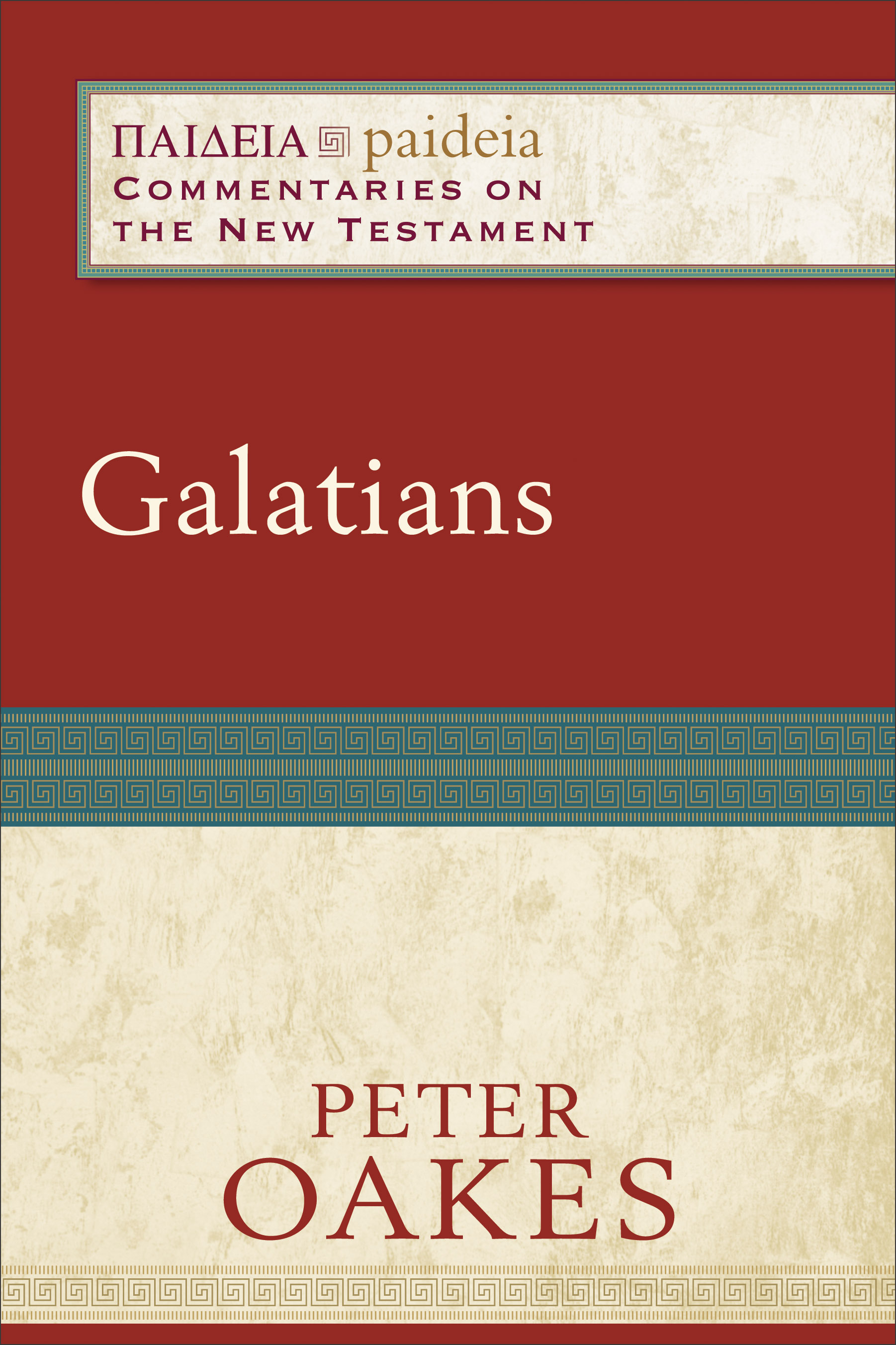
Galatians by Peter Oakes

Galatians
Paideia: Commentaries on the New Testament 
Peter Oakes
Grand Rapids: Baker Academic, 2015
ISBN 978-1-4412-4651-6
240pp


There are three important things that one needs to keep in mind when interpreting scripture: context, context and context. That of the writer’s, the audience and the present reader's as well as the social, political and cultural milieu. The Paideia series of commentaries focus on context: 
Paideia: Commentaries on the New Testament is a series set out to comment on the final form of the New testament Text in a way that pays due attention both to the cultural, literary, and theological settings in which the text took form and to the interests of the contemporary readers to whom the commentary is addressed.  
Peter Oakes, the author, is New Testament lecturer at Manchester University, he begins by ‘taking an initial look at Galatians, together with relevant external evidence such as the use of Galatians, to gather with relevant external evidence such as the early use of Galatians, to give us a provisional idea of the nature of the text.’  He arrives at fairly conservative and largely uncontroversial positions: Paul is the author writing between AD 46-61 - up to his imprisonment in Rome. He divides the main structure of Galatians into three parts: the narrative (1:11-2:21), argument (3:1-4:11) and instruction with argument (4:12-6:10). 

After each section of the commentary is a ‘Theological issues’. However, these read more like a devotional section for daily reading notes particularly when questions such as ‘What would it mean for present day Christians..?’

The strength of this commentary is its use of external evidence and the stress on the context. The text is helpfully supplemented by ‘side bars’, photographs and maps. He interacts well with more recent work on Galatians in an easy accessible style. The book will be particularly useful for undergraduates.

The most quoted authors are in order: Martinus Boer, Hans Dieter Betz, Richard Longnecker, Louis Martyn, James Dunn, Richard Hays, F.F. Bruce and Tom Wright.


We are well served with excellent commentaries on Galatians, not least Dunn, Bruce, Longnecker, Schreiner and Moo - and now to that list we could add Oakes. 

Friday, 15 May 2015

WYSOCS: Faith & Wisdom in Science with Tom McLeish 5-6 June 2015


Full details and an online booking form here.

In these three talks Tom will:

  • Ÿ outline the current ‘science and religion’ debate and its false assumptions
  • Ÿ present the Hebrew tradition of Wisdom as a resource for insights about the sciences
  • Ÿoffer a biblically-inspired framework for fruitful living, thinking and communicating in our changing world

The talks will prove invaluable for those interested in approaching the sciences from new, fresh and Christian perspectives.

Faith and Wisdom in Science, Professor Tom McLeish
Leeds City Academy, Woodhouse Cliff, Leeds. LS6 2LG

Doug Blomberg's Inaugural Presidential Address at ICS, Toronto

Saturday, 9 May 2015

Renato Coletto: Kuyper’s razor?

Kuyper’s razor? Rethinking science and religion, trinitarian scholarship and God’s eternity
Renato Coletto
In die Skriflig/In Luce Verbi 49(1) (2015).
doi: 10.4102/ids.v49i1.1891

"This article explores three research fields in contemporary Christian scholarship and argues that the way they are approached is often questionable due to the basic assumptions, the methods or the implications. The following allegations are proposed. Research on the relationship between religion and science is based on a framework of assumptions which does not reflect the biblical standpoint properly. Trinitarian scholarship expects too much from the presumed correspondence between Trinity and created reality, whilst it tends to neglect other resources available to Christian scholarship. Scientific reflection on God’s eternity is speculative in as much as it tries to transcend the modal horizon of knowledge. In these three cases (other cases are also briefly mentioned) it is argued that ‘Kuyper’s razor’ (an approach promoted in the Kuyperian reformational tradition) would help rethinking research in these areas."

Kuyper's Om de Oude Wereldzee on Dutch TV

(Re)Discovering an Evangelical Heritage

Rediscovering an Evangelical Heritage
A Tradition and Trajectory of Integrating Piety and Justice
Donald W. Payton with Douglas M. Strong
Grand Rapids: Baker Academic, 2014 
ISBN: 978-1-4412-4643-1


The original book, Discovering an Evangelical Heritage, of which this is a revised and updated diversion had its origins in a series of articles in Post American, now Sojourners (June-July 1974 to may 1975). This version adds 'Re' to the title as well as five chapter postscripts and a new introduction and conclusion. The heritage discovered was that evangelicalism had a strong commitment to social justice; personal piety didn't mean a neglect social reform and justice. He discovered a tradition of evangelical social activism that had been 'buried and largely forgotten'. Contemporary American evangelicalism is often portrayed as right wing and socially conservative, Payton through a series of case studies shows that this was not always the case. As Strong notes in his helpful and insightful introduction:
'Dayton's narrative of socially active Christians contradicted the negative reputation of revivalism as an other worldly enterprise concerned only with saving souls.' 
What is surprising in this book is the evangelicals Dayton examines. They include: Jonathan Blanchard, Charles Finney, Theodore Weld, Arthur and Lewis Taipan, Orange Scott and Luther Lee. They are all from the Arminian end of the evangelical spectrum. If Jonathan Edwards and Charles Finney can both be regarded as evangelicals - it raise the question as to how effective and/ or appropriate is the evangelical label? Is it too elastic a term to be useful? 

In his final chapter Dayton examine some of the reasons why this social active heritage has been lost among North American evangelicals. He identifies a number of issues that prompted what elsewhere Moberg terms the 'great reversal’; including: 
an institutionalisation of the movements diluted the reform impulse
complex social realities posed too much of a problem
a fatalistic, and often pessimistic, pre-millennialism replaced the optimistic post-millennialism
the growth in impact among evangelicals of the "Old School" of Presbyterianism, especially as it found expression in the "Princeton Theology" with its incarnation of conservative views. 

Not all evangelicals accept Dayton's thesis - and not just those of a right wing fundamentalist persuasion, e.g. George Marsden. Nevertheless it provides a useful insight into American evangelicalism.  Particularly helpful is the commentary by Strong - this helps place the book within its original context as well as updating the discussion.  

Tuesday, 5 May 2015

Glenn Friesen's Neo-Calvinism and Christian Theosophy: Franz von Baader, Abraham Kuyper, Herman Dooyeweerd

Glenn Friesen has a new book published:

Neo-Calvinism and Christian Theosophy: Franz von Baader, Abraham Kuyper, Herman Dooyeweerd
Aevum Books, 2015.
ISBN 978-0994775108


The blurb for the book states:

The key ideas of Abraham Kuyper’s Neo-Calvinism do not come from Calvin or from Reformed sources. Their source is the Christian theosophy of Franz von Baader (1765-1841). Among the many ideas derived from Baader are the ideas of a Christian worldview, a Christian philosophy, the idea of sphere sovereignty, opposition to the autonomy of thought, a Free University, the importance of an embodied spirituality, and the idea of our supratemporal heart, the center of our existence. Seeing these ideas in their historical context of Christian theosophy will challenge many of the current assumptions of evangelicals and reformational philosophers who claim to base their worldview and philosophy on Kuyper’s ideas or on the development of these ideas in the Christian philosophy of Herman Dooyeweerd (1894-1977).

Part 1 of this book traces the reception of Baader's ideas by Daniël Chantepie de la Saussaye and J.H. Gunning Jr., who then introduced Baader’s Christian theosophy ideas to Dutch Reformed theology. Chantepie de la Saussaye and Gunning transmitted these ideas to Kuyper, who acknowledges their influence. Kuyper refers to Baader’s writings with approval, and incorporates many of his ideas.
Part 2 is a history of the development of Dooyeweerd’s Christian philosophy, and of the very different philosophy of his brother-in-law Dirk Vollenhoven. Whereas Dooyeweerd chose to incorporate the ideas of Christian theosophy, Vollenhoven did not. They disagreed with respect to almost every idea in their philosophies.
Part 3 is a detailed examination of Dooyeweerd’s Christian philosophy. Although Dooyeweerd was not at all forthcoming about his sources, it is clear that there is a deep historical connection of his philosophy to Baader’s Christian theosophy, as well as to other mystical and non-Reformed sources. This insight allows us to understand many previously obscure parts of his philosophy and to correct previous misinterpretations of his work. It also opens the way for ecumenical and inter-religious dialogue.

Wednesday, 22 April 2015

Kuyperania April 2015

Cory Brock has reviewed Bratt's Abraham Kuyper in Journal of Theological Studies April 2015.  66 (1): 496-499.
doi: 10.1093/jts/flu202

He begins:

James Bratt's Abraham Kuyper: Modern Calvinist, Christian Democrat offers to the Anglophone world an outstanding and long-desired portrait of the nineteenth-century founder of neo-Calvinism. Bratt is a fair, balanced, and careful historian who makes much of Kuyper’s profound contextual insight, unique application of Calvinist theology, and lasting theological and political legacy without hiding Kuyper’s tendency towards sweeping generalization, blind hubris, and glaring defects. Bratt narrates the central tension in Kuyper between ‘the lust for labor and influence, the regimented discipline that made it good, the passion to make his voice heard [and] the insistence on doing things his way and on his schedule’. Kuyper was, perhaps, the most accomplished man in the modern era, who lived a life of endeavours equalling or exceeding those of the most ambitious.

John Halsey Wood Jr, also has a review of Bratt's Abraham Kuyper  in Journal of Ecclesiatical History 66(02) (April 2015): 454.

The April 2015 issue of Themelios 40(1) has two relevant reviews:

Christopher G. Woznicki on Kuyper Center Review 4.
Robert Covolo on Kuyper's Scholarship

Saturday, 18 April 2015

An interview with Willem J. Ouweneel.

The latest addition to the All of life redeemed pages is Willem Ouweneel. The author of several books recently published by Paideia Press.

He kindly agreed to be interviewed.


Could you please tell us something about yourself?

Apart from my biography on AoLR: I am married to Gerdien. We have four children and eleven grandchildren. My great passions are preaching, teaching and writing (and music - see below). My religious background is Plymouth Brethren. Officially I still belong to them, although I preach most of the time in a great variety of denominations.


You work have recently had four books and two more on the way published by Paidiea Press. Could you tell us something about the background to the books - how did they come about? And when are the rest of the series to be published?

My Canadian publisher, John Hultink of Paideia Press, invited me to write several books on several subjects, and then soon one book followed the other... Ten manuscripts are almost finished by now.


You are obviously very prolific in your writings over 160 books published. How do you manage to produce so much - what's the secret?

(a) I started early, (b) I write fast, and (c) I spend most of my time writing.


Your books are written from a dooyeweerdian perspective - where did you first come across this philosophy and why do you find it so helpful?

In many theological books, such as Bible commentaries, there is no "Dooyeweerdian perspective" at all. - In the seventies, I began studying philosophy, and through friends came across writings by Dooyeweerd and his associates, and was fascinated by them.


You differ from Dooyeweerd in that you split his psychic mode into the sensitive and the perceptive - why do feel this is necessary? How have other other dooyeweerdians reacted to this?

I believe the perceptive and the sensitive cannot be reduced to each other, or to a common denominator. Moreover, the sensitive seems to presuppose the perceptive, not the other way round. - I have to admit that I know of no philosophers or psychologists who have adopted my point of view.


You have three earned degrees - why did you choose to do that? Most people find that one is onerous enough, let alone three in three different countries! 

I began with biology, but discovered that I became more and more interested in the great philosophical questions preceding it. So I studied philosophy too. In theology I had been interested all my life. I am the opposite of a specialist (someone who knows virtually everything of virtually nothing): as a generalist, I strive to know virtually nothing about virtually everything. I would have loved to study psychology, musicology and linguistics as well... Please notice that in all three fields in which I obtained degrees, I have done academic work.


Who are the people that have most influenced you and in what ways?

To begin with, the great writers among the Plymouth Brethren (Darby, Kelly, Mackintosh, Grant, etc.). Later also theologians from all the great denominational strands, mostly Evangelical (such as C.S. Lewis) and Reformed (Bavinck, Berkouwer etc.). In philosophy, Dooyeweerd and the great dooyeweerdians.


I notice in the Dutch wikipedia entry on you it notes that you have moved from a creationist to a more guided/ theistic evolution position. Is that right? If so what prompted the shift?

That is not entirely correct. I got disappointed in many "results" of creationist research, but keep an open mind when it comes to the exegesis of Genesis 1-3.


What do you do for fun?

Genealogy (I know about 5000 ancestors of my children) and classical music (I love listening to it, but also singing in all the great classical religious choral works, from Bach to Jenkins; I take part in about ten concerts a year).


What music do you enjoy listening to?

All classical music (from, say, Monteverdi to present), with a preference for late Romanticism and impressionism (Bruckner, Mahler, Richard Strauss, Rachmaninoff, Stravinsky, Debussy, Ravel, Janacek etc.).


What books are you reading at the moment?

I have to admit that I like writers such as John Grisham to 'distract' myself.

If you were on a desert island what two luxuries would you take with you?

A computer with internet (so that, e.g., I could listen to music via, e.g., YouTube, and could keep writing books).

Many thanks. 

Willem has a Dutch website here and tweets at @wjouweneel.


Friday, 17 April 2015

Recent Kuyperania: update on the Kuyper Translation project

The following  is a description of the status of the translation projects as of April, 2015:

1. Pro Rege: Kuyper’s three-volume work on the lordship of Christ will be published and edited precisely as Kuyper viewed them, i.e. as the application of his common grace principles. These volumes are being translated by Albert Gootjes and Nelson Kloosterman. Nelson Kloosterman is doing the editing and annotation for these volumes. Clifford Anderson is writing the introduction.

2. Common Grace: Kuyper’s seminal work comprising three volumes and totaling 1700 pages in the Dutch is being translated for the first time into English. The series is being translated by Nelson D. Kloosterman and Ed M. van der Maas and annotated/edited by Dr. Jordon Ballor and Dr. Stephen Grabill. Dr. Richard Mouw has provided the introduction. Volume one is completed and available for purchase.

3. Abraham Kuyper Church Anthology: key essays and speeches that Kuyer gave on the church have been translated. The anthology will include selections from Kuyper’s doctoral dissertation on the theology of John Calvin and John a Lasco; various treatises and sermons such as the Twofold Fatherland and Address on Missions; and selections from Kuyper’s larger works on the church, such as Kuyper’s commentary on the Heidelberg Catechism. The centerpiece will be Kuyper’s programmatic statement Tract on the Reformation of the Churches, which takes a unique approach to ecclesiology. Dr. John Halsey Woods, author of the award winning book titled Going Dutch in the Modern Age: Abraham Kuyper’s Struggle for a Free Church in the Nineteen Century Netherlands, is editing this anthology.

4. Abraham Kuyper and Islam: this volume will provide an English translation of the significant pieces that Kuyper wrote about Islam, together with one or more essays of commentary on the context and import of his thought. Dr. Jim Bratt, Professor of History at Calvin College, in conjunction with other scholars, has selected various sections from Abraham Kuyper’s two travel volumes: Om de Oude Werelde-Zee for translation. Dr. Jan van Vliet, Professor of Economics at Dordt College, is doing the translation work for this project. Dr. Bratt is serving as the editor.

 This book will provide students, scholars, pastors, and interested laity with an instructive model for observing another faith and its cultural ramifications from an informed Christian point of view. The importance of this anthology is underscored in that we are not discussing just any faith but that of Islam, when at this moment its role on the global scene is so visible and controversial, its future so significant, and its relationships with Christianity so crucial for both faiths.

5. Abraham Kuyper Business, Economics, and Care of the Poor anthologies. Plans are to translate and publish Kuyper’s major speeches and essays on these subjects in two separate anthologies. The first anthology will contain material on business, ecomonics, and personal social ethics. The second volume will include material on the care of the poor. Dr.Peter Heslam, Dr. Harry VanDyke, and Dr. Jim Bratt are assisting in the selection of material to be included in these two anthologies. Dr. Harry VanDyke will translate and annotate the material for these two volumes.

6. Abraham Kuyper on Christian Education: An Anthology of Essays is a translation of a number of Kuyper’s important essays and speeches on education. In anticipation of this anthology, we have translated and published as a teaser volume Kuyper’s Scolastica I and II-- two convocations addresses that Abraham Kuyper gave as rector of the Vrije Universiteit (Free University) in Amsterdam. In these two important addresses Kuyper shares his view of the divine purpose of scholarship for human culture. Additionally, the reader will encounter a human side of Kuyper that is not always readily apparent in his other works.

The education anthology will include Kuyper’s important essay entitled “Bound to the Word,” which discusses the topic of what being bound by the word of God means within the entire world of human thought. The Kuyper education anthology will also include extracts from important parliamentary speeches by Kuyper on the subject of education, plus a translation of Kuyper’s sixteenth article about schooling that appeared in his daily newspaper in 1880 under the title of “Antirevolutionary Also in Your Household.” Other important speeches and essays that Kuyper gave on education are included as well as material on Kuyper’s views on vouchers. Dr. Wendy Naylor and Dr. Harry Van Dyke will serve as co-editors for the Kuyper Education Anthology. Dr. Naylor, Dr. Van Dyke, Dr. John Bolt, and Dr. Nelson Kloosterman have all assisted in the selection and translation of material for this important anthology.

Friday, 10 April 2015

Two new excellent pieces from Jonathan Chaplin

Jonathan Chaplin has had two excellent pieces published very recently. They are both worth a read:

Living with liberalism in Comment

Christian Scholarship Beyond the Theological Guild Fulcrum:

"Insofar as mentoring in this kind of Christian scholarship takes place in the UK it is ad hoc and episodic. As far as I can tell it is offered from one of four sources:
  • by a rather small group of individual Christian scholars in non-theological disciplines who have intentionally equipped themselves for the task;
  • by a handful of faith-oriented research institutes in secular universities;
  • by individuals or programmes within the Cathedrals Group of 16 church-related universities and university colleges;

Tuesday, 7 April 2015

Dooyeweerd: What is religion?

What is religion?

Herman Dooyeweerd

To the question, what is understood here by religion? I reply: the innate impulse of human selfhood to direct itself toward the true or toward a pretended absolute Origin of all temporal diversity of meaning, which it finds focused concentrically in itself.

This description is indubitably a theoretical and philosophical one, because in philosophical reflection an account is required of the meaning of the word "religion" in our argument. This explains also the formal transcendental character of the description, to which the concrete immediacy of the religious experience remains strange.

If, from out of the central religious sphere, we seek a theoretical approximation of it, we can arrive only at a transcendental idea, a limiting concept, the content of which must remain abstract, as long as it is to comprehend all possible forms in which religion is manifested (even the apostate ones). Such an idea invariably has the function of relating the theoretical diversity of the modal aspects to a central and radical unity and to an Origin.

From: Dooyeweerd, H. 1953. New Critique of Theoretical Thought Volume 1. The Necessary Presuppositions of Philosophy. Philadelphia: P&R, p. 57.

Friday, 3 April 2015

A Good Friday meditation - by Abraham Kuyper

REDEMPTION THROUGH HIS BLOOD

Abraham Kuyper

In whom we have redemption through his blood, the forgiveness of sins, according to the riches of his grace (Ephesians 1:7).

At Venice, in a Roman Catholic church, officials will show visitors a drop of Jesus’ blood, spattered upon a piece of cloth, carefully preserved. Whether this drop of blood was actually shed by Jesus can never be proved. That it was not is as hard to demonstrate. There is nothing to say against supposing that one of the women who followed Jesus, out of tender regard for Him, blotted up with her skirt some of the blood spattered against the cross or oozing from the thorn-pierced brow. It is not impossible to believe that this piece of cloth was carefully preserved, that it tremulously passed from mother to daughter, until it eventually passed into the hands of ecclesiastical officials.

But, even though nothing compels us to regard such a piece of cloth and drop of blood as unactual, even, in fact, if the actuality of these could be scientifically demonstrated, that bloody mark upon that piece of linen would add nothing to our faith. Granted that the blood were actual, it would not be that blood of which the apostle said that “through it” we have redemption. To those who penetrate more deeply, that drop of blood is blood no longer. Blood is a material substance which has life. When that life leaves it, when that blood congeals and dries, it is nothing more than decaying matter. It has neither life nor potency.

Hence, God’s people may not look to such a preserved particle of the blood of Christ for redemption, but must look to the red blood of Christ, to the blood of Christ when it was still blood, when Christ’s life still coursed with it, when it was still warm by reason of the life-warmth of the exertion of our Lord’s soul.

There is no atonement without blood. Hence, no one may mock the confession of the church of God which asserts that redemption comes by “faith in His blood.” The scornful laughter of the ungodly at the so-called “blood-theology” will, we fear, some day severely aggravate their suffering. Precious in the sight of the Lord is the death of His saints: How much more precious, then, the death of the Son of God? Nor are we to believe the interpretation that this love was revealed in that blood and that it is really by His love, not by His blood, that we are saved. For the love of Christ is as clearly manifest in the statement made in the counsel of peace: “In the volume of the book it is written of me, I delight to do thy will.”

No, but the Church of God must, in a literal sense, cling to the beautiful teaching of the apostles and must in quiet reverence confess that she has her redemption through His blood.

That does not, of course, mean that that blood was the source, the fountain out of which salvation flowed, or that the Lord God was first moved to reveal His grace by that blood. Those who think so are not familiar with the Holy Scriptures. The apostle adds the explanation that blood is effectual only according to the riches of His grace. That means, then, that the source of the blessedness, the fountain of salvation, lies not in the blood but in God’s eternal grace, which is superabundantly laid away as a treasure for all His elect. Nevertheless, the Church clings tenaciously to the truth that in the incomprehensible counsel of eternal grace, saving grace is in its effects attached to the blood of Christ. Let no one wishing to avoid that condemnation try to break that relationship between grace and blood. “For the life of the flesh is the blood: and I have given it to you upon the altar to make an atonement for your souls; for it is the blood that maketh an atonement for the soul.”

Hence we need not guess or conjecture, but we can know what is the seat, the source of this mystery of grace. That source lies not in the corpuscles nor in the plasma, but in the soul of the body.

An animal, or a human creature, is really a wonderful organism. One can come upon it as a composition of matter and moisture lying prostrate. Suddenly one sees it move, arise and approach. One hears sounds issuing from it, and, if it is a human being, one hears songs of freedom and of praise. How is that possible? The Scriptures say that is due to the miracle of blood. Conceive, if you can, of the creature you saw without blood. The composition of matter would crumble then and would decay. But the creature has blood. Hence it has life, unsearchable, incomprehensible life, and that life, the Scriptures say, exists in the blood. God, the Creator of animal life, tells us: “Life, the soul of the body, exists in the blood.” Hence the seriousness of illnesses of the blood; hence the fatality when thirst causes the blood to become parched. Whatever affects the blood affects the whole human being.

Everything depends, therefore, upon a true and certain knowledge that our Refuge and Mediator really poured out His blood for us. That does not mean, of course, that all of our Saviour’s blood flowed away. In fact, very little blood flowed from Jesus’ wounds before He died. It gushed forth only after the spear had been thrust into His side afterwards. Before that, a little had oozed from His whipped shoulders, a little from His thorn- lacerated brow and a little from the wounds of the nails in His hands and feet. It was not a matter of quantity, but of the soul of the body contained in it.

The certainty we needed for full assurance of redemption was this: That He poured His blood for us, that the soul of the body contained in that blood was again separated from it by death, or, in Isaiah’s words, that “He hath poured out his soul unto death.”

John appreciated our need of that assurance most. The Lord God knew that we needed it. Hence He planned it so that a brutal soldier, doing what no one who loved Jesus could have done, profaned Christ’s body by driving his spear into it. Therefore he who loved Jesus, the beloved Apostle John, seeing that brutal act, confirmed it for us preciously, saying that “he saw it” and that he saw that the water issuing from the wound was blood no longer. “Forthwith came there out blood and water.” By that statement we are assured that the soul of Christ’s body had departed from it.


Taken from: Kuyper, A. 1960. The Death and Resurrection of Christ: Messages for God Friday and Easter. Grand Rapids, MI: Zondervan, pp. 60-62.