An accidental blog

"If God is sovereign, then his lordship must extend over all of life, and it cannot be restricted to the walls of the church or within the Christian orbit." Abraham Kuyper Common Grace 1.1.

Saturday, 7 December 2013

Kuyper's Common Grace #CG1.1 Chapter 3

 Chapter 3. The Noahic Covenant was not Particular

Previously Kuyper has shown that the Noahic covenant reveals that there will be no further violent ruptures until the Lord returns. Though the same flood waters still exist God in his common grace covenant prevents another flood. The Noahic covenant means that there is rest, security and confidence for humanity. 

There is, however, a serious objection regarding this covenant and whether it concerns the world in general. Kuyper points out that Calvin shows that it is for all posterity and for all people: “A covenant of grace to all people and nations in common.” In Genesis 9 God speaks to Noah, his three sons and their descendants as well as every living creature.

Again, Kuyper stresses that it is not a covenant of particular grace bit of common grace. This is only denied by those who have a false view of spirituality. 


The flood came because of human sinfulness and depravity. Only Noah and his family were saved and only because they had the fear of the Lord. God will never flood the earth again, he will deal with sin in another way. It is through common grace that sin will be restrained. 

Enya "O come, O come, Emmanuel"

Friday, 6 December 2013

Kuyper's Common Grace #CG1.1 Chapter 2

Chapter 2. The Starting point of the doctrine of common grace

Surprisingly Kuyper begins his look at common grace not with Adam but with Noah and the Noahic covenant: "By means of that starting point with Noah, common grace, which began in Paradise acquired its more definite form".

He feels that the Noahic covenant, despite being the most detailed of the covenant in the scriptures, has been neglected and that too often we move too quickly to Abraham. The Noahic covenant has no hint of saving grace - there is no forgiveness or promise of eternal life.

Kuyper contrasts Noah with Adam. Noah, was the second progenitor of the human race, but was not the second head of our race, Noah, unlike Adam, was the fruit of himan procreation..

There are three upheavals mentioned in the Bible effected by the wrath of God: the fall, the flood and the Maranatha (the return of Jesus). The fall resulted on a curse, thorns, wild animals and Paradise vanished; in the flood water played a key role but there is now new conditions, which will remain until the Maranatha. The third catastrophe will be different in that the first two caused disaster but the third will bring restoration.

We are not given many details of the pre-flood condition of the earth other than that there was an increase in violence and people were living for long lives; only Noah's family were God fearing. The implication is that without God's intervention there would eventually be no church. God's intervention was common garce aquiring a definite form.


Thursday, 5 December 2013

Kuyper's Common Grace #CG1.1 Chapter 1

Chapter 1 Introduction

Kuyper had recently completed a series of articles in De Heraut, on particular grace. Here he compares particular and common grace. Particular grace deals with the individual person being saved, it is saving grace. Common grace is neither individual nor saving. 

Individuals are also “part of a community, member[s] of a body, … enclosed within an organism” (8) and thus particular grace must be understood within the context of the covenant. There are three aspects to be considered: 
first, our personal life; second, our incorporation into the body of Christ; and third, our existence as human beings (i.e., our origin by human birth, our membership in the human race) (9)
There is then a trinitarian aspect: the Spirit is concerned with our sanctification; the Son with our redemption; and the Father with our creation. There is also a threefold aspect to grace: covenant grace expands into particular grace and common grace which expands into covenant grace.

Common grace is not then saving grace. It is “the touchstone of a general human grace, coming to you because you are among the children of humanity, yours together with not only all God’s children but in common with all the children of humanity” (p 11).
Kuyper chose common rather than general to modify grace in order to prevent misunderstanding that he was undermining particular grace, and hence his efforts here to stress that common grace is not saving grace.

“In itself general grace carries no saving seed within itself and is therefore of an entirely different nature from particular grace or covenant grace. Since this is often lost from view when speaking about “general grace,” to prevent misunderstanding and confusion it seemed more judicious to revive in our title the otherwise somewhat antiquated expression, and to render the phrase communis gratia, used formerly by Latin-speaking theologians, as common grace” (12).

Bavinck’s address “Common grace” (translated in Calvin Theological Journal 24(1): 35-65) is mentioned as well as the hints in Calvin, yet Kuyper maintains that common grace has not received the attention it deserves and he hopes this volume will go some way to provide a  "degree of coherence and completeness" (13).

He concludes with a summary of common grace:
outside the church grace operates among pagans in the midst of the world, this grace is neither an everlasting grace nor a saving grace, but a temporal grace unto the restraint of ruin that lurks within sin

Wednesday, 4 December 2013

Christmas together

Kuyper's Common Grace #CG1.1 Kuyper's Foreword

Foreword

Kuyper begins his foreword with this provocative statement: “The Reformed paradigm has suffered no damage greater than its deficient development of the doctrine of common grace” (3). He then goes on to lament the lack of doctrinal development that occurred in Calvinism after 1650. What happened was a “repristinating their well-worn polemic against Arminianism” (5). 

For Kuyper common grace is “deduced directly from the sovereignty of God” and is the “root and conviction for all Reformed people” (p 5). Resuscitating the doctrine of common grace, which Kuyper plans to do here, will help the believer “take hold of the plow” rather than retreat from this life. It provides the foundation for engagement with the world and so avoid spiritual and ecclesiastical isolation and so help believers exercise dominion (5).


Tuesday, 3 December 2013

Interview with Harry Van Dyke editor and translator of Kuyper's Ons Program


Harry Van Dyke, Professor Emeritus in History at Redeemer University College in Ancaster, Ontario, and Director of the Dooyeweerd Centre for Christian Philosophy, has recently completed the translation of Abraham Kuyper's Ons program. It is now available from Christian's Library Press as Guidance for Christian Engagement in Government. I caught up with Harry and he was kind enough to answer some of my questions.


Harry, could you please tell us a little about yourself?
I was born in Rotterdam and moved with my parent to Canada at the age of 12. Translating has been my hobby ever since.


Your translation of Kuyper's Ons program has recently been published. What prompted the translation and publication of the book?
While attending the annual Kuyper Conference at Princeton Theological Seminary I heard that a translator was being sought for the book Ons program. I volunteered and was accepted on condition that I submit a time schedule. I estimated it would take me 18 months and after 20 months the job was done. I could not have done without the Internet.


What is the background to Ons program?
The Dutch historian and statesman G. Groen van Prinsterer battled his whole life against the repercussions of the French Revolution in his country and the ramifications of secular humanism in Dutch politics. Pastor Abraham Kuyper inherited his position of leadership and looked for ways of making the "anti-revolutionary" movement a more effective fighting machine. He and others gave formal organization to it by means of a national political party for which Kuyper single-handedly composed a "Program of Principles." He wrote a systematic commentary on it in weekly instalments in his daily newspaper. These articles were published in a popular edition in 1880. They helped galvanize his followers and for years was an oft consulted manual for determining what political line to follow.


In what ways is a nineteenth-century political programme relevant for today?
The book Our Program is less a political platform and more a commentary on fundamental principles for engaging in politics from a biblical standpoint. These do not change, although their formulation varies of course with the concrete situation in which one finds oneself. Meanwhile it is fascinating to see how Our Program in places immediately tries to apply those principles to concrete issues of the day. Kuyper's ideas about politics are best mirrored, I think, in the careers of Gladstone in the UK and Woodrow Wilson in the USA. It opens one's mind to a rich heritage that remains inspiring.

As is to be expected after a century and a half, quite a few, if not many, of Kuyper’s notions, suggestions and concrete proposals, even if attractive, would be unworkable today. Despite his originality and his courage to row against the current of his time, he too was very much a child of his time. Ideas that were common coin in his day—such as a romantic view of national genius, an appreciation of the wholesome effects of war, a father’s exclusive headship of the family, an approach to colonial policy as the White Man’s Burden—have long since been moderated or abandoned. Equally open to question may be the apparent ease with which Kuyper detects divine ordinances in specific empirical patterns and historical growths. I would say, therefore, that the enduring value of his musings, dreams and alternatives lies, rather, in the backdrop against which he approaches the whole area of practical politics: his biblically honed common sense, fair-mindedness, indignation at patent injustices, zeal for genuine liberty, and freshness of ideas.


You have mentioned before that North Americans sometimes confuse pluralism with sphere sovereignty. Could you expand on what you mean by this? Why is it important to distinguish the two?
There is sociological pluralism and worldview pluralism. The first distinguishes the plurality of unique structures and relationships (spheres) that compose human society and that are each subject to distinct laws and norms which must be respected (their sovereignty honored) if society is not to become unhinged. The second recognizes that humanity is divided over a plurality of religiously defined worldviews that cannot be treated with coercion but only persuasion, hence demand parity treatment or a level playing field so that each can speak up for its convictions and try to shape society in accordance with them without disadvantage or penalty. To confuse these two pluralisms is to commit a category mistake, which in this case can lead to misconstruing Kuyper's career and goals at several points.


What started your interest in Kuyper?
 It's all providential, really. I attended a Reformed day school in Holland, followed by a public high school in Ontario where I experienced the "antithesis" in outlook and learning. I then enrolled in Calvin College in Michigan where Evan Runner became my mentor. My graduate work was done in the Free University of Amsterdam, where I ended up as an instructor in the theory and philosophy of history under the guidance of Meyer Smit. Returning to Canada, our family settled in Hamilton, Ontario, and I taught history for a quarter century at Redeemer University College, an undergraduate school based on Reformed Christianity. Since my retirement I have been involved as a co-editor of the Collected Works of Herman Dooyeweerd. Translating Kuyper texts is more or less a sideline. You should know that my published dissertation was dedicated to the memory of my grandfathers "in whose home I first saw the portraits of some of the leading anti-revolutionaries who appear on the following pages." That book, my only one, dealt with Groen van Prinsterer's lectures in 1845/46 on Unbelief and Revolution, a work that marks the birth-cry of the anti-revolutionary movement in the Netherlands. I guess you could say about me that neo-Calvinism was bred in the bone.

What would you say is the essence of neo-Calvinism?
That Christ came to redeem the world, of which humanity is a crucial part, but only a part.

There seems to be a resurgence in Kuyper studies - several major books have been published this year on or by  Kuyper. What do you think has sparked off this resurgence?
Ever since the Chicago Declaration of 1993, American evangelicals have been searching for a full-bodied "public theology," a system of thought that helps analyse the challenges posed by a secularizing public arena. One source that has now been (re)discovered is the work of Abraham Kuyper, especially his elaboration of the doctrines of common grace and the antithesis - common grace creating the possibility and the obligation to engage in the world's affairs, and the antithesis defining the manner in which to do so as a Christian alternative or "third way." As well, when Princeton celebrated the centennial of Kuyper's famous Stone Lectures on Calvinism, it expected 40 people to attend, but 400 came! Soon after, a retired banker endowed a Kuyper Chair at Princeton Seminary, where for the past ten years a student can choose an ethics course, besides Dietrich Bonhoeffer and Karl Barth, in Abraham Kuyper. A Kuyper Study Center there is now equipped with many materials to which researchers are drawn for months on end.


What advice would you give to someone who wants to study more about Kuyper? 
Learn Dutch! Hah, fond hope. No, start with Abraham Kuyper: A Centennial Reader that came out with Eerdmans and the Paternoster Press in 1998. Then read some recent publications by Richard Mouw and the well-researched biography of Kuyper by James D. Bratt. Other good books about Kuyper are by Vincent Bacote and James E. McGoldrick. Get your library to subscribe to the Kuyper Center Review that comes out of Princeton.


Are there any other projects in the pipeline that you are working on?
Four of us are doing pieces for an anthology of Kuyper's writings on education.

What do you do for fun?
Translate, play the harmonium, read historical novels, do crossword puzzles.

What music are you listening to at the moment?
Bach's trio sonatas played by blind organist Helmut Walcha.

What books are you reading now?
The Lemon Tree by Sandy Tolan and a novel about the War of 1812 by David Nevin.

If you were on a desert island and were allowed two luxuries what would you take?
Oh sure, a pipe organ and a New King James Version of the Bible in gilded leather.


Thanks Harry for taking the time to respond to my questions.

Monday, 2 December 2013

Kuyper's Common Grace #CG1.1 Preliminaries

In 1895 Abraham Kuyper began a series of newspaper articles on common grace. They were completed in 1901 and were then published in book form as De Gemeene Gratie in 1902.13, 1903.13 and 1905.08. Now in 2013 we have the first part of volume 1 translated into English as Common Grace. In the following weeks I'll be posting a summary/ review of this excellent book.

Kuyper began these at the peak of his career, the books were published when he was prime minister. The first volume of the English translation covers the first third of the first Dutch volume (from Noah to Abraham). The first Dutch volume covers the historical sections. The complete English translation will be in ten volumes - it is proposed that the tenth will be a comprehensive index.

This volume of dedicated to Dr Rimmer De Vries. It is translated by Nelson Kloosterman and Ed M. van der Maas on behalf of the Abraham Kuyper Translation Project and the Acton Institute. There is a foreword by Jordan Ballor and Stephen Graybill the editors, and an introduction by Richard Mouw. The books has 29 chapters in 249 pages.

The editors note that “There is often a temptation, particularly among evangelicals, to engage in social reform without first developing a coherent social philosophy to guide the agenda” (xi) They hope that Kuyper’s idea of common grace will help to provide that social philosophy. They see common grace as the “capstone of of Kuyper’s constructive public theology” (xi).


In his introduction Mouw describes Kuyper as an activist (xxix) as well as churchman (xxiv) and  “multi-tasker” (xxiv) who did “theology on the run”(xxiv). Mouw stresses that Kuyper with his emphasis on common grace does not reject the notion of the antithesis. Kuyper was a good Calvinist and held to the doctrine of “total depravity”. Kuyper saw his common grace project as a development of Calvin, though Calvin never used the term common to preface grace, he seems to prefer the term “peculiar”. Mouw is keen to stress this continuity between Calvin and Kuyper. Indeed this is something that Kuyper acknowledged. Mouw sees Kuyper’s common grace as “a divine strategy for bringing the cultural designs of God to completion” (xxv).

Sunday, 1 December 2013

Kuyperania Stop Press: Guidance for Christian Engagement in Government ed and translated by Harry van Dyke

Available here.

Abraham Kuyper’s Our Program was originally written to inform people participating in the Dutch general elections of 1879. The French Revolution was long over, but not its ideas. The influence of modern life and its secularizing influence was growing and reshaping the minds and hearts of Europeans and the rest of the Western world. What should the Dutch people believe and understand on the basis of Scripture, sound reason, and common sense?

Kuyper reminded them of their Dutch Calvinist heritage and the legacy left to them by the freedom fighters against Spanish tyranny in the sixteenth century. But Kuyper wisely concluded that they should not strive for a “Calvinist utopia” but rather for a pluralist state, one in which all groups enjoy a level playing field as they try to enlist support for their vision of a just society. So he laid out the intellectual architecture of what we now call “sphere sovereignty,” an ordering principle that takes on new and contemporary relevance as globalization reorganizes governmental and nongovernmental jurisdictions.

Kuyper’s antirevolutionary (or Christian-historical) vision attempts to remedy the failure of modernity to satisfy the human spirit and its propensity to establish monstrous tyranny. As the emancipator of the then still disenfranchised middle and lower classes in his country, Kuyper in this English translation of his seminal foray into political theory and practice takes his place beside Locke and Tocqueville as a titanic European intellect whose thought can help us understand the American experiment in religious liberty and constitutional democracy.

Saturday, 30 November 2013

Calvinism: A History by D. G. Hart - an Anglocentric (re)view

Calvinism: A History
D. G. Hart
Yale: Yale University Press, 2013
xii + 339 pp, hbk, £25
ISBN 9780300148794

Publisher's website.

It was Bishop John Aylmer in his 1559 book An Harborowe for Faithfull and Trewe Subjects who identified the English roots of the Reformation he wrote: “Wycliffe begat Hus, who begat Luther”. Sadly, this Englishness of the Reformation is neglected in Hart.

Hart looks at how Calvinism has become a global faith (xii). He identifies three phases:

1. Calvinism took root in settings where church reform was tethered to efforts to establish political autonomy.
2. Calvinists adopted new models for extending their beliefs; and
3. Adjusted to the rise of secular political orders prompted by the 18th century.

Calvinism was most dominant in Switzerland, the German-speaking Palatinate, the Dutch Republic and Scotland. So, inevitably these geographical areas then have the most words. However, only a few pages are devoted to the English scene (primarily pp 35-41, 83-90). At least McNeill in his History and Character of Calvinism had a chapter on England and Ireland. David Creamans’s Reception of Calvinism in England - surprisingly absent from Hart’s bibliography - would fill in some of the gaps. Sadly, though, we still wait for the definitive history of Calvinism in England.

Hart’s take on the English Puritans is interesting and worth further investigation. Their emphasis on personal holiness and pursuit of a “vein of introspective piety” replaced the “zeal for a thoroughly reformed church” (p 84). He claims that it was then responsible for the “unintended consequence” of a “high-church sacramental Anglican reaction” (p 85). This may well explain why Jim Packer wasn't asked to write a Foreword! Here perhaps in Puritainism are the roots of a privatisation of the gospel.

Despite the title this book is more a history of Presbyterianism than Calvinism. Perhaps Hart thinks that Presbyterianism is Calvinism? Which would explain the lack of Anglican or Baptist emphases in the book. The gaps are easy to identify - Carl Trueman has already mentioned the lack of Baptists and Steven Wedgworth has highlighted the injustice done to Anglicans. There is no mention of Henry Atherton and the Sovereign Grace Union or D. Martyn Lloyd Jones his Calvinistic Methodist roots. Despite concentrating on Presbyterianism there is no mention of the formation of the URC in 1972 from the Presbyterian Church of England and the Congregational Church in England and Wales or even Thomas Cartwright, one of the first English Presbyterians. Or if we go more up to date there is no mention of the  aberration of Calvinism that is New Calvinism (perhaps justly so). Of course, to include all of these (and more) would probably mean that a separate volume would be needed for each country and that is not Hart’s aim. This is intended to be global and an overview - and as such it works.

Rather that the Diet of Worms it seems the Reformation started with another diet: sausage eating (in 1522)! And this is where Hart begins his narrative. He is correct that “Reformed Christianity existed before Calvin became a Protestant, and so calling the churches to which he belonged Calvinistic is anachronistic” (p 20). The story then finishes with a look at the geography of global Calvinism in the 21st century.

Sadly, there is a lack of footnotes - and the notes are few (8 pages) - so we are left to guess where some of the information has come from. There is however, a useful “Further reading” section.

Hart concludes with: “If it is not responsible for the blessings of democracy, liberty, and prosperity, in its own way Calvinism’s history qualifies as remarkable” (p 304). This book too qualifies as being remarkable in that Hart has been able to survey the complicated global history of Calvinism in less than 350 pages.

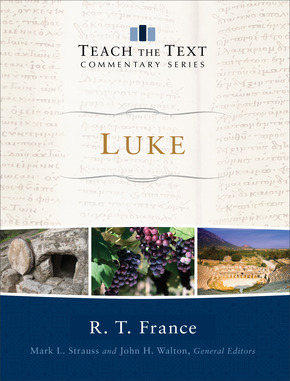
Luke (Teach the Text) by R. T. France

Luke
Teach the Text Commentary Series
R. T. France
General Editors: Mark L. Strauss and John H. Walton
Grand Rapids: Baker Books
ISBN9780801092350, hbk, 416pp,

Publisher's website here.

This book is part of a new commentary series: Teaching the Text, a commentary series aimed primarily at pastors and teachers. The series is designed to provide a ready reference for teaching the biblical text. Each chapter of Luke, like others in the series, has a section in the commentary and each chapter is divided in to sections:

1. The Big Idea - as a sub heading
2. Key themes - in a side box

And then the main three sections:

3. Understanding the text
4. Teaching the text
5. Illustrating the text.

The text is in two columns and is well illustrated with colour photographs and images.

In the "Understanding the text" section each chapter is placed in its context, there is usually an outline of the text, and brief discussion of the historical and cultural background and finally, the main focus, interpretative and theological insights.

The "Teaching the text" section offers helpful ideas on applying the passage. "Illustrating the text" offers appropriate suggestion from resources such as poetry, other scriptures, films, news stories, books and object lessons. The layout makes it accessible and easy to use.

R. T. France (1933-2012) was an excellent choice to write this commentary. He has already produced a superb commentaries on Mark and Matthew. He was an astute and wise commentator letting the biblical evidence shape his views and approach. He takes the traditional view that Luke-Acts is one work composed, most likely, by Luke, a non-Jewish physician who had excellent Greek and was an associate of the apostle Paul. He sees this Gospel as being more than a "simply revised version of Mark". He thinks that dating Luke is problematic. Acts was written before the Neroian persecution ( AD 64-65), which suggests the Gospel written before that; however, Luke (in ch 19-21) seems to be familiar with the Roman siege in AD 70 and if Luke was reliant upon Mark and Mark was written in AD 60 then a later date may be possible. On balance France favours the earlier date.

Luke is a man with a message - the message of salvation. A message that was for all that were lost including the marginalised and disadvantages, even for the tax collector and Gentiles. France successfully brings out these themes. This is particularly evident in Luke 4:14-30, what France terms “Jesus’s manifesto”. Here the Big Idea is:
Back in Nazareth, Jesus sets out his mission of deliverance, but his own townspeople in Nazareth reject him because of his vision for salvation of fall people everywhere, which includes the Gentiles.
France maintains that “the Nazareth sermon plays out in miniature the whole ministry of Jesus, including his proclamation of the gospel in the power of the spirit and his ultimate rejection by his own people.” He suggests that it would be helpful to go through the quoted Isaiah passage and “point out how each of the statements there find expression in Jesus’s later ministry”. To illustrate the text he provides vignettes of Martin Luther and Gandhi, anecdotes told by Leighton Ford and John Killinger regarding Mother Teresa and D. T. Niles respectively, as well as a quote from Extreme Righteousness by Tom Hovestol.

In many ways France’s description of Luke could also apply to France and this commentary: “his aim is to write reliable, accurate history, set out in an acceptable literary form, and he went to considerable pains to ensure that he was as well informed as he could be”. The literary form of this commentary and France’s reliability and considerable pains will certainly help preachers to be better informed before they go on to preach from Luke.

Thursday, 28 November 2013

Recent Kuyperania (November 2013 part 2)

Brett McCraken (Gray Matters) is interviewed on the Acton blog and discusses the influence Kuyper has had on him.
Kuyper’s emphasis on God’s sovereignty over all creation has been huge in informing my own theology of culture. I grew up with a pretty defined sense of “sacred” vs. “secular,” and like many in my generation of evangelicals, I grew up consuming mostly “Christian” music, books, movies, etc. But Kuyper argues that we should have a broader view of what God can redeem.
Literacy Licensing, LLC have released reproduction of two of Kuyper's works: Lectures on Calvinism and The Implications of Public Confession. Both at rather inflated prices. 

Kuyper's Encyclopedia of Sacred Theology has also been reproduced by Nabu Press - again at an overinflated price, particularly as it's available free as a pdf on the Internet!


Bruce Wearne has reviewed two books by Richard Mouw and Kuyper in America in Zadok
Perspectives (Spring 2013): 23-25. Bruce asks some pertinent questions at the end of his reviews:

 These books lead us to ask: Has the failure of Kuyper’s world view to ‘take hold’ among North American evangelical and reformed Christians anything to do with the traditional tendency, endorsed ambiguously by Richard Mouw, that a ‘Christian world view’ is primarily a matter of theology? Does Kuyper’s exposition of a Calvinistic world view actually provide guidance to those wanting to understand why his views have not really caught on?

Saturday, 23 November 2013

Why Study History? by John Fea

Why Study History?
Reflecting on the Importance of the Past

John Fea
Grand Rapids: Baker Academic, 2013
ISBN 9780801039652
Publisher's website

What is history? Why bother studying it? John Fea has written this accessible and jargon-free book to address these questions. He helpfully focuses on “the pursuit of history as a vocation” (ix).

His aim is to provide a primer on the study of the past. Its intended audience is “Christian college students who are studying history” (ix), but it would be a shame if those were the only ones who read it.

Fea writes with wisdom and insight and provides a helpful introduction for history undergraduates and for those who would like to study history. Fea is a Professor of American history at Messiah College, he is also the author of Was America Founded as a Christian Nation?, and so it is inevitable that his illustrations draw from that country. This has the down-side of making it less accessible for those who study non-American history.

Particularly helpful was the discussion on providence and history. How are we to interpret history from a Christian perspective? Can we have a God-perspective on history? Some would claim to, Fea is more sceptical. God obviously intervenes in history, but can the historian be true to her calling and interpret events as God interventions? Fea believes in providence (p 67) but contra Steven Keillor, is sceptical about providential history. He looks at one contemporary popular providential history book, that of The Light and the Glory by Marshall and Manuel. These authors write a Christian history focused on the sovereignty of God (p 74). Fea maintains that “An appeal to providence in a historical narrative like that of the East River fog of 1776 fails to help us better understand what happened on that day, and one of the historian’s primary tasks is to aid our understanding of the past” (p 78). My concern is that this could lead to the historian practicing methodological naturalism but on the other hand the danger is that providence can become what is beneficial to the one describing it. (p 81) Fea is right though when he states that we need to approach history with a “sense of God’s transcendent mystery, a health does of humility, and a hope that one day soon, but not now, we will all understand the Almighty’s plan for the nations" (p 81). Again to quote Fea: “historians are not in the business of studying God; they are in the business of studying humans” (p 85).

Providence, may not then be a useful tool for the historian but there are others that Fea reveals; these include: the idea that humans are created in the image of God; the reality of human sin; an incarnational approach to the past; the role of moral reflection in historical work. There is a good emphasis on the need for the historian not to preach or moralise.

As Fea states “the Christian church is in need of a history lesson”. He obviously has a passion for history, and this passion comes through. He also has a very high regard for history for him history is: “a discipline …the art of reconstructing the past .. the exciting task of interpretation” (p 3); “more about competing perceptions of the past event or life than it is about nailing down a definitive account of a specific event of life” (p 16); “a discipline that requires interpretation, imagination, and even literary or artistic style” (p 29); “the glue that holds communities and nations together” (p 37); “like being swallowed up in an immense ocean or field and losing oneself in its midst” (p 60); “essential for producing the kind of informed citizen, with the necessary virtues and skills, needed for our society to thrive” (p 116). “Doing history is not unlike the kind of ‘disciplines’ we employ in our spiritual lives—disciplines that take the focus off of us and put it on God or others (p 132). History has the power to civilise us and to transform. Sometimes I think he overstates the case, but nevertheless he makes some excellent points.

The final chapter takes a look at what those with history degrees are doing now (adapted from here). History degrees obviously prepares people for a wide range of vocations. The epilogue is a heart-felt appeal for “historians who are willing to go into churches and listen to people” to the benefit of the historian and the church. To this end, in an appendix, he makes an appeal for a “Center for American history and a civil society”. I hope it comes to fruition.

This book will help all budding historians be better historians.


Contents
Prologue
1. What Do Historians Do?
2. In Search of a Usable Past
3. The Past Is a Foreign Country
4. Providence and History
5. Christian Resources for the Study of the Past
6. History for a Civil Society
7. The Power to Transform
8. So What Can You Do with a History Major?
Epilogue: History and the Church
Appendix: A Proposal for the Center for American History and a Civil Society
Index


For other resources on a Christian approach to history see here.

Monday, 18 November 2013

Recent Kuyperania (November)

The first volume of Kuyper's De Gemeene Gratie has been translated and published: Common Grace vol 1 Part 1  Noah - Adam. Christian's Library Press, 2013.

David Carlson at Fresh Read reviews Kuyper's Wisdom and Wonder

James Bratt looks at "Transforming Kuyper" at The twelve

Abraham Cho reviews Bratt's biography of Kuyper at TGC.

The Emerging Scholars Network Blog has a review of Kuyper's Wisdom and Wonder by Dan Jesse and republishes the one by David Carlson from Fresh Read.

A. A. van Ruler on Kuyper's sphere sovereignty (translated by Ruben Alvarado - excerpted from Religie en Politiek, Nijkerk: Callenbach, 1945, pp. 373-379.)


Logos are releasing the Abraham Kuyper Studies Collection (6 vols.); a collection of five recent books on Kuyper and one by Kuyper.

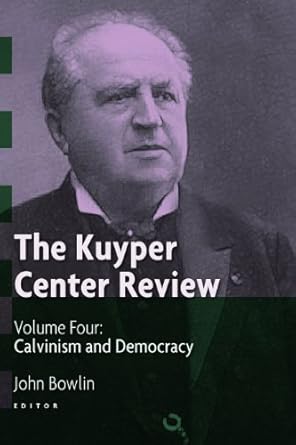
The Kuyper Center Review Vol 4 has been announced it is subtitled: Calvinism and Democracy edited by John Bowlin. It will be published in April 2014.


Music for a Monday morning - Nit Project

Friday, 15 November 2013

Kuyper's Common Grace 1.1

According to George Harink and Jordon Ballor on Twitter, the publication of the first volume (excluding Wisdom & Wonder) of Kuyper's Common Grace is now published.

Here's a glimpse of the front cover:


Update: More details on publisher's site here.

Here's the full contents of volume 1- the above is part 1 (Adam -Noah)

COMMON GRACE 

by 

Abraham Kuyper 

VOL. 1: THE HISTORICAL SECTION 

CONTENTS 
Part1?
 1. Introduction
 2. The starting point of the doctrine
 3. The Noahic covenant is not particular
 4. The spiritual and material significance of the Noahic covenant
 5. The blessings of the Noahic covenant
 6. The ordinances of the Noahic covenant
 7. The protection of human life
 8. The institution of capital punishment
 9. The institution of capital punishment (continued)
10. The institution of capital punishment (continued)
11. The institution of civil authority
12. The new dispensation

Part 2?
13. From Noah back to Paradise
14. The Paradise narrative history
15. The state of rectitude
16. The original lifespan
17. The Tree of Life
18. Natural or supernatural?
19. The crown of creation
20. Perfect integrity
21. Original righteousness
22. Conscience and the covenant of works
23. The starting point for further development
24. The language of Paradise
25. The probationary command
26. Being like God
27. Knowing as self-examination
28. Undergoing death
29. In that day
30. Forms of grace
31. Damnation and grace
32. Establishing enmity
33. Recreation
34. Decay unleashed in the heart
35. Decay unleashed in the body
36. Decay unleashed in nature
37. From Paradise to the Flood
38. From Paradise to the Flood (continued)
39. The Flood as an act of judgment and an act of grace
40. After the Flood
41. Babel’s tower building
42. The confusion of languages

Part 3?
43. Abraham’s universalist calling
44. Abraham’s history
45. Abraham and Melchizedek
46. Isolation as a merely temporary interlude
47. The great secret
48. No oasis in the wilderness
49. Symbol and type
50. Israel for the sake of the nations.
51. Jehovah and the nations
52. The Messiah and Israel
53. The light in the darkness
54. The Baptizer
55. The sparks in the pagan world
56. The sparks extinguished
57. Preference of the pagans
58. The continued effects of decay
59. Continued effects according to a fixed law
60. The process of sin
61. The final decision
62. Ongoing gains
63. Fruit for eternity
64. The connection between this and the future life
65. The relationship between this and eternal life
66. The connection of this life with the life to come
67. Review


Monday, 11 November 2013

Review of Giberson's The Wonder of the Universe

The Wonder of the Universe: Hints of God in Our Fine-Tuned World
Karl W. Giberson
Downers Grove IL: IVP Books, 2012, 216 pp. pb. £10.72
ISBN 978-0-8308-3819-6


This book is, in part, a sequel to Giberson and Francis Collins’ book The Language of Science. It aims to be a faith-friendly “science and religion” book (202), and it largely succeeds in that it treats both science and faith with respect. However, it sometimes fails to deal explicitly with the faith commitments implicit within science.

It is an accessible, easy read with a lightness of touch as one would expect from Giberson who has written or co-written eight books dealing with the interaction between science and faith. As always, Giberson writes with the conviction that science is the ‘handiwork of the Creator’ (13). He seeks to show that, on the one hand, Christians need not fear science as a challenge to faith and, on the other, that science does not necessarily lead to, or promote, atheism. His main theme for this book is that ‘our expanding view of the world around provides us with a constant new source of wonder that motivates reflection on the Creator of this world’ (25).

The first part of the book tells the ‘story’ of science from the Greeks to the big bang and quantum theory. Giberson focuses on the cosmic coincidences that make ‘the Earth is such a great place to live’. In the second part he looks more at the design arguments. He avoids the inductive approach of moving from design to a designer and rightly suggests that design arguments are ‘all-too-often based on gaps in our knowledge’. But if we believe in a designer then we should see marks of design in the creation.

At times there is almost a tacit acceptance of the belief in the progress of science and in the scientific method. We are provided with an oversimplified view of the scientific method: observation and theory are the two legs of science. Much of the discussion of observation and theory is very good and he does acknowledge the ‘complex and idiosyncratic’ relationship between the two, but he sometimes doesn’t quite go far enough. There is little discussion of the theory-dependent nature of observation (we see what we want to see) and the role of worldviews in our understanding.

Giberson has an optimistic view of science, though he does acknowledge that it ‘is a finite human enterprise with all the limitations that entails’ (125). He sees the progress of science as one that ‘extends, encompasses and absorbs rather than refutes old understandings’ (128). For him science works by consensus, but ‘there is no way to draw a clean boundary between science and nonscience’ (137) and yet he does draw boundaries when he asserts that astrology and dowsing are not science, though he is more circumspect where multiple universes are concerned. He sees science, then, in terms of a spectrum: presumably, the demarcation is by consensus; and we are encouraged to ‘trust the generally accepted picture of science’ (140). Is democracy a way of deciding truth or even science?

The book is well illustrated with black and white photographs and line drawings scattered through the text and with eight colour plates. There is a short bibliographic essay, but, surprisingly, there is no mention of Polkinghorne’s work in the bibliography – and that despite Giberson having previously written a book about him (which is mentioned; for a review see S&CB (2012)24 (1): 87; for my less effusive review see PSCF (2012) 64(4): 271).

Despite some of my reservations this is a helpful well-written introduction to the complex area of science and faith. Giberson succeeds in showing that science can be embraced as an encouragement rather than a threat to the Christian faith.


This review first appeared in Science & Christian Belief (2013)25(1).

Tuesday, 5 November 2013

Interview with Colin Wright editor of Marcel's newly translated book.

Colin Wright is the editor and translator of two new important books by Pierrre Marcel on Herman Dooyeweerd. He graciously agreed to be interviewed here.


Colin could you please tell me something about yourself?

I took my degree in Mechanical Engineering (Birmingham, 1966), about as far from philosophical studies as you can get!

When I became a Christian just before my final year at university I began the life-long task the Scriptures refer to as metanoia or changing one's mindset (wrongly and disastrously translated in English versions as repentance). After working in industry (making grinding machines) for a couple of years I decided to go to Bible college where I discovered two recent additions in the library that opened up a whole new avenue of thought. They were Francis Schaeffer's Escape from Reason and Hebden Taylor's Christian Philosophy of Politics, Law, and the State.

But the atmosphere there was not conducive to such thought and I could carry it no further. Sometime shortly after (the details after all this time are now very hazy) I found myself listening to Arthur Jones, who had recently been awarded his PhD at Birmingham. His Lecture had a profound and striking effect upon me. For clarity, precision and cogency it was light years from anything I had ever heard (and still is). As a result I began investigating. From somewhere I obtained an early typewritten copy of what was later published as Dooyeweerd's Roots of Western Culture and by the early seventies I was poring over the New Critique.

I would regard my own thought as in some respects quite distinct from Dooyeweerd. I also have a profound respect for Rousas Rushdoony (who is vastly underestimated in reformationalist circles in my opinion) and Cornelius van Til. If I slavishly follow Dooyeweerd in anything it is in his insistence that no one follow him, that we all think out our own solutions within a broad community, listening to and learning from each other.

I should add that career-wise I became a maths teacher, then a bookseller and ended up with my own computer software company.

I am now retired and looking for moments of quiet study in between the demanding attention of three wonderful grandsons.


Who was Pierre Marcel and why your interest in him?

Marcel spent most of his career as pastor of the Reformed church in Saint Germain en Laye, north-west of Paris. He wrote and published mainly practical theological works, a number of which have been translated into English. I knew of these works, especially his book on Infant baptism, long before I discovered his Dooyeweerd studies. A serious biography is sadly lacking but there appears to be no interest; maybe I should try it myself!


How did you first become interested in him?

My good friend Jean-Marc Berthoud of Lausanne not only told me about Marcel's Dooyeweerd studies but kindly obtained copies for me. When I told him of my plans he was extremely encouraging and supportive, and put me in touch with a number of people who were able to help in various ways.


How did the translation project come about?

Really quite by accident. Originally my sole intention was to produce a translation in Word document form for my own use. But to do this I needed a reliable French text. All that was available was a poor photocopy of Marcel's original typed theses. So I set about creating an edited French text. I got it into my head somehow that it might be a good idea to share this with others, especially as Marcel had so much to offer to French Christians, who were unlikely ever to get a translation of the WdW or NC in their own language.


What were the highlights and low lights of the project?

This was an exhilarating project in every way.

-The translation itself forced me to think much more carefully and deeply about Dooyeweerd because there was no way to translate Marcel without fully understanding what every phrase, let alone sentence, meant. I had to make constant reference to the New Critique and the WdW, comparing them with each other and with Marcel. I made some interesting if not intriguing discoveries and my own grasp of Dooyeweerd's thought was deepened significantly.

-I have been told I should feel proud of the achievement but what I really feel is an intense satisfaction, especially at having been involved in completing Marcel's project for him. I hope he would have been pleased with it. It is a pity he did not live to see it.

-On such a huge undertaking, even someone of Marcel's stature has to take shortcuts, and he did it where it was, seemingly, least likely to matter...in the footnotes. Unfortunately his reliance on Dooyeweerd's footnotes was a trust badly placed. In this area at least, Dooyeweerd seems to have taken little care to be accurate. Sometimes he even quotes his own work wrongly! I had to spend an inordinate amount of time checking references and expanding them; sometimes spending as much as a couple of days on a single footnote.

-The project kept opening up new vistas and it has been frustrating having to limit what I could do. I think it would have been a much better work, in English and French, if I had had the time and resources to research archives in Amsterdam, Aix-en-Provence and elsewhere. I do not doubt that there is a substantial correspondence that took place in the writing of the theses. Marcel's aim was to give the French the WdW in their own language. Lecerf had put him up to it and secured grants to enable him to go to the Netherlands to study with this as the sole aim. His interest in Marcel's progress surely did not stop there. Also, Marcel must have consulted Dooyeweerd on such a major undertaking.

-I would have liked to include a short biography in the first volume, with something of the history and development of Marcel's project. I did approach someone eminently suitable to do this for me but he was unfortunately far too busy to even contemplate it and, as I have said, I had neither the time nor the resources to do it myself.


How was Marcel's work received originally? 

Marcel appears to have made no effort to get these theses published. He gave copies to a few friends, but his pre-occupation was more theological than philosophical, more ecclesiastical than academic. He wrote and published a great deal on practical theological issues. Those who did look into his Dooyeweerd theses, such as Pierre Courthial, remarked on how brilliant they were.

How do Marcel and Dooyeweerd differ?

In his theses Marcel went out of his way to present a truly faithful exposition of Dooyewerd's thought, doing so in Dooyeweerd's own words as much as possible. He offers no critique or criticism of the Master. His intention was to bring Dooyeweerd to the attention of his fellow Frenchmen, not to teach his own slant on it. His only remark was to the effect that in so far as he understood Dooyeweerd he was in full agreement with him.


If Marcel were alive today what would he say to the church?

I haven't a clue. This is one if the many questions that could have been answered if research into the archives had been possible. There is an untold story here that opens up possibilities for research by postgraduate students of French church history.


Why should we read Marcel?

To the French I would say, this is about as near as you will get for a long time to Dooyeweerd's authentic voice in French. It is not complete, Marcel never got around to the sections on epistemology and individuality structures.

To the English I would say, don't expect anything novel here, but you will find a much better written book than the New Critique on the topics it does discuss (the transcendental critique and modal theory). If Marcel had been Dooyeweerd's editor, I believe the WdW would have been a much better book. Marcel not only carefully selected all the truly salient features; at times he quietly rearranged them and presented a much better argument.


How can we get hold of the books?

Easiest is through Amazon. In the UK that means through their subsidiary Book Depository for the best deals.

Are there anymore projects in the pipeline?

Yes, for sure. Marcel wrote a prize winning 'essay' when he was only 26. It has never been published either, and the only copy I can find is in the VU library. I am trying to get a copy to edit and translate. I have also had an ongoing project in the background for some years translating Pierre Duhem's ten volume Systeme du Monde that I would like to complete. And if God spares me, and I can get my German up to scratch, I would like to tackle Anneliese Maier's brilliant works on medieval science (also 10 vols!). Why this work has never appeared in English is one of the great mysteries - and scandals - of our time.


For more details on the books see here.


Saturday, 2 November 2013

Recent Kuyperania (Oct 2013)

James Bratt was recently interviewed about his Kuyper biography at the Reformed Forum.

Comment magazine has had a Kuyper month with these articles:

An Eclectic Inheritance: Kuyper's Politics Today by Tracy Kuperus
MINE! Kuyper for a new century by Richard Mouw
Casting Call: Abraham Kuyper and the Drama of History by Eric Miller
The Full Weight of our Convictions: The Point of Kuyperian Pluralism by Jonathan Chaplin

Joe Carter looks at "What the poor need most" with help from Kuyper

Anthony Bradley on "Kuyper on higher education"

Anthony Bradley "Presuppositions matter, so let's work together"

Two articles in Philosophia Reformata 78(1) (2013):
Roger Henderson "Gum and Wire, a Time for Everything under the Sun. From Kuyperian Root to Dooyeweerdian Fruit and Back"
Jaap Klapwijk "Abraham Kuyper on Science, Theology and University". This also appeared in On Kuyper.


Monday, 28 October 2013

Pierre Marcel: The Christian Philosophy of Herman Dooyeweerd (edited by Colin Wright)

The Christian Philosophy of Herman Dooyeweerd
Pierre Marcel
edited and translated by Colin Wright

VOLUME I: THE TRANSCENDENTAL CRITIQUE OF THEORETICAL THOUGHT
VOLUME II: THE GENERAL THEORY OF THE LAW-SPHERES


Until now available only in typewritten manuscript, Pierre Marcel's two-volume analysis of the philosophy of Herman Dooyeweerd has now been made available to the reading public in a magnificent English translation by Colin Wright.

The first volume provides a detailed analysis of Dooyeweerd’s critique of theoretical thought. Dooyeweerd analyzed the very basis of thought itself, its presuppositions; and then also the consequences of those presuppositions. The entire range of historical philosophy is taken into account, as are all the schools that manifested themselves up until the time of his writing.

The second volume provides an analysis of Dooyeweerd’s positive philosophy based on explicit presuppositions, those of Christianity. Dooyeweerd analyzes reality in the light of the framework of laws of thought embedded in the mind and in extant reality. The result is an audacious synthesis that provides a foundation for justified reason.

Marcel constructively criticizes both these areas of Dooyeweerd’s achievement in the two volumes now presented. They will occupy the top shelf of the works dedicated to the analysis and continuation of the great Dutchman’s philosophical magnum opus.

Saturday, 19 October 2013

Woodbridge and James Church History Vol 2.


Church History: Volume Two: From Pre-Reformation to the Present Day
The rise and growth of the church in its cultural, intellectual, and political context 

John Woodbridge and Frank A. James III

Grand Rapids: Zondervan, 2013
ISBN 9780310515142; 864pp; hbk; £
Publisher's website

This is a mammoth book: 2 authors, 22 Chapters covering 8 centuries, 16 pages of contents, 4 maps, 103 black and white illustrations in 843 pages. It covers the period from the “Babylonian Captivity of the Church" in 1309 to January 2012 when Boko Haram, a violent Islamic terrorist group, committed 54 murders.

The book has a number of goals: to provide an academically responsible engagement with the facts of history; to provide a global perspective; to be contemporary and relevant to the church today; not to avoid controversial issues, but not make final judgments; and to evaluate actions according to the cultural norms of the times but mindful that Christians affirm doctrinal and ethical standards that are culturally transcendent; and finally to be respectful of all Christian traditions.

Far too often history has been written by white men about other (usually dead) white men. How then does this book fare? It is written by two white men, but women do get a share - albeit a small one - of mentions. So, for example in the first chapter we have mentions of Birgitta of Sweden, Catherine of Sienna.The book aims to be global and it does avoid being too Euro and American-centric.

Inevitably, there is more focus on Protestantism than Roman Catholicism and on Europe and North America than Africa or Asia. But that is perhaps more a statement about the nature of history and the available documents rather than the book; until the nineteenth recently most Protestants lived in Europe, in 1900 81% of Christians were white - it is estimated that by 2015 this will be 30% - and in 1900 70% of all Christians lived in Europe and by 2025 this will be 20%. This global shift from Europe to North America and now to the Global South is certainly reflected in the later chapters of the book.

Why don’t Christians study more history? One problem has been a lack of good introductory resources. Woodbridge and James have addressed the that problem, they have produced a good overview of the story of history. However, as John Fea in his Why Study History? points out “Historians are not mere storytellers. Not only do they have the responsibility of making sure that they get the story right; they are also charged with the task of analyzing and interpreting the past.” Woodbridge and James are great story tellers, but at times I was wanting a little more analysis and interpretation.

Having said that though there is a brief helpful analysis of Calvin. The accusations that Calvin’s emphasis on predestination led to a lack of evangelism and missionary emphasis are examined and found wanting. They point out that “Contemporary scholars generally agree that predestination was not the wellspring of Calvin’s theology.” And they provide evidence of church growth that supports Phillip Hughes assertion that “Calvin’s Geneva was nothing less than “a school of missions … and a dynamic centre of missionary concern and activity.” (Churchman 78(4))

This is a great resource for those who want to know more about Church history. It provides enough detail in its overview to be also satisfying to undergraduates. At the end of each chapter is a “For further study” section which highlights several key books which will be helpful to those who want to take church history further.


Saturday, 12 October 2013

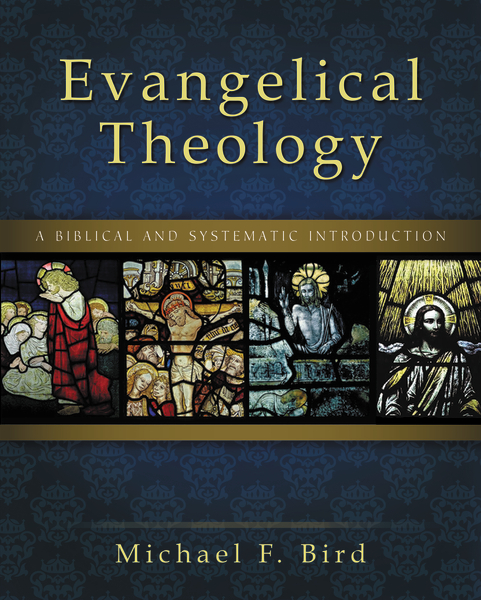
Evangelical Theology by Michael F. Bird

Evangelical Theology
A Biblical and Systematic introduction
Michael F. Bird
Grand Rapids: Zondervan, 2013.
ISBN: 9780310494416
Hbk, 912pp, £28.99


Gordon Spykman in his superb Reformational Theology describes the eclipse of creation in theology. He writes that much of evangelical theology:
gives the impression of bypassing creation in a hasty move to take a shortcut to the cross.
Michael Bird in his evangelical theology doesn’t do that. This is refreshing in an evangelical systematic theology.

What is the single most important thing in evangelicalism? Bird maintains it is the gospel - so he has written a systematic theology that reflects that emphasis. What is the goal of theology? That we would be gospelised! But this raises the question what is the gospel? Is it the redemption of creation, the escape of Christians to heaven, or what? How does Bird view the gospel? He cites with approval Al Wolters who demonstrates that “creation regained” is an underlying theme of the gospel:
The gospel envisages a comprehensive restoration of the created order so that the relational disruption between God and creation caused by the intrusion of evil can be finally resolved. … The gospel is umbilically connected to the wider concepts of covenant and creation.
Such an approach alone would justify the purchase of this book.

Comparison with Grudem’s Systematic Theology is perhaps inevitable. For me Bird's is by far the superior book.

For Grudem the focus is on what does the Bible say, for Bird it is also the engagement with contemporary theological ideas. Though this is a strength of Bird’s approach it may prove to be its weakness as it may well date it.

A look at the contents shows marked differences: Bird starts with God, Grudem with the Bible. Grudem emphasises doctrine, Bird the gospel. In comparison Grudem is lame and pedestrian. This may be in part its age. Bird is a most welcome replacement for Grudem.

I have attempted to summarise some of the differences between Grudem and Bird in the table below.

Other than Spykman’s sadly out of print Reformational Theology I can think of no better summary of theology.


Grudem
Bird
No of pages
1296
912

Cost
$49.99
$49.99

Intended aim/  purpose
 Written primarily it for students …  “but also for every Christian who  has a hunger to know the central  doctrines of the Bible in greater  depth.”

To produce a textbook for Christians that represents a biblically sound expression of the Christian faith from the vantage point of the evangelical tradition. 
Intended audience
Students and all those who want 
to know the Bible
To be accessible to laypeople, seminary students and leaders in the evangelical churches

Author’s stated theological position
Holds to a “conservative view of biblical inerrancy, very much in agreement with the “Chicago Statement” of the International Council on Biblical Inerrancy … and a traditional Reformed position with regard to questions of God’s sovereignty and man’s responsibility …, the extent of the atonement …, and the question of predestination.

Ex-Baptist post-Presbyterian Anglican.
Reformed, evangelical and Calvinist
Overview of Contents
Part 1 Doctrine of the Word of God
Part 2 Doctrine of God
Part 3 Doctrine of Man
Part 4 Doctrine of Christ and the Holy Spirit
Part 5 Doctrine of the application of redemption
Part 6 Doctrine of the church
Part 6 Doctrine of the future
 Part 1 Prolegoma: Beginning to talk    about God
 Part 2 The God of the gospel: the triune  God in being and action
 Part 3 The gospel of the kingdom: the  now and the not yet
 Part 4 The gospel of God’s Son: The  Lord Jesus Christ
 Part 5 The Gospel of salvation
 Part 6 The promise and power of the  Gospel: The Holy Spirit
 Part 7: The Gospel and humanity
 Part 8: The community of the gospelized

Prolegomena 
No
Yes

Indexes
Author
Hymn
Scripture
Subject

Scripture and Apocrypha
Subject
Author
Definition of (Systematic) Theology
Uses the following definition of 
John Frame: “Systematic theology is any study that answers the question, “What does the whole Bible teach us today?” about any given topic.

The study of the living God.
“It is the attempt to say something about God and God’s relationship to the world. It is thinking about faith from faith. In a sense, theology is very much akin to the study of philosophy, worldview, religion, ethics, or intellectual history; it is a descriptive survey of ideas and the impact of those ideas.”

Position on charismata
“all the gifts of the Holy Spirit mentioned in the New Testament are still valid for today, but that “apostle” is an office, not a gift, 
and that office does not continue today.”

 not all of the gifts and offices have to  endure ... For instance, I think it likely  that the offices of prophet and apostle,  which were eschatological ministries to  provide the “foundation” for the church  (Eph 2:20), no longer persist because  the foundation has been laid, and the  apostolic office and prophetic voice is  largely subsumed into Christian    preaching, witness, and teaching.


Position on women
“neither traditional nor feminist, 
but ‘complementarian’— 
namely, that God created man and woman equal in value and personhood, 
and equal in bearing his image, 
but that both creation and redemption indicate some distinct roles for men and women in marriage .. and in the church.

  Not made explicit here. Elsewhere in     Bourgeois Babes, Bossy Wives, and         Bobby Haircuts he argues for almost an egalitarian position. 
Position on eschatology
Premillennial and post-tribulation.
“I would seriously like to be amillennial. It  is so much simpler. It recognizes the already’ and ‘not-yet’ of biblical eschatology and avoids the eccentricities of postmillennialism and dispensational premillennialism”… “I conclude that the  biblical eschatology is best described as historic premillennialism.”


Promise Unfulfilled

Promise Unfulfilled
The Failed Strategy of Modern Evangelicalism
Rolland McCune
Greenville, SC: Ambassador Intl., 2004


McCune, writing as a self-confessed fundamentalist, looks at the rise of new evangelicalism and the split between fundamentalists and evangelicals. It’s an oversimplification but we can illustrate his view of the increasing distancing between evangelicals and fundamentalists thus:


  Andy Naselli's review and rejoinder by McCune.

Andrew Basden on Dooyeweerd's aspects and ground motives


Saturday, 5 October 2013

Job by Daniel Estes - a boon to any hard-pressed pastor planning to preach through Job

Job
Teach the Text Commentary Series

Daniel J. Estes
General Editors: Mark L. Strauss and John H. Walton
Associate Editor: Rosalie de Rosset
Grand Rapids: Baker Books, 2013.
Hbk, £18.89, 288pp.
ISBN 978-0-8010-9206-0

The book of Job has provided much inspiration for art and literature. It hasn't, however, been well served by commentaries - one blogger couldn't find more than four to recommend (Clines, Hartley, Andersen and Smick). Two new commentaries may well change that: one in the NIV application series by Walton and this book from Daniel Estes, professor of Old Testament at Cedarville University. This one is part of a new commentary series: Teaching the Text.

As the series title suggests this is no "ordinary" commentary. It is aimed primarily at pastors and teachers.
This series is designed to provide a ready reference for teaching the biblical text, giving easy access to information that is needed to communicate a passage effectively.

Each chapter of Job has a section in the commentary and each chapter is divided in to sections:

1. The Big Idea - as a sub heading
2. Key themes - in a side box

And then the main three sections:

3. Understanding the text
4. Teaching the text
5. Illustrating the text.

The text is in two columns and is well illustrated with colour photographs and images.

In the "Understanding the text" section each chapter is placed in its context, there is usually an outline of the text, and brief discussion of the historical and cultural background and finally, the main focus, interpretative and theological insights.

The "Teaching the text" section offers helpful ideas on applying the passage. "Illustrating the text" offers appropriate suggestion from resources such as poetry, other scriptures, films, news stories, books and object lessons.

For example, for Chapter 6 (Job's frustration with his friends), three key points are identified (with the following illustrations): "God want us to be candid before him and to put words to what is in our hearts" (Jer 2 and 2 Cor); "We must correct any distortions in our view of God" (Moby Dick by Melville); and "We must depend on God when friends are disloyal or fail us" (Count of Monte Cristo by Dumas and the poem "Invictus" by Hemmingway).

Sometimes these seem a little stretched and moralistic but the time-pressed preacher may appreciate them.

Throughout the book Estes offers wise and insightful advice about preaching Job, for example:
It is helpful to begin a study of Job with an overview of the book as a whole. The prologue should be analyzed in detail to provide an interpretive lens through which to view the rest of the book. As the speeches unfold in the long dialogue section, they should be related back to the synthesis of the book. If this is not done, then the faulty statements and arguments by Job and the other speakers can be wrongly taken as truth, when in fact a careful consideration of what the entire book teaches unmasks them.
Estes draws upon his considerable experience in Old Testament to provide a useful resource particularly for preachers. This book will be a boon to any hard-pressed pastor planning to preach through Job. It is an accessible and helpful commentary, anyone who wants to get to grips with the book of Job would benefit by reading this book. One suggestion is that the publishers provide the images and text outlines online, thus saving even more time and energy for the preaching pastor.