An accidental blog

"If God is sovereign, then his lordship must extend over all of life, and it cannot be restricted to the walls of the church or within the Christian orbit." Abraham Kuyper Common Grace 1.1.

Thursday, 2 May 2013

On Kuyper mentioned in CRC News


The name of Dutch journalist, theologian and politician Abraham Kuyper has long been familiar in Reformed circles and is increasingly so in the broader evangelical world.
The Dordt College Press has recently published On Kuyper: A Collection of Readings on the Life, Work and Legacy of Abraham Kuyper, a collection of essays examining how he influenced Christians’ thinking about church, culture, gender, common grace, education, politics, scholarship, fashion, art, science, and evolution throughout the last century.
“Kuyper’s vision has continued relevance for Christians today,” says John Kok, Dordt’s dean for research and scholarship and co-editor of the book.
“People take his ideas seriously, even if they don’t agree with everything he said.”
He said he believes that the book is a valuable resource for those who want to think about implications of faith for contemporary thought and social action.
Steve Bishop, who runs the website All of Life Redeemed, is the  other editor. He and Kok gathered and edited 31 articles, some in print for the first time, from 28 authors who use a Kuyperian framework to critique and to develop Christian perspectives on a broad range of topics that relate to how Christians live in today’s world.
The book gives an introduction to Kuyper's life and thought through the eyes of others. They range from articles titled “How Abraham Kuyper Became a Kuyperian” to “Common Grace and Christian Action in Abraham Kuyper” to “Rehabilitating the State in America: Kuyper’s Overlooked Contribution.”
The breadth and scope of these articles stand as testimony to Abraham Kuyper's desire to see the lordship of Christ extend to every area of life, say the editors.
Twenty-seven of the 31 articles have been published previously, some of them obscurely and not readily accessible.
Four of the articles have never been published and contribute significant insights into Kuyper’s thought, says Kok. The book brings all of these resources under one title.
The book comes out at nearly the same time as a new biography on Kuyper by Calvin College history professor James Bratt. Released today, on May 1, by Wm. B. Eerdmans Publishing Co., the biography is titled Abraham Kuyper: Modern Calvinist, Christian Democrat.

Saturday, 20 April 2013

Two of Irving Hexham's books on-line

Irving Hexham has made available two of his books - one co-written with Karla Poewe - available as pdfs on his Understanding World Religions website. These are some of the best introductions to religions and the cults. Possibly the best introduction is Irving's latest book Understanding World Religions.


Friday, 19 April 2013

Politics and prose: two new books on Kuyper reviewed by Byron Borger

The first review of On Kuyper has been spotted. This is from Bryon Borger, he reviews Bratt's excellent biography of Kuyper and On Kuyper. This is what he says about the latter:


On Kuyper: A Collection of Readings on the Life, Work & Legacy of Abraham Kuyper is an indispensable resource for those wanting to discern the implications of Kuyperianism for contemporary thought and social action. While it may not be a page-turner like the epic new biography by Bratt, it is the best anthology of essays about Kuyper to date. Compiled by individuals deeply rooted in the neo-Kuyperian movement, the collection features some of the most astute Christian intellectuals of the last half a century ruminating on, and in some cases incisively dissecting, important details of Kuyper’s perspective and programs.
John Kok, an esteemed philosopher at Dordt College, and Steve Bishop, a feisty cultural critic and teacher who maintains the neo-Calvinist website allofliferedeemed.co.uk, have brought together in one major volume the world’s finest Kuyperian scholars, from philosophers like Dooyeweerd, Zuidema, Klapwijk and Strauss to theologians, churchman, political theorists, and historians.  The collection also has excerpts from biographies, scholarly articles, and popular speeches, along with several pieces never before published in English, and a few introductory essays about Kuyper’s life, including one by his daughter, Catherine.
Many of the chapters explore specific aspects of Kuyper’s work such as Mary Stewart Van Leuween’s detailed study of Kuyper’s writings on women, Del Ratzch’s report of Kuyper’s view of evolution, Peter Heslam’s chapter on Kuyper’s view of the arts, and George Harinck on the legacy of Kuyper in South Africa. There are numerous pieces on the tradition of Christian Democracy, Kuyper’s statesmanship, and anti-revolutionary politics. James Skillen’s chapter shows how Kuyper’s framework shaped CPJ’s significant contribution to welfare reform.  
Pondering the treasures of these two new Kuyperian books will help us clarify how to think about and propose fresh policy initiatives in ways that are different from conventional liberal or conservative ideologies and will help CPJ be true to its heritage and calling.   
-Byron Borger runs Hearts & Minds Books. Capital Commentary readers can get a 20% discount on books listed here by ordering through Hearts & Minds.

The full review is here.

Saturday, 13 April 2013

Odds and sods

Jeremy Ive has series of three excellent YouTube videos describing the basis of a Christian worldview: Elements of a working Christian philosophy

Jonathan Chaplin debates debates "A Secular Society: Should faith play an active role in public debate?" with the National Secular Society's Alistair McBay:


On Kuyper: A Collection of Readings on the Life, Work & Legacy of Abraham Kuyper is now available from amazon.co.uk (£23.60) and the bookdepository (£23.59). Expensive but great value for  money!


Anthony Smith looks at Jamie Smith's Desiring the Kingdom

Why scholars tend to be awful writers!

Peter Escalante looks at the two kingdoms debate

Douglas Groothius reviews Bill Edgar's Schaeffer book

Wednesday, 3 April 2013

Eric Miller's Christianity Today review of Bratt's Kuyper biography

Christianity Today have published a review of Bratt's soon to be released biography of Abraham Kuyper by Eric Miller entitled: "Father Abraham: Meet the Dutch neo-Calvinist who helped birth an enduring intellectual movement."

Miller writes:
Bratt is an invaluable guide, with a sprightly, erudite style and a sharp grasp on Kuyper's sprawling career and writings. To be clear, this is anything but a heroic gloss; Bratt's Kuyper is prescient, canny, profound, and flawed. 

Keep calm ...


Monday, 1 April 2013

Five new Kuyper books for 2013


2013 is proving to be an excellent year for Kuyperania.
Five new books have been recently announced:

On Kuyper: A Collection of Readings on the Life, Work & Legacy of Abraham Kuyper, edited by Steve Bishop and John H. Kok. Sioux Center: Dordt College Press. (April)

Rooted and Grounded: The Church as Organism and Institution, by Abraham Kuyper. Christian's Library Press. (March)

Abraham Kuyper: Modern Calvinist Christian Democrat, by James D. Bratt. Grand Rapids: Eerdmans. (May)

Abraham Kuyper: A Pictorial Biography, by Jan de Bruijn. Grand Rapids: Eerdmans.
(August)

Going Dutch in the Modern Age: Abraham Kuyper's Struggle for a Free Church in the Netherlands, by James Halsey Wood Jr. Oxford: Oxford University Press. (May)


Links thanks to Gregory Baus:

2: Rooted&Grounded
http://www.clpress.com/publications/rooted-grounded

http://www.amazon.com/Rooted-Grounded-Organism-Institution-ebook/dp/B00C0DI2ZK

3: AK: Modern Cal XianDemocrat
http://www.eerdmans.com/Products/6906/abraham-kuyper.aspx

http://www.amazon.com/Abraham-Kuyper-Calvinist-Christian-Religious/dp/0802869068

4: AK: Pictorial Bio
http://www.eerdmans.com/Products/6966/abraham-kuyper.aspx

http://www.amazon.com/Abraham-Kuyper-A-Pictorial-Biography/dp/0802869661/

5: Going Dutch
http://www.oup.com/us/catalog/general/subject/HistoryWorld/European/?view=usa&sf=toc&ci=9780199920389

http://www.amazon.com/Going-Dutch-Modern-Age-Netherlands/dp/0199920389

Tom Wright bargains

Several of N. T. (Tom) Wright's books are available for free on Scribd and cheaply under (£1.50) as kindle files:

Scribd

Simply Christian
Jesus and the Victory of God
What St Paul Really Said
The Last Word

There may well be (c) issues with the above so take care.

Kindle
Simply Jesus
How God became King

Both available for under £1.50.

N T Wright Simply Christian available on Scribd!

Sunday, 31 March 2013

He is risen!

Happy Easter all!

Evidences for Jesus’ Resurrection

It is difficult to maintain that Jesus rising from the dead is a myth, legend or an invention. The evidence contradicts this: the gospels were written within a generation of his death and there are (admittedly disputed) non-Christian sources.

Some have suggested that it was not Jesus that died on the cross but someone else – if this were the case then why didn’t anyone spot it? How could the Roman and Jewish leaders be fooled? And then why not produce the body of the supposed Jesus to prove their case?

There are two main problems for those who want to suggest that Jesus did not rise from the dead: the empty tomb and the actual appearances of Jesus.

I THE EMPTY TOMB

1. His body was stolen

There are, at least, three problems with this hypothesis:
i. The character of the disciples, they were too scared to do anything at the time and such actions would be inconsistent with their subsequent high moral teachings
ii. Then they were prepared to die - and some did die - for a lie.
iii. Guards at the tomb – how did the disciples overcome them and persuade them not to say anything?
iv. The way the grave clothes were in the tomb suggests the body came through them. If the body was stolen why would they leave the grave clothes?

1.2 The Jews or Romans stole it
Why then did they not produce the body and stop the disciples preaching that Jesus had risen from the dead?

1.3 Grave robbers
Why go to a guarded tomb? They were only interested in money – why steal a body?

2. The wrong tomb

This implies that the Romans were guarding the wrong tomb – they weren’t so incompetent!
Why not then go to the right tomb and produce the dead body?

3. Jesus didn’t die – the swoon theory

The Romans were crucifixion experts; they did it regularly and so would know from experience when someone was dead or not.
When a spear was put into his side, water and blood came out – which suggests his lungs had collapsed and had died. The soldiers didn’t break Jesus’ legs which suggest that they knew he was already dead.
Jesus had been tortured before he was hung on the cross, he had had little or no food and water for a few days, he was placed in a cold tomb and yet he must have been able to remove the large stone in front of his tomb get past the guards, walking on wounded feet and then convince everyone that he had risen from the dead and had victory over death! Almost as great a miracle as rising from the dead!!

II. JESUS’ APPEARANCES

It has been suggested that Jesus’ appearances were hallucinations, pathological or psychic experiences. There are a number of problems with this.

1. These types of experiences seem only to happen to certain types of people and yet he appeared to 500 people at once, according to the apostle Paul.

2. Hallucinations tend to be individual, it is unusual for two experiences to be the same and yet it appears that the 500 saw the same thing.

3. Psychic experiences seem to occur in suitable times and places and yet Jesus appeared at all different times and places.

4. Hallucinations increase or decrease in occurrences and yet Jesus appearances occurred for forty days and then suddenly ceased.

5. Jesus after his resurrection broke bread and ate with people, he had physical marks on his hands and feet and could be touched. Things which are very difficult for an apparition or ghost to do! His appearance even convinced ‘doubting’ Thomas.

6. Even if they were hallucinations, why didn’t the authorities produce the dead body of Jesus?


III. OTHER

There are other evidences that suggest that Jesus did rise from the dead. These include:

1. The change in the disciples.

The disciples changed from a group that were cowering, hiding and scared to a group who were prepared to die for the message that Jesus raised from the dead.

2. Jesus first appeared to women

The fact that the Gospels recorded that Jesus first appeared to women rather than men is evidence that the Gospels are reliable and not fabrications as contemporary views of women were that they not regarded as credible witnesses

3. The change in a day of rest from the Sabbath to a Sunday

The resurrection of Jesus on a Sunday is one explanation of the change of day.

4. Church history

Without the resurrection there would be no church. The church grew out of a belief in the resurrection of Jesus. Many early Christians were prepared to die for their faith in the resurrected Jesus; for example: Polycarp, Justin Martyr and Irenaeus.

5. Personal experiences

The resurrected Jesus has changed and transformed many Christian’s lives; including the sceptic Saul and he certainly has changed mine. There is also the experience of lawyer Frank Morison who originally started to write a book disproving the resurrection and found himself converted as a result (Morison, 1930).

The apostles were either deceived or deceivers. Either supposition has difficulties; for it is not possible to mistake a man raised from the dead...‑‑While Jesus Christ was with them, He could sustain them. But, after that, if He did not appear to them, who inspired them to act?
Pascal Pensees (Section XII)


FURTHER READING

Pro

Contra

Debates

Thursday, 28 March 2013

On Kuyper - A Collection of Readings on the Life, Work & Legacy of Abraham Kuyper


Over the last year or more I've been working on a compilation of writings on and about Kuyper. It will soon be published by Dordt College Press. Above is the first draft of the cover.

The contents will include:

Introduction
Steve Bishop 
PART I
Kuyper, the man and his context
1. Abraham Kuyper: heir of anti-revolutionary tradition
Harry Van Dyke
2. Abraham Kuyper: his early life and conversion
Catherine M. E. Kuyper
3. Raging tumults of soul: the private life of Abraham Kuyper
James D. Bratt
4. How Abraham Kuyper became a Kuyperian
Roger D. Henderson
Kuyper the politician
5. How Abraham Kuyper became a Christian Democrat
Harry Van Dyke
6. The political spirituality of Abraham Kuyper
McKendre R. Langley
Kuyper the church reformer
7. Every inch for Christ: Abraham Kuyper on the reform of the church
James Edward McGoldrick
Kuyper the theologian
8. Abraham Kuyper - answering criticisms of his worldview
Cornelius P. Venema
9. Claiming every inch: the worldview of Abraham Kuyper
James E. McGoldrick
10. Called back to stewardship: recovering and developing Kuyper’s cosmic pneumatology
Vincent Bacote
11. Abraham Kuyper on creation and miracle
Chris Gousmett
12. Abraham Kuyper and the church: from Calvin to the neo-Calvinists
Michael R. Wagenman
13. The two-kingdom doctrine: a comparison study of Martin Luther and Abraham Kuyper
Timothy P. Palmer

PART II
Kuyper and cultural trends
14. Kuyper’s philosophy of science
H. Dooyeweerd
15. Abraham Kuyper: cultural critic
Edward E. Erickson
Kuyper and education
16. The viability of Kuyper’s idea of Christian scholarship
D. F. M. Strauss
17. Abraham Kuyper’s rhetorical public theology with implications for faith and learning
Vincent Bacote
18. Abraham Kuyper on science, theology, and university
Jacob Kalpwijk
Kuyper and common grace
19. Common grace and Christian action in Abraham Kuyper
S. U. Zuidema
20. Antithesis and common grace
Jacob Klapwijk
Kuyper and sphere sovereignty
 21. Common grace or the antithesis? Toward a consistent understanding of Kuyper’s “sphere sovereignty”
Timothy I. McConnel
22. Sphere sovereignty for Kuyper and for us (translated by John H. Kok)
D. H. Th. Vollenhoven
Kuyper and science
23. Abraham Kuyper’s philosophy of science
Del Ratzsch
24. Critical reflections of Abraham Kuyper’s Evolutie address
Clarence Menninga
Kuyper and art
25. A theology of the arts: Kuyper’s ideas on art and religion
Peter S. Heslam
26. Re-fashioning faith: the promise of a Kuyperian theology of fashion
Robert S. Covolo
Kuyper and politics
27. Rehabilitating the State in America: Kuyper’s overlooked contribution
Timothy Sherratt
28. E pluribus unum and faith-based welfare reform: a Kuyperian moment for the church in God’s world.
James Skillen
29. Kuyper, South Africa, and apartheid
George Harinck
Kuyper and women
30. Abraham Kuyper and the cult of true womanhood: an analysis of De Eerepositie der VrouwMary Stuart Van Leeuwen
31. Kuyper’s legacy and multiculturalism: gender in his conception of democracy and sphere sovereignty
Hillie J. van de Streek

On Kuyper – a bibliography
Steve Bishop


The draft  back cover blurb reads:

Abraham Kuyper, theologian, church reformer, politician, journalist, statesman, prime minister, founder of a church denomination, a university and a political party, was born in Maassluis in the nineteenth century, he died in The Hague in the twentieth century, but his impact and legacy stretch well into the twenty-first century.
In this volume we have scholars using the Kuyperian framework to critique and develop Christian perspectives on the church, miracles, education, politics, scholarship, fashion, art, science … as Kuyper famously declared:
no single piece of our mental world is to be hermetically sealed off from the rest, and there is not a square inch in the whole domain of our human existence over which Christ, who is Sovereign over all, does not cry: “Mine!”
No area of life is exempt from the claims of the risen Christ. This was certainly true for Kuyper, he not only preached it he lived it. 
Kuyper has been described as a renaissance man, and this renaissance man is certainly undergoing a renaissance. This reader, a collection of articles written on the life, work and legacy of Kuyper, provides evidence that work on Kuyper and Kuyperianism is alive and well. This book provides an introduction to Kuyper’s life and thought through the eyes of others. The breadth and scope of these articles all stand as testimony to Kuyper’s desire to see the lordship of Christ extend to every area of life.


Wednesday, 27 March 2013

Introduction to a Christian Worldview and a Systematic Christian Philosophy

Jeremy Ive of SEESOCS explains the need for a Christian worldview and a Christian philosophy

Video streaming by Ustream

Abraham Kuyper Rooted & Grounded - a new translation

Abraham Kuyper's 1870 inaugural sermon to the Nieuwe Kirk in Amsterdam has now been translated by Nelson Kloosterman and published by Christian's Library Press. John Halsey Wood Jr has written a helpful introduction.


Monday, 25 March 2013

Behold the Man by Abraham Kuyper


BEHOLD, THE MAN

Abraham Kuyper

From His Decrease at Jerusalem. Grand Rapids: Eerdmans, 1928.

SUPPOSE, Jesus had come into the world and had undergone His violent death when the Syrians, the Egyptians or the Parthians were still masters of Jerusalem, the court of justice or the judge would have consented to Jesus’ death without a suggestion of opposition. What among such people cared a judge for a man’s life?

Then that Parthian or that Syrian or that Egyptian would have committed a crime against Jesus, but the world as such would not have been guilty of the judicial murder of God’s Firstborn. It would have remained a private piece of shame on the part of this Satrap or of that lawless people, and would not have concerned us as a race.

The Church of Christ has felt this, and therefore in her creed she has confessed: “suffered under Pontius Pilate.” Not as a superfluity. Not as a reminder of an incident, which is neither here nor there. No, the Church has made this a part of her confession, as though she would say: The Emperor of Rome was lord of the whole world; in the whole world there was no nobler development of jurisprudence than that which went out from Rome; and in the name of the Emperor of the whole world, by him who sat as judge in this highest developed form of jurisprudence, Jesus has been delivered to the cruel death of the Cross. For thus the whole world stands guilty of His cruel death, and it was the highest form of justice, found among men, which outraged itself, when it passed sentence of death upon Jesus. Hence it is indeed the world as world, humanity as such, that appointed Jesus unto death, and no one of us can wash his hands in innocence, but we all have to accuse ourselves, and to confess our mortal sin before God.

This is the reason, why the Evangelists give so brief an account of the trial before the Sanhedrin, and one so circumstantial of that before Pontius Pilate.

Not what the Sanhedrin in wild fanaticism asserted, but what Pontius Pilate in calmly pronounced sentence would decide, is what here counted.

And Pilate shrank from it.

He felt that it was unjust. He did not want to do it. At first he did not dare. He exhausted himself in subterfuges, by which to stop the mouth of the Sanhedrin. Intentionally, knowingly, to deliver to the executioner, one, whose guilt was fabricated, whose innocence was clear as sunlight, was to a Roman judge cruel, pusillanimous and dishonorable.
That in this combat Pilate finally succumbed, was our succumbency; it was the violation of right perpetrated against Him, Who died to regain our right with God.

Only one way of escape might still be open: human feeling might raise a voice against this violation of right.

On the square of Gabbatha the great multitude was gathered. In the hearts of those people was a twofold trait. On one hand cruelty, that revels in the sight of pain. But also on the other hand humanity, that feels the urge of pity at the sight of the chosen victim.

Upon that first trait banked the high priests and their accomplices, and with wild gesticulations they kindled in the heart of the vast crowd fanatical cruelty, calling out and crying: To the cross with this miscreant, Away with Him, Away with Him. Crucify Him!
But Pilate trusted in that other trait, the human feeling, the trait of commiseration with, and compassion for a victim. And there was promise in this of much, when he, the stern Roman and severe judge, took measures to waken that human feeling.

From the court-room he came outside again, and standing on the steps of the house of judgment, he briefly addressed the masses as follows: “See, I bring Jesus out to you once more, that ye might know that I find no fault in Him.”

And then by his officers he ordered Jesus to be brought out from the court-room to the front steps, robed not in the garb of the hated rabbi, but in that of a mock king. With a purple mantle about His shoulders, a crown of thorns upon His head, and with a reed, as though it were a sceptre, in His hand.

And when all the people, in the first moment of surprise, in silence looked upon Jesus, Pilate, in true Roman fashion, embraced the opportunity, very briefly, as a Roman speaks, to say to the multitude: “Behold, the man” (John 19: 5).

He counted upon the tragic contrast. The mock-robe, and the reposeful, holy face of the Christ; the restful-tender and yet so touching appearance of Jesus’ entire person.
As though he would say: For one moment forget this wild noise, and the clamor of your leaders for His blood. Consider what you do. See Who here stands before you.
Behold, the man. Think no more of the Rabbi; no more of the hard accusations. Have an eye to the man; to your victim. And if there is any human feeling in your heart, confess, is this a man to put to death without just cause.

Pilate might perchance have reached a stronger effect, if he had left off that mock-robe; but he evidently counted on the power, which mockery sometimes exercises, of breaking the tension of seriousness.

The report had gone out from the Sanhedrin that Jesus was a false Messiah, and that had excited the minds of the people against Jesus. This in all seriousness had made the people angry with Him. Against this the resounding cry had been raised.

Might not ridicule of so foolish a pretension unnerve this frenzy of the people?

What danger can there be, that this mock-king should present Himself as the real Messiah? What is this but the imagination of fools? What could Rome, what could the Jews fear from this impotent, this almost silly man?

Of danger there is no semblance or appearance. Of effort to lay claim to sovereignty there is not the faintest notion.

Here is no pretention, and though He might have called Himself a King, so foolish an assertion betrayed but its own emptiness.

Behold Him, look at Him. Is He one to lay snares for your national peace? Is this Jesus a man to turn your State upside down?

Behold, the man. What is He but a man like other men. Perchance one given to mental aberration and conceit. But as He stands there, is He not rather a helpless than a disturbing figure?

For once think not of what has been told about Him, but see Him Himself.

He, Who here stands before you, is after all a man; is there in your human heart no pity for this man?

Pilate’s endeavor did not succeed.

What he achieved, was merely, that human feeling hardened itself against Jesus, and this added new and bitter woe to His suffering. For nothing affects one so bitterly as to perceive that in hot, blind passion, even ordinary human feeling is denied him.

No one can now say, that the authorities alone incurred guilt with regard to Jesus, for that the people at least pleaded for the innocent One, and human feeling asserted itself in compassion for Jesus. No, with public authority, legal verdict, and people’s plebiscite, and human feeling, in brief, with all the energies of our human heart and our human life, we have arrayed ourselves against Jesus, and the wild passion, mad with fury against Jesus, is by nothing abated.

That, Behold, the man, spoken by Pilate, and greeted by the people wth new outcries for His blood, consummated the guilt of the world wherewith it has sinned against the Holy One.

There is more.

As in the saying of Caiaphas: “It is expedient that one man should die for the people” (John 11:50), there lay a deep, prophetic truth, which he himself did not perceive, so Pilate in this: Behold, the man, gave expression to a mystery, of which he himself had no idea.
What the world lacks, what in all its spiritual conflicts the world seeks, is the man. Not man sunken away from himself, such as every one finds him in his own heart; not fallen man whom we meet in one another every day. But the man, who can reconcile us again to the fact of our being man ourselves. The man about whom to enthuse. The man, as our ideal. The man who lifts us up from our humiliation, and who restores us again to what in ourselves as man we lack.

And the answer to this burning inquiry the Church of Christ has understood to be the Ecce, homo. Behold the man.

The only true man, the Christ has become to her.

And in this mystery to the eye of her soul the mock-robe changes into glorious reality.

The man, Who, because He alone was truly man, is not a mock-prince, but Lord and King of us ali.


Sunday, 24 March 2013

Palm Sunday: why were the crowds so fickle?

Several suggestions have been made as to why Jesus could draw the acclamation of the crowd on Palm Sunday and incurred their ‘Crucify him!’ less than a week later. Edersheim proposes that the multitude were ‘pilgrim strangers’ who acclaimed Jesus. Whereas the majority were ‘bitterly and determinedly hostile to Christ’ [1] Hence, two distinct groups were involved thus removing the need for explanation. This may contain a kernel of trth but it is a gross oversimplification. Another proposal is that the multitudes on Palm Sunday were Jesus’ disciples and the event went largely unnoticed by others. [2] This is unlikely; how are we then to learn of the responses of the Pharisees (Lk 19:39) and of the whole city (Mt 21:10)?

We can go some way to answering the question if we split it into three parts.

Why did the crowds acclaim Jesus?
Jesus’ entry into Jerusalem coincided with the time of the Passover, a time when Jewish messianic expectation was at its peak. They were awaiting the messiah who would free them from the Roman occupiers. Jesus riding into Jerusalem in fulfilment of Eucharist's prophecy (Zech 9:9), could only fuel their aggressive nationalistic fervour [3] Hence, their acclamation of Jesus, miracle worker, potential messiah and liberator from Rome. This was not the first time that the crowds had misunderstood Jesus’ intentions. [4]. Jesus told the parable of the minas (Lk 19:11ff) because they had assumed that the kingdom was going to appear at once. They were perhaps still labouring under this misconception.

Why did the crowds want Jesus crucified?
The Romans regarded Jesus as a threat to the stability of Israel; the chief priests, scribes and elders of Jerusalem saw Jesus, with his increasing popularity (Lk 19:47; Mk 11:18), as a threat to the very nature and identity of Israel and had long planned to kill Jesus. Hence, the highly unlikely alliance of Jewish leaders and Romans in the execution of Jesus, the ‘king of the Jews’. With the crowd’s hopes of deliverance from the Romans dashed it was relatively easy for the chief priests to persuade them to release Barabbas and crucify Jesus (Mk 15:11; Mt 27:20).

The events between the triumphal entry and the crucifixion
The Jewish hopes of a deliverance from the Romans were dashed by the events that took place between the entry and his crucifixion. An examination of two events will suffice to illustrate this point

The cursing of the fig tree
The fig tree was a symbol of Israel (Hos 2:12; Is 34:4; Lk 13:6-9), and the withering of the tree would have been understood as a prophetic action of what was about to happen to Israel if they did not repent. Hardly the action of a messianic deliverer.

The cleansing of the temple
Jesus’ action in the temple has pose a few problems for interpretation. It of itself could not have been the reason for Jesus’ death: if so, he would have been arrested straight away. Neither could it be an attempt to ‘cleanse’ the temple: buying and selling was required for temple worship. It is best seen as a ‘demonstration’ in the temple; as Ben F. Meyer comments: ‘Planned for prime time and maximum exposure, it was a “demonstration” calculated to interrupt business as usual and bring the imminence of God’s reign abruptly, forcefully, to the attention of all.’[5]. It was an acted out parable of judgement on the temple. It was an attack on idolatry, the temple was the centre of the religious life of Judaism [6], it was the place of God’s presence, consequently they thought it was indestructible. God would protect it as he had done in the past. [7] This dedication to the temple resulted in it becoming a symbol of nationalism and then an idol. [8,9]. Jesus’ attack on it then would neither endear him to the Jewish leaders nor the crowds! Hardly surprising that the crowds should at one moment declare him as king and the next call for him to be crucified.


Notes
[1] Life and Times of Jesus the Messiah (MacDonald, reprint of the 1886 ed), part II p. 371.
[2] E P Sanders Jesus and Judaism (SCM, 1985).
[3] John Riches The World of Jesus: First century Judaism in Crisis (CUP, 1990) suggests that the triumphal entry and the cleaning of the temple could have ‘evoked echoes of a Judas Maccabeus’s repossession of Jerusalem and the Temple after its desecration by Antiochus Epiphanes (1 Macc 6)’ p. 105.
[4] The fact that Jesus was riding into Jerusalem on a donkey should have undermined any idea of military force. Perhaps crowd psychology too k over common sense.
[5] The Aims of Jesus (SCM, 1979) p. 179.
[6] Christopher Rowland Christian Origins (SPCK, 1985) p. 162.
[7] Marcus J Borg The Conflict, Holiness and Politics in the Teachings of Jesus (Mellen, 1984).
[8] Idolatry distorts reality, they were blinded to the fact that Nebuchadnezzar, for eaxmple, had at one time destroyed the temple.
[9] G B Caird comments: ‘Instead of being the centre of a world religion, the Temple had becoem the symbol of nationalism and division’ ‘Christ’s attitude to the institutions’ Exp. Times 62 (1950-51) p. 260.

From the archives April 2007

Saturday, 23 March 2013

Abraham Kuyper 's Particular Grace part III - a mindmap


Abraham Kuyper's Particular Grace Part III - a mindmap. (Click on the image to enlarge it.)
Part I is here.
Part II is here.

Thursday, 14 March 2013

2013 Lake District Summer school

Henry Vyner-Brooks and family have organised a reformational summer school in the wonderful Lake District; see below for details:


2013 Summer Sch.

MORE INFO:
  • 27th July - 3rd Aug - Song writers & Musicians (people involved in music production & distribution)
  • 10th Aug - 17th Aug - Writers & Poets (historians, publishers, editors and other literary professionals)
  • 24th Aug - 31st Aug - Artists & Designers (curators, architects, art historians; ie designers of all types)
  • SPACES LIMITED to 15 for each week. 
  • APPLICATIONS CLOSE:  for WK.1 by 1st May (WK.2 & 3 by 1st June)
 DOWNLOADS:          Application Form here.      PDF poster here.        Follow on Facebook

Transforming the Mind NCPC June 2013

The 2013 National Christian Postgrads Conference is taking place in Dovedale House 21-23 June 2013. One of the highlights of the conference will be nija independent (in the best sense of the word) Christian bookseller Richard Russell's bookstore - a chance to stock up on the books most Christian bookstores are afraid to sell! 

Conference details here


2013 Conference
Come and unwind in the beautiful setting of Dovedale House and share your busy life with other students and young academics. This unique weekend features talks, group discussion, outdoor leisure and worship time, all in fellowship with other Christians as we seek to integrate academic life with faith in Christ.
The speakers this year will be: Roy McCloughry, Donald Hay, and Maithrie White. The conference will be on the weekend 21-23 June, and the location once again will be Dovedale House.

Monday, 4 March 2013

Christian Geography - a prezi

A prezi by Bethany Van Kooten outling a Christian view of geography:


 For a list of Christian resources on geography see here or here

Helpful pastoral advice from Bob Newhart

An excellent case study on counselling and two words of great pastoral advice:

Sunday, 3 March 2013

Josh Wilkerson on the case for Christian influence in the field of mathematics

Josh Wilkerson has posted his paper "Stewards of the Created Order: A Case for Christian Influence in the Field of Mathematics" presented at the 2013 southwest meeting of the Evangelical Theological Society.

In it he remarks:


The separation of mathematics and theology is a relatively recent development.
Throughout history people have viewed the pursuit of mathematical study as a way of communing with the divine, pursuing something completely beyond the created world we see around us.

Music for a Sunday morning: Rend Collective Experiment

Saturday, 2 March 2013

Martyn Lloyd Jones - updated

Are we insulting God? The Christian life is not a task.


Jaroslav Pelikan on tradition

Tradition is the living faith of the dead; traditionalism is the dead faith of the living. Tradition lives in conversation with the past, while remembering where we are and when we are and that it is we who have to decide. Traditionalism supposes that nothing should ever be done for the first time, so all that is needed to solve any problem is to arrive at the supposedly unanimous testimony of this homogenized tradition.
US News and World Report 26 July 1989.

Music for a Saturday afternoon: Rend Collective Experiment

Friday, 1 March 2013

Jamie Smith interviews Nicholas Wolterstorff

There is an excellent interview of Nicholas Wolterstorff by Jamie Smith in the recent issue of Comment.

They discuss the changes that have taken place within philosophy in North America, which is largely dominated by Christians ush as Wolterstorff, Plantinga, Stump and Van Inwagen.

JS: So it was not like there was this group of Christian
philosophers in some smoky backroom who were sitting around hatching a
plot to change the field?


NW
: No. We began with much more modest ideas than that. I was a graduate of Calvin College, a convicted Kuyperian. So I did not think that philosophy was some sort of "neutral" enterprise. I thought one engaged in philosophy qua Christian, or qua materialist, or whatever. My hope was that there would be space for me, and friends of mine, to engage in philosophy qua Christians. I don't think we visualized much more than just having space to do that.


Wednesday, 27 February 2013

Abraham Kuyper: A Pictorial biography Jan de Brujin

Another book on Kuyper has been announced, this time Abraham Kuyper: A Pictorial Biography (Grand Rapids, Eerdmans, 2013). It looks like a translation of Abraham Kuyper: Leven en Werk in Beeld. The former is replete with images of Kuyper and his family arranged in chronological order.

Details here.

Tuesday, 19 February 2013

Herman Bavinck bibliographies by Willem J. de Wit

Willem J. de Wit has done all Herman Bavinck scholars an excellent service. He has made available two bibliographies of Bavinck works:

1. Literature and and about Bavinck
2. Literature by Bavinck


Going Dutch in the Modern Age

John Halsey Wood's doctoral dissertation is soon (May 2013) to be published by Oxford University Press.
It is marketed as "One of the first books about the Dutch Protestant social activist and public theologian Abraham Kuyper". A touch of an overstatement me thinks!

Going Dutch in the Modern Age
Abraham Kuyper's Struggle for a Free Church in the Netherlands

John Halsey Wood Jr.
OUP USA Oxford Studies in Historical Theology
256 pages | 235x156mm
978-0-19-992038-9  Hardback
Contents

Acknowledgments
Chapter One: Going Dutch in the Modern Age
Chapter Two: The Emergence of a Free Church Ecclesiology, 1863-1867
Chapter Three: The French Revolution as an Ecclesiological Crisis: Abraham Kuyper's Sacramental Ecclesiology
Chapter Four: A Believers' Church: Kuyper's Ecclesiology for Reformation
Chapter Five: The Ins and Outs of Baptism: The Development of Kuyper's Theology of Baptism
Chapter Six: Theologian of the Revolution: Abraham Kuyper's Radical Proposal for Church and State
Chapter Seven: Private Church and Public Theology
Notes
Bibliography
Index

Saturday, 9 February 2013

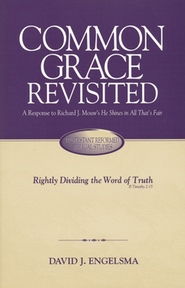
Common Grace Revisited by Engelsma

Common Grace Revisited
A Response to Richard J. Mouw’s He Shines in All That’s Fair<
David J. Engelsma
Grandville: MI: Reformed Free Publishing Association, 2003
ISBN 0 916206 81 5; pbk, xii + 100pp.

John Frame in his article on Machen’s warrior children identifies 21 areas that they disagreed upon. Surprisingly, common grace is not mentioned. And yet in 1924 it split a church denomination. Herman Hoeksema (1886-1965) took exception to the three points of common grace adopted by the Christian Reformed Church. The result was that Hoeksema formed the Protestant Reformed Church. David Engelsma is a professor of Dogmatics at the Theological School of the Protestant Reformed Church.

This book, as the subtitle shows, is a response to Mouw’s excellent little book He Shines in All That’s Fair. This book started as a series of editorials in The Standard Bearer, Mouw and Engelsma that debated the topic in September 2003 (see below). Despite their differences Mouw and Engelsma treat each other with respect and civility. There are no ad hominems here.

Engelsma focuses on Mouw’s approach, but does look at Kuyper and Bavinck who he sees as the originators rather than Calvin. Calvin he maintains is “not a main theme in the theology of John Calvin. It is not even a theme. It is barely mentioned” (p. 15).

Engelsma argues that common grace is not in Calvin, not in the scriptures and not in the Reformed creeds.

He identifies three reasons for the acceptance of common grace by Mouw:
The seemingly good deeds of justice, kindness and mercy of the non-Christian (Ch 5);
Mouw’s empathy for the ungodly (Ch 6); and
The “power and warrant of the Christian’s earthy life in the world” (Ch 7)
Engelsma also dislikes the term culture: “it is not a biblical term” (p. 53) (but then neither is the Trinity); it is he claims "ambiguous and unhelpful” (p. 54).

There are three issues that common grace help address these are: “the continuing existence of the earth after the fall” (p. 54); an account for “the Christian’s life in society as well as in neighbourhood” (p. 55); and “the justification for the Christian’s use and enjoyment of the interventions and products of the wicked” (p. 55). However, for Engelsma, God’s providence rather than common grace accounts for these points. It is the confusion of common grace and providence that is the fundamental error of those who adhere to common grace.

Engelsma has highlighted a number of key issues that can arise out of a (misuse) of common grace doctrine. He highlights some consequences of common grace, these though are misuses of the doctrine. He is concerned that common grace may lead to worldliness. This is an important point that we need to be aware of. Common grace rightly understood and not misused does not negate the antithesis. It does not have to lead to universal saving grace – despite Engelsma’s protestations. Kuyper held to both common grace, particular grace and the antithesis without the contradictions and tensions Engelsma seems to imply would be there.

His replacement of providence with common grace doesn’t quite work. There is much overlap between providence and common grace; though at times the terms as used in Engelsma’s book can be exchanged without any change in meaning. I welcome Englesma’s book – even if I don’t agree with its main premises – it does provide a warning about what may arise out of the misuse of common grace. But as often been said the corrective to misuse is not disuse (or denial) but right use.


Friday, 8 February 2013

Roy Clouser video recordings

These recordings of Roy Clouser are taken from the Wrestlers Class of National Presbyterian Church, 4101 Nebraska Avenue, NW, Washington, DC USA.


Presenter Name(s)TitleCourse DateClick for recordings
Roy ClouserReformed Theology and the Myth of Religious Neutrality (2 of 2) 4/25/2010 Link
Roy ClouserCan we Know that God is True? 5/15/2011 Link
Roy ClouserThe Idea of a Christian Philosophy 3/11/2012 Link
Roy ClouserThe Dutch Philosopher Dooyeweerd's Theory of Reality 3/18/2012 Link

HT Gregory Baus

Tuesday, 5 February 2013

Proverbs Reconstructed

Proverbs Reconstructed
Gus Dallas
Westbrow Press, Bloomington IN, 2011


How should we read Proverbs? Unfortunately, this book doesn't help. It divorces Proverbs from its context, historically, culturally and canonically. It provides a model of how not to read Proverbs. Essentially it lists all the Proverbs under separate headings such as Abomination, Adultery, Adversity, Advocate, Anger, Answer, Anxiety, Age, Animal, Ant, Apple, Argue, Associations, Atonement, Authority - to list just the A categories. The proverbs are then sorted into these categories under good or bad sections. Such a cut and paste approach may appeal to some; but not to me. It makes Proverbs into a set of cookie promises.

Fortunately, I didn't have to spend money to get this book - I was provided with an electronic review copy. Don't waste your money buying this. If you want to know how to read Proverbs you'd be much better buying Craig Bartholomew's booklet Reading Proverbs with Integrity (Grove Books, 2001). Sadly, it is integrity that this book lacks.

When Herman met Jack part 2


Continuing a Conversation Between C S Lewis and Herman Dooyeweerd - imagined by Paulo Ribeiro

CSL - Herman I heard of your problems with the Gestapo during the war.  I am so glad you knew Amsterdam better than those sniffing dogs.

HD - Oh, I also realized that since 1933 you were denouncing the Nazis in your Pilgrims’ Regress and then in the Screwtape Letters and in Mere Christianity you mentioned the Nazis several times and the Gestapo twice.

CSL – But I am not sure that if they had invaded I could find a safe place in Oxford - especially at the University.  Some professors would be glad to see me go somewhere.

HD – Sad times, indeed.  But it is good to know that in the religious centre of our existence we can transcend time.

CSL – Without forgetting that except in the present the eternal be can met.

HD – I heard of your Inklings group - - - does the pub where you meet serve good meals?

CSL – Yes, I forgot the time - - - let us walk there.

To be continued: on music

Monday, 4 February 2013

How to write a worship song


When Herman met Jack


A Conversation Between C S Lewis and Herman Dooyeweerd

Imagined by Paulo Ribeiro


CSL - Good evening Herman.  Welcome to Magdalene College.  Feel yourself comfortable.  By the way, I just completed reading the first volume of your splendid and prolific NCoTT  and I very much liked your concept of “meaning as the mode of being of all that is created.”    It reminded me of a discussion I had with  Prof. Tillyard in which I said to him:  "Either there is significance in the whole process of things as well as in human activity, or there is no significance in human activity itself.... If the world is meaningless, then so are we; if we mean something, we do not mean alone."

HD – Oh, yes Jack, that is great and reminds of a point you made in The Abolition of Man – that  “If nothing is self-evident, nothing can be proved – that there are some premises that can't be reached as conclusions.”   - - - I made that very clear in all my writings.  But we need to go further and affirm that “the direction of philosophical thought to the totality of meaning implies critical self-evaluation.”

CSL – Indeed, Herman - - - - Would you like some tea or a stronger drink?

HD – I would love some whisky, if I could.

CSL – Oh, yes - that will gives us the tonic we need for continuing our conversation.  [going to get the whisky] - - By the way, when I gave the Riddell Memorial Lectures at Durham University in 1943 I got a certificate for an honorary doctor – I wish they had presented me with a box of whisky.

To be continued