An accidental blog

"If God is sovereign, then his lordship must extend over all of life, and it cannot be restricted to the walls of the church or within the Christian orbit." Abraham Kuyper Common Grace 1.1.

Saturday, 22 August 2009

John Calvin and the natural world

Davis A. Young's book John Calvin and the Natural World (University Press of America, 2007; ISBN 0761837132) is reviewed in PSCF by J W Haas and in Pro Rege by John Zwart [HT  Reformed Academic]


Friday, 21 August 2009

Odds and sods

Criticker - provides film recommendations based on your ratings of other films
Kevin DeYoung attempts to find things that neo-clavinists and two kingdom theology adherents might agree on
Nice pice by Scot McKnight on 'What do teachers make?'


Sunday, 16 August 2009

James 3: 1-12: taming the tongue


James, one of the half-brothers of Jesus, is the author of this book. He was writing to predominantly Jewish Christians dispersed around the roman Empire. The Romans were persecuting Christians and so the people James was writing to were well aware of the trials and temptations that they faced.

James grew up with Jesus. He knew how a mature person behaved and spoke. So, James is here writing with an aim that the believers would grow, be mature and complete v4 in what they do and in what they say.

“James addresses the pride of the rich, the persecution of the church and pay withheld by the rich. He also addresses those tempted to retaliate with violent acts or words. He responds with a call to wisdom, faith and patient endurance.”

Chapter 1 sets the agenda for the main issues James wants to address as we can see from this table.

Chapter 2 focuses on the doing: faith must lead to action, and one aspect of that action is that they do not show favouritism. Remember James was writing under a world dominated by the Romans and Roman laws favoured the rich over the poor, James is in essence saying don’t be conformed to the way of the world. Don’t treat people as the world does.

In this chapter he turns to the tongue and the need to be mature in what we say. These issues had already been flagged up in chapter 1:

v19 everyone should be quick to listen, slow to speak and slow to become angry.

v 26 If anyone considers himself religious and yet does not keep a tight reign on his tongue, he deceives himself and his religion is worthless.


These themes are then taken up in the first part of chapter 3.

Three vicars are at a ministers’ fraternal. They decide they need to be more open and vulnerable with each other, so they decide to share their weaknesses.

The first one says, 'Well, I have a problem with drink. I often slip and drink a whole bottle of port.
The second one says, 'Well, I have a problem with pornography. I often spend hours looking at it on the Internet.

One of the others asks the third one, 'Well, what is something that you have a problem with?'
The third preacher replies, 'Gossip, and I can't wait to tell everyone about you guys!'

The tongue can cause all sorts of problems!

James starts by addressing teachers:

Not many of you should presume to be teachers, my brothers, because you know that we who teach will be judged more strictly.

Yikes! Hardly an advert for teachers! Why this strong warning?
Two possible reasons: many thought the role of teacher was something to be aspired to. So James is warning them.

The other possibility is to warn teachers watch what you say. No matter who it is addressed to the warning is clear – it is by your words that you will be judged

The tongue it is said can be used to analyse a person’s health. At least that what the Chinese thought.
In a way it does - it shows us what’s in our hearts.

Why such an emphasis on what we say? Why such an emphasis on words?

In Jewish culture words were important.
We often say: ‘Actions speak louder than words’ - we make a distinction between word and deed - God doesn’t his word is deed: he speaks and it is.

God created by speaking – word is event.
In Genesis 1 – we hear the refrain ‘And God said’ the response: ‘and there was’
The book of Proverbs emphasises how important our words are:

Proverbs 12:18
Reckless words pierce like a sword, but the tongue of the wise brings healing.

Proverbs 15:4
 The tongue that brings healing is a tree of life, but a deceitful tongue crushes the spirit.

Proverbs 18:21
 The tongue has the power of life and death, and those who love it will eat its fruit.

Psalm 64:3 They sharpen their tongues like swords and aim their words like deadly arrows.


2 We all stumble in many ways. If anyone is never at fault in what he says, he is a perfect man, able to keep his whole body in check.


Again we have James’s emphasis on being mature – this time mature in what we say.
We are what we eat, if a certain TV doctor is to be believed – but biblically we are what we say.

Our words reveal who we are.

It is from our heart that our words come – Matthew 15:18 But the things that come out of the mouth come from the heart, and these make a man 'unclean.'

What’s in our hearts is expressed through our mouths. Our heart is what we are in our totality, genuine authentic humanity.

James then goes on to give two illustrations:

3 When we put bits into the mouths of horses to make them obey us, we can turn the whole animal.
4 Or take ships as an example. Although they are so large and are driven by strong winds, they are steered by a very small rudder wherever the pilot wants to go.


Why horses? Why ships? Remember, James is speaking to Christians dispersed around the Empire, many of them would have travelled by horse and by boat, so they were examples they were familiar with.

What do bits and rudders have in common?
Small, direction, who is controlling it directs the horse or the ship.

5 Likewise the tongue is a small part of the body, but it makes great boasts.
Time for another illustration:
Consider what a great forest is set on fire by a small spark.
6 The tongue also is a fire, a world of evil among the parts of the body. It corrupts the whole person, sets the whole course of his life on fire, and is itself set on fire by hell.


The effects of our words can be devastating – life and death are in the power of the tongue. Do we want to spread life or death?

7 All kinds of animals, birds, reptiles and creatures of the sea are being tamed and have been tamed by man, 8 but no man can tame the tongue. It is a restless evil, full of deadly poison.


Reference here to Gen 1 cultural mandate. How can we control, develop and transform culture if we can’t control our tongue?

9 With the tongue we praise our Lord and Father, and with it we curse men, who have been made in God's likeness.

Again Gen 1 - image and likeness of God. It looks like James had had his quiet time and had been reading Genesis 1 just before writing this bit.

10 Out of the same mouth come praise and cursing. My brothers, this should not be.


James is emphasising that this situation shouldn’t occur – our hearts are redeemed. Why then are we double-spoken? James then uses two more illustration:

11 Can both fresh water and salt water flow from the same spring?


12 My brothers, can a fig tree bear olives, or a grapevine bear figs? Neither can a salt spring produce fresh water.

It doesn’t happen – then why speak with a forked tongue? Let’s resolve, by God’s grace not to. Lets’ speak life and not death.

The book of James also gives us some positive advice about how we should use words:

How can we bring life rather than death?

  • To ask God for wisdom (1:5).
  • To be quick to listen and slow to speak (1:19).
  • To speak without discriminating between rich and poor (2:1-4).
  • To speak as those going to be judged (2:12).
  • To speak as one whose words are as good as their deeds (2:16).
  • To speak without boasting (3:14).
  • To speak without quarrelling and fighting (4:1).
  • To speak without slandering anyone or speaking against anyone (4:11).
  • To speak without presumption (4:13).
  • To speak without grumbling (5:9).
  • To speak as though you mean what you say (5:12).
  • To speak to God in prayer and praise whatever the circumstances (5:13).
  • To ask for prayer when sick (5:14).
  • To confess sins to one another (5:15).

Friday, 14 August 2009

Wednesday, 12 August 2009

Monday, 10 August 2009

James 2: faith and deeds

These are the notes and slides for a talk I gave yesterday.

Before we start proper, a little test: what has this picture [ a picture of camel knees] got to do with our subject today?

James, one of the half-brothers of Jesus, was known as ‘camel knees’ is the author of this book. He was writing to ‘the twelve tribes of the Dispersion’. Most take this to be Jewish Christians scattered around the globe at a time when the world was dominated by the Romans and Roman law favoured the rich over the poor. All this a few decades after the death and resurrection of Jesus.

The book has had a mixed reception. Luther thought it was ‘a right strawy epistle’ - there was nothing of the gospel in it and it seemed to contradict Paul’s teaching on faith.
But James is a book of wisdom, it is the proverbs of the NT.
His concern is that we should be like his half-brother Jesus: in what we do and what we say.
The structure of the book of James is complicated it has been described as having a ‘structureless structure’.

The first two chapters contain many insights and then some of the these points are taken up in the rest of the book:
“James addresses the pride of the rich, the persecution of the church and pay withheld by the rich. He also addresses those tempted to retaliate with violent acts or words. He responds with a call to wisdom, faith and patient endurance.”

The outline shows how these issues are outlined in the start of his epistle and then dealt with in more detail later.


James was around when his eldest half-brother Jesus was growing up, he got to know him and what he was like. He was around when Jesus was resurrected and he was part of the first Church in Acts 2. And yet here he is writing to a church that seems to be divided, divided between the haves and the have nots, the rich and the poor, the oppressed and the oppressors, a far cry from the apparent egalitarianism, where each had everything in common of the first few days of the church in Acts.

He is not writing a theological treatise but admonition and encouragement.

Some maintain that Paul and James have different messages - they are contradictory. This was the position of Martin Luther and the main reason why he didn’t like the book of James, it appeared to be contradicting the message of the reformation: faith alone saves.
Compare these two verses:
Rom 3:28 and James 2:24

Before we stat to try and unravel this knotty problem let’s take a step back and I want you to do a little work:
I want you to think about these questions:
  • What do we have to believe to be saved?
  • Is there some minimum set of beliefs?
  • What are they?
  • Can we do what we like and be saved?
  • Are there some minimum set of behaviors that we must do to be saved?
  • What are they?
Is it merely a matter of saying the sinners’ prayer? Do we have to attend Alpha and say the prayer in the Nicky Gumbel book to be saved? Or do we have to live and behave properly to be saved?
These are the issue that James is addressing - though he doesn’t mention Gumbel by name! The issues are contemporary ones.
Some say only beliefs matter, others say that it doesn’t matter as long as you are living well.

Part of the problem is the green house effect.

If I say ‘Look at that green house’. What do you expect to see?
A greenhouse (one made of glass) or a green house (one painted green) or a green house (one made so it is sustainable)?

The same words can mean different things.

James is using the word faith in a different way to Paul. They are both using the word deeds/ works in different ways. They are dealing with different issues, different contexts and have different emphases.

James may well have been reacting to a form of Jewish piety that wanted a revolution against the Romans, who were dominating the world at the time.
James is not talking about saving faith, but the faith that is lived out because we are saved.

In verse 14 he poses a question – James is good at asking questions, this book is full of rhetorical questions.
In verses 15-16 he uses an illustration – again James is full of illustrations.

Then in verses 17 -18 he summarises his position.

So, for James how do faith and deeds relate?

Faith leads to deeds and deeds arise from faith.

James is not against faith. He is warning against faith as a set of propositions to be believed that has no effect on what we do.

In James the noun ‘faith’ is used 16 times – only five times outside this passage. In the five times outside this passage it is used positively. But it is never used as an intellectual agreement to a set of propositions.

The great tightrope walker Blondin, walked across a tigtrope over the Niagra Falls. First with a balancing pole, then without it, then sometimes he would stop and cook and eat an omelette, or he would do it with someone on his back.

In 1860 the Duke of Newcastle came to watch him.
Blondin asked him, do you believe I can take a man over the tightrope in this wheelbarrow.

Yes I do, replied the Duke. Hop in! Said Blondin.
The crowd went silent, but the Duke declined the offer.
An old woman came forward and climbed in to the wheelbarrow. It was Blondin's mother.

Who had faith in Blondin?

Faith is not merely intellectual assent, it is putting our trust – and lives - in Jesus' hands. This is the sort of faith that James is talking about.

In verse 19 he pulls no punches; if faith is just a set of beliefs to be believed then what about the demons? They believe too!

James than uses two more illustrations; Abraham and Rahab. Both showed their faith by their actions.

Paul is right – it is by faith in Jesus that we are saved – by faith alone, but faith is never alone, James is also right it is accompanied by deeds.

Gordon Spykman sums it up well:
‘We are indeed justified by faith alone. But faith does not remain alone. It works.’

Thursday, 23 July 2009

Banksy vs the Bristol Museum


After a two hour queue - and this was midweek and before the kids have broken up from school - we managed to get in to see the Banksy exhibition. Banksy is a Bristol graffiti artist. It now looks like he has become mainstream; all the postcards were sold out.

Is this art? Is it a joke? or is it both? I'm not sure. There is no doubt that there is creativity and much playfulness involved. What was interesting is that he is subverting many popular art forms and making a comment on society - and in some respects his art works like Jesus' parables.

This was a take on Jean-François Millet's The Gleaners (1857) with the subtitle - agency work.


Or this:


The captions read: 'Does anyone take this kind of art seriously?' 'Never underestimate the power of a big gold frame'.

Loads of photos from the exhibit are available on flickr see here.

Tuesday, 21 July 2009

All of life redeemed update: Skillen and Zylstra articles


Added to the Jim Skillen pages:

Christians Organizing for Political Service: A Study Guide Based on the Work of the Association for Public Justice APJ Education Fund, 1980.
This is an excellent introduction to a Christian view of politics.

Confessing Christ and Doing Politics APJ Education Fund 1982
Chapter 5 “Public Justice and True Tolerance” pp.54-62
Chapter 7 “Christian Action and the Coming of God’s Kingdom” pp.88-103


Added to the Bernie Zylstra pages:

1970. The crisis of our time and the evangelical churches. In Out of Concern for the Church Toronto: Wedge Pub. Foundation. pp 75 ff.

Monday, 20 July 2009

A redeemed horror film: The Spell

Mark Roques comments:
This new film by Owen Carey Jones is a 'redeemed' horror film and you will enjoy the trailer.

Owen is doing what we say Christians should be doing. He is a culturally transformative Christian. I've seen the film and it really tells a great and poignant story in a subtle Christian way.


The film is a based on a true story and is out in September.

The film's website is here.

Faith + politics = the wrong approach

Proper Christian faith concerns all of life. It has no limited meaning that can be isolated from the political, agricultural, economic, and artistic lives of Christians and non-Christians. Likewise, politics is never purely secular from a biblical point of view. Nothing in this creation (in this world or this age) has a life and meaning of its own, independent of the Creator’s will and purpose. Biblical revelation and political life, Christian faith and human government are intimately connected from the start in God’s single creation. It is a mistake to think that we should be trying to connect two experiences which have never been disconnected.


James W. Skillen in Christians Organizing or Political Action APJ, 1980 (forthcoming on allofliferedeemed)

Sunday, 19 July 2009

Colossians 3 - it's all about holiness

These are the note and slides for a talk I did tonight. The title was 'It's all about holiness'.


Two cars are waiting for a traffic light. The light turns green, but the man didn't notice it. A woman in the car behind him is watching traffic pass around them and go through the light. She begins pounding on her horn and yelling at the man to move. He doesn't.

The woman is going ballistic inside her car, ranting and raving at the man. The light turns amber and the woman flashes the finger and screams a stream of profanities and curses at the man.

The man looks up, sees the amber light and accelerates through the lights just as they turn red. The woman is beside herself, screaming in frustration.

She is in mid-rant when she hears a tap on her window and looks up to see a policeman.
The policeman orders her to get out of her car. She is cuffed and taken to the police station where she is put in a cell.

Later a policeman takes her back to the booking desk where the original officer is waiting with her personal effects.

He hands her the bag containing her things, and says, "I'm really sorry for this mistake. But you see, I pulled up behind your car while you were blowing your horn, flipping the guy off in front of you, and swearing at him. Then I noticed the: 'What Would Jesus Do' bumper sticker, the 'Follow Me to Sunday School' bumper sticker, and the fish emblem on the back of your car. So, naturally . . . I assumed you had stolen the car."


So, what does it mean to be holy? What does Colossians 3 have to say?

First we need to look at the context - the whole context is the scriptures. An important hermeneutical principle is that the scriptures don't contradict each other. The next context is the NT, then Paul's writings and finally the book of Colossians and the cultural, political, economic, cultic context. Unfortunately, we don’t have time to go into all the detail but the immediate context is ch 2:20

20 Since you died with Christ to the basic principles of this world, why, as though you still belonged to it, do you submit to its rules: 21"Do not handle! Do not taste! Do not touch!"? 22-23 Such regulations indeed have an appearance of wisdom, with their self-imposed worship, their false humility and their harsh treatment of the body, but they lack any value in restraining sensual indulgence. These are all destined to perish with use, because they are based on human commands and teachings.

Dos and don'ts don't help - so what does Paul suggest?

We have died with Christ – our old selves are dead – so why live as if they aren’t? Holiness doesn’t come from working at it. Holiness is not something we can accomplish.

1 Since, then, you have been raised with Christ, set your hearts on things above, where Christ is seated at the right hand of God. 2 Set your minds on things above, not on earthly things.

The key words here are since then… we died in Ch2 and now in Ch3 we are raised with Christ.

But then we have something a little strange – forgive me while I make a little but important digression:

One of the things that I’m totally convinced of is that there is no dualism in Christianity. Dualism is pagan contraband imported into Christianity. Nothing is more spiritual than anything else - all of life is spiritual, we can’t split things up into spiritual and non-spiritual.

And yet here Paul seems to he appears to make a dualism of things above and things of the earth. What’s going on?

The issue here is one of direction. It is useful to make a distinction between structure and direction. I know I’ve said it before – but all I’m doing is reminding you. Structure is the way God has made things – he created and it was good. Creation is good. However, then came sin … there is now two directions: the God way and the other way. Direction is all about how we take things.

The distinction here is in terms of the old age of self and the new age in Christ. The kingdom of darkness and the kingdom of light.

Paul goes on to expand on what he means by things above and earthly things. One thing he is not doing is decrying the physical this is no hair shirt asceticism that Paul is advocating. He has been at pains to point that out in chapter 2. Neither is he advocating a head/ heat dualism – heart good, head bad. In fact he stresses the unity of the two here:

1 Since, then, you have been raised with Christ, set your hearts on things above, where Christ is seated at the right hand of God. 2 Set your minds on things above, not on earthly things.

The direction, where we are looking to and where we are going are important.

He defines what he means by earthly things:

5 Put to death, therefore, whatever belongs to your earthly nature: sexual immorality, impurity, lust, evil desires and greed, which is idolatry. 6 Because of these, the wrath of God is coming. 7 You used to walk in these ways, in the life you once lived. 8 But now you must rid yourselves of all such things as these: anger, rage, malice, slander, and filthy language from your lips. 9 Do not lie to each other,

SIN!

It has nothing to do with culture, art, music, maths, science, business, law or any other aspect of creation. The ‘things above’ do not mean that the physical is decried.

So, what does it mean to be holy?

Look at Amazon data: How many books with holiness, miracle, sex, power in their titles?

It says something about what sort of books Christians will buy. We get the publisher's we deserve!

For many holiness is conjures up asceticism, an attempt to get away from worldliness by abstaining from things. One such acetic was Simeon Stylites. He lived for 37 years at the top of a pillar becasue he wanted to get away from the world. A rather drastic approach!

Simeon became very serious about his religion at the age of 13, at 16 he joined a monastery and beagn fasting for a past-time! He became too austere even for the rest of the monks so they kicked him out. So Simeon went and lived in a hut, he also went without food and water for the whole of the Lent period. It was regarded as a miracle and Simeon gained a large number of followers and crowds came to seek his advice. That's when he decided to live on top of a pillar in an attempt to escape the world and put down the body. This has nothing to do with holiness. It is a misconception of holiness.

Holy comes from the word separate - many Christians see it as a separation form the world and culture an other worldliness. But can we be holy without living in a hole? Without sitting on a pillar and escaping the world - we are not called to an other-worldliness but a worldly holiness, a holy worldliness.

God is holy, He is involved he didn’t try to escape the world he became involved, he became flesh, he became physical.

Holiness is not something that we do - it is something that we are. Herman Ridderbos says ‘it is necessary to recognise that it does not in the first instance have a moral content’.

Colossians 3 we see the source of holiness: new life in Christ. Living in Christ.

We have died with Christ, we are also raised with Christ.

The image used here is that of a garment. The old garment is the old life but in Christ we now have a new garment.


v 5 Put to death
v 6 rid yourselves of all such things A Putting Off
v10 taken off your old self

v 10 put on the new self
v 12 clothe yourselves A Putting on!
v 14 put on

A change of direction.

In Christ we have a more radical solution to holiness than legalism or attempting to escape from the world.

Our old selves have been dealt with - they have been nailed to the cross and in Christ we are raised to a new life. Like an old garment they need to be taken off and discarded. We are united in Christ - we died with him and we are raised with him. We are holy, set apart, because of what he has done.

Being made holy we are called to live holy. We must reject a cheap grace that means we can live as we wish, likewise we must reject a legalistic set of dos and donts.

Gordon Spykman:
The summons to sanctified living calls, therefore, not for superficial moralistic acts of self-exertion, but for a sturdy kind of ‘worldy’ holiness, rooted in wholehearted dedication to the Lord in all our Christian callings. It calls for covenant faithfulness, kingdom loyalty, in full reliance on an unfailing divine initiative. Such a life of obedience is motivated and directed by a faith which finds God's grace its source of strength.

The final verses of this chapter show that holiness needs to be worked out in the house and at work, for husbands, wives, children, slaves and masters.

17 And whatever you do, whether in word or deed, do it all in the name of the Lord Jesus, giving thanks to God the Father through him.

And in case we didn’t get it the first time – Paul repeats himself:

23 Whatever you do, work at it with all your heart, as working for the Lord, not for men, 24 since you know that you will receive an inheritance from the Lord as a reward. It is the Lord Christ you are serving.

Holiness embraces all of life - we can have a political holiness, an academic holiness, economic holiness, artistic holiness, business holiness, a workplace holiness. Let’s not limit the gospel … the gospel is for all of life. Holiness is not about what bumper sticker we have, it's about what car we drive, it's about how we drive, how we live and work in the market place, the workplace, it's about the whole of life. It's about the whatever of life.


Let us pray. Father thank you we can be holy without living in a hole or on top of a pole.
Thank you you have done it all in Christ – we are holy because of what you have done for us. Help us to be holy in all areas and aspects of our lives. Help us to put on Christ and to image you and not to restrict your gospel. Open our eyes. Amen

Music for a Sunday morning

Friday, 17 July 2009

At Home in God's World - B J van der Walt


I'm pleased to announce that Bennie van der Walt has a new book published in August/ Sept: At Home in God's World: A transforming paradigm for being human and for social involvement.
ISBN: 978-1-86822-570-5

Contents

Preface: Prof. J. J. Venter
Recommendations: Dr Samson Makhado and Revd Isaac Mutua
Introduction: Why and how to be at home in God’s world

SECTION A
The biblical basis of a Christian worldview and philosophy

1. The directives of God’s Word for ethical/moral behaviour
2. How to read the Bible to hear God speak and understand our social responsibility

SECTION B
Christian-philosophical basics

3. John Calvin (1509-1564) the father of a transforming Christian worldview
4. An overview of the global presence of a Christian Reformational philosophy and scholarship
5. A new paradigm for doing Christian philosophy: D. H. Th. Vollenhoven (1892-1978)
6. God’s ordinances: providing direction in a crisis of norms and values

SECTION C
A multidimensional Christian view of being human

7. John Calvin’s struggle to attain a truly biblical view of the human being
8. The biblical perspective on being human
9. The human heart rediscovered in the anthropology of Dirk H. Th. Vollenhoven
10. Imaging God in the contemporary world
11. Even death cannot separate us from God and his creation

SECTION D
A Christian social philosophy

12. The biblical foundations and historical development of a Christian paradigm for social involvement
13. A systematic exposition and practical application of a transforming Christian social philosophy
14. Towards a normative practice
15. A partnership model for transforming development cooperation in Africa

Acknowledgements

Monday, 13 July 2009

Planetwise - a review

Planetwise
Dare to Care for God's World

IVP, 2008
156pp £7.99
ISBN 978-1-84474-251-6

Recent years have seen a proliferation of books on a Christian approach to environmental care. We have had Russell, the Hodgsons, White and Spencer, Berry and Bookless. Why the resurgence of interest? What is interesting is that most of these authors have imbibed a neocalvinist framework: creation, fall and redemption. Many via Tom Wright and his amplification of the three stage into a five part play. Such is the case of Bookless in this book.

Bookless was throwing away some rubbish while on holiday when he felt God spoke in an inner whisper to him 'How do you think I feel about what you are doing to my world?' This book is the result of careful thought about that revelation and shift in perspective. As he puts it: 'God spoke, creation groaned, and worship could never be the same again'.

Bookless is the National Director of A Rocha UK, a Christian environmental group, so this book is the result of thought and action. This is no armchair theorising.

He starts by utilising Tom Wright's five acts framework of Creation, Fall, Israel, Jesus and the present future age. These form the first five chapters of the book. He writes in an engaging and helpful way. Though I would have liked to have seen more emphasis on the cultural mandate. His approach is very accessible and readable, each chapter ends with a three questions which aid reflection and discussion. The influence of another Wright - Christopher J. H. - is also evident here. Not only in the number of triangles but with the emphasis on land.

The remaining chapters, 6-9, all look have the title: 'Living it out: X as if creation matters'. Where X is discipleship, worship, lifestyle and mission. Here we see these important topics in the light of creation. He makes an important observation: 'Can you spot Christians by the cars that they drive (not just the the bumper stickers)...?' p.117. There are many wise practical and attainable ideas for how we can make our discipleship and lifestyle consistent with our beliefs and he manages to do it in a way that is not guilt inducing.

Unfortunately, there is no index, but there are three pages of end notes and two and a half pages of useful resources.

This is one of the best of the recent spate of green books. Highly recommended!

Book website

Available in the UK from:
IVP
amazon
book depository
eden books
wesley owen

Friday, 3 July 2009

Christians the reluctant greens (1989)

This s a piece I wrote for the Christian Ecology Group (now Link) magazine Green Christians (Feb-April 1989). It formed the outline for a chapter in The Earth is the Lord's. The section I wrote on eschatology was edited out.

Christians: The Reluctant Greens (1989)

Thursday, 2 July 2009

Spykman on sanctified living

The summons to sanctified living calls, therefore, not for superficial moralistic acts of self-exertion, but for a sturdy kind of ‘worldy’ holiness, rooted in wholehearted dedication to the Lord in all our Christian callings. It calls for covenant faithfulness, kingdom loyalty, in full reliance on an unfailing divine initiative. Such a life of obedience is motivated and directed by a faith which finds God's grace its source of strength
Gordon Spykman, Reformational Theology p. 497-8.

Wednesday, 1 July 2009

Towards a biblical view of environmental care

Here's a piece I wrote in 1989 on environmental care. It was published in the British journal Evangel. The editor then was Gordon McConville.


Towards a biblical view of environmental care (1989)

Tuesday, 30 June 2009

Saving Planet Earth by Colin Russell - a review

Saving Planet Earth: A Christian Response
Colin A. Russell
Authentic Media
x + 133pp, £8.99, pbk
ISBN 9781850787716


Colin Russell has produced an interesting and accessible book on a Christian response to the environmental crisis. The great strength of the book is that it places the present environmental crisis within a historical context. Pollution is not a new problem. One problem with books that deal with environmental problems is that they can date very quickly. Science changes, populations increase and decrease (occasionally) and the data can become dated. Russell in looking at historical contexts has managed to get round this problem, history rarely gets out of date!

In nine short chapters he provides an overview of the problems and some of the possible responses we can make as Christians. He starts with looking at our stumbling blocks to Christian involvement; these are: the subject is depressing, difficult, demeaning and even dangerous. By dangerous he means that some maintain that it's a dangerous distraction, though Russell maintains that it might not be the heart of the gospel though it is part of the gospel.

He then looks at how special a place the earth is, a place designed for human life and yet a place spoiled by sin. The polluted planet is examined in more detail in the next chapter. Modern concern goes back to the 1960s, but Russell places this all in historical perspective looking at land, water and air pollution. from biblical times onward. 'A ravaged planet' is the topic of chapter 4. Waste, destruction of habitats and hence species, deforestation and overpopulation are all briefly dealt with. 'The big one', climate change, gets a chapter to itself. It is interesting to see how this topic has come to the fore in recent Christian discussions on the environment.

From chapter 6 onwards we are offered some hope. It is God's earth and he cares for it, he sustains the whole of creation. In chapter 7 our role as stewards is examined. This has been called the 'default position' for Christians, I would have liked to have seen some discussion on the weaknesses of this position. If we are stewards what then? How does stewardship prescribe how we might respond? What does it mean, for example, for population control?

The earth belonging to God and we being its stewards are two good reasons for Christians to care for the planet, but Russell adds a third. And one that is often neglected in other similar discussions: the call to mission. This missional aspect is seen in care for the poor. The needs of the poor can be helped by environmental care. Christian mission without environmental care is inadequate.

Overall this is an excellent introductory primer. A great book for those beginning to get interested in a more greener Christianity.

Book wesbite

Other reviews:
David Thistlewaite

Available in the UK from
amazon
wesley owen
eden books

Monday, 29 June 2009

Environmental Stewardship - a review

Environmental Stewardship
Critical Perspectives - Past and Present

edited by R. J. Berry
T&TClark International
ISBN 9780567030184
xii+348
£39.99


Over two hundred years ago a British clergyman published a book that has had unprecedented effects. Its effect on Charles Darwin was so profound that it provided the seed thoughts for his theory of natural selection. It was perhaps the first doomsday-scenario environmental book to be written. It was Thomas Malthus's Essay on the Principle of Population (1798). Malthus (1766-1834) was the first to spell out the apparently inevitable consequence of a geometric growth in population and an arithmetic growth in food supply. Survival meant a reduction in population growth. The same idea as taken up in the 1970s by the think tank the Club of Rome in their book The Limits to Growth. The book was based on computer models; their conclusions were similar to Malthus's: a limit to the population growth is required or we are on an apocalyptic collision course.

Less than a decade previously in 1962, Rachel Carson's Silent Spring was published. the book brought attention the problems of pesticides such as DDT in the food chain. This marked the beginning in the rise of an environmental awareness or consciousness. In the nineties there were signs that such environmental enthusiasm was beginning to wane - at least if membership numbers of environmental pressure groups were any indication. Now with climate change a major issue it seems we are all greens.

Christians cannot be culture transformers and shapers if they follow such cultural ebbs and flows. We have a responsibility to God's good creation irrespective if it fashionable to be green or not. Unfortunately, the shadow of Lynn White's seminal paper 'The historical roots of our ecologic crisis' Science 155 (10 March 1967) has loomed large over Christian discussion of the environment. Until recently most Christian writing has been to defend Christianity against the accusation of Lyn White that Christianity with its emphasis on dominion has been to blame for the environmental crisis. The debate, however, must move on. And that is exactly what these essays do. Christianity is not merely environmentally benign but it has something vital to contribute to a robust theocentric environmental ethic. An ethic that avoids the excesses of anthropic approaches and the sloppy mysticism of biocentric approaches.

The role of humans as stewards is a crucial issue and it is this that volume, Environmental Stewardship, seeks to address. Stewardship has been the 'default position' for most Christians. However, not many stop to consider it and examine its implications. What does it mean to be a steward? As Gandalf once said we are all stewards now. But is stewardship dominion and technological imperialism by another name?

This book was conceived at the 2000 consultation on 'environmental stewardship' organised by the John Ray Institute at St George's House, Windsor Castle. Four of the papers delivered there are included here - but this is far more than the proceedings of a conference. The list of authors is truly impressive - though there are some notable omissions Steven Bouma-Prediger, Celia Deane Drummond, Loren Wilkinson, Lukas Vischer, Tim Cooper are the ones that immediately spring to mind. Most of the papers were written specifically for this volume, some are (revised) reprints from elsewhere.

The book is split into six parts with an introduction by Sam Berry. Berry's introduction is clear, precise and provides an excellent overview. Part I looks at the history of the idea with two excellent essays by Peter Harrison and Richard Bauckham - both for me were the highlights of the book.

Part II looked at some criticisms and expositions of stewardship. Despite being the default position for many stewardship hasn't escaped criticism. Critics include Clare Palmer (ch 5). Her objections include:

  • There is no 'biblical concept of stewardship of nature' (p 65) - 'even if there were, it would only represent one view of many displayed in biblical writing' (p 65)
  • It has the problem of accommodating God's action or presence in the world. God becomes an absentee landlord (this is also an accusation made by Matthew Fox) (p. 68)
  • It originates in a society based on slavery, a represents an autocratic form of government. It is thus unsuitable for modern society (p. 70)
  • It assumes that humanity is separated from the rest of creation. (p 70)
  • It may lead to the assumption that the natural world is a resource that humans are in control of. (p 70) (p 72) This attitude is in a feudal perception of stewardship (p 72)
  • In the light of evolution this metaphysical set apartness is impossible to justify (p 71) [Might not the same also be said on being the image bearers of God?]
  • It is influenced by the idea that the eath needs to be managed because it is fallen and imperfect (p 71). The earth existed for millions of years without humans.
  • Stewardship is an anthropocentric ethic, which considers it to be best for humans and the natural world to be it to be managed by humans. (p 73)
  • Is non-theistic stewardship exercised on behalf of the planet? (p 74)
  • It is un-ecological (p 75)
Many of these concerns are directly addressed by Attfield in the next essay. The agnostic James Lovelock (ch 9) also dislikes the stewardship model, he senses that it is ‘an imperial concept that assumes an automatic superiority invested in those in charge’ (p 108), he prefers a partnership model - a partnership with the Earth/ Gaia. Ruth Page also proposes a similar model, but from a theistic perspective, preferring to call it ‘fellowship with creation’ (ch 8). The advantage of such approach is that it avoids the anthropocentrism that can accompany stewardship but the danger is that it can slip into pan(en)theism.

In Part III, Consolidation, Douglas Hall makes an excellent point, which does much to alleviate many concerns of stewardship - he writes: ‘The steward is different [from the rest of creation], but the steward is also the same. Like all the others, the steward is recipient of that which can never be his or hers to own’ (p. 143). Cal de Witt contends, rightly, that stewardship must be ‘highly interactive and dynamic’ (p150). He sees it involving an engagement with science, ethics and praxis. This raises the question why not also with religion, history, law and so on? He then advocates a two-books approach. I have reservations about such a framework/metaphor - why, for example, only two books? Other essays in this section look at stewardship in the context of evolutionary theory. Christopher Southgate sees stewardship - in a limited way - as a part of a matrix of our relationship with the rest of creation. Larry Rasmussen sees it as one symbol among others including dominion, partner and priest

In Part IV, Applications, Susan Power Bratton examines the implications of stewardship for marine systems by extending the sabbath and jubilee principles to include them. Michael Northcott applies it to the soil and agriculture. Crispin Ticknell opens his essay with a great statement: ‘Environment is the stuff of religion, and religion is the stuff of the environment’ (p 220). He goes on to clarify what he means but it seems his view of religion is more mystical than a robust earthy Christianity. Derek Osborn makes a valid plea to slay the four giants of unsustainability: the ideas that growth, efficiency, money and the present all come first.

Part V, Relevance/ Ways forward, may have been mis-titled as I saw little to take the discussion forward in these articles. There is little attention paid to how a stewardship model might help say climate change or deforestation or further avenues for philosophical or even theological exploration. Zizioulas advocates seeing humans as priests of creation but there is no discussion as to what this model could add to a stewardship view, or even if it is compatible with it. The highlight in this section for me is Murray Rae’s paper originally presented at the St George’s House consultation. Rae covers much ground including examining other models that have been proposed. It provides a good summary of the many approaches mentioned elsewhere in this volume.

Part VI - by far the shortest has a three-page conclusion by John Houghton. The book concludes with a 21-page bibliography and a 10-page index.

This is an excellent compilation of some of the best material available on stewardship. Berry has a done a great service in pulling together these articles. Taking stewardship as the default position is now no longer an option - here are the resources to examine closely the issue. It seems to be that the malleable concept of stewardship has taken a bit of battering in recent decades but it has come out in better shape and though it can no longer be seen as the panacea for a Christian approach to the environment it certainly seem to be the best model or metaphor to work from.


Publisher's website

Available in the UK from:
amazon
book depository
eden

Friday, 26 June 2009

New on all of life redeemed

Several new papers have been added:

Jaap Klapwijk 'Commemoration: On the First and Second History in, Philosophia Reformata 73 (2009)

Andrew Basden 'A Different Way of Approaching Data Models and KR [knowledge representation] Ontologies'

Bruce Wearne Philosophy as Dependable Analysis: Roy Clouser's Contribution to Christian Scholarship

Bernard Zylstra : 'The Society of the Future'. Presented at the Canadian Sociology and Anthropology Association.

Roy Clouser 'Can we know God is real?'

Albert Weideman 'Constitutive and regulative conditions for the assessment of academic literacy'. Forthcoming in SALALS 27(3).

Albert Weideman 'Uncharted territory: an emerging paradigm and the foundations of applied linguistics'. Forthcoming in Per linguam.

Volumes 1-3 of the Reformational journal/newsletter Anakainosis.

Sunday, 21 June 2009

The God debate - Terry Eagleton

Terry Eagleton is interviewed on cbc.ca (at the bottom of the page)

The best-seller list has not been kind to God lately. Evolutionary biologist Richard Dawkins took aim at the big guy in The God Delusion. Then the well known writer Christopher Hitchens - never one to shy away from a fight - followed up with God is Not Great.

And after carefully considering the mounting number of arguments for atheism, Terry Eagleton decided that a rebuttal was in order. He's one of Britain's leading literary critics and theorists. His new book is Reason, Faith and Revolution: Reflections on the God Debate, takes on the two leading atheists whom Eagleton refers to, simply as, Ditchens. He was in Derry, Northern Ireland.


Monday, 15 June 2009

The 12 stages of social media

The twelve stages of social media:

  1. Curiosity
  2. Interest
  3. Novelty
  4. Excitement
  5. Inviting Everyone You Know
  6. Optional: Inviting the Wrong Person (skip to 9)
  7. Massive Use / Addiction
  8. Slight Abuse / Accidental Use
  9. Annoyance / Frustration
  10. Cutting Way Back
  11. “Going Dark” / “Taking a Break” / “Going Private”
  12. Acceptance / Renewed Curiosity

Thursday, 11 June 2009

Keith Sewell @ Bristol

The audio for Keith Sewell's excellent talk at St Mike's, Stoke Gifford, Bristol is available here to listen to for a short time.

It can be downloaded from here.

Keith took a very broad brush view of church history and placed evangelical Christianity within a wider context. He emphasised the importance of history - it shapes and moulds us whether we realise it or not - it is better to be historically wise than ignorant!

There is a very large gap between where we are now and the first Christians. He then looked at some of the reasons for that. We have undergone three big shifts: Hellenistic infiltration into the early church; the Christianisation of the Roman Empire; and the collapse of the Roman Empire.

He posed a fascinating question: how has Islam shaped medieval-Christian culture?

The Reformation went a long way to bring Christianity in line with the scriptures, but it didn't go far enough.
Evangelicalism started with Count von Zinzendorf. 'The Count' was so opposed to arid intellectualism that he said, forget the head, go for the heart. Christianity is a religion of the heart but its never anti-head. The Count has given us a legacy of the heart - but under emphasised clear Christian thinking about everything- law, politics, the state, learning, science , medicine, art ...

Jesus never says follow me in private but the public is irrelevant, follow me in the emotional but not intellectual. it is not right to abridge or limit the claims to discipleship.

Privileging the heart over the head has underestimated the religious importance of human culture, art, literature, the way we dress, style, how we relate.

We have inherited a Bible-believing Christianity that does not read the Bible.

Christianity has become too much churchianity. No one can see what obedient participation in culture is about. What about a Christian Voters Association? How do we pursue justice? It is important to seek justice for those that are different to us. This is not deserting evangelism - it is evangelism; it is communicating the evangel.

We have a choice: a Christianity that is shaped by the world or a Christianity that is world shaping.

Wednesday, 3 June 2009

Lennox and Dawkins debate audio

The audio of Richard Dawkins' third encounter with John Lennox can be downloaded here.
It took place on 21st October 2008 at Oxford university Museum.

Tuesday, 2 June 2009

Odds and sods

William Dembski's new book The End of Christianity has been announced - it is his response to Ditchens et al.
An interesting chart on Galatians [HT Scot McKnight]
John Walton's new book: Ancient Cosmology and the Origins Debate - should promote much debate.
John Frame has some useful questions to ask when watching a film [HT Between two worlds]

Monday, 1 June 2009

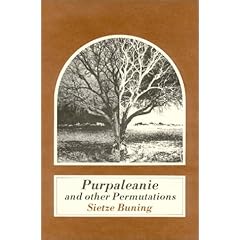
Calvinist farming by Sietze Buning

'Calvinist Farming' in Purpaleanie and other Permutations, Sietze Buning (Stanley Wiersma), (Middleburg Press, 1978) ISBN: 0-931940-00-1


Calvinist Farming


Our Calvinist fathers wore neckties with their bib-overalls
and straw hats, a touch of glory with their humility. They rode
their horse-drawn corn planters like chariots, planting the corn
in straight rows, each hill of three stalks three feet from each hill
around it, up and over the rises. A field-length wire with a metal knot
every three feet ran through the planter and clicked off three kernels
at each knot. Planted in rows east-west, the rows also ran north-
south for cross-cultivating. Each field was a checkerboard even
to the diagonals. No Calvinist followed the land's contours.

Contour farmers in surrounding counties
improvised their rows against the slope
of the land. There was no right way.
Before our fathers planted a field,
they knew where each hill of corn
would be. Be ye perfect, God said,
and the trouble with contour farmers
was that, no matter how hard they worked
at getting a perfect contour, they could
never know for sure it was perfect -- and
the didn't even care. At best they
were Arminian, or Lutheran, or Catholic,
or at worst secular. Though they wore bib-
overalls, they wore no neckties, humility
without glory.
Contour field resulted
from free will, nary a conrnstalk pre-
determined. The God contour farmers
trusted, if any, was as capricious
as their cornfields. Calvinists knew
the distance between God and people was
even greater than the distance between people
and corn kernels. If we were corn kernels in God's
corn planter, would we want him to plant us at random?
Contour farmers were frivolous about the doctrine of election
simply by being contour farmers.
Contour farmers didn't control
weeds because the couldn't cross-cultivate. Weed control was laid
on farmers by God's curse. Contour farmers tried to escape God's curse.
Sooner or later you could tell it on their children: condoning weeds
they condoned movies and square-skipping. And they wasted land,
for planting around the rises, they left more place between
the rows than if they'd checked it. It was all indecent.

We could drive a horse cultivator -- it was harder
with a tractor cultivator -- through our checked rows
without uprooting any corn at all, but contour farmers
could never quite recapture the arbitrary angle, cultivating,
that they used, planting. They uprooted corn and killed it. All
of it was indecent and untidy.
We youngsters pointed out that the tops
of our rises were turning clay-brown, that bushels of black dirt
washed into creeks and ditches every time it rained, and that
in the non-Calvinist counties the tops of the rises were
black. We were told we were arguing by results, not
by principles. Why, God could replenish the black
dirt overnight. The tops of the rises were God's
business.
Our business was to farm on Biblical principles.
Like, Let everything be done decently and in good order; that is
keep weeds down, plant every square inch, do not waste crops, and be tidy.
Contour farmers were unkingly because they were untidy. They could not be
prophetic, could not explain from the Bible how to farm. Being neither kings
nor prophets, they could not be proper priests; their humilty lacked defi-
nition. They prayed for crops privately. Our whole county prayed
for crops the second Wednesday of every March.
God's cosmic planter
has planted thirty year's worth of people since then,
all checked and on the diagonal if we could see
as God sees. All third-generation Calvinists
now plant corn on the contour. They have the word
from the State College of Agriculture. And so the clay-
brown has stopped spreading farther down the rises
and life has not turned secular, but broken.
For
God still plants people on the predetermined check
even though Calvinists plant corn on the contour. God's
check doesn't mean a kernel in the Calvinist's cornfield.
There's no easy way to tell the difference between Calvinists
and non-Calvinists: now all plant on the contour; all tolerate
weeds; between rows, all waste space; all uproot corn, cultivating;
all consider erosion their own business, not God's; all wear
overalls without ties; all their children go to the same
movies and dances; the county's prayer meetings
in March are badly attended; and I am improvising
this poem on the contour, no checking it in rhyme.

Glad for the new freedom, I miss the old freedom of choice
between Calvinist and non-Calvinist farming. Only in religion
are Calvinist and non-Calvinist distinguishable now. When different
ideas of God produced different methods of farming, God mattered more.
Was the old freedom worth giving up for the new? Did stopping the old
erosion of earth start a new erosion of the spirit? Was stopping old
eroision worth the pain of the new brokenness? The old Calvinists
insisted that the only hope for unbrokenness between the ways
of God and the ways of farmers is God.
A priest, God wears
infinite humility; a king, he wears infinite glory. He is even
less influenced by his upward-mobile children's notions of what not
to wear with what than our Calvinist fathers were in neckties with bib-
overalls. Moreover, a prophet, he wears the infinite truth our Calvinist
fathers hankered after to vindicate themselves, not only their farming.
Just wait, some dark night God will ride over the rises on his chariot-
corn planter. It will be too dark to tell his crown from a straw hat,
to dark to tell his apocalyptic horses from our buckskin horses or
from unicorns. No matter, just so the wheels of that chariot-corn
planter, dropping fatness, churn up all those clay-brown rises
and turn them all black, just as the old Calvinists predicted.

Lord Jesus, come quickly.


From here transcribed by Loren Harsma

Wednesday, 27 May 2009

Christianity, Climate Change and Sustainable Living - a review

Christianity, Climate Change and Sustainable Living
Nick Spencer and Robert White
SPCK, 2007
pbk, ISBN 978-0-281-05833-4
x+245 pp
£9.99

This book was 'conceived and nurtured' by the Jubilee Centre and the John Ray Institute. Nick Spencer was a researcher for the Jubilee Centre until 2007 and is now Director of studies at Theos, and Bob White, a geophysicist, is director of the Faraday Institute for Science and Religion.

The book split into three parts: the nature of the problem, the biblical perspective and the Christian response.

The first takes a look at global warming (ch 1) and sustainability and well-being (ch2). Here we have the science of climate change this is explained in an accessible way and contains abundant figures and charts. Unfortunately, the issue of 'climate scepticism' isn't addressed: 'The take home message is that global warming is real and unequivocal, and is caused by humans' (p. 25).

Climate change is the result of unsustainable development and so the issue of sustainability is examined in the next chapter. As they put it: 'The way we use energy at home, the way we travel and the manner in which we consume lie at the heart of climate change. Unless they change it won't' (p. 72).

Part 2 poses the question should Christians care about the environment? (Ch 3) Their answer an emphatic Yes! - they then look at what a Christian response might look like (Ch 4-5). In response to Why care? They respond:

  • because God does
  • because it is part of what it means to be human
  • to obey the command to love 'our neighbours'
  • because of our hope for the future

Chapter 4 looks at the biblical vision of sustainable living here they draw heavily on Isaiah 40-66 as 'it offers the fullest biblical vision the Bible has to offer of sustainable living', an example of how life on earth should be lived. Next drawing upon the Jubilee theme, in chapter 5, they look at the biblical practice of sustainable living.

The final part looks at the vision (ch 6) and practice of sustainable living (ch 7). In chapter 6 they outline eight helpful - the 'shoulds' notwithstanding - principles for sustainable living:
  1. We should value and protect creation, seeing that as a joy rather than a burden
  2. We should reflect the close bond between society and environment in our decisions
  3. We should pursue justice for the vulnerable and marginalized
  4. We should not confuse wealth and value: our goal should be relational health rather than money or personal freedom
  5. We should favour regulated, market-based solutions that take account of natural, human and social capital
  6. We should express commitment to our immediate environment and favour local solutions
  7. We should aim to offer just and equitable access to natural resout=rces
  8. We should respond seriously and with hope.

Chapter 7 looks at what we can do as individuals, as part of a community, nationally and internationally.

The brief final chapter looks at the new creation. God has not given up on his creation but will re-create it.

There are 16 pages of notes, a 3-page index of biblical references and a 6-page subject index. Sadly there is no bibliography, but a list of organisations such as the Jubilee Centre, The Faraday Institute, The John Ray Institute, Tearfund and WorldVision all judging by the logos on the back cover have supported the book.

The authors close this book with the comment that 'Christians are in a unique position to live and promote such "responsible and collaborative behaviour". We need to do so now.' This book doesn't provide all the answers or solutions but it is certainly a great place to start so that we can become more responsible and informed stewards of God's good earth.

Jubilee Centre has a number of Bible studies to accompany the book here.

Available in the UK from:
SPCK
amazon
eden
book depository

Other reviews:
Celsias
Geoff Stratford
Ethel White

Extracts
Times OnLine

Tuesday, 26 May 2009

Odds and sods

Unmasking the new age Jesus by Doug Groothuis

Piers Paul Read reviews Terry Eagleton's Reason, Faith and Revolution in The Observer:
The book stems from lectures he gave at Yale in 2008 and the jokes transfer well from the auditorium to the page. It is essentially a contra-Dawkins and contra-Hitchens polemic: he conflates the two angry atheists as "Ditchkins" and successfully shreds what they say in their books. "This straw-targeting of Christianity is now drearily commonplace among academics and intellectuals - that is to say, among those who would not allow a first-year student to get away with the vulgar caricatures in which they themselves indulge with such insouciance."
Mike Wittmer reviews Blomberg's A Case for Historic Premillennialism

John Loftus claims that atheism isn't a religion: 'It's not even a worldview'.

Gideon Strauss has been interviewing the borad of the Center for Public Justice; including: