An accidental blog

"If God is sovereign, then his lordship must extend over all of life, and it cannot be restricted to the walls of the church or within the Christian orbit." Abraham Kuyper Common Grace 1.1.

Thursday, 29 May 2014

British Calvinists: John Lightfoot (1602-1675)

John Lightfoot (1602-1675) was an Erastian member of the Westminster Assembly. He was the son of Thomas Lightfoot of Stoke-on-Trent. Lightfoot graduated from Christ's College, Cambridge in 1621 with a BA. He was ordained in 1623 and for a while was a curate in Shropshire where he met (Sir) Rowland Cotton. In 1626 he became the rector of Stone, Staffordshire. There he was married to Joyce Crompton. In 1628 they moved to Hornsey, Middlesex. In 1630 he became rector at Ashley, Staffordshire. He moved to London and in 1643 he became Lecturer at St Bartholomew's and then in 1644 rector at Great Munden, Hertfordshire.

The first part of his Harmony of the Evangelists was published in 1644. 

He kept a record of the deliberations of the Westminster Assembly in his Journal of the Proceedings of the Assembly of Divines. This shows that he was favourable towards the Presbyterians but opposed to the Independents.

He was appointed Master of St Catherine's, Cambridge in 1650, in 1654 he became the Vice-Chancellor of the University. 

He sided with the Presbyterians at the Savoy Conference in 1661. 

Some of his writings are available here: http://www.prdl.org/author_view.php?a_id=395


Tuesday, 27 May 2014

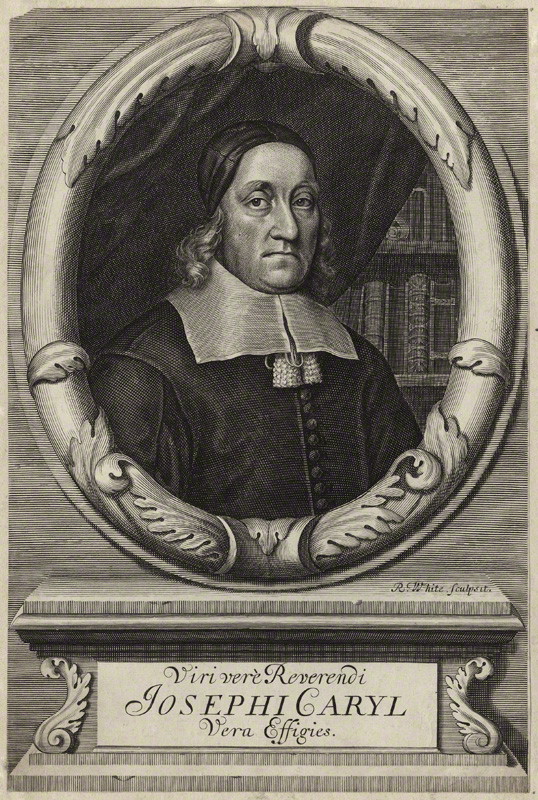
British Calvinists: Joseph Caryl (1602-1673)

Joseph Caryl (1602-1673) was born in London and was graduate of Exeter College, Oxford. He is best known for his commentary on Job. He was often asked to preach before the Long Parliament and was one of the Westminster Assembly 'divines'. 

After the restoration he was ejected from his church, St Magnus near London Bridge, but he continued to minister as an Independent (Conegationalist) in London.  

Some of his writings are available here: http://www.prdl.org/author_view.php?a_id=196


Friday, 23 May 2014

British Calvinists: John Trapp (1601-1669)

John Trapp (1601-1669) was born in Croome d'Abitot and graduated from Christ Church,
Oxford in 1622 with a BA and in 1624 with an MA. By 1624 he was the headmaster of the free school of Stratford-on-Avon.

He sided with the government in the Civil War. During the Civil War he was the chaplain to the parliamentary troops in Stratford for two years. He was the minister at Welford-on-Avon from 1636-1660 and then from 1660 until his death. 

Some of his writing can be found here:


Tuesday, 20 May 2014

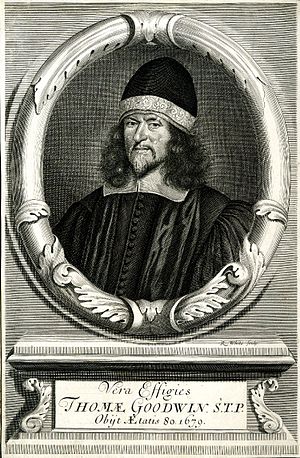
British Calvinists: Thomas Goodwin (1600-1680)

Thomas Goodwin (1600-1680) born in Rollesby, Norfolk, graduated from Christ's College, Cambridge in 1616 with a BA. At Emmanuel he was influenced by the preaching of John Preston and Richard Sibbes. During this time he wrestled with doubts about his faith, the lessons of  which are contained in his A Child of Light Walking in the Darkness

In 1633 he resigned his clergy posts in Cambridge and became aligned with the independent congregationalist principles of church government. After marrying Elizabeth Prescott in 1638 he went to Arnhem and worked with Philip Nye (1596-1672) to make the church there a model of congregationalism. 

In 1640 Goodwin returned to London and set up an independent congregation in the parish of St Dunstan's-in-the-East. 

He was with Nye one of the independent representatives at the Westminster Assembly in 1643-52. Goodwin, Nye, Jeremiah Burroughes, William Bridge and Siddrach Simpson (1600-1655) were known as the 'Five Dissenting Brethren'.

Oliver Cromwell appointed him as one of his chaplains and appointed him as president of Magdalen College, Oxford.

Together with John Owen he helped to draw up the Savoy Declaration of Faith and Order. 

Many of his writings are available here: http://www.prdl.org/author_view.php?a_id=311


Saturday, 17 May 2014

Recent Kuyperania (May 2014)

Bruce Wearne's review of Kuyper's Kuyper in America and two of Mouw's books Cultural Discipleship and Abraham Kuyper from Zadok Perspectives is now online at Platforma C

Peter J. Leithart takes a brief look at Kuyper's common grace

Another republished version of Kuyper's Lectures on Calvinism is available from GLH and on Kindle.

Darryl L. Bock looks at Kuyper's book on Common Grace:
This is my first read of Kuyper, a famous Reformed theologian of the late 19 and early 20th century. His style is clear. His address of issues is direct. He raises and pursues questions that many do not even raise. He reasons in detail, sometimes one senses he infers to answer questions that may not have an answer. Still it is a worthy read. If one has ever wondered why there is so much discussion of covenants to Adam and Noah in the Reformed tradition, this text will help to explain why the topic is raised.
Robert Covolo's review of Bratt's biography of Kuyper is now online at academic.edu, as is his 2013. "Faith in a Fashionable Age: Abraham Kuyper and Charles Taylor on the Secular Nexus Between Mode and Modernité"  International Journal of Public Theology 7: 297–314.

And as has been mentioned before John Boer's translation of Abraham Kuyper's The Ascent of the Son - The Descent of the Spirit is available from lulu.com.

Friday, 16 May 2014

British Calvinists: William Bridge (c. 1600-1671)

William Bridge (c. 1600-1671) was born in Cambridgeshire and graduated form Emmanuel College with an MA in 1626. 

For a while he was a vicar in Norwich. He was one of the main Puritan influences in East Anglia. However, he came into conflict with the bishop of Norwich, Matthew Wren he went 'to Holland rather than conform'. He returned to England in 1642 and was an independent (Congregationalist) representative at the Westminster assembly.  


Some of his writings are available 


Abraham Kuyper The Ascent of the Son - The Descent of the Spirit

John Boer has translated Abraham Kuyper's The Ascent of the Son The Descent of the Spirit. It is now available for free from lulu.com. It comprises 26 Meditations on Ascension and Pentecost.

It is a translation of  Op den Pinksterdag (met Hemelvaart), volume 3 of his series Dagen van Goede Boodschap (Kampen: Kok, 1923. It was originally written in 1888 and published posthumously.


Monday, 12 May 2014

British Calvinists: Edmund Calamy (1600-1666)

Edmund Calamy (1600-1666) was born in London and graduated from Pembroke Hall with a BA in 1620 and MA in 1623; he was a key Presbyterian leader. He is often known as 'the elder' his son was also called Edmund Jr(1634-1685) (the younger) and his grandson, the son of Edmund (III) was also called Edmund (1671-1732), this Edmund was a historian; all of them were nonconformists. 

Father  and son (Jr)  were both ejected from their parishes during the Great Ejection in 1662. All three were educated at Merchant Taylors' School. 
Edmund the elder was a chaplain to Nicholas Felton, the bishop of Ely and became vicar of St Mary's Swaffam Prior in Cambridgeshire. It was here worked with Jeremiah Burroughes. 

In 1639 he became the perpetual curate of St Mary Aldermanbury in London. He became involved in arguments against the Episcopacy. He was part of the  amalgam "Smectymnus' (the others were Stephen Marshall, Thomas Young, Mathew Newcomen and William Spurstowe) who wrote against the Episcopacy. 

He was an active member of the Westminster assembly particularly in the debates regarding church government. 

Some of his writings are available here: http://www.prdl.org/author_view.php?a_id=1532


Thursday, 8 May 2014

British Calvinists: Samuel Rutherford (1600-1661)

Samuel Rutherford (1600-1661) was born near Jedburg in the Scottish Borders. He graduated with an MA from Edinburgh University in 1621. In 1623 he became the Regent Professor of Humanity, teaching Latin. During bis time at Edinburgh he was involved with radical presbyterians. He had to resign his Edinburgh post when he got his future wife pregnant. 


He became the minister of Anworth in 1627. Here he was involved with and organised presbyterian campaigns against royal ecclesiastical policy for which he was deprived of his charge in 1636. He was forbidden to preach and confined to the city of Aberdeen. 

In 1638 the National Covenenat was signed and Rutherford became a leading Covenanter. he was appointed professor of Divinity at New College. St Andrews. 

He was one of the main Scottish representatives at the Westminster Assembly (1643-1647). Other Scots included: Alexander Henderson, Robert Bailie, George Gillespie and John Maitland. During this time Rutherford wrote  Lex, Rex: or the Law and the Prince (1644)  The Due Right of Presbyteries (1644) and The Divine Right of Church Government and Excommunication (1646)

On return to Scotland he sided with the more radical Covenanters, the 'Remonstrants', against the more moderate 'Engagers'. 

In 1650 when Charles II came to Scotland Rutherford addressed him on the duty of kings. In 1660 with the restoration of the monarchy under Charles II copies of Rutherford's Lex, Rex were burned, he was deprived of his university post and confined to his home. In 1661 he fell ill and died. His Letters were published posthumously. 

Some of his writings are available here: http://www.prdl.org/author_view.php?a_id=484

Tuesday, 6 May 2014

British Calvinists: Tobias Crisp (1600-1643)

Tobias Crisp (1600-1643) obtained a BA from Christ's, Cambridge and his MA from Balliol, Oxford in 1629. He married Mary Wilson at this time and had thirteen children. He was ordained and became the parson at Brinkworth, Wiltshire after a short time at Newington Butts, Surrey. He began his ministry as an arminian but became a high Calvinist;  he was a controversial figure and was accused of antinomianism. 

During the Civil war he was forced to leave his parish and fled to London. It was in London he met with opposition from other Calvinists. Some have suggested this was die in part to Crisp's popularity as a preacher. He died in 1643 of smallpox.

His Christ Alone Exalted  was published posthumously by Robert Lancaster. John Gill, in 1765, published the complete Works


Some of his works are available here: http://www.prdl.org/author_view.php?a_id=1330

Friday, 2 May 2014

British Calvinists: Hanserd Knollys (1599-1691)

Hanserd Knollys (1599-1691) was born in Cawkwell, Lincolnshire. He studied at Catherine Hall, Cambridge where his contemporaries included John Arrowsmith, Thomas Goodwin. He was a school master at Gainsborough before being ordained. He became a minister at Humberston in. Lincolnshire. 

During his time there he prayed for a widow who was at death's door - she was healed. In 1631 he married Anne Cleney. He became increasingly concerned about many Anglican practices and eventually gave up his living. He then doubted the validity of his ordination. During this time he met the Puritan John Wheelwright and Knollys came to a saving faith. 

In 1633 Knollys was arrested for being a dissenter. He was let released and then made his way to Boston in Massachusetts in 1691. On the 12 week sail his only child died.

In 1641 he returned to England to care for his ageing father and returned to teaching. When the civil war broke out he briefly joined the army but soon became disillusioned and returned to London where he joined the Henry Jessey's congregation. There became convinced that infant baptism wasn't biblical. This led to the formation of the Particular Baptists. Two Particular Baptist congregations developed one led by Knollys and the other by William Kiffin. 

Knollys rejected the Presbyterian model of church and adopted a congregational model. Knollys advocated a High Calvinism and a closed communion. He was unjustly accused of being an antinomian after signing the reprint of Tobias Crisp's sermons. 

During this time the Particular Baptists experienced much growth. Knollys travelled around the country helping to set up many local churches.

After the restoration of the monarchy and Charles II came to the throne it meant persecution for many non-Conformists, Knollys included. He was imprisoned many times. He spent some time in Holland and in Germany but returned to London after two or three years. 

In the late 1660s he wrote several books advocating a historical approach to Revelation. He became convinced that mystical Babylon was papal Rome. He was a post millennialist. 
In 1670 he was again put into prison but was allowed to preach to the prisoners. 

In 1677 the Knollys and the London Particular Baptists published a new confession of faith - it was published in 1689 when William and Mary ascended the throne. Knollys and Kiffin were the only two that signed both the first and second London Confessions. 

He died in 1691 and was buried in bunhill Fields, London.


Further reading

Michael A. G. Haykin (1996) Kiffin, Knollys, Keach: Rediscovering our English Baptist Heritage. Leeds: Reformation Today Trust.

Barry H. Howson (1998)  'Hanserd Knolleys (c. 1598-1691)' In Michael A. G. Haykin The British Particular Baptists 1638-191 Volume 1. Springfield, MI: Particular Baptist Press. 

Thursday, 1 May 2014

Recent Kuyperania (April 2014 - part 2)

Kuyper's Scholarship is now available from CLP 

Stephen Williams reviews John Halsey Wood Jr's Going Dutch in the Modern Age at Reformation 21.

My article on kuyperania will soon appear in Koers, the full reference is:
Bishop, S., 2014, ‘Kuyperania in recent years’, Koers – Bulletin for Christian Scholarship 79(1), Art. #2138, 6 pages.  http://dx.doi.org/10.4102/koers.v79i1.2138 [NB link not yet working]

Monday, 28 April 2014

British Calvinists: John Davenport (1597-1670)

John Davenport (1597-1670) was born in Coventry. He attended Merton College and Magdalen Colleges in Oxford, but never received a degree. He ws ordained and became a curate in London and then the vicar of St Stephen's, Coleman Street. Initially Davenport conformed to liturgical practices but as anti-Calvinism and ceremonialism spread in the Established church he became a non-Conformist. In 1626 he helped to organise the Feoffees for Impropriations - the buying of church livings so that could be given to those with puritan leanings. 


He eventually left England for the Netherlands in 1633. In 1637 he left for the New World. He was invited to the Westminster Assembly in 1642; other New Englanders that were invited included John Cotton and Thomas Hooker. He was unable to attend as he was the only minister of New Haven. 

One of his works is available here: http://www.prdl.org/author_view.php?a_id=4883

Friday, 25 April 2014

British Calvinists: John Spilsbury (1593-c.1668)

John Spilsbury (1593-c. 1668) is one of the pioneers and prominent leaders of the Particular Baptists. Particular Baptists were so-called because of their belief in particular, or limited atonement.

Spilsbury was originally a London cobbler. He became involved with Henry Jessey's church in London, probably the first Particular Baptist church. He was one of the main - if not only - author of the First London Confession of Faith (1644). 

His main theological contributions, other than the First London Confession of Faith were defending believers' baptism and the defence of particular redemption. He sought to distance the particular Baptists from the paedobaptists and the General Baptists. 

Further reading

Reniham, James M. (1998) "John Spilsbury(1593-c. 1662/8) In Michael A. G. Haykin The British Particular Baptists 1638-191 Volume 1. Springfield, MI: Particular Baptist Press. 


Wednesday, 23 April 2014

British Calvinists: John Forbes (1593-16448)

John Forbes (1593-1648) of Corse attended the universities of Aberdeen and Heidelberg. He was ordained by his father in Aberdeen. He became the first synod professor of divinity at King's College, Aberdeen in 1620. He died at Corse Castle (left).

Some of his writings are available here: http://www.prdl.org/author_view.php?a_id=291

Monday, 21 April 2014

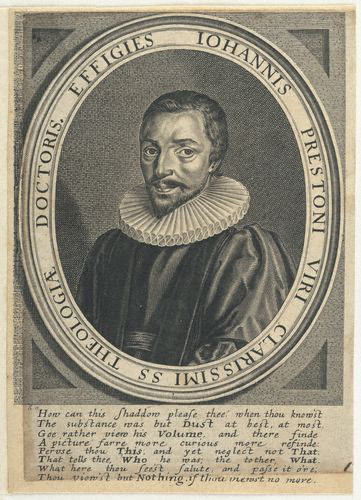
British Calvinists: John Preston (1587-1628)

John Preston (1587-1628) was born in Northamptonshire. He obtained a BA from King's College, Cambridge and then MA in 1611 from Queens' College, Cambridge. He was converted under the preaching of John Cotton. He then became ordained around 1611. Jonathan Moore describes him as "perhaps the most influential and esteemed leader of the godly in both church and state." 

He obtained his BD in 1620 and held numerous high level posts including dean of Queens',chaplain to Prince Charles and master of Emmanuel College, Cambridge. He attended the York House Conference in 1626 set up to bring a rapprochement between Arminians and Calvinists. 

Preston adopted a form of hypothetical universalism some time after 1615. He was a moderate and non-separating Calvinist, though he did much to help foster the growth of Puritanism during his time as master of Emmanuel.


Some of Preston's works are available here: http://www.prdl.org/author_view.php?a_id=466

Saturday, 19 April 2014

British Calvinists: John Cotton (1585-1652)

John Cotton (1585-1652) was born in Derby. He received his BA from Trinity College, Cambridge in 1603 and an MA from Emmanuel College, Cambridge in 1606. At Cambridge he was influenced by William Perkins. He was ordained in 1610 and became the rector at St Botolph's in Boston, Lincs. He was anti-Catholic and pro-Puritan. He became increasingly concerned with the Established Church and he favoured presbyters over bishops. He attempted to follow Anglican practices while at St Botolph's but his conscience and convictions eventually prevented him from doing so.

When Charles I came to the throne in 1625 the Anglican church became more hostile to the Puritans. Archbishop Laud was ruthless in his attempts to put down puritan tendencies in the Established church. During this time many left England for the New World. Cotton was summoned to appear before laud, this was the catalyst that led Cotton in to hiding and eventually to  New England in September 1633.

He is reputed to have said "I have read the fathers, and the schoolmen and Calvin too, but I find that he that has Calvin has them all."

Some of his works are available here: http://www.prdl.org/author_view.php?a_id=216


Thursday, 17 April 2014

British Calvinists: John Ball (1585-1640)

John Ball (1585-1640) born in Oxfordshire, he graduated from St Mary's Hall, Oxford in 1607/08. He was for a while a tutor in the home of Lady Cholmondeley where he became introduced to puritanism. He was ordained by an Irish Bishop and became curate at Whitemore, Staffordshire. he remained there for the rest of his life. 


He was an opponent of episcopal government and was imprisoned twice for his views. He also attacked the separatists. For him the Church of England was flawed but basically sound. 

Wednesday, 16 April 2014

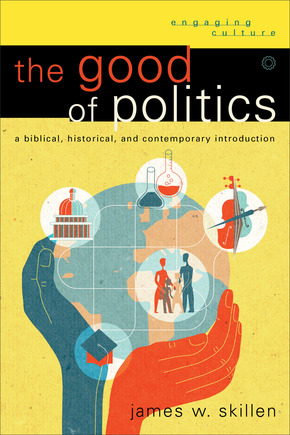
Skillen's The Good of Politics - a Review

The Good of Politics
A Biblical, Historical, and Contemporary Introduction
James W. Skillen
Grand Rapids: Baker Academic, 2014.
ISBN 978-0-8010-4881-4
Pbk, xxi + 214pp, £13.89

It's often said that religion and politics don't mix. It's also said that politics and religion should be avoided in polite conversation. In an interview for Vanity Fair magazine Tony Blair was asked about his Christian faith, Alistair Campbell, Blair's former communications Chief (aka spin doctor), immediately interrupted and said "I'm sorry, we don't do God".

Contrast this with a scene in the film Amazing Grace. William Wilberforce when considering giving up his political career for one in religion was visited by members of the Clapham Sect and Thomas Clarkson. Clarkson says to Wilberforce ‘We understand you are wondering whether to pursue politics or religion’. Hannah More responds: ‘We humbly suggest you can do both’.

That is the reformational response. We can serve God and do politics – in fact we can serve God in doing politics. Religion and politics do mix! In part this is why Skillen has written this excellent book, the title of which may seem to some Christians to be outrageous - how can politics be good?  

His main aim is to show the creational role of politics and thus politics can be good. The current Christian consensus is that politics is a necessary evil. Skillen exposes this misunderstanding and ably shows the creational role of politics.

This misunderstanding has been prevalent since Augustine. Augustine suggested that institutions of government are unnatural and are permitted by God only in response to sin as both a punishment and a remedy for our sinful condition. If this is the case, as Skillen points out, then natural law cannot provide a basis for unnatural institutions. This Augustinian-perpetuated error stems from not having a strong enough view of creation. God created humans for political life and thus it can be good and it is ‘not a neutral terrain’ (p. 118).

Skillen shows the deficiency of the Augustinian perspective in the first two sections - biblical and historical. In the third and final section he looks at what Christian political involvement might look like. Here he surveys important topics such a economics, the environment, education, family and citizenship as vocation.


This is an important book, it should be read widely - and not just by Christians who have an interest in politics - but by every Christian who is touched by politics. 


For my interview with Jim Skillen see here
The book is available in the States from Byron Borger's Heart and Minds Bookstore

David Gay: Septimus Sears A Victorian Injustice - a review

 
Septimus Sears
A Victorian Injustice and its Aftermath
David H. J. Gay
Biggleswade: Bracchus, 2010, pbk, 70pp, £2.75
ISBN 9780956023827

The content of this book was originally presented as a paper to the annual meeting of Strict Baptist Historical Society in 2009. It still bears the marks of a conversational lecture format and at times this does grate - but fortunately, content triumphs over style.

This book provides a brief introduction to the little-known Septimus Sears (1819-1877) - I would have like more biographical information - but the main topic is the debate between him and John Gadsby, the editor of the Gospel Standard (1870 - 1877) over the nature of the free offer of the Gospel.

Sears moved from a hyper-Calvinist position to a free-offer of the gospel position, however Gay feels he didn’t move far enough. Gay maintains that Sears held to an “incipient hyper-Calvinism”.

Gay examines three main primary sources: Sears’ 1841 letter to J C Philpott, his Memoirs and his preaching. Sears originally agreed with Philpott that although the first-century apostles preach and invited sinners we shouldn’t: we have no basis for copying the biblical examples. Sears somewhere between 1841 and 1865 changed his mind and thought that we should. 

In his memoirs Sears advocates warning sinners, inviting seekers and exhorting saints. Yet Gay’s examination of Sears’ preaching post 1865 shows that Sears told his hearers of the gospel invitation but offered no invite. It was more you are invited rather than I invite you to respond to the gospel. Despite this Sears was repeatedly taken to task by John Gadsby in the pages of the Gospel Standard for supposedly being too free in the way he addressed sinners. 

The issue seems to focus around the question of whether we should copy the apostles in the way they presented the gospel to sinners. In an Appendix Gay suggests that the first person to suggest that we shouldn’t wasn’t a Puritan but rather Revd Robert Hawker (1735-1823) of Plymouth in his The True Gospel: No Yea and Nay Gospel (1818), this idea was taken up and developed by J. C. Philpott. 

In this short book Gay has packed a lot of research. This not an issue that has gone away the debate still continues, many of the arguments are the same though the arguers have changed.