An accidental blog

"If God is sovereign, then his lordship must extend over all of life, and it cannot be restricted to the walls of the church or within the Christian orbit." Abraham Kuyper Common Grace 1.1.

Monday, 29 February 2016

Kuyper's Common Grace God’s Gift for a Fallen World - a review

Common Grace
God’s Gift for a Fallen World
Volume 1: The Historical Section
Collected Works in Public Theology
Abraham Kuyper 

General editors Jordan J. Ballor and Melvin Flikkema
Bellingham, WA: Lexham Press, 2016.
Print ISBN 978-1-57-799653-8 
Digital ISBN 978-1-57-799694-1
xxxiv + 632; hbk; £35.90

Publisher's website: https://abrahamkuyper.com/


Kuyper has been described as the ‘Theologian of Common Grace’ - this book provides good evidence to back up that claim. At the outset, Kuyper claims: ‘The Reformed paradigm has suffered no damage greater than its deficient development of the doctrine of common grace’ (xxxv). However, common grace is a controversial subject and is often viewed with suspicion if not loathing by those who do not embrace it. It has even split a denomination - in 1924, the Protestant Reformed Churches (PRC) rejected Kuyper's common grace and so split from the Christian Reformed Church in North America. As Kuyper puts it: ‘we find three emanations of God’s grace: a grace that applies to you personally, then a grace that you have in common with all God’s saints in the covenant, but also thirdly, a grace of God that you as a human being have in common with all people’ (4). It is the latter that Kuyper calls ‘common grace’. 

There are hints of common grace in Calvin, and Kuyper sees himself writing in Calvin’s line. This book is a very welcome addition to the ever-increasing collection of works being translated into English. We are promised the further two more volumes on Common Grace as well as Pro Rege. This volume is translated by Nelson Kloosterman and Ed M. van der Maas on behalf of the Abraham Kuyper Translation Project and the Acton Institute. The foreword is written by the editors, Jordan Ballor and Stephen Graybill. 

The book is well laid out, the text is very clear and section numbers are placed in the margins. There is a 7-page bibliography, a17-page subject/ author index and a 6-page scripture index.
The original book began life in 1895 when Kuyper began a series of newspaper articles on common grace. They were completed in 1901 and were then published in book form as De gemeene gratie in 1902.13, 1903.13 and 1905.08 (the numbered dates are those given in Kuipers’ 2011 Abraham Kuyper: Annotated Bibliography). This new translation has previously been published before by Christian Library Press, but has now been reissued as a hardback by Lexham Press – the people behind the popular Logos software.

The book is broken into 77 short chapters in over 600 pages - the length betrays their origin as newspaper articles. This is both an advantage and a disadvantage. It means the short chapters are easy to digest but as the articles were originally published weekly it does mean there is a lot of repetition. 

This volume is subtitled ‘the historical section’ - this is slightly misleading as it deals with biblical history rather than the theological history of common grace. We start with Noah before going back to the beginning of Genesis. The majority of the book deals with the book of Genesis.

One surprising thing is that Kuyper begins his book not with creation but with the flood. Why start with the Noahic covenant? Kuyper places much emphasis on the inclusive nature of the Noahic covenant and that it was not a redemptive covenant. The flood change the state of the earth and the purpose of the covenant was to take into account these changes. This was because of God’s grace - a common grace as it applied to all.

After dealing with the Noahic covenant Kuyper then turns to Adam in Paradise. The main focus there is on the issue of original righteousness. This issue it seems is central to Kuyper’s argument. He regards the initial Genesis passages as being historical and that Adam creation was almost instantaneous.

‘The more closely we analyze the Paradise narrative, the more clearly we see that we must take everything literally as it stands written’ (232)

Throughout the book Kuyper is careful to distinguish between particular grace and common grace; but they have an almost symbiotic relationship— but one that is mutually beneficial:
… common grace is only an emanation of particular grace, and that all its fruit flows into particular grace, provided we understand that particular grace itself is not in the least exhausted in the salvation of the elect, but finds its ultimate goal in the glorification of the Son of love, and through this, in the extolling of the virtues of our God (267)
Common grace stands in direct contrast to particular grace. Particular grace is personal and is geared to the personal; common grace by contrast always follows the rule that God “makes his sun rise on the evil and on the good, and sends rain on the just and on the unjust” [Matt. 5:45] (321)
Common grace is the foundation upon which the building of particular grace is erected, and it is particular grace that preserves individual elements of common grace among Israel from eroding (593)
…particular grace always presupposes common grace, and the presence of common grace is the necessary precondition for any functioning of particular grace. Without common grace any functioning of particular grace would be unthinkable (505)
Then it will be clear how common grace has cooperated with particular grace in amazing harmony, to direct God’s work, albeit along two different paths, to this one beautiful destination (585-586)
Apart from particular grace, common grace would have had no goal. And similarly, apart from common grace, the divine intention for particular grace would not have been capable of being implemented (589-590)
… particular grace is treated too much in isolation while neglecting its foundation in “common grace” and its ultimate goal: the salvation of the world that was created, maintained, and never abandoned by God (377)

He continues:

The sad consequence of this error is that particular grace floats in the air; the salvation of our soul is dissociated from our position and our life in the world; the flood-gates open for the in flux of Jewish particularism; and our Christian people are hindered from arriving at a thoroughly sound, truly Christian world- and lifeview that impassions their faith and steels their resilience (377)

He is also careful to point out the problems with what he terms “Jewish particularism’. He points out:

The fact that someone of non-Jewish descent could also be saved was a “mystery” to no one. Everyone knew this and everyone agreed (410).
 the gospel states that God so loved not the Jews but the world that he gave the world his Son; Jesus’ name is not Son of the Jews but Son of Man; this is the great mystery, that salvation in Israel is prepared for the nations … (424)
The nations do not exist for the sake of Israel, but Israel exists for the sake of the nations (439).

For Kuyper common grace was not merely an important doctrine, but also for our worldview and our praxis:

The further we develop this doctrine of “common grace,” the more clearly we shall discover the far-reaching significance of this doctrine, not only for dogmatics, but also for our entire world- and lifeview, and for the praxis of life (420)
Common grace extends over our entire human life, in all its manifestations. There is a common grace that manifests itself in order and law; there is a common grace that manifests itself in prosperity and affluence; there is a common grace that becomes visible in the healthy development of strength and heroic courage of a nation; there is a common grace that shines in the development of science and art; there is a common grace that enriches a nation through inventiveness in enterprise and commerce; there is a common grace that strengthens the domestic and moral life; and finally there is a common grace that protects the religious life against an excessive degeneration (498)

Common grace is not salvific:
God has let the wonder of common grace operate among all peoples and in all nations, even where this had no direct connection with the salvation of the elect (302).

And is not ecclesiastical:
Common grace has operated for ages in China and India without there being any church of Christ in those countries. We still enjoy the fruits that have come from common grace in Greece and Rome in the days when even the name of Christ’s church had never yet been mentioned (301-302) 

For Kuyper common grace is ‘deduced directly from the sovereignty of God’ and is the ‘root and conviction for all Reformed people’ (xxxvii). Kuyper thinks that resuscitating the doctrine of common grace will help the believer ‘take hold of the plow’ rather than retreat from the world. Common grace provides the foundation for engagement with the world thus avoiding spiritual and ecclesiastical isolation and thereby helping believers exercise dominion (xiv). Let us hope that this will be the case. It is a much-needed message for many Christians who mistakenly tend to place the spiritual over the secular and grace above nature.

The series of volumes that are to appear are entitled Collected Works in Public Theology. Public theology is a term that causes concern to Kuyperians, as it suggests a priority of theology over other sciences; nevertheless, if ‘public theology’ is in search of a framework then Kuyper’s common grace provides a solid biblical foundation for Christian action within the world. These volumes will deserve to be widely read, inwardly digested and then, we can in Kuyper’s words, ‘take hold of the plow’.


Saturday, 27 February 2016

Peter Heslam lecture on Kuyper: Christian Social Reformer 7th March 2016 in Cambridge

Christian Social Reformer event – Monday 7th March – Cambridge


Abraham Kuyper
Who: our guest speaker is Dr Peter Heslam (Director,Transforming Business)
What: A presentation followed by discussion about Christian Social Reformer Abraham Kuyper
When:  Monday 7th March (7pm-8:30pm)
Where: The Jubilee Lounge (at Jubilee Centre’s office – 59 St Andrew’s Street, CB2 3BZ)
This is the first in a new series of events from the Jubilee Centre designed to equip believers in and around Cambridge with the tools to pursue biblical social transformation by drawing on inspiration and wisdom from Christian change-makers throughout history.
Peter will deliver the keynote address which will focus on the life and work of Dutch theologian and politician Abraham Kuyper before we open up the floor to questions, discussion and broader issues of application.  Light refreshments will be served.
Space in the Lounge is limited so please do let them know if you would like to attend!  
(RSVP – n.mahiaini@jubilee-centre.org) 

Reformational Christian Studies Trust


The Reformational Christian Studies Trust is a newly launched New Zealand organisation. The recently launched website has several sections - each well worth checking out:


Friday, 5 February 2016

Saturday, 30 January 2016

Journal for Christian Scholarship (2015) 51(3) is now out

The latest issue of Journal for Christian Scholarship (2015) 51(3) is now out. It contains the following papers in English:

Michael F. Heyns & Renato Coletto. Reconciling science and faith: dialogues with Anton Van Niekerk.
 Danie Strauss. Intelligent Design – A Descendant of Vitalism?
Albert Weideman. Autoethnography and the presentation of belief in scholarly work.

as well as my book review of Friesen's Neo-Calvinism and Christian Theosophy:Franz Baader, Abraham Kuyper, Herman Dooyeweerd.

Friday, 29 January 2016

#Kuyperania January 2016

I have updated the Kuyper pages on allofliferedeemed. There is now:


Do let me know if there is anything out there I've missed.


The latest edition of Transformation has two papers looking at Kuyper and Dooyeweerd:

Thomas Harvey. 2016. Sphere Sovereignty, Civil Society and the Pursuit of Holistic Transformation in Asia. Transformation: An International Journal of Holistic Mission Studies 33: 50-64, doi:10.1177/0265378815595246

Timothy Keene. 2016. Kuyper and Dooyeweerd: Sphere Sovereignty and Modal Aspects.  Transformation: An International Journal of Holistic Mission Studies 33: 65-79, doi:10.1177/0265378815625441

Brian Collins over at Exegesis and Theology has a brief review of Bratt's Abraham Kuyper.

James Bratt takes a brief relook at Kuyper's most famous quote over at The Twelve:

To recapitulate briefly: “every square inch” can be taken as our claim of possession—worse, of entitlement—as if all the earth belongs to us good Christians. In fact, Kuyper said, it belongs to Christ, a different proposition altogether. Plus, the philosophically informed physicist in the room this week pointed out that Kuyper’s original statement exercises a double negative which springs from a particular stream of continental thought and which is essential to its meaning: “There is not a square inch in the whole domain of our human existence over which Christ, who is Sovereign over all, does not cry, Mine!”
My own pet peeve is that this quotation typically comes without a hint of Kuyper’s strategic thinking, or—far worse—of Jesus’ own directives on the matter. In the first instance, “every square inch” can be taken to rubber-stamp whatever I want to do; after all, it’s all God’s work, and if it fits my ambition and salary demands, all the better. As to the second, here’s how Jesus dispatched his disciples into square-inch land: “I am sending you out like sheep among wolves. Therefore be as shrewd as snakes and as innocent as doves.” Finally, from Kuyper’s own angle, we should rehearse another word he uttered in the same speech in which the square-inch statement appears, so as to take due recognition of who occupies our brave new world: “It cannot be said often enough: money creates power for the one who gives over the one who receives.” American politics anyone?
In short, we cannot capture Kuyper in just one quotation, even if it’s his most famous. 

Monday, 18 January 2016

WYSOCS - Relaunch and fundraising event 9 April 2016

SATURDAY 9TH APRIL 2016


WYSOCS relaunch and a fundraising dinner

WYSOCS is changing... We're delighted to invite you to join us on Saturday 9th April 2016, at the Jubilee Centre in Bradford, for a free relaunch and fundraising dinner. We'll have tapas and sangria (plus desserts), some amazing live music, and we'll share with you our exciting vision for the future of WYSOCS - with an opportunity to support our work through regular monthly giving.

Venue: The Jubilee Centre, Bradford
Dates: Saturday 9th April 2016
Time: 19.00 for 19.30-21.30
Cost: Free!

Booking: Please reserve your free place online or contact us for more information.

Tuesday, 12 January 2016

WYSOCS event with David Lyon 29 January 2016, Leeds, UK

FRIDAY 29TH JANUARY 2016

Surveillance, Snowden and See-Through Lives

David Lyon

Surveillance, Snowden and See-Through Lives

Surveillance is much-discussed in the news media, especially after Edward Snowden's disclosures and following each new terrorist attack.

Snowden's disclosures suggest surveillance is carried out beyond ethics and law. Terrorist attacks prompt calls for intensified surveillance.

How do we assess surveillance today? What difference does Christian commitment make? And how do we act appropriately in our daily lives?

Come and explore one of the defining issues of today with one of its leading thinkers.

David Lyon is a Professor of Sciology and Law, and Director of the Surveillance Studies Centre at Queen's University, Ontario, Canada.

A founder member of WYSOCS, David has spent over 30 years studying surveillance, privacy, information, ID and social sorting. He now lives and works in Canada.

Venue: Outwood House, Outwood Lane, Horsforth, Leeds, LS18 4HR

Dates: Friday 29th January 2016

Time: 19.30-21.30

Cost: £8 per person (£5 for students/couples)

Booking: Please book online or contact us for more information.

Saturday, 9 January 2016

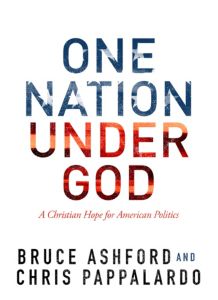
One Nation Under God - a review

One Nation Under God
A Christian Hope for American Politics
Bruce Ashford and Chris Pappalardo
B&H Publishing
176 pages; Hbk; ISBN 9781433690693

In the introduction to the book, Ashton and Pappalardo pose some pertinent questions: ‘How can we navigate between the dual extremes of political withdrawal and political salvation? Can we really engage in politics responsibly, confidently, graciously—in a word, Christianly?’ The latter may give the impression that a Christian approach to politics is a moral infusion to a secular politics. But that is far from the perspective that the authors take.

As they maintain ‘Most are confused, wanting to rightly relate their Christianity to politics and public life but not knowing how.’ The aim is that this book will help such people. 

The context is that of North American politics, but the underlying principles they write about are relevant to any place. In Chapters 1-6, they deal with overriding themes and principles before in Chapters 7-13 dealing with the following topics: abortion and euthanasia, marriage and sexuality, economics, the environment, race and immigration, and war. A final chapter looks at Augustine. 
Chapter 1 draws on Vollenhoven’s distinction, made popular by Al Wolters, between structure and direction: 'In the aftermath of the fall, the political realm remains structurally good but has been corrupted directionally' (loc 257). 

Chapter 2 looks at four competing views between nature and grace: grace against nature- a plague on the political sphere; grace alongside nature — bottom-floor politics; grace alongside nature — politics and pastors as dual ministers of God ; and the one they favour grace renews nature — a political preview of a coming kingdom (an approach flavoured by Kuyper and Bavinck). In Chapter 3 and 4, they examine the role of the gospel as public truth and the relationship of the church with the state. They make an excellent point: ‘If religion shapes a person’s core beliefs and values and cultivates their dispositions and patterns of action, then how could it not affect their political views and public interactions?’ (loc 523). This, however, as they carefully point out, drawing on Kuyper’s notion of sphere sovereignty, doesn’t mean that all spheres of life are subservient to the church: no one sphere is sovereign over another. As they put it: ‘the church should not seek to control the government. But on the other hand, the government should not seek to control the church’ (loc 740).

Chapter 5 examines the case for pluralism. They advocate a form of principled pluralism. This, of course, derives once again from Kuyper’s sphere sovereignty. Drawing on the excellent discussion in Mouw and Griffioen in Pluralism and Horizons they identify six models of pluralism, we can illustrate these in a two-way table:


All options comport well with a Christians position apart from the directional normative version of pluralism. They then expose the myth of a naked public square - a public area where values and beliefs are put to one side. Instead they cogently argue for a confessional public square.

The remaining chapters then follow a similar format - they start with a biblical perspective on the subject, then look at some key proponents or supporters of the positions. These include a look at the debate between Pete Singer and Richard John Neuhaus on - here Ashford and Pappalardo analyse how Neuhaus responds to Singer and draw relevant insight on how Christians can behave in the public square. A similar analysis is taken on the writings and responses of Rosaria Butterfield on sex; Francis Schaeffer on the environment, Martin Luther King Jr. on race, Barrett Duke and Russell Moore on immigration, and Daniel Heimbach on the just war question. Each of these chapters close with some helpful discussion questions as well as some suggestions for further reading. This makes the book a good choice for group discussions. 

My only reservation with the book is primarily the chapter on economics. Here they utilise the work of Michael Novak and Jay Wesley Richards to defend capitalism as a Christian position. I would have liked to have read a more trenchant, or as Kuyper’s puts it an ‘architectonic’, critique of capitalism along the lines of Kuyper’s Problem of Poverty or in the work of Bob Goudzwaard. How would a Christian approach to economics based on the stewardship model differ from that based on capitalism? 

There is are subject, name and scripture indexes. This book provides an excellent primer on many public issues and would be a good place to start for many Christians who are unaware of how we should proceed in the public sphere.


Friday, 8 January 2016

Koers 80(2) 2015

Koers 80(2) 2015 is now available online:

Table of Contents

Original Research

Cover Image
Renato Coletto
10
Cover Image
J.L. Van der Walt, F.J. Potgieter, C.C. Wolhuter
12
Cover Image
S Grant, C.J.P. Niemandt
6
Cover Image
Leandra Cronjé-Malan, Izanette Van Schalkwyk
10
Cover Image
Jugathambal Ramdhani, Sarita Ramsaroop
7
Cover Image
Ferreira C, Salome Schulze
8
Cover Image
M Malaba
7


ISSN: 0023-270X (print) | ISSN: 2304-8557 (online)


Why Did the Chicken Cross the Road? (Theological Version)

This made me smile - a number of different versions are doing the rounds (I've added a few of my own)
:

John Calvin: He was able to because of the grace of God.
Peter: What chicken? What road? Never knew a chicken!! (rooster crows)
Ezekiel: God revived those chicken bones and then they crossed the road.
Thomas: I won’t believe the chicken crossed unless I see it with my own eyes.
Paul: The chicken went to sleep and fell out the window only to be able to cross the road
Moses: And the Lord said: "Thou shalt cross the road"
Rick Warren: The chicken was purpose driven.
Pelagius: Because the chicken was able to.
Irenaeus: The glory of God is the chicken fully alive.
John Piper: God decreed the event to maximize his glory. OR . . . it was an act of Christian hedonism. The chicken realized that his greatest joy would only be found on the other side.
Irenaeus: The glory of God is the chicken fully alive.
C.S. Lewis: If a chicken finds itself with a desire that nothing on this side can satisfy, the most probable explanation is that it was created for the other side.
 Graham: The chicken was surrendering all.
Pluralist: The chicken took one of many equally valid roads.
Universalist: All chickens cross the road.
Martin Luther: The chicken was fleeing the Antichrist who had stolen the Gospel with his papist lies.
Tim LaHaye: The chicken didn’t want to be left behind.
James White: I reject chicken centred eisegesis.
John Wesley: The chicken’s heart was strangely warmed.
Rob Bell: The chicken. Crossed the road. To get. Cool glasses.
Harold Camping: Don’t count your chickens until they’ve hatched.
Benny Hinn: If I was a chicken I'd cross the road too. Now, HEAL chicken !!
Joel Osteen: The chicken crossed the road to maximize his personal fulfilment so they he could be all that God created him to be.
Roger Olson: The chicken recognizes no clear evangelical boundaries.
Mark Driscoll: A [bleeping] chicken crossed the road to go get a beer.
Jim Wallis: The chicken is an organizer for Occupy Barnyard.
Emergent: For this chicken, it's not the destination that’s important. Its the journey itself.
Greg Boyd: It’s a possibility that the chicken crossed the road.
N.T. Wright: This act of the chicken, which would be unthinkable in British barnyards, reeks of that American individualism that is destructive to community.
Al Mohler: When a chicken begins to think theologically, he has no other alternative but to come over to the Calvinist side of the road.
Michael Horton: The chicken was forsaking the kingdom of this world to live solely in the Kingdom of Christ.
John Frame: The chicken had an existential need to change its situation according to a new norm.
T.F. Torrance: The inner logic of the incarnation proved an irresistible draw to the other side of the road.
Dietrich Bonhoeffer: He was abandoning cheap grace for the costly discipleship of risking the dangers of crossing the road.
Karl Barth: The crossing of the road, like all true theology, was done for profoundly Christological reasons. Because Christ came as the judge to be judged, all chickens cross the road in the end.
Paul Tillich: Because he sensed that the other side of the road represented the ground of all being.
New Ager: Because he saw the light beckoning him forward.
Fundamentalist: Because his pastor tells him so.
Gary Demar: The chicken was fleeing the destruction of Jerusalem in AD 70. That’s it.
Annihilationist: The chicken was hit by a car and ceased to exist.
Biblicist: because the Bible tells him so
Buber: I and Thou, Chicken.
Methodist Church: Road-crossing chickens are affirmed in our churches regardless of their motives or sexual orientation.
Anglican vicar: Chickens have rights too. This chicken must not be in any way prevented from running across the road. Let us show a caring and pluralistic spirit as we identify with the chicken in its plight.
Anglican PCC: We don't know yet - but we'll form a sub-committee to investigate.
Liberation Theologian: Because that's where the poor are.


Tuesday, 5 January 2016

By Kuyper - available online

The following is a list of books or articles available by Abraham Kuyper translated into English and available online - in date order of original.
1878. 'Liberalists and Jews' translated by Dr. Jann Schlebusch available on line here.
1879 Dr. A. Kuyper, Het heil in ons (1879; repr. Kampen: Kok, 1910), pp. 165–225.
This study appeared in thirteen instalments in the Sunday supplement of De Standaard, from Aug. 2 to Nov. 15, 1874. ©Translation by Harry Van Dyke

1880. 'Sphere Sovereignty' (A public address delivered at the inauguration of the Free University, Oct. 20, 1880) Translated by George Kamps


1888. Days of Glad Tidings - Pentecost (with Ascension Day) vol. III (translated from Dagen van Goede Boodschap -Op den Pinksterdag (Met Hemelvaart) J.A. Wormser: Amsterdam, 1888 - by Jack Van Meggelen)
 1888. The Ascent of the Son The Descent of the Spirit. (26 Meditations on Ascension and Pentecost)Translated by Jan H. Boer
1890. "Lecture on missions." Given at the mission conference, Amsterdam, Jan. 28–30, 1890. ©Translation by Harry Van Dyke

1895.  "Commentary on the Heidelberg Catechism Lord’s Day 42 (1895)" Markets & Morality.16(2) (2013)


 Extracts from The Work of the Holy Spirit:
    Sermon on Sanctification
      Sermon on Sanctification and Justification

1901. "Catholic Voters of District VIII" Source: Kuyper-archief, Historisch Documentatiecentrum VU, nr. 6460. ©Translation by Harry Van Dyke

1904. 'The Biblical Criticism of the Present Day'Bibliotheca Sacra (July/ Oct 1904)
1907. The Mystery of Islam. Translated by Jan H. Boer.  Chapter 1 of Volume 2 of Kuyper’s Om de Oude Wereldzee (Around the Ancient Mediterranean Sea).

1909. "Kuyper on political cartooning." From the Foreword to Dr. Kuyper in de Caricatuur. (Amsterdam: Van Holkema & Warendorf, 1909) ©Translation by Harry Van Dyke

1909. "Kuyper on coalitions and antithesis." From Wij, Calvinisten . . . (Kok, Kampen, 1909), 11–18. Selection from an address to the 17th National Assembly of Anti-Revolutionary Party delegates, convened in Utrecht on 22 April 1909, in preparation for the coming general elections. ©Translation by Harry Van Dyke

1909. "Kuyper on Calvin" From Wij, Calvinisten . . . (Kok, Kampen, 1909). Extract from Abraham Kuyper’s address to the 17th National Assembly of Delegates of the Antirevolutionary Party, gathered at Utrecht, 24 April 1909, in preparation for the upcoming general election campaign. This translation of pp. 149–52. ©Translation by Harry Van Dyke.
1912. Abraham Kuyper on separate organizations Pro Rege, or the Kingship of Christ (Kampen: Kok, 1912), 3:184–94 (§ XIX). ©Translation by Harry Van Dyke
1912. You Can Do Greater things Than Christ. Translated by Jan H. Boer (section from Pro Rege)
1916. The Evolution of the Use of the Bible in Europe in Centennial Pamphlets, No. 2. American Bible Society: New York, 1916