An accidental blog

"If God is sovereign, then his lordship must extend over all of life, and it cannot be restricted to the walls of the church or within the Christian orbit." Abraham Kuyper Common Grace 1.1.

Thursday, 24 March 2022

Review of God, Technology and the Christian Life

 God, Technology, and the Christian Life
Tony Reinke

Crossway Books

9781433578274

320pp, pbk

Book website here


Recent years has seen Christians are becoming aware of the impact of technology on cultural life. Although technology has always been with us, from the time Adam used a branch to reach fruit on a tree (as Calvin Seerveld observes) it is good to see books written on a Christian view of technology (see a list here). The 1986 book Responsible Technology was one of the first in recent decades to take it seriously. They pointed out that technology was not a neutral activity and that it must be done under the Lordship of Christ. One of the authors of that book Egbert Schuurman has written extensively on the impact of technology.


It is good to see that Christians are taking this issue seriously and in the last 12 months has seen several books on this topic. One of them is this book by Tony Reinke. Reinke is no stranger to technology he has previously written on 12 Ways Your Phone Is Changing You. In this book, he examines the border effects of technology ostensibly drawing on the insights of John Calvin, Charles Spurgeon, Abraham Kuyper, Herman Bavinck, Jacques Ellul, Wendell Berry, Kevin Kelly, Elon Musk, and Yuval Noah Harari. 


He identifies and debunks 12 common myths regarding faith and technology. These are:


Myth 1: Human innovation is an inorganic imposition forced onto the created order. 

Myth 2: Humans set the technological limits and possibilities over creation. 

Myth 3: Human innovation is autonomous, unlimited, and unchecked. 

Myth 4: God is unrelated to the improvements of human innovation. 

Myth 5: Non-Christian inventors cannot fulfill the will of God. 

Myth 6: God will send the most beneficial innovations through Christians. 

Myth 7: Humans can unleash techno-powers beyond the control of God. 

Myth 8: Innovations are good as long as they are pragmatically useful. 

Myth 9: God governs only virtuous technologies. 

Myth 10: God didn’t have the iPhone in mind when he created the world. 

Myth 11: Our discovery of atomic power was a mistake that God never intended. 

Myth 12: Christian flourishing hinges on my adoption or rejection of the technium.


Each chapter ends with a numbered list of take-always. 

I was hoping to see more on Kuyper and Bavinck - but they like to other authors mentioned are only utilised in passing. It is a shame that the two (unrelated) Schuurman’s are not drawn upon mere extensively - as both Schuurman’s provide some of the best Christian insights int technology. This is no academic book but provides a good introduction to the subject.


One point I found stimulating was Reinke’s observation in Chapter 3 he makes an interesting observation: Cutting-edge advances will mostly come through God rejectors. 


Of course, this is not always the case - most of the early scientists were Christian. And we have the Christian Faraday to thank for discovering electromagnetism. Reinke’s point does however show the effect of common grace. It begs the question is this descriptive or prescriptive?


Why is it the case? Is it because Christians are too heavenly minded to be if earthy use? Is it because technological involvement takes second place to church-based activities? Of course, it shouldn’t be the case - that it is is an indictment on dualistic Christianity.


Contents:

Chapter 1: What Is Technology?

 Chapter 2: What Is God’s Relationship to Technology?

 Chapter 3: Where Do Our Technologies Come From?

 Chapter 4: What Can Technology Never Accomplish?

 Chapter 5: When Do Our Technologies End?

 Chapter 6: How Should We Use Technology Today?

General Index

 Scripture Index


My thanks to Crossway for a review copy.


Friday, 18 February 2022

The State of neo-Calvinism in Wales

 My piece on neo-Calvinism in Wales is now up here


Feeding the Earth - seminars


 Climate change, population growth and movement, cost of living pressures, animal welfare, seed monopolies, supply chain shortages, consumption and health… the list of challenges around food seems endless. Yet there is much thoughtful and positive work taking place to improve the health and sustainability of our food systems worldwide.

In this four-part seminar series, an international platform of researchers will speak on their work in this area from a range of perspectives that ‘use research to do good for all’.

The seminars take place on Fridays, from 12:00-14:00 BST.

Presented in partnership with All of Life Redeemed.

The full series: 20/05 | 27/05 | 03/06 | 10/06


Details available here

Tuesday, 25 January 2022

Thursday, 6 January 2022

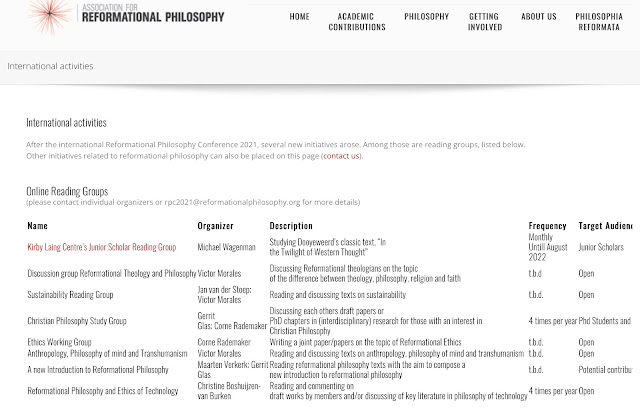
Reformational reading groups

International activities


After the international Reformational Philosophy Conference 2021, several new initiatives arose. Among those are reading groups, listed below.

Details here


Wednesday, 5 January 2022

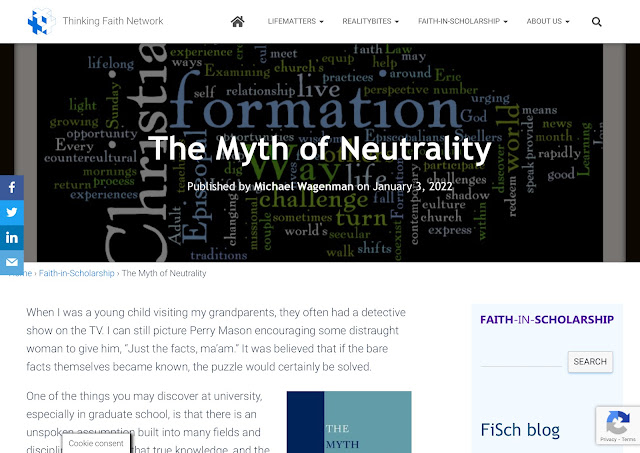
Wagenman on Dooyeweerd’s In the Twilight of Western Thought

 Mike Wagenman as part of an initiative for the Kirby Laing Centre is beginning a reading group looking at Dooyeweerd’s In the Twilight of Western Thought.

He will blog through each chapter on Thinking Faith Network’s FiSCh blog

Details of the reading group are here


Thursday, 16 December 2021

The Relevance of Kuyper to Asia Zoom Seminar


This event is sponsored by the Hwapyung Sujik church and supported by Arastamar Evangelical Seminary in Indonesia.

To register, please click the link below:


Saturday, 11 December 2021

Digital Initiatives for Reformational Philosophy

 My slides for the Reformational Philosophy Conference Panel 8: Digital initiatives for Reformational philosophy:

AoLRDec2021Conf by stevebishop

Wednesday, 8 December 2021

The Asia Kuyper Institute


 The Asia Kuyper Institute is now online: https://www.asiakuyper.org/home

Their aim is:

is to develop research on the possibilities of Kuyper’s thoughts for contemporary Asian Christians and appropriations of his ideas while pondering the uniqueness of each country in Asia.

Friday, 12 November 2021

Another variation on Dooyeweerd's modal aspects from John Paul Roberts Haine


Thanks to Eliel Morales
https://twitter.com/eliel_morales/status/1458564303842422795

Ref: Ramírez-Catalán, Jorge. 2003. Cosmovisión bíblica. Nociones esenciales. México: Seminario Teológico Juan Calvino International

Wednesday, 27 October 2021

Findings issue 2 published


 Thumbwidth Press and the All of Life Redeemed International Seminars Project is pleased to announce the publication of Findings, Issue 2. This is available free from

https://www.thumbwidthpress.net/shop

Contributions to this issue are:

Editorial: Bruce Wearne – Inspiration and Update

Isaac Njaramba Mutua – In Search of My True African Christian Identity: Journey from a dualistic to a holistic view of reality

Egbert Schuurman – Enlightenment of the Enlightenment

Mark Roques and Steve Bishop – Stewardship Epistemology

Chris Gousmett – Researching all that is “under the sun.” Creation order, the limits of science and the error of speculation in the thought of Antheunis Janse

Antheunis Janse – Translation: “The work of God that happens under the sun”

Bruce Wearne – Book Review: “The Frog and the Fish: Reflections on Work, Technology, Sex, Stuff, and Happiness.”


Issue 1 is still available, free at the same website.


Saturday, 23 October 2021

Reformational Scholarship Discussion List

If you are interested in discussing the Reformational approach to philosophy and other academic disciplines, you are welcome to join the email list: 

https://groups.google.com/g/refoscholarship

Circa 1998 the Mythnet/Thinknet group was formed for such discussion. The Reformational Scholarship Discussion [RSD] list continues its purpose.


Important:

1) If you want to access the email list's google group website, you need to join with a gmail/google account.

2) Those using a non-gmail address can still join, be members of the list, send messages and replies, etc... but they can only do so from their email, not from the group website.

3) If you want to join with a non-gmail email address, contact RSD list admins <refoscholarship+managers@googlegroups.com>

4) A day or so after joining, if you don't otherwise see it, check your spam/junk folder for the welcome message or confirmation.


More information is here: