An accidental blog

"If God is sovereign, then his lordship must extend over all of life, and it cannot be restricted to the walls of the church or within the Christian orbit." Abraham Kuyper Common Grace 1.1.

Wednesday, 14 August 2019

Interview with Mike Wagenman on his new book on Kuyper

Mike Wagenman is the author of a new introductory book on Abraham Kuyper. Details  of  Engaging the World with Abraham Kuyper can be found here - get a copy, you won’t regret it. 

It's been over 18 months since the previous interview (here) - what's been happening in the intervening period?

I have continued to teach and mentor university students. My teaching has been primarily in the area of theological anthropology, helping students explore Christian reflections on what it means to be human and how our religious beliefs (explicit or not) become woven into the cultures we create (political or ecclesiastical). It has been a real joy as students have learned the skill of “reading” the culture(s) that surround(s) them and exploring what Christian faithfulness in the midst of these cultures might look like. In this vein, I worked about a year ago with fellow Canadian theologian Douglas John Hall (McGill) in preparing his 1980 book, The Canada Crisis: A Christian Perspective, for reprint. That little book has much more to offer (in terms of interpreting our times with a distinctly theological clarity) than has been recognized. 

I have also been working on an edited and reworked version of my PhD dissertation that will be published in 2020 - a theological analysis of Kuyper’s ecclesiology, with particular focus on what it might mean to call Kuyper’s ecclesiology “sacramental." John Halsey Wood has written about Kuyper’s ecclesiology being of a “sacramental” nature and I engage with some of his work and - with deep reliance on Vatican II and post-Vatican II Roman Catholic theologians - have offered a corrected and fuller understanding of Kuyper’s “sacramental ecclesiology.”

I’m also now about six months into a brand new research and writing project that seeks to uncover some of the momentous cultural changes that started to sweep across the western world in the 1960s. This is more in the vein of “theological aesthetics” as I am working to bring some new musical artists and genres from the period into dialogue with Charles Taylor and his work on “A Secular Age.” I’m convinced that what started in the 1960s isn’t finished yet. I’m also convinced that with the rise of “secularism” we can still perceive “echoes” of Christian faith or, more generally, transcendence in popular art forms.


How did your Engaging the World with Abraham Kuyper come about?

Engaging the World was really the brainchild of a pitch I made to Lexham Press, the publisher of the Abraham Kuyper Translation Project. In conversation with them, I pointed out that for those within the Kuyperian/ Reformed branch of European and North American Protestantism, Kuyper is fairly well-known. But outside that tradition, where a lot of new Kuyper interest is growing like wildfire, a short, accessible introduction was needed. They liked what I said and jumped on the project. They especially liked the idea of trying to do two things simultaneously: introduce Kuyper’s various cultural roles/thoughts in chronological order as well as frame Kuyper’s theological and cultural efforts in terms that American evangelicals outside the Kuyperian/Reformed tradition could understand and appreciate with little translation necessary. Both elements seemed especially important for introducing Kuyper to an evangelical audience: What all was Kuyper able to accomplish one hundred years ago? And, Why did he seek to accomplish so much, on such a wide number of fronts?


Who is the book aimed at - and why should they read it?

Because American evangelicals have become much more interested in Kuyper in recent years, the book was written for an American evangelical young adult (in that order). We wanted to keep the level out of the academic realm (thus also why it’s so short) and we wanted to notice some of the debates going on in the evangelical world today and how Kuyper’s thought might contribute to those debates. So, picture a Baptist volleyball player in Oklahoma who attends First Baptist Church and struggles in her public high school biology class or an electrician with a young family who's worried about politics and wants more nuance to the debate than he gets at his non-denominational church where it’s mostly just Red State/ Blue State simplicity. It was written so that high school classes and church small groups could tackle the book and have a good discussion with relative ease. To that end, I’m going to be posting a downloadable discussion guide for the book on my personal website later this Fall. Check out www.MichaelRWagenman.com for that.

So, because of this, those well-acquainted with Kuyper will be disappointed with the lack of nuance. This really is an introduction to Kuyper for those who need an introduction to Kuyper. Those already on the inside track with Kuyper will find it mostly old hat, though I hope that some of the biographical stories will catch their attention.


What do you hope the book will achieve (apart from making you rich!)?

I hope the book will spark some rich imagining of what it means to carry out our Christian discipleship and national citizenships under the lordship of Jesus Christ today.

The book is broken down into chapters that look at different cultural arenas in which Kuyper worked. The chapters address personal identity, public discourse/ media, education, church, socio-economics, and politics. Each of the chapters begins with a short story of something Kuyper did within each of these cultural spheres, followed by an explanation of why Kuyper did what he did - what his cultural theology was that motivated him, and concluding with some thoughts about how our Christian work in each of these areas might be sparked towards renewed commitment and more imaginative faithfulness because of Kuyper’s theology.

These are cultural arenas/spheres that we as Christians are deeply engaged in already. But maybe we’re not engaging in them fully aware that we are engaged as Christians or with a redemptive goal. Every Christian needs to navigate what faithfulness to the lordship of Christ looks like, mostly in these areas of our shared, public life together. And so I’m hoping that as readers are introduced to Kuyper, they will also be introduced to a robust version of Christian faith that propels disciples out into the world to be the salt and light that point to Jesus and the reign of God in the world. So I hope that the book helps to achieve a renewed level of Christian faithfulness in the world, that Christians would follow Kuyper as he follows Christ into a deep and faithful engagement with the world that God loves and Christ by his Spirit and people is redeeming.


You seem to downplay/ ignore the role of common grace in Kuyper - is there a reason for this?

Common grace would have been a wonderful theme in Kuyper to pursue and maybe another project will do this. Really, common grace is the big foundational concept that enabled Kuyper to venture out in the world beyond the institutional church with boldness. I didn’t include it for a number of reasons. First, the book would have had to have been twice as long to do the concept justice. Second, it would have made the book much more philosophical in nature rather than practical/ cultural and this would have rendered the book much more academic and therefore limited in audience. Third, common grace is a hotly debated element of Kuyper’s theology and the publisher and I envisioned a much more straightforward introduction. Those interested in common grace and other concepts that Kuyper championed will have to go elsewhere.


What do you see as the strengths of Kuyper's approach to engaging the world?

As I try to highlight in the book, Kuyper engaged in numerous cultural arenas/spheres because he was a Christian who sought to be faithful to Christ in his own historical/cultural moment. He clearly didn’t do this perfectly and I point out a few areas in the book where I believe he failed. And, I believe it is an open question whether or not Kuyper was truly a “public" theologian - something we have a lot to learn from the Scandinavian theologians living and working around the same time as Kuyper who were able to achieve a much more democratic solution to the increasing diversity of the late nineteenth century.

I also think a strength of the book is that it will gently poke Christians where they are vulnerable: in how they understand and live out their faith. It is my opinion that today many otherwise good and faithful Christians still tend to understand their Christian faith in one of two unhelpful and unfaithful ways. On the one hand, many view their Christian faith as a *private* (social) club that separates them from deep redemptive engagement with the world outside the institutional church (what I call “cultural Christians” in the book). They live their lives within the boundaries of the church with a "Field of Dreams" mentality: that we will build our church and keep ourselves holy and if people are interested in what we’re doing they will come to us (and become like us). Or, others view their Christian faith as deeply *personal*, a kind of nice but ultimately meaningless accessory to their lives when what really matters and what is most real is happening out in the world (what I call in the book, “modernist Christians"). These live their lives with their ultimate hope being actually rooted in a political ideology or cultural agenda and their Christian faith is so personal that it, functionally, has little or no formative or guiding influence on how they actually live their lives.

The strength of Kuyper’s approach was to be rooted and grounded in Christ, overwhelmed by his love and grace, transformed through his Word, inspired by God’s present and coming Kingdom of peace and shalom, with Christ having total control in matters of faith, belief, and practice, and then venturing out into the world to make a concrete redemptive difference from that fundamental starting point. Too often today we either don’t venture out into the world or, if we do, we think that the hope for the world emerges from the world itself rather than the in-breaking disruption of the Kingdom of God manifest in Jesus.


What about the weaknesses that we should be aware of?

As someone who has been immersed in the thought-world of Kuyper for decades now, I know that there are serious weaknesses with the book. First and maybe most important: I definitely didn’t have a chance to address the shortcomings of Kuyper as a person or as a theologian. We know today that Kuyper’s theological vision was deeply racist. Indeed, like we all are, he was rooted in his historical context. But too often his theological vision was deeply and, I think, inexcusably shaped by his European worldview that put wealthy white males at the top of the power hierarchy, complete with God’s blessing that this was how things were intended to be. I also touch on how Kuyper was a workaholic, to the point of suffering psychosomatic breakdown three times in his public career. I also would have very much liked to devote more time and attention to what I perceive to be an “early Kuyper” and a “late Kuyper.” I believe a solid case could be made that a significant shift occurs in Kuyper’s theological and political orientation after he is elected Prime Minister in 1901. I wonder how Kuyper succumbed to the temptations of political power after railing against it earlier in his career. Finally, I’m a Canadian citizen and theologian but the book has a decidedly American tone and orientation. There are many exciting ways in which Canadian (and global) Christians are experimenting with how to live out Kuyper’s Christian vision today. Unfortunately, like much in the globalized world we inhabit today, the American gravitational pull is overwhelming.


What was the best movie you have seen this year so far - what was so good about it?

I have to pass on this one - so many distractions, so little time.


What are you reading at the moment?

The Pastor in a Secular Age by Andrew Root


If you were stuck on a desert island and were only allowed two luxury items, what would you take?

That’s an easy question: A Tardis and a Millennium Falcon.


Tuesday, 13 August 2019

God's Sabbath with Creation by James Skillen - a review


God's Sabbath with Creation
Vocations Fulfilled, the Glory Unveiled
James W. Skillen
Eugene, OR: Wipf & Stock
ISBN978-1532659492
xix + 348 pp, pbk, £27.00.

Within evangelicalism there has been a tendency to downplay creation. Consequently, creation becomes identified with the beginning of the cosmos and not seen in a broader setting, the whole of the cosmos - institutions included. This has resulted in an emphasis on sin and salvation in personal, individual terms. As important as this is, it is not the whole gospel. This book by Skillen seeks to correct this misaligned perception of the gospel of the kingdom.
The book is split, like the creation week, into seven parts. In part 1 Skillen begins by looking at the opening chapters of Genesis. He does so by looking at it as God's story, a story that concludes with the sabbath, a day of rest.

Part 2 examines a pattern of doublets within the order of creation. These doublets are (almost) conveniently alliterative: honour and hospitality; Commission toward commendation; revelation in anticipation; and covenant for community. 

Part 3 examines in detail the covenant and how God engages with the fallen creation, his ‘covenantal disclosure of reality’ (133) and how it points towards God's sabbath rest fulfilled. 

Part 4 explores the relation of the first and second Adam. While Part 5 takes up the important theme of ’the already and not yet of the kingdom’.

Part 6 deals with the thorny relationship of the old and new covenants and the relationship between Israel and Jesus as the messiah - Romans 9-11 are the key passages examined here. Part 7 concludes with how all this opens up ‘the challenge of living faithfully in this age in service to God’.

To live at present as disciples of Christ does not mean waiting around to enter another world in the future while feeling alienated from this world

Skillen draws upon a wide range of sources, as the 12 page bibliography and 32-page index testifies, but in particular, he interacts most with Tom Wright, Juergen Moltmann and Abraham Kuyper. However, he is not afraid to disagree with them. For instance:

In contrast to Wright, Kuyper, and Moltmann, I believe the eschatological feast with God will take place as the fulfillment of this creation, the one and only seven-day creation of God. Therefore, the creation’s climax in God’s day of rest has everything to do with the responsibilities of God’s sixth-day servants throughout their generations. (144)

He views Kuyper's view of government as flawed:

Thus, in many respects, Kuyper remains rooted in the Augustinian belief that God established government because of sin rather than as part of the creational responsibility of the image of God from the beginning.

Though he sees:


Kuyper’s importance for us in this book is the attention he gave to the diverse responsibilities for which God made humans—the creatures who have been called to serve God and one another throughout their sixth-day generations.


This is a majestic book - it surveys a vast amount of material, it should be required reading for all Christians who take the call to follow God seriously. Grappling with the issues raised in this book will help Christians understand creation better, but more importantly understand the God of creation that much better and thus our place in relation to him and his creation.


Links:

Monday, 12 August 2019

New and recently published books

These books are recently published or are soon to be published. They will be well worth getting:


Review of Economics by Greg Forster

Economics
A Student’s Guide
Greg Forster
Series edited by David S. Dockery
Crossway
ISBN 978-1433539237
128pp, pbk, £8.99


This book by Greg Forster, director of the Oikonomia Network at the Center for Transformational Churches at Trinity International University, is a welcome addition to Crossway’s Student Guide series.
Here Forster looks at the economy ‘through the lens of the Christian intellectual tradition, seeing these things as the church has seen them in the light of Scripture and the Spirit.’
He begins by differentiating between economics, the academic discipline that studies the economy, and the economy. The economy is more than money and material goods, it involves other economic resources such as time and, surprisingly, reputation.
He is clear that important as it is, life is not just economics.
The Bible does not provide an economic theory, any more than it provides a theory of quantum gravity. What it does is provide premises or presuppositions for economics. Forster contends:
‘According to Scripture we were made to be good stewards of God's world. … The two key concepts of stewardship in Genesis are cultivating and protecting… Thus us where a Christian view of the economy comes in.’
Thus, Forster takes seriously the cultural mandate and the need for development in the creation, where stewardship is a key factor.

In chapter 2 he looks at the role of justice and mercy in terms of integrity, fruitfulness, provision and compassion. He then moves on in Chapters 3-5 to look at Augustine, Aquinas and Luther to see what insights can be gleaned for economics. Surprising is the omission of any discussion of Calvin’s views.
In the final chapter, he notes that the world is dominated by economic ideologies. He makes an excellent point:

‘However, we would be equally naive to think that we can totally repudiate existing systems of economic thought and set up “Christian economics” against them. That is not how the Holy Spirit works. At Pentecost, the people of many nations did not hear the gospel preached in a totally new language. They heard it in their own languages, the existing languages of human culture. God does not remove us from cultural systems—which include systems of economic thinking—when he redeems us.’

 He makes a good case that in challenging the idolatries we do so ‘from the position of active and loving participation in the economic life and thinking of our communities’. This echoes the so-called LACE-approach of Andrew Basden. The need to listen and affirm before critiquing idolatries and then enriching (redeeming) the viewpoints,
 Areas discussed are the market, political intervention in the markets and the role of the state.
There is a list of further reading, but notable Christian economists such as Bob Goudzwaard and Alan Storkey are surprisingly absent from it.
The book takes seriously the discipline of economics and the economy from a Christian perspective, particularly welcome is the emphasis on stewardship and thus provides a good introduction to the subject.


Table of Contents:

1. The Economy: How We Steward the World Together

2. Justice and Mercy: Key Scriptural Teachings for Economic Arrangements

3. The Ancient Crisis: From Natural to Supernatural Economics

4. The Medieval Crisis: From Conventional to Reforming Economics

5. The Modern Crisis: From Static to Dynamic Economics

6. Economic Idols and Economic Wisdom: From Ideological Captivity to Theological Transformation


Further Reading

Friday, 9 August 2019

Journal for Christian Scholarship Volume 55 (1 & 2) (2019)


The latest  Journal for Christian Scholarship Volume 55(1 & 2) (2019) has been published.

Contents

– Michael F. Heyns
A transcendental critique of some assumptions of the “silencing-of-Christian-voices” lobby

– Louise Mabille
Luther, Milton and Parrhêsia: the Reformed roots of free speech

– Rafael Benjamin
Dooyeweerd en Lever over het biologische soortbegrip

– Andries Raath
Middeleeuse staatsfilosofie, die geïndividualiseerde staat en Samuel Rutherford se bydrae tot die politieke wetenskap.

– Rufus O. Adebayo & Sylvia P. Zulu
Miracle as a spiritual event and as a marketing tactic among neo-Charismatic churches: a comparative study

– Bennie van der Walt
The leadership crisis in Africa

– Pieter Verster & Bongani Ngesi
Pastoring churches in the informal settlement of Khayelitsha in Mangaung, Free State Province, South Africa

– Danie Strauss
The antinomies entailed in Dooyeweerd’s epistemological view of a Gegenstand

– Bennie van der Walt
The influence of the traditional African worldviews and Western colonialism on leadership in Africa

Tuesday, 6 August 2019

David Doherty interviews Elmer Thiessen


David Doherty interviews Elmer Thiessen (here) - possibly the only Mennonite to own a copy of Dooyeweerd's A New Critique of Theoretical Thought 

DD: WITHIN CHRISTIAN HISTORY THERE HAVE BEEN DIFFERENT SCHOOLS AND STYLES OF CHRISTIAN PHILOSOPHY. IS THERE A PARTICULAR SCHOOL AND/OR STYLE THAT YOU IDENTIFY WITH?

ET: Although I am Anabaptist/Mennonite by persuasion, I have been strongly influenced by Calvinist/Reformed philosophy. Indeed, I often say that I owe my philosophical salvation to Reformed philosophers who have built on the writings of John Calvin and Abraham Kuyper.  I was first introduced to this philosophical tradition by the writings of Francis Schaeffer in the late 1960s. I found Schaeffer’s overview of the history of ideas most instructive. He introduced me to the notion of presuppositions, underscoring the importance of penetrating to the underlying assumptions of a belief system in order really to understand a position or argument. I am probably the only Mennonite philosopher in North America who has Herman Dooyeweerd’s four-volume A New Critique of Theoretical Thought on his shelves. I identify very much with what has come to be known as “Reformed epistemology,” and here my thinking has been shaped by contemporary writers like George Mavrodes, Nicholas Wolterstorff, and William Alston. Alvin Plantinga’s 1984 essay “Advice to Christian Philosophers” has long been an inspiration in my own research and writing. I should perhaps add that my own writing is still very much shaped by the analytic tradition in philosophy even though I recognize the shortcomings of this approach to doing philosophy.

Monday, 5 August 2019

Richard Gunton's philosophy of science diagrams

Richard Gunton writes:
Research for the Church Scientific workshops led me to produce a series of diagrams to illustrate some ideas from the Reformational philosophy tradition that inspired this project.  Most of these were originally published online at the Faith-in-Scholarship blog, but they are reproduced here in a more instructive order and with edited descriptions.  Clicking on an image will, in most cases, take you to the original blog post.


They are available online here

Here's a taster!


Sunday, 30 June 2019

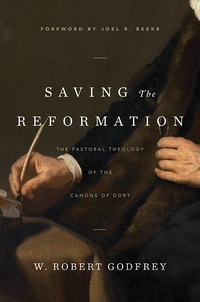
Review of Saving the Reformation by W. Robert Godfrey

Saving the Reformation
The Pastoral Theology of the Canons of Dordt
W. Robert Godfrey
The Reformation Trust
ISBN 978-1642890303
255 pp, Hbk, £14.08
Publishers website:


It is at the Synod of Dordt (1618-1619) that the Calvinistic orthodoxy was forged on the anvil of Arminianism. The Calvinistic orthodoxy has often been described as the five points of TULIP - although the Synod of Dordt developed what has become known as the five points, the acronym TULIP was not part of the formulations at Dordt.

TULIP does not sum up Calvinism. Even if it does sum up the discussions at the Synod of Dordt - although the order here was ULTIP.  Godfrey, a professor of church history at Westminster Seminary, California, in this fresh look at the Canons of Dordt, makes a pertinent point:

“Calvinism is summarized in full confessional statements such as the Heidelberg Catechism, the Belgic Confession, and the Westminster Confession of Faith.”

The aim of this book is to help Christians “appreciate the important work of the Synod of Dort in the history of the church.” Godfrey focuses on the ”fundamentally religious convictions of the synod and the canons.” In this Godfrey does an excellent job. He succeeds in showing the importance of the synod and of the canons in Reformed theology. What is missing, however, is a critical engagement with the philosophical presuppositions that were inherent in the confession - South African, Christian philosopher, Bennie van der Walt, has done this, though his main work is in Afrikaans, a useful summary in English is found here. This though is undoubtedly beyond Godfrey’s remit. And Godfrey seems happy with the Reformed scholasticism that is at times evident in the confessions.

The first part of the book examines the historical and theological background to the synod and goes on to look at the character and the work of the synod.

The second part provides a new ‘Pastoral’ translation and in part 3 there is an extremely accessible and engaging exposition of the canons. This alone is worth the price of the book. There are several appendices, including a helpful brief biography of Arminius And a detailed outline of the canons.

Godfrey has succeeded in what he set out to do. Anyone who wants an introduction to the synod and its canons could do no better than start here.


Wednesday, 26 June 2019

Ethics in Brief


Ethics in Brief was a publication produced by the Whitefield Institute and then by KLICE. It is now published as Ethics in Conversation

Other articles are available here.

Here are some of the selected highlights from the series:

Cal Bailey 2008. Building God’s Empire or Ours? The Purpose of Work in Business

Andrew Basden 2009. Ethics of Information Technology

Andrew Basden 2015. The Rise and Demise of Thomas Cook Travel: A Case Study of the Relevance of a Christian Approach to Business

Jonathan Chaplin 2013. Nicholas Wolterstorff, Justice in Love – a review and response.

Jonathan Chaplin 2009. Talking God: The Legitimacy of Religious Public Reasoning

Jonathan Chaplin 2012. A time to marry - twice

Jonathan Chaplin 2017. Understanding Liberal Regimes of Tolerance

Philip Sampson 2015. The Curious Case of the Kind Evangelicals

Maarten Verkerk  2008. Reading the ‘Two Books’: a Christian approach to organisational leadership 


Whitefield Briefing:

Andrew Basden 2000. Towards a Biblical View on Politics 

Campbell Campbell-Jack 1997. Culture: Growth Towards Glory

Peter Heslam 2005. The Role of Business in Making Poverty History:Liberation versus Transformation

David I. Smith 2001. Christian Belief and the Spirituality of Education

Tuesday, 14 May 2019

Interview with David Koyzis on Political Visions & Illusions


David, it's been over three years since the last interview (here) when We Answer to Another was published - what has happened in the intervening years?

Well, I'm no longer teaching, and I am effectively retired. This has given me time to work on a second edition of Political Visions and Illusions, which was published at the start of the century and was in need of an update.

That book went through several printings and now has been revised. Were you surprised at its success?

No and yes. No, because it filled a gap in the literature that I first noticed when I began teaching just over three decades ago. I found plenty of books that treated political ideologies, but I couldn't locate one that did what I thought needed to be done. So I wrote my own. Eventually, it went through 12 printings, the last two of which were in late 2017. I am, of course, pleased that it was picked up by so many politics instructors for use in the classroom.

But there were a couple of things that surprised me. First was the success of the Portuguese translation and Brazilian edition, titled Visões e Ilusões Políticas, published by Vida Nova in São Paulo in 2014. I've made a huge number of contacts in that country over the past few years, and well over half my so-called “friends” on Facebook are Brazilians. I am hoping that Vida Nova will translate the second edition as well. I've also received an offer to translate We Answer to Another, but I've heard nothing concrete on this as yet.

Second, I was not expecting that PV&I would be used profitably in theological seminaries. That prompted one important addition to the new revision, which I'll get to in a moment.

I have to ask then—what is new in this edition?

Quite a bit actually. The most significant change is a tweaking of the central thesis, in which I connect political ideologies with idolatry—the making of a god out of something the true God has created. Soon after the first edition was published, I began to think of the stories each of the ideologies tells—a redemptive narrative that parallels the biblical story of salvation in Jesus Christ. This angle I got from my friend and former colleague, Mike Goheen, and from the man on whom he wrote his dissertation, Bishop Lesslie Newbigin. The new edition provided me the opportunity to rework the book so as to adjust its focus.

The second chapter on liberalism may have seen the most changes, because liberalism itself has changed since the start of the century. The longstanding effort to recast as many communities as possible as mere voluntary associations has taken a malignant turn in recent years. What began as an effort to expand and enhance individual freedom has effectively produced a climate in which this freedom has become the mere satisfaction of desires, with the larger society expected to affirm these desires indiscriminately. Those who persist in believing that such institutions as state, church, marriage and family answer to norms irreducible to the subjective wills of contracting individuals are increasingly vilified as narrow-minded and bigoted. The five stages in the development of liberalism that I described in the first edition no longer follow a linear progression. If the choice-enhancement state, the fifth stage, is followed through to its logical end, I believe it will foment the sorts of society-wide conflict that will lead to the Leviathan state of Hobbes, that is, it will double back to the first stage.

In recent years I have also come to see more clearly the importance of the institutional church for political life. In the first edition, my understanding of the church was primarily as the larger body of Christ living out its members' diverse callings throughout the broad array of life's responsibilities. But in a “Concluding Ecclesiological Postscript,” I now undertake to explore the role that the institutional church—the gathered community of the faithful meeting for worship and catechesis—might play with respect to political life. This will make the book even more relevant for ministers in training at seminaries, or even for seasoned parish clergy grappling with their roles in equipping their members for living out the kingdom in their daily lives.

Finally, at the end of the book are discussion questions for each chapter.

What are the key arguments of the book?

Well, I believe that political ideologies, such as liberalism, conservatism, nationalism, democratism and socialism, have each got something right. Liberalism is right about individual liberty. Conservatism is right about tradition. Nationalism, democratism and socialism are right about communal solidarity. However, each goes astray at precisely the point where it has seen a genuine truth. Liberals make too much of individual freedom at the expense of the legitimate claims of community. Conservatives stick with tradition, but they are often unable to distinguish between the positives and the negatives in a particular tradition. As I indicated earlier, each of these ideologies follows an implicit redemptive narrative, a story that parallels the biblical story of creation, fall, redemption and consummation. This is most evident in Karl Marx and his heirs, but it can be found in the others as well. Conservatism is a bit different, but I won't go into that here. The religious roots of the ideologies have escaped most of the writers on the subject, which is why I wrote the book in the first place.

Who is it aimed at and why should they get hold of a copy?

The book can speak to virtually any educated person, although the primary audience is a Christian one. Many Christians understand that they are saved only through Jesus Christ and that they are called to live in gratitude for this salvation through the empowering of the Holy Spirit. Yet it's not always evident to them that this has implications for their life in the larger culture and society. Some Christians do get involved in politics, but such involvement may take the form of crusades on this or that particular issue. My book is an effort to get them to think more deeply about the spiritual foundations of political life.

If you think social conservatism is deficient, if you have doubts about the so-called social justice warriors, if you think populism may not be bringing the best leaders to the fore, then this book is for you!

What do you make of the current attraction for white evangelicals of Donald Trump?

I must admit, this came as a surprise to me. I didn't think Trump was a serious candidate at first; I thought he was merely trying to increase his brand recognition. Perhaps that's what he thought too. Some evangelicals appear to have sold their souls for Trump, but I don't think that's true of everyone. Many Americans voted less for him than against his opponent. Why?

Well, today's Democratic Party appears to have embraced all the logic—and illogic—of what I call the choice-enhancement state. You may have seen this statement from the US Supreme Court's decision in Planned Parenthood vs. Casey (1992): “At the heart of liberty is the right to define one’s own concept of existence, of meaning, of the universe, and of the mystery of human life.” The Court is claiming to make each of us into a god, but this is incompatible with life in community, where we are bound together by norms irreducible to our private predilections. The Democratic Party has run with this expansive understanding of liberty, but in so doing it is threatening the liberties of real communities with their own nonliberal traditions. What we are now seeing in the Trump presidency is the predictable backlash against this.

However, the Republicans have embraced a different side of the liberal agenda, and it revolves largely around economic choice and the market. Both Democrats and Republicans have embraced the expansive ego, and both are tending towards an unhealthy statism, as Patrick Deneen has so lucidly explained in Why Liberalism Failed (2018). Trump is by no means the answer to this. As I see it, he is only a symptom of what's wrong in American public life.

Any observations for those of us currently undergoing Brexit?

As with Trump, I understand the motivations behind those voting to leave the European Union. Having to answer to so-called “eurocrats” in Brussels has irritated many Britons, whose insular geography has protected them from so many European tyrannies over the centuries, the most recent of which was three-quarters of a century ago. 

However, I don't see why the EU needs to be a symmetrical federation along the lines of the United States, Germany and Australia. Here in Canada we have been compelled by our circumstances to experiment with an asymmetrical federalism in which Québec relates to Ottawa somewhat differently than the other nine provinces. Spain has done something similar with its regions. There is no reason why the EU could not consist of a more tightly integrated core, consisting perhaps of Germany, France, Italy and the Benelux countries, while other member states have a looser association with Brussels. The Maastricht Treaty of 1992 offers the principle of subsidiarity, often associated with Catholic social teachings, as a means of differentiating the powers of Brussels and the member states:
In areas which do not fall within its exclusive competence, the Community [or the EU] shall take action, in accordance with the principle of subsidiarity, only if and in so far as the objectives of  the proposed action cannot be sufficiently achieved by the Member states and can therefore, by reason of the scale or effects of the proposed action, be better achieved by the Community. Any action by the Community shall not go beyond what is necessary to achieve the objectives of this Treaty.
If this division of powers is taken seriously, it should be possible for the United Kingdom to remain in the Union while retaining its independence in domestic and much of foreign policy as well. Perhaps it's too late for that now, but the continual postponement of the departure date would seem to indicate that a lot of people are having second thoughts. Perhaps it's time for another shot at making EU membership work in a way that fits Britain's unique needs and aspirations.

Are there any other projects you are working on?

Well, a few years ago I wrote a series of reflections on the Heidelberg Catechism which I hope to publish at some point.

I have also worked out a quite detailed sketch of another major book on the relationship between political culture and political institutions. I've given this project the provisional title, “The Real Constitution.” For those of us in the tradition of Abraham Kuyper, I think we have not always been sufficiently aware of the cultural soil in which our political systems grow and develop. This cultural soil has religious foundations that cannot be called into existence by manipulating political institutions. Americans think their 18th-century founders were skilled constitutional engineers who produced something approaching a perfectly balanced system, but virtually every country that has tried to replicate these institutions for itself has ended up a presidential dictatorship. What is lacking in these countries is the culture of self-governance to which Americans had become practised during the colonial era. Culture matters much more than we are often aware.

What books have had the most influence on your life?

Well, this may seem like a terrible cliché, but the Bible has easily had the most influence. Over the decades I have maintained a regimen of daily morning and evening prayer, praying through the Psalms every 30 days (as prescribed in the Book of Common Prayer), and reading the Old and New Testaments in course. Every time I read through its books, I see something I hadn't seen before. I was raised in a Bible-reading household, I worshipped in a Bible-believing church, and I still love God's written word.

Al Wolters' Creation Regained remains an inspiration for me and for so many others. I was privileged to sit under Wolters' teaching at the Institute for Christian Studies, and I still have the handwritten notes I took—the nucleus of what would become Creation Regained a few years later!

Other books include H. Richard Niebuhr's Christ and Culture, Abraham Kuyper's Lectures on Calvinism, Jim Skillen's The Scattered Voice and Bob Goudzwaard's Idols of Our Time. 

Sunday, 12 May 2019

Groen van Prinsterer


Bruce Ashford reviews Van Prinsterer's Unbelief and Revolution:  How an Obscure Dutch Historian Helped Me Understand 2019

A new PhD on Van Prinsterer:

Schlebusch, J. (2018). Strategic narratives: Groen van Prinsterer as Nineteenth-Century Statesman Historian. [Groningen]: University of Groningen.

Through the application of Carr’s narrative approach to the study of Groen as simultaneously statesman and historian, for the first time a holistic picture of Groen as Anti-Revolutionary public figure emerges, casting new light on the political strategies behind his public engagement. This enables a fresh appreciation of Groen’s historical significance for constitutional democracy in the Netherlands

Tuesday, 7 May 2019

James Skillen's new book: God's Sabbath with Creation

James Skillen has a new book published by Wipf &Stock:


God’s Sabbath with Creation: Vocations Fulfilled, the Glory Unveiled
Wipf & Stock, an imprint of Wipf and Stock Publishers
ISBN 978-1-5326-5949-2 / paperback / $35

Full details are here

Jim was interviewed as part of the book launch - with Jim's permission I've reposted it here.


1. What do you offer in this book?
First, I am showing, on a biblical basis, that human responsibilities in this age matter for the age to come. Second, I’m presenting a distinct interpretation of Genesis 1-2 as the story of God’s days, which encompass all of creation from beginning to fulfillment. The text is not first about the “beginning of time.” Third, the book is a biblical, covenantal interpretation of the unfolding of God’s disclosure of creation’s meaning, all the way to God’s sabbath with creation. That climactic sabbath will include the full disclosure of the Alpha and Omega, Jesus Christ, whose work will be finished only when he comes again in final judgment and redemptive reconciliation. That will be the the time of God’s sabbath rest (the seventh day of creation) when humans will rest from their labors in God’s rest (see Heb. 4).

2. What is the audience for your book?
Any educated person with an interest in the Bible, in the meaning of creation, and the meaning of human life should find this book rewarding. Among such “educated persons,” those who will have special interest are seminary and university professors, pastors, and students who work in areas of biblical studies, theology, ethics, and pastoral care. The book deals with serious matters in a serious way, but it is not written for experts alone. One need not have a seminary or graduate school education to read it with profit.

3. How is the book structured and how does it progress?
First of all, the book shows my dependence on, and interaction with, a large number of authors in diverse areas of life. I have chosen three authors in particular as interlocutors with whom I converse throughout the book: N.T. Wright, Jurgen Moltmann, and Abraham Kuyper. They are introduced in the Preface.

The book has seven main sections, each containing 4 or 5 relatively short chapters. Part 1 develops the primary interpretive argument of the seven days of God’s creation. Part 2 looks closely at four of creation’s “revelatory patterns”: honor and hospitality, commission towards commendation, revelation in anticipation, and covenant for community. Part 3 presents an overview of the developing and cumulative disclosure of God’s covenantal bond with the human genertaions. Part 4 deals with the relation of the first Adam to the Last Adam. Part 5 takes up the peculiar biblical duality of the “already” and the “not yet” of the revelation of Christ and the coming of God’s kingdom. Part 6 shines new light on the relation of God’s covenant with Israel to the new covenant in Christ. And in the light of all that has been presented up to this point, Part 7 addresses questions about how we should live as followers of the Way, the Truth, and Life.

4. What led you to write this book?
Early in my college years I began to ask what it means to be human. I was not satisfied that traditional Christian liturgies, confessions, and theologies in which I had been raised offered enough to provide an answer. Serious and prolonged study of the Bible (including a seminary degree) and pursuit of my vocations in marriage, family, citizenship, teaching, and more led me to realize that Jesus is not first of all the savior of sinners, and humans are not first of all sinners. The incarnate savior is first of all the one through whom all things are created and hang together, and humans are first of all the creature made in the image of God to be the chief stewards, priests, and governors of creation. Therefore the sin-and-salvation story of the Bible needs to be located more firmly and comprehensively in what the Bible tells us about creation, human vocations, and God’s purposes and goal for creation. Fifty years of studying, teaching, and service in the political arena, have driven me to the completion of this volume.

5. What is your education and experience that grounds the book?
My early questions about “the meaning of life” led me to major in philosophy at Wheaton College, from which I graduated in 1966. Next was a three-year seminary degree at Westminster Theological Seminary where I studied Hebrew and Greek as part of the basic curriculum. My wife and I then traveled to The Netherlands where I studied philosophy for a year and where I became interested in Dutch politics and government. In 1970, we returned to the States where I completed my PhD at Duke University (1974), majoring in political philosophy, comparative politics, international relations, and Christian ethics.

My education after the Duke Years was in the trenches of college teaching, the birth and growth of our two children, and becoming involved in the founding of a civic education and research organization, the Center for Public Justice, which I directed full time from 1981 to 2009. Through the work of that center, I traveled throughout the country and to many parts of the world—east, west, and south—participating in conferences, learning about the multiple vocations of countless people in many different countries.

6. What impact do you hope your book will have?
My primary hope is that people of Christian faith will be inspired to join with others in reflecting on the importance of their earthly vocations and to change their view of life and their daily habits to pursue their calling to follow Jesus in faith, hope, and love. Of course, I hope that many university and seminary professors will engage the book in their classrooms and that graduate students in biblical studies, theology, ethics, politics, and many other fields will take on one or more of the theses in the book when writing their theses. And most important of all, I hope that pastors will look at and preach from the Bible in new ways, having read this book, and that many adult Bible-study groups will read and discuss it.