An accidental blog

"If God is sovereign, then his lordship must extend over all of life, and it cannot be restricted to the walls of the church or within the Christian orbit." Abraham Kuyper Common Grace 1.1.

Monday, 25 May 2015

Interview with Glenn Friesen - part 1

J. Glenn Friesen M.A. LL.B, DLitt et Phil has published a new book looking at the roots of reformational philosophy. He has a website Christian non-dualism. This is the first part of the interview.  Details of his book and a view of some of the contents can be found on Amazon's website.


Thanks for agreeing to this interview, Glenn. What led you to write your book Neo-Calvinism and Christian Theosophy?

I have spent a large part of my life studying Dooyeweerd, and I have published many articles about his philosophy. I thought it would be helpful to summarize this research in one book. But once I started the book, the project became much larger. It eventually included a lot of new research.

Why should we read your book?

If you are at all interested in the ideas of neo-Calvinism, in the idea of a Christian worldview, in Abraham Kuyper, or in the philosophy of Herman Dooyeweerd, or in the very different philosophy of Dirk Vollenhoven, then I think you will also be interested my book. I explore the development of these ideas and challenge many commonly held views of what they mean. The historical facts that I discuss will need to be taken into account in any future discussion of Neo-Calvinism or Dooyeweerd.

Even if you think you are familiar with Dooyeweerd, there are many ideas in my book that will surprise you. Check out the dynamic diagram of the modes of consciousness on page 313. The diagram is by Janet Danielson. See how Dooyeweerd’s idea of retrocipations and anticipations differs from what he has been assumed to say. Take a look at the explanation of ‘enstasis,’ ‘systasis,’ ‘dis-stasis’ and ‘ana-stasis.’ Look at the history of the idea of individuality structures and enkapsis. No one has examined Dooyeweerd’s philosophy in this kind of detail before.

After reading my book, some readers will reject neo-Calvinism and Dooyeweerd’s philosophy. Others will embrace my findings as a way of understanding Dooyeweerd’s philosophy as a coherent whole. And they will see the possibility that this provides for ecumenical and inter-religious dialogue.

What is neo-Calvinism and what is Christian theosophy?

Neo-Calvinism is usually linked to Kuyper’s idea that every part of our life (every square inch of our existence) is to be governed by our Christian worldview. As I discuss in my book, a worldview is not a theoretical set of concepts. It is not a theology or even a philosophy. It is a way of looking at the world, of seeing differently. A Christian philosophy is a theoretical account of that non-theoretical worldview.

And what is Christian theosophy?

‘Theosophy’ means “the Wisdom of God.” Christian theosophy looks for the revelation of God’s Wisdom within his creation. To use Boehme’s phrase, it is looking for “the signature of God” within creation. Christian theosophy then seeks to use that Wisdom of God in order to help creation be what it ought to be. At present, there are only “anticipations” of such future fulfillment, but the Christian theosophist seeks out those anticipations and helps to realize them.

What first alerted you to the similarities between Baader and Kuyper and Dooyeweerd?

It was a book by Mike Sandbothe, entitled The Temporalization of Time. Sandbothe reviewed several theories of time, including Franz von Baader’s. I was surprised by the similarity to Dooyeweerd’s theory of time, so I started reading Baader. I was astonished by the similarities for his entire philosophy, too numerous to be coincidental. The connection to Baader also made sense of many previously obscure ideas in Dooyeweerd. After writing my first article, I then discovered that Kuyper had read Baader, and that he praised Baader’s ideas—particularly Baader’s rejection of the autonomy of thought. There is no doubt that Kuyper was influenced by Baader in this and other ideas, including the idea of sphere sovereignty, the idea of a created heaven, the idea of our central selfhood, and even the idea of a Free University.

How did you get introduced to Dooyeweerd's philosophy?

I first heard about Dooyeweerd when I spent two months at Francis Schaeffer’s L’Abri Fellowship (Switzerland) in 1970. I was interested in the idea of a Christian philosophy. The staff at l’Abri were aware of Dooyeweerd’s work, but also suspicious of him for reasons they could not explain. As you know, Schaeffer was much more strongly influenced by Cornelius Van Til than by Dooyeweerd. As I discuss in my book, Dooyeweerd did not share Van Til’s ideas, and regarded his view of Scripture as rationalistic.

After L’Abri, how did you pursue studies of Dooyeweerd?

I found a copy of his New Critique of Theoretical Thought in the Lutheran Seminary library at the University of Saskatchewan. The set had been donated by William Hordern, a Lutheran scholar of Paul Tillich. I understand that Tillich expressed interested in Dooyeweerd. That is not surprising in view of Tillich’s interest in Jacob Boehme, who is so prominent in the tradition of Christian theosophy. Tracing the similarities would make a good doctoral thesis.

And did you study Dooyeweerd’s philosophy at any educational institutions?

Well, I briefly attended the Institute for Christian Studies in Toronto. I realized I needed to get closer to the source, and so I learned Dutch, and received a Netherlands Government Scholarship to study at the Free University of Amsterdam.

How did that go?

I was incredibly disappointed by my studies at the Free University. I left after completing a preliminary degree. Dooyeweerd had retired, and systematic philosophy was being taught by Hendrik van Riessen. I was fortunate to meet with Dooyeweerd at his home, and Dooyeweerd told me that he did not agree with the way that his philosophy had been changed by Van Riessen and his student D.F.M. Strauss. Dooyeweerd later wrote an article confirming his disagreement and outlining some of his differences in detail.

Van Riessen was a most opinionated man who expressed great annoyance at my questions. Once during a discussion in class, he walked out and slammed the door of the classroom. He was not used to a student challenging his ideas. There was no way that I wanted to work with him for my doctorate. And I did not see anything specifically Christian in the functionalistic philosophy that he taught.

But you did pursue graduate studies elsewhere?

Yes, I obtained an M.A. in philosophy from Western Ontario, a degree in law from McGill, and a doctorate in religious studies from the University of South Africa.

As a lawyer, did you find that Dooyeweerd helped you in the practice of law?

Not really, although I would like to look at this again sometime in view of my recent research. Dooyeweerd was a professor of jurisprudence, and his doctoral thesis had to do with the role of the Dutch cabinet. Now the common law system in North America and England is very different from the Dutch legal system, and so many of his specific ideas are hard to carry over into our system. In any case, I don’t think that Dooyeweerd’s philosophy can be applied in a mechanical way, even to law. It is a vision of how we are to do our theoretical work. I am, however, very intrigued by Bohatec’s suggestion that positive law is the synthesis of the essential and the peripheral, of equity and the constitutive. This seems to relate to Dooyeweerd’s (and Baader’s) distinction of the center and the periphery, of Idea and concept. Can this be applied to the difference between law and equity? In our common law legal system, equity was developed by the Court of Chancery to mitigate the harshness of the law by applying certain equitable maxims–for example, that someone may not seek certain kinds of relief if he or she does not have “clean hands.” Those seeking equity must do equity. Ideas of trust and fiduciary duties also come from equity. In my book, I discuss Dooyeweerd’s view of anticipations as finding the ‘figure’ within temporal reality. Finding the ‘figure’ in things is the opening process. He specifically discusses some of these ‘figures’ when law is opened up by anticipations, such as the legal idea of “good faith.”

What about the view that our law is based on the Bible?

No. Dooyeweerd specifically disagrees with that viewpoint. He criticizes Friedrich Julius Stahl for the view that our law is based on the Ten Commandments. He did not believe that Scripture should be used that way. He also disagreed with Groen van Prinsterer’s way of reading Scripture.

What do you see as the key differences between Dooyeweerd and Vollenhoven?

Dooyeweerd followed the ideas of Christian theosophy. Vollenhoven did not. Instead, Vollenhoven followed the ideas of his mentor Jan Woltjer, although he did not give adequate credit to Woltjer. Dooyeweerd and Vollenhoven disagreed with respect to almost every issue, whether in theology, ontology, or epistemology. They disagreed as to our human nature and of our selfhood, of the relation of time to eternity, of the nature of theory, of how we are to read the Scriptures. What is confusing is that they used similarl terminology, like ‘modality.’ But they used these terms in totally different ways.

But surely Vollenhoven and Dooyeweerd agreed on the Christian ground-motive of creation, fall and redemption?

No. They both used those terms. But they did not agree as to their meaning. For Dooyeweerd, creation, fall and redemption all occur in the supratemporal root. Vollenhoven does not share the idea of a supratemporal root, or even of the supratemporal. Vollenhoven’s philosophy is what Dooyeweerd calls ‘immanence philosophy.’ It is philosophy restricted to what is immanent to (within) time. For Dooyeweerd, it is of crucial importance that we transcend time in our selfhood. And that idea is also essential to understanding creation, fall, redemption, the working of the Word of God, and even the incarnation of Christ.

(To be continued)

Sunday, 17 May 2015

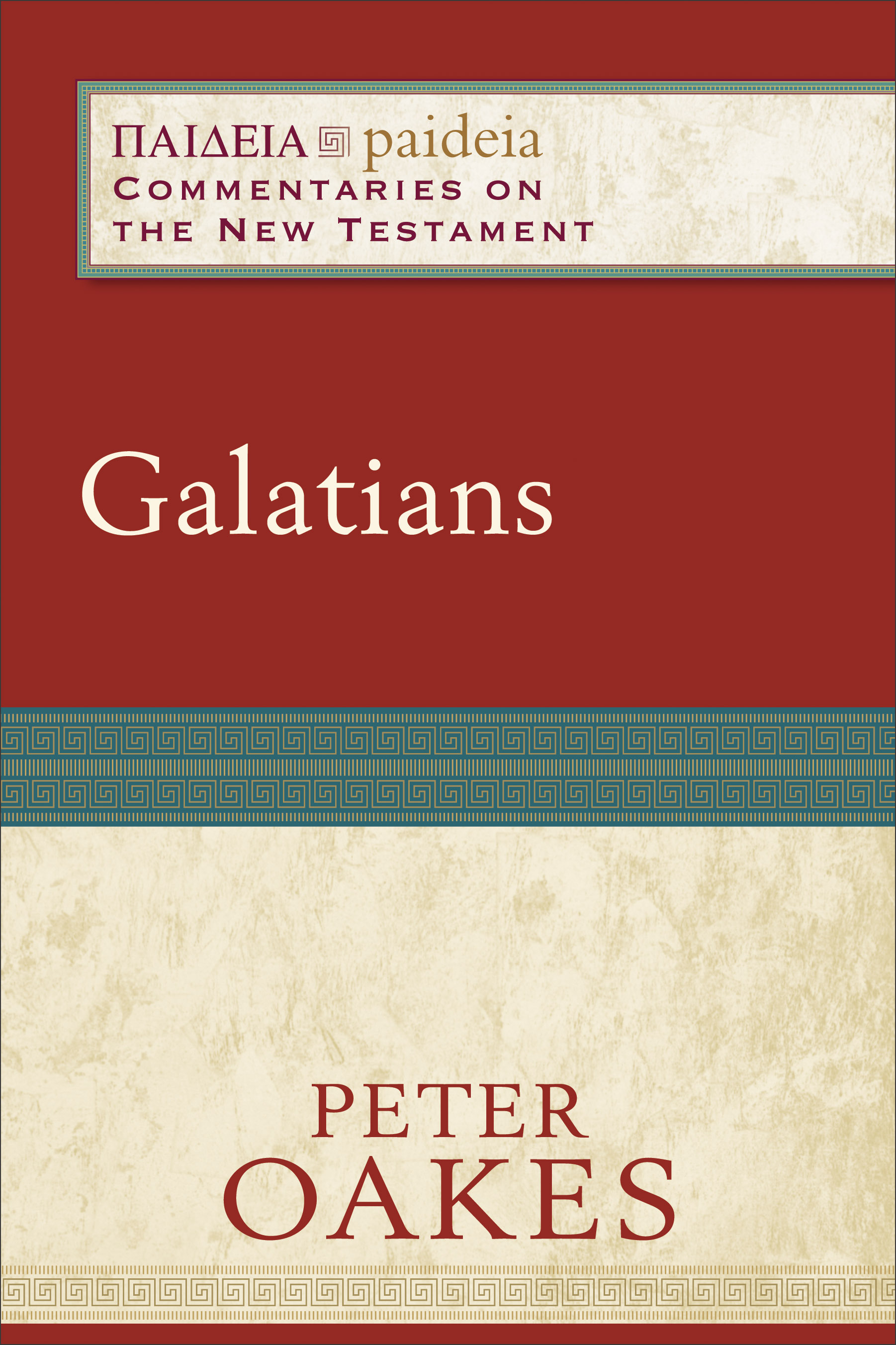
Galatians by Peter Oakes

Galatians
Paideia: Commentaries on the New Testament 
Peter Oakes
Grand Rapids: Baker Academic, 2015
ISBN 978-1-4412-4651-6
240pp


There are three important things that one needs to keep in mind when interpreting scripture: context, context and context. That of the writer’s, the audience and the present reader's as well as the social, political and cultural milieu. The Paideia series of commentaries focus on context: 
Paideia: Commentaries on the New Testament is a series set out to comment on the final form of the New testament Text in a way that pays due attention both to the cultural, literary, and theological settings in which the text took form and to the interests of the contemporary readers to whom the commentary is addressed.  
Peter Oakes, the author, is New Testament lecturer at Manchester University, he begins by ‘taking an initial look at Galatians, together with relevant external evidence such as the use of Galatians, to gather with relevant external evidence such as the early use of Galatians, to give us a provisional idea of the nature of the text.’  He arrives at fairly conservative and largely uncontroversial positions: Paul is the author writing between AD 46-61 - up to his imprisonment in Rome. He divides the main structure of Galatians into three parts: the narrative (1:11-2:21), argument (3:1-4:11) and instruction with argument (4:12-6:10). 

After each section of the commentary is a ‘Theological issues’. However, these read more like a devotional section for daily reading notes particularly when questions such as ‘What would it mean for present day Christians..?’

The strength of this commentary is its use of external evidence and the stress on the context. The text is helpfully supplemented by ‘side bars’, photographs and maps. He interacts well with more recent work on Galatians in an easy accessible style. The book will be particularly useful for undergraduates.

The most quoted authors are in order: Martinus Boer, Hans Dieter Betz, Richard Longnecker, Louis Martyn, James Dunn, Richard Hays, F.F. Bruce and Tom Wright.


We are well served with excellent commentaries on Galatians, not least Dunn, Bruce, Longnecker, Schreiner and Moo - and now to that list we could add Oakes. 

Friday, 15 May 2015

WYSOCS: Faith & Wisdom in Science with Tom McLeish 5-6 June 2015


Full details and an online booking form here.

In these three talks Tom will:

  • Ÿ outline the current ‘science and religion’ debate and its false assumptions
  • Ÿ present the Hebrew tradition of Wisdom as a resource for insights about the sciences
  • Ÿoffer a biblically-inspired framework for fruitful living, thinking and communicating in our changing world

The talks will prove invaluable for those interested in approaching the sciences from new, fresh and Christian perspectives.

Faith and Wisdom in Science, Professor Tom McLeish
Leeds City Academy, Woodhouse Cliff, Leeds. LS6 2LG

Doug Blomberg's Inaugural Presidential Address at ICS, Toronto

Saturday, 9 May 2015

Renato Coletto: Kuyper’s razor?

Kuyper’s razor? Rethinking science and religion, trinitarian scholarship and God’s eternity
Renato Coletto
In die Skriflig/In Luce Verbi 49(1) (2015).
doi: 10.4102/ids.v49i1.1891

"This article explores three research fields in contemporary Christian scholarship and argues that the way they are approached is often questionable due to the basic assumptions, the methods or the implications. The following allegations are proposed. Research on the relationship between religion and science is based on a framework of assumptions which does not reflect the biblical standpoint properly. Trinitarian scholarship expects too much from the presumed correspondence between Trinity and created reality, whilst it tends to neglect other resources available to Christian scholarship. Scientific reflection on God’s eternity is speculative in as much as it tries to transcend the modal horizon of knowledge. In these three cases (other cases are also briefly mentioned) it is argued that ‘Kuyper’s razor’ (an approach promoted in the Kuyperian reformational tradition) would help rethinking research in these areas."

Kuyper's Om de Oude Wereldzee on Dutch TV

(Re)Discovering an Evangelical Heritage

Rediscovering an Evangelical Heritage
A Tradition and Trajectory of Integrating Piety and Justice
Donald W. Payton with Douglas M. Strong
Grand Rapids: Baker Academic, 2014 
ISBN: 978-1-4412-4643-1


The original book, Discovering an Evangelical Heritage, of which this is a revised and updated diversion had its origins in a series of articles in Post American, now Sojourners (June-July 1974 to may 1975). This version adds 'Re' to the title as well as five chapter postscripts and a new introduction and conclusion. The heritage discovered was that evangelicalism had a strong commitment to social justice; personal piety didn't mean a neglect social reform and justice. He discovered a tradition of evangelical social activism that had been 'buried and largely forgotten'. Contemporary American evangelicalism is often portrayed as right wing and socially conservative, Payton through a series of case studies shows that this was not always the case. As Strong notes in his helpful and insightful introduction:
'Dayton's narrative of socially active Christians contradicted the negative reputation of revivalism as an other worldly enterprise concerned only with saving souls.' 
What is surprising in this book is the evangelicals Dayton examines. They include: Jonathan Blanchard, Charles Finney, Theodore Weld, Arthur and Lewis Taipan, Orange Scott and Luther Lee. They are all from the Arminian end of the evangelical spectrum. If Jonathan Edwards and Charles Finney can both be regarded as evangelicals - it raise the question as to how effective and/ or appropriate is the evangelical label? Is it too elastic a term to be useful? 

In his final chapter Dayton examine some of the reasons why this social active heritage has been lost among North American evangelicals. He identifies a number of issues that prompted what elsewhere Moberg terms the 'great reversal’; including: 
an institutionalisation of the movements diluted the reform impulse
complex social realities posed too much of a problem
a fatalistic, and often pessimistic, pre-millennialism replaced the optimistic post-millennialism
the growth in impact among evangelicals of the "Old School" of Presbyterianism, especially as it found expression in the "Princeton Theology" with its incarnation of conservative views. 

Not all evangelicals accept Dayton's thesis - and not just those of a right wing fundamentalist persuasion, e.g. George Marsden. Nevertheless it provides a useful insight into American evangelicalism.  Particularly helpful is the commentary by Strong - this helps place the book within its original context as well as updating the discussion.  

Tuesday, 5 May 2015

Glenn Friesen's Neo-Calvinism and Christian Theosophy: Franz von Baader, Abraham Kuyper, Herman Dooyeweerd

Glenn Friesen has a new book published:

Neo-Calvinism and Christian Theosophy: Franz von Baader, Abraham Kuyper, Herman Dooyeweerd
Aevum Books, 2015.
ISBN 978-0994775108


The blurb for the book states:

The key ideas of Abraham Kuyper’s Neo-Calvinism do not come from Calvin or from Reformed sources. Their source is the Christian theosophy of Franz von Baader (1765-1841). Among the many ideas derived from Baader are the ideas of a Christian worldview, a Christian philosophy, the idea of sphere sovereignty, opposition to the autonomy of thought, a Free University, the importance of an embodied spirituality, and the idea of our supratemporal heart, the center of our existence. Seeing these ideas in their historical context of Christian theosophy will challenge many of the current assumptions of evangelicals and reformational philosophers who claim to base their worldview and philosophy on Kuyper’s ideas or on the development of these ideas in the Christian philosophy of Herman Dooyeweerd (1894-1977).

Part 1 of this book traces the reception of Baader's ideas by Daniël Chantepie de la Saussaye and J.H. Gunning Jr., who then introduced Baader’s Christian theosophy ideas to Dutch Reformed theology. Chantepie de la Saussaye and Gunning transmitted these ideas to Kuyper, who acknowledges their influence. Kuyper refers to Baader’s writings with approval, and incorporates many of his ideas.
Part 2 is a history of the development of Dooyeweerd’s Christian philosophy, and of the very different philosophy of his brother-in-law Dirk Vollenhoven. Whereas Dooyeweerd chose to incorporate the ideas of Christian theosophy, Vollenhoven did not. They disagreed with respect to almost every idea in their philosophies.
Part 3 is a detailed examination of Dooyeweerd’s Christian philosophy. Although Dooyeweerd was not at all forthcoming about his sources, it is clear that there is a deep historical connection of his philosophy to Baader’s Christian theosophy, as well as to other mystical and non-Reformed sources. This insight allows us to understand many previously obscure parts of his philosophy and to correct previous misinterpretations of his work. It also opens the way for ecumenical and inter-religious dialogue.

Wednesday, 22 April 2015

Kuyperania April 2015

Cory Brock has reviewed Bratt's Abraham Kuyper in Journal of Theological Studies April 2015.  66 (1): 496-499.
doi: 10.1093/jts/flu202

He begins:

James Bratt's Abraham Kuyper: Modern Calvinist, Christian Democrat offers to the Anglophone world an outstanding and long-desired portrait of the nineteenth-century founder of neo-Calvinism. Bratt is a fair, balanced, and careful historian who makes much of Kuyper’s profound contextual insight, unique application of Calvinist theology, and lasting theological and political legacy without hiding Kuyper’s tendency towards sweeping generalization, blind hubris, and glaring defects. Bratt narrates the central tension in Kuyper between ‘the lust for labor and influence, the regimented discipline that made it good, the passion to make his voice heard [and] the insistence on doing things his way and on his schedule’. Kuyper was, perhaps, the most accomplished man in the modern era, who lived a life of endeavours equalling or exceeding those of the most ambitious.

John Halsey Wood Jr, also has a review of Bratt's Abraham Kuyper  in Journal of Ecclesiatical History 66(02) (April 2015): 454.

The April 2015 issue of Themelios 40(1) has two relevant reviews:

Christopher G. Woznicki on Kuyper Center Review 4.
Robert Covolo on Kuyper's Scholarship

Saturday, 18 April 2015

An interview with Willem J. Ouweneel.

The latest addition to the All of life redeemed pages is Willem Ouweneel. The author of several books recently published by Paideia Press.

He kindly agreed to be interviewed.


Could you please tell us something about yourself?

Apart from my biography on AoLR: I am married to Gerdien. We have four children and eleven grandchildren. My great passions are preaching, teaching and writing (and music - see below). My religious background is Plymouth Brethren. Officially I still belong to them, although I preach most of the time in a great variety of denominations.


You work have recently had four books and two more on the way published by Paidiea Press. Could you tell us something about the background to the books - how did they come about? And when are the rest of the series to be published?

My Canadian publisher, John Hultink of Paideia Press, invited me to write several books on several subjects, and then soon one book followed the other... Ten manuscripts are almost finished by now.


You are obviously very prolific in your writings over 160 books published. How do you manage to produce so much - what's the secret?

(a) I started early, (b) I write fast, and (c) I spend most of my time writing.


Your books are written from a dooyeweerdian perspective - where did you first come across this philosophy and why do you find it so helpful?

In many theological books, such as Bible commentaries, there is no "Dooyeweerdian perspective" at all. - In the seventies, I began studying philosophy, and through friends came across writings by Dooyeweerd and his associates, and was fascinated by them.


You differ from Dooyeweerd in that you split his psychic mode into the sensitive and the perceptive - why do feel this is necessary? How have other other dooyeweerdians reacted to this?

I believe the perceptive and the sensitive cannot be reduced to each other, or to a common denominator. Moreover, the sensitive seems to presuppose the perceptive, not the other way round. - I have to admit that I know of no philosophers or psychologists who have adopted my point of view.


You have three earned degrees - why did you choose to do that? Most people find that one is onerous enough, let alone three in three different countries! 

I began with biology, but discovered that I became more and more interested in the great philosophical questions preceding it. So I studied philosophy too. In theology I had been interested all my life. I am the opposite of a specialist (someone who knows virtually everything of virtually nothing): as a generalist, I strive to know virtually nothing about virtually everything. I would have loved to study psychology, musicology and linguistics as well... Please notice that in all three fields in which I obtained degrees, I have done academic work.


Who are the people that have most influenced you and in what ways?

To begin with, the great writers among the Plymouth Brethren (Darby, Kelly, Mackintosh, Grant, etc.). Later also theologians from all the great denominational strands, mostly Evangelical (such as C.S. Lewis) and Reformed (Bavinck, Berkouwer etc.). In philosophy, Dooyeweerd and the great dooyeweerdians.


I notice in the Dutch wikipedia entry on you it notes that you have moved from a creationist to a more guided/ theistic evolution position. Is that right? If so what prompted the shift?

That is not entirely correct. I got disappointed in many "results" of creationist research, but keep an open mind when it comes to the exegesis of Genesis 1-3.


What do you do for fun?

Genealogy (I know about 5000 ancestors of my children) and classical music (I love listening to it, but also singing in all the great classical religious choral works, from Bach to Jenkins; I take part in about ten concerts a year).


What music do you enjoy listening to?

All classical music (from, say, Monteverdi to present), with a preference for late Romanticism and impressionism (Bruckner, Mahler, Richard Strauss, Rachmaninoff, Stravinsky, Debussy, Ravel, Janacek etc.).


What books are you reading at the moment?

I have to admit that I like writers such as John Grisham to 'distract' myself.

If you were on a desert island what two luxuries would you take with you?

A computer with internet (so that, e.g., I could listen to music via, e.g., YouTube, and could keep writing books).

Many thanks. 

Willem has a Dutch website here and tweets at @wjouweneel.


Friday, 17 April 2015

Recent Kuyperania: update on the Kuyper Translation project

The following  is a description of the status of the translation projects as of April, 2015:

1. Pro Rege: Kuyper’s three-volume work on the lordship of Christ will be published and edited precisely as Kuyper viewed them, i.e. as the application of his common grace principles. These volumes are being translated by Albert Gootjes and Nelson Kloosterman. Nelson Kloosterman is doing the editing and annotation for these volumes. Clifford Anderson is writing the introduction.

2. Common Grace: Kuyper’s seminal work comprising three volumes and totaling 1700 pages in the Dutch is being translated for the first time into English. The series is being translated by Nelson D. Kloosterman and Ed M. van der Maas and annotated/edited by Dr. Jordon Ballor and Dr. Stephen Grabill. Dr. Richard Mouw has provided the introduction. Volume one is completed and available for purchase.

3. Abraham Kuyper Church Anthology: key essays and speeches that Kuyer gave on the church have been translated. The anthology will include selections from Kuyper’s doctoral dissertation on the theology of John Calvin and John a Lasco; various treatises and sermons such as the Twofold Fatherland and Address on Missions; and selections from Kuyper’s larger works on the church, such as Kuyper’s commentary on the Heidelberg Catechism. The centerpiece will be Kuyper’s programmatic statement Tract on the Reformation of the Churches, which takes a unique approach to ecclesiology. Dr. John Halsey Woods, author of the award winning book titled Going Dutch in the Modern Age: Abraham Kuyper’s Struggle for a Free Church in the Nineteen Century Netherlands, is editing this anthology.

4. Abraham Kuyper and Islam: this volume will provide an English translation of the significant pieces that Kuyper wrote about Islam, together with one or more essays of commentary on the context and import of his thought. Dr. Jim Bratt, Professor of History at Calvin College, in conjunction with other scholars, has selected various sections from Abraham Kuyper’s two travel volumes: Om de Oude Werelde-Zee for translation. Dr. Jan van Vliet, Professor of Economics at Dordt College, is doing the translation work for this project. Dr. Bratt is serving as the editor.

 This book will provide students, scholars, pastors, and interested laity with an instructive model for observing another faith and its cultural ramifications from an informed Christian point of view. The importance of this anthology is underscored in that we are not discussing just any faith but that of Islam, when at this moment its role on the global scene is so visible and controversial, its future so significant, and its relationships with Christianity so crucial for both faiths.

5. Abraham Kuyper Business, Economics, and Care of the Poor anthologies. Plans are to translate and publish Kuyper’s major speeches and essays on these subjects in two separate anthologies. The first anthology will contain material on business, ecomonics, and personal social ethics. The second volume will include material on the care of the poor. Dr.Peter Heslam, Dr. Harry VanDyke, and Dr. Jim Bratt are assisting in the selection of material to be included in these two anthologies. Dr. Harry VanDyke will translate and annotate the material for these two volumes.

6. Abraham Kuyper on Christian Education: An Anthology of Essays is a translation of a number of Kuyper’s important essays and speeches on education. In anticipation of this anthology, we have translated and published as a teaser volume Kuyper’s Scolastica I and II-- two convocations addresses that Abraham Kuyper gave as rector of the Vrije Universiteit (Free University) in Amsterdam. In these two important addresses Kuyper shares his view of the divine purpose of scholarship for human culture. Additionally, the reader will encounter a human side of Kuyper that is not always readily apparent in his other works.

The education anthology will include Kuyper’s important essay entitled “Bound to the Word,” which discusses the topic of what being bound by the word of God means within the entire world of human thought. The Kuyper education anthology will also include extracts from important parliamentary speeches by Kuyper on the subject of education, plus a translation of Kuyper’s sixteenth article about schooling that appeared in his daily newspaper in 1880 under the title of “Antirevolutionary Also in Your Household.” Other important speeches and essays that Kuyper gave on education are included as well as material on Kuyper’s views on vouchers. Dr. Wendy Naylor and Dr. Harry Van Dyke will serve as co-editors for the Kuyper Education Anthology. Dr. Naylor, Dr. Van Dyke, Dr. John Bolt, and Dr. Nelson Kloosterman have all assisted in the selection and translation of material for this important anthology.

Friday, 10 April 2015

Two new excellent pieces from Jonathan Chaplin

Jonathan Chaplin has had two excellent pieces published very recently. They are both worth a read:

Living with liberalism in Comment

Christian Scholarship Beyond the Theological Guild Fulcrum:

"Insofar as mentoring in this kind of Christian scholarship takes place in the UK it is ad hoc and episodic. As far as I can tell it is offered from one of four sources:
  • by a rather small group of individual Christian scholars in non-theological disciplines who have intentionally equipped themselves for the task;
  • by a handful of faith-oriented research institutes in secular universities;
  • by individuals or programmes within the Cathedrals Group of 16 church-related universities and university colleges;

Tuesday, 7 April 2015

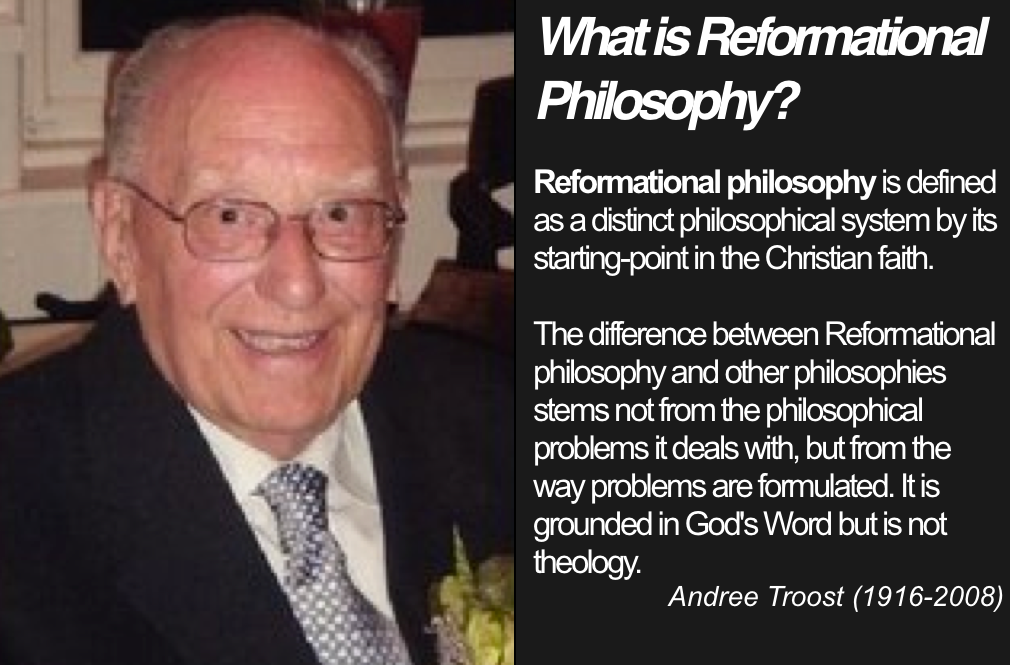
Dooyeweerd: What is religion?

What is religion?

Herman Dooyeweerd

To the question, what is understood here by religion? I reply: the innate impulse of human selfhood to direct itself toward the true or toward a pretended absolute Origin of all temporal diversity of meaning, which it finds focused concentrically in itself.

This description is indubitably a theoretical and philosophical one, because in philosophical reflection an account is required of the meaning of the word "religion" in our argument. This explains also the formal transcendental character of the description, to which the concrete immediacy of the religious experience remains strange.

If, from out of the central religious sphere, we seek a theoretical approximation of it, we can arrive only at a transcendental idea, a limiting concept, the content of which must remain abstract, as long as it is to comprehend all possible forms in which religion is manifested (even the apostate ones). Such an idea invariably has the function of relating the theoretical diversity of the modal aspects to a central and radical unity and to an Origin.

From: Dooyeweerd, H. 1953. New Critique of Theoretical Thought Volume 1. The Necessary Presuppositions of Philosophy. Philadelphia: P&R, p. 57.

Friday, 3 April 2015

A Good Friday meditation - by Abraham Kuyper

REDEMPTION THROUGH HIS BLOOD

Abraham Kuyper

In whom we have redemption through his blood, the forgiveness of sins, according to the riches of his grace (Ephesians 1:7).

At Venice, in a Roman Catholic church, officials will show visitors a drop of Jesus’ blood, spattered upon a piece of cloth, carefully preserved. Whether this drop of blood was actually shed by Jesus can never be proved. That it was not is as hard to demonstrate. There is nothing to say against supposing that one of the women who followed Jesus, out of tender regard for Him, blotted up with her skirt some of the blood spattered against the cross or oozing from the thorn-pierced brow. It is not impossible to believe that this piece of cloth was carefully preserved, that it tremulously passed from mother to daughter, until it eventually passed into the hands of ecclesiastical officials.

But, even though nothing compels us to regard such a piece of cloth and drop of blood as unactual, even, in fact, if the actuality of these could be scientifically demonstrated, that bloody mark upon that piece of linen would add nothing to our faith. Granted that the blood were actual, it would not be that blood of which the apostle said that “through it” we have redemption. To those who penetrate more deeply, that drop of blood is blood no longer. Blood is a material substance which has life. When that life leaves it, when that blood congeals and dries, it is nothing more than decaying matter. It has neither life nor potency.

Hence, God’s people may not look to such a preserved particle of the blood of Christ for redemption, but must look to the red blood of Christ, to the blood of Christ when it was still blood, when Christ’s life still coursed with it, when it was still warm by reason of the life-warmth of the exertion of our Lord’s soul.

There is no atonement without blood. Hence, no one may mock the confession of the church of God which asserts that redemption comes by “faith in His blood.” The scornful laughter of the ungodly at the so-called “blood-theology” will, we fear, some day severely aggravate their suffering. Precious in the sight of the Lord is the death of His saints: How much more precious, then, the death of the Son of God? Nor are we to believe the interpretation that this love was revealed in that blood and that it is really by His love, not by His blood, that we are saved. For the love of Christ is as clearly manifest in the statement made in the counsel of peace: “In the volume of the book it is written of me, I delight to do thy will.”

No, but the Church of God must, in a literal sense, cling to the beautiful teaching of the apostles and must in quiet reverence confess that she has her redemption through His blood.

That does not, of course, mean that that blood was the source, the fountain out of which salvation flowed, or that the Lord God was first moved to reveal His grace by that blood. Those who think so are not familiar with the Holy Scriptures. The apostle adds the explanation that blood is effectual only according to the riches of His grace. That means, then, that the source of the blessedness, the fountain of salvation, lies not in the blood but in God’s eternal grace, which is superabundantly laid away as a treasure for all His elect. Nevertheless, the Church clings tenaciously to the truth that in the incomprehensible counsel of eternal grace, saving grace is in its effects attached to the blood of Christ. Let no one wishing to avoid that condemnation try to break that relationship between grace and blood. “For the life of the flesh is the blood: and I have given it to you upon the altar to make an atonement for your souls; for it is the blood that maketh an atonement for the soul.”

Hence we need not guess or conjecture, but we can know what is the seat, the source of this mystery of grace. That source lies not in the corpuscles nor in the plasma, but in the soul of the body.

An animal, or a human creature, is really a wonderful organism. One can come upon it as a composition of matter and moisture lying prostrate. Suddenly one sees it move, arise and approach. One hears sounds issuing from it, and, if it is a human being, one hears songs of freedom and of praise. How is that possible? The Scriptures say that is due to the miracle of blood. Conceive, if you can, of the creature you saw without blood. The composition of matter would crumble then and would decay. But the creature has blood. Hence it has life, unsearchable, incomprehensible life, and that life, the Scriptures say, exists in the blood. God, the Creator of animal life, tells us: “Life, the soul of the body, exists in the blood.” Hence the seriousness of illnesses of the blood; hence the fatality when thirst causes the blood to become parched. Whatever affects the blood affects the whole human being.

Everything depends, therefore, upon a true and certain knowledge that our Refuge and Mediator really poured out His blood for us. That does not mean, of course, that all of our Saviour’s blood flowed away. In fact, very little blood flowed from Jesus’ wounds before He died. It gushed forth only after the spear had been thrust into His side afterwards. Before that, a little had oozed from His whipped shoulders, a little from His thorn- lacerated brow and a little from the wounds of the nails in His hands and feet. It was not a matter of quantity, but of the soul of the body contained in it.

The certainty we needed for full assurance of redemption was this: That He poured His blood for us, that the soul of the body contained in that blood was again separated from it by death, or, in Isaiah’s words, that “He hath poured out his soul unto death.”

John appreciated our need of that assurance most. The Lord God knew that we needed it. Hence He planned it so that a brutal soldier, doing what no one who loved Jesus could have done, profaned Christ’s body by driving his spear into it. Therefore he who loved Jesus, the beloved Apostle John, seeing that brutal act, confirmed it for us preciously, saying that “he saw it” and that he saw that the water issuing from the wound was blood no longer. “Forthwith came there out blood and water.” By that statement we are assured that the soul of Christ’s body had departed from it.


Taken from: Kuyper, A. 1960. The Death and Resurrection of Christ: Messages for God Friday and Easter. Grand Rapids, MI: Zondervan, pp. 60-62.

Monday, 23 March 2015

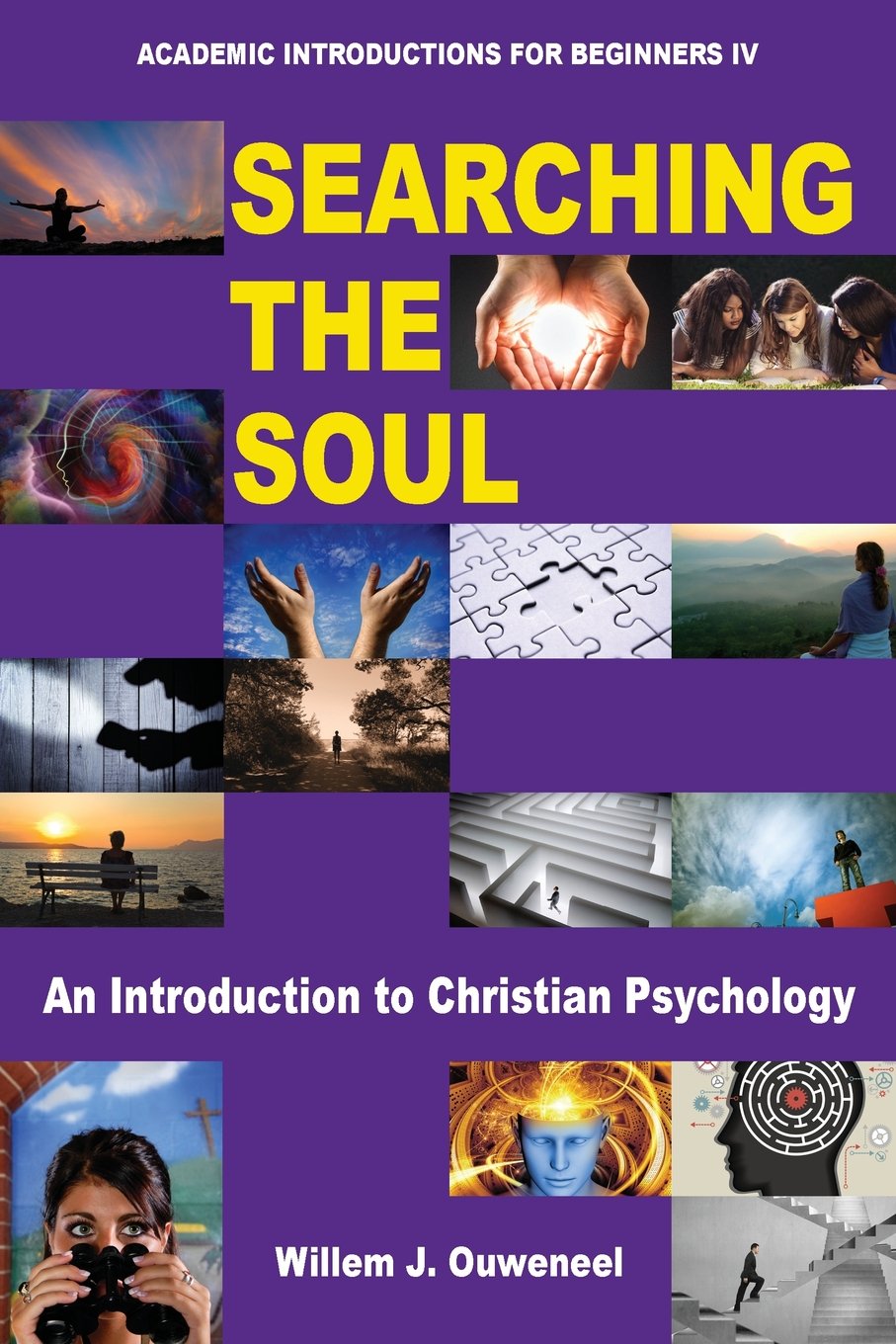
Searching the Soul by Willem J. Ouweneel - a review

Searching the Soul
An Introduction to Christian Psychology
Academic Introductions for Beginners IV
Willem J. Ouweneel.
Jordan Station, ON: Paideia Press
ISBN 978-0-88815-225-1
Pbk, xiii + 231 pp, £8.00


What is Christian psychology? Willem Ouweneel answers this question, in the fourth volume of his Academic Introductions Series, by first looking at what it’s not. It’s not a neutral science and it’s not a biblical psychology. In respect to the latter he reminds us that the Bible is true, but not all truth is in the Bible. Christian psychology is based on a Christian worldview which is ‘rooted in the Bible’ (p10). He is scathing about attempts to integrate psychology and theology; all to often the integrationists, like biblicists, understand by ‘psychology’ the current secular psychological views (p 12); they often also confuse theology with the Bible. Theology is unable to provide a Christian worldview as a basis for psychology - the limited role of theology is dealt with further in his What Then Is Theology? 

The book is an expansion of his earlier Heart and Soul (2009), which in turn was a translation of his Dutch work Hart en Ziel (1984).

His working definition is ‘psychology deals with what goes on inside a person as well as with his outward behaviour’. (p3) He develops the formula B = f(R,P,S) to show that behaviours cannot be reduced to one element or another but are a function of religious (R), personal (P) and situational factors (S).

The strength of the book is that it develops a Christian view of psychology within a Christian anthropology. So erroneous dualistic and tricotomistic (body/ soul/ spirit) views of humanity are rejected. (Unfortunately, he keeps using exclusive language.) His approach does not set Christian psychology against secular psychology, he discerns what is good in the former and seeks to transform it. He can do this as he is working from a Christian philosophical view of reality based largely on Dooyeweerd and Vollenhoven’s works. 

Particularly interesting for me was the chapter on the development of psychology from its nineteenth century origins through structuralism, functionalism, depth psychology, reflexology, behaviourism, humanistic psychology, cognitive, Gestaltand existentialist psychologies. 

It is in the context of psychology that Ouweneels’s splitting of Dooyeweerd’s psychical modal aspect into two: the perceptive and the sensitive that makes practical sense. He also makes good use of Vollenhoven’s distinction between structure and direction to critique the different psychological approaches on offer.

This books would be an excellent resource for those studying psychology at school or as undergraduates, but any Christian would find something of value in it, particularly if they are involved in any form of pastoral ministry. It is replete with good sound Christian wisdom.


Contents
  1. Psychology and Christianity
  2. Starting points for a christian psychology
  3. The unity of man
  4. Psychological knowledge
  5. The development of psychology
  6. The lower mental idionomies
  7. The spiritive idionomy
  8. The normal personality
  9. The human heart
10. The abnormal personality
11. Causes of mental disorders
12. The Christian and psychotherapy.


Friday, 20 March 2015

Computer Science by Jonathan R. Stoddard

Com­puter Sci­ence: Dis­cov­er­ing God’s Glory in Ones and Zeros
Jonathan R. Stoddard 
Presbyterian and Reformed
ISBN: 9781596389908

In this 24-page booklet Jonathan Stoddard, an associate pastor with computer science degree, attempts to understand how God is the Lord over computer science. He takes a Van Tilian approach: 

‘First, God is the foundation for computer science. Second, there is an analogical relationship between God and computer science.’

He views computing as being possible because of God: God created the foundations for computing. It is not the accident of evolution but a reflection of ‘the God who has spoken in our world’ and he has ‘established the laws needed to make computer science possible’.

Stoddard explores several analogical relationships. The way a computer scientists writes his code and the computer executes that code is analogical to the way God creates by his word: ‘there is a relation between the act of God’s creative speech and the creative speech of the programmer’. 

His approach, like Van Til’s (and Poythress, who wrote the preface), gets rather close at times to a Christian theo-ontological view, where the attributes of God provide the basis for the sciences. This perhaps comes to the fore when he writes ‘When we program computers, we are still thinking God’s thoughts after him’. 

This booklet, then is something of a curate’s egg. It is great to see a work - albeit brief - exploring what the lordship of Christ over computing might look like, but is marred by his reliance on Van Til’s analogical thinking. There is no discussion of how worldviews impact on computing or on how computer science can be viewed through the  Christian approach of creation, fall and redemption. But then a booklet of more than 24 pages would be required to do justice to that. Stoddard is right that God is the foundation for computer science, but I would disagree that that foundation is to be found in an analogical relationship.


Thursday, 12 March 2015

Mark Roques on Parables, Paris and Posing Probing Questions

Mark Roques in his own inimitable, iconoclastic style does his stuff on parables and communicating the gospel at Leeds City Church:


Tuesday, 10 March 2015

Power in Service by Willem Ouweneel - a review

Power in Service
An Introduction to Christian Political Thought
Willem J. Ouweneel
Jordan Station, ON: Paideia Press, 2014
Isbn:978-0-88815-229-9
Pbk, 146pp, £5.75

What is the Kingdom of God? This question opens the book by Ouweneel, the second volume in the Academic Introductions for Beginners series. This is an apposite question. Ouweneel develops the idea that politics cannot be separated from the kingdom of God. Likewise politics is also rooted in creation and grounded in creational ordinances - despite what Augustine thinks.

Drawing on a reformational approach Ouweneel ably shows, in this brief but brilliant book, that politics is an important area for Christian involvement. Humans are political agents, but since the fall all of life has been tainted with sin and that includes politics. But we can look forward to a fully redeemed politics when Christ returns.

Ouweneel utilises the kuyperian concept of sphere sovereignty to examine the relationship between the church and the state. Employing Dooyewerd’s analysis of institutions he sees the State as a juridicial institution that maintains public legal order. He stresses the importance of the separation of church and state but rightly affirms that this does not mean a separation between religion and society, as all of life is religious - all the way down. The role of the state is limited, it cannot play the role of a moralist but neither is it neutral.
He makes excellent use of the Vollenhoven's distinction between structure and direction to show how the fall has changed the direction but not the structure of the human heart. Ouweneel sees structure and direction as two polarities, as horizontal and vertical. 

He makes a very good point in noting that Christians often make the mistake of identifying the ‘world’ with ‘society’. Many Christians then avoid society thinking that in doing so they are avoiding the evil world. Hence, an avoidance of politics. Understanding the world as direction, and society as structure helps avoid such a non-biblical pietistic approach to society. Avoiding society taken to an extreme would be to withdraw into a monastery; but then that too is a society!

Also helpful is his discussion on being strangers and pilgrims. As he points out we cannot escape society and social institutions; no societal relationship is of itself evil, biblically there is no distinction between sacred and profane. 

Several of the key themes are then covered in a case study in the final chapter on Christian schools and religious and moral education imposed by the state.

Recent year have seen a significant number of helpful book on a Christian approach to politics - in particular David Koyzis’  Political Visions and illusions and James Skillen’s The Good of Politics. (See my list of resources for a Christian approach to politics.) This book is a helpful addition to those. It outlines clearly and accessibly what a reformational approach to politics looks like.


Contents
1. What is the kingdom of God?
2. Church and state apart
3. Offices and responsibilities
4. Theocracy
5. Strangers and pilgrims
6. The two kingdoms
7. Creation and re-creation
8. En route to the kingdom
9. The Christian school under attack