An accidental blog

"If God is sovereign, then his lordship must extend over all of life, and it cannot be restricted to the walls of the church or within the Christian orbit." Abraham Kuyper Common Grace 1.1.

Friday, 26 January 2018

Interview with Andrew Basden (part 1)


Andrew Basden is the Professor of Human Factors and Philosophy in Information Systems at Salford University. He maintains the Dooyeweerd Pages and his book The Foundations of Information Systems: Research and Practice has recently been published by Routledge (full details here).

Here he responds to my questions about his influences, Dooyeweerd and the new book.


 Could you please tell us something about yourself?

Born and brought up in Scotland, I tend to like to integrate theory and practice, I value the 'everyday' side of life, and I love the natural world, especially wilderness.  Over fifty years ago, aged 12 at camp in the Scottish Highlands, I asked Jesus Christ to be my Saviour, as the way to acceptable to God, and my Master, so that my life since then has been governed by him more deeply than by myself or my own wishes.  At university I studied electronics and, while doing so, began to yearn for a faith that was relevant to my life here-and-now, rather than just for the future.  In the early 1970s, I received this and for the first time began to love God, not just obey him.  At the same time I became active in the environmental movement.  While undertaking a PhD in computer-aided design, I met and married Ruth.  We settled down into jobs and church life and during the 1980s we raised two lads.  I returned to academic life as researcher and lecturer in the late 1980s.  I felt called by God to stand for election for the UK Green Party, and began to take part in seminars on Christians in politics.  It was there, in the mid 1990s, that I heard of the philosophy of Herman Dooyeweerd, which has shaped my academic life ever since.  It is perhaps the best philosophy of everyday life that is yet to emerge.  I'll tell you more about myself in as the interview proceeds.  


Who or what have been your main influences?

In no particular order: Scotland, Asperger's Syndrome, my family, Jesus Christ, the Bible, C.S. Lewis, biographies of Christians, a love of games, the natural world, my brother Nick, and Herman Dooyeweerd.  

Scotland I have explained above.  When I was in my late fifties, I was diagnosed with Asperger's Syndrome; I had it all my life, but this explained various of my traits, both annoying and valuable.  One of the valuable ones is that I have always been able to think out of the box, see the 'elephant in the room' and talk without threat about things most people would avoid.  I have a liking for unusual or unpopular ideas - and perhaps the uniqueness of Dooyeweerd's ideas added to its attraction.  

My family:  Parents, siblings, my wife Ruth and two sons.  Each have shaped me and I owe a considerable amount to them.  

Jesus Christ:  He is the one who has allowed me to know God personally, and he is the one to whom I owe my entire life.  He has shaped my whole life, character, personality, ideals, aims in life, and means.  He is the meaning of my life.  He is also my destiny: I believe that what I do here and now will 'translate' into the next life when I am with him in eternity; that is exciting, and it makes everything worthwhile.  

The Bible:  I love the Bible, as God's unique and important communication to the world he loves (the 'Word of God' is written form).  But I don't love standard Christian interpretations, each of which I see as a theorization of what God is or has been communicating.  Too often, Christians tend to take yesterday's theorizations for today, when God wants to emphasise something new.  

Take Romans chapter 8, for example.  In it, I find three Dimensions of Salvation, each of which has entered the world at a different time in history.  Dimension 1 is that in Christ there is no condemnation before God; this was rediscovered during the Reformation, 500 years ago.  Dimension 2 is that the Spirit of God leads us here and now, and we experience God as 'Daddy': a here-and-now dynamic relationship rather then merely a hope of forgiveness and eternal life; this was rediscovered about 150 years ago via the Holiness and Pentecostal movements.  Dimension 3 is that "Creation waits with eager longing for the revealing of the 'sons' of God"; this is being rediscovered today.  

For me, this takes two forms.  One is our responsibility for the non-human creation.  In these days that needed as never before, since humanity is destroying the earth at a faster rate than ever before because of increased population and demands, amplified by technology and economy.  The Bible suggests to me that if we are to truly address our environmental problems, then this cannot be done via education, media, economics, government policy and the like; it requires what used to be known as religious revival - with or without the emotion.  It requires people indwelt by the Holy Spirit to take the lead.  

The other form is academic life.  "The creation" includes the cultural worlds (perhaps nicely delineated by Dooyeweerd's aspects?).  One of these is academia.  After centuries of service to the world, academia is today losing its meaning.  But God's people, indwelt by the Holy Spirit, might take a lead in reforming it.  I see that is what God was using Dooyeweerd to begin to do - as a long-term project.  

This is what impels me towards both environmental sustainability and linking my faith with my academic work. 

In the midst of this, I find C.S. Lewis' writings very helpful.  Also, biographies of Christians especially missionaries who have taken God seriously.  Both inform my understanding of Dimensions 1, 2 and 3 of Salvation.  

Love of games:  I love playing games, both computer and non-computer.  This has kept me aware of issues that have been largely ignored by most academic discourses.  For example, the field of information systems is only just now waking up to computer games as a valid research area - and even so it distorts them into 'gamification' (serious games) rather than truly understanding the fun that computer games can be.  So I mention games a lot in my book.  

The natural world:  I feel at home in, and love, wilderness, plants of all kinds, birds of all kinds, most insects, and most animals.  Whereas some people spiritualize it as a stimulus to worship, I have a creational relationship with it that I believe God intended.  When Francis of Assisi called the animals his brothers, that rings true for me.  

My brother Nick:  Nick has modelled the love of our Heavenly Father, and how to see things in different ways, and how to cope with adversity.  

Herman Dooyeweerd:  At last I have found a philosophy of everyday life.  Interestingly, I adopted his philosophy not because it is a 'Christian' philosophy but because it 'works' better than others.  That Dooyeweerd shared my faith is a bonus - and also an explanation of why he was able to articulate such radical and useful ideas about meaning and everyday life.  

 How did you get introduced to Dooyeweerd's philosophy?

I was at a seminar on Christians in Politics at the Spring Harvest celebration in 1993 or 1994 and recommended Paul Marshall's book Thine is the Kingdom - the book that had inspired me to become involved in Green politics.  A guy at the back (Revd. Richard Russell, who runs the Christian Studies Unit) told the assembled company that the book had been remaindered and he had all the copies.  He then took me for coffee and asked me if I knew the background to Paul Marshall's ideas: the philosophy of Herman Dooyeweerd.  Richard gave me an overview of Dooyeweerd's aspects - which I immediately saw could help me understand the conflicts in the Green movement, and also the challenges of benefits and harm in using information technology.  

Your new book  The Foundations of Information Systems: Research and Practice has just been published. What is the main aim of the book? What prompted you to write it?

I am near the end of a very interesting career, during which I have found Dooyeweerd's philosophy to be extremely helpful in understanding all the areas of interest that I have worked in: computer science, artificial intelligence, knowledge-based systems, human-computer interaction, information systems, computer games, IT development, and societal issues - both technical and social areas.  Not many philosophers can achieve this, but Dooyeweerd did.  

So I want to leave behind a means by which people can understand Dooyeweerd and his usefulness.  That is primarily why I wrote the book.  It explains Dooyeweerd's philosophy to a degree that I think people would be able to work from even if I wrote nothing more, and it discusses how Dooyeweerd's philosophy can do two things in each of five areas.  One is to provide a foundational understanding of each area.  The other is to engage with discourses in the area - over 50 of them.  I don't want to reject or replace the ideas on which each discourse centres, but to affirm what is valid, critique the underlying presuppositions, and enrich the ideas, all using Dooyeweerd and the foundational understanding I have constructed.  

The five areas spread across both technical and social, and are seldom brought together:  the nature of ICT (information and computer technology) and the artificial intelligence question, ICT in use and its benefits and problems, ICT features that annoy or delight us, ICT and society, and ICT development.  A secondary aim of the book is to show how these things can be integrated rather than kept separated, using Dooyeweerd's ideas.  


How does it differ from your previous book  Philosophical Frameworks for Understanding Information Systems?

Both books offer a way to understand the five main areas of concern in the field of information systems, and the later book advances the older one.  However, the biggest difference is that, in the older book, that is almost all I did.  In the new book, I also discuss how these ideas can engage with extant (existing) ideas in each of the areas.  

I briefly examine over fifty discourses that are going on, ranging from computer programming and artificial intelligence, through the usefulness of information technology, to its impacts on society, to identify what issues are most meaningful in each.  Then I propose a Dooyeweerdian foundational understanding, and with that, I try to affirm, critique and enrich each of the discourses.  

For example, much of the discussion of the usefulness of ICT is about how it helps reduce costs or increase profits - a potential it has that is meaningful in the economic aspect.  However, there are fourteen other aspects in which it has potential for good or ill, such as enhancing (or confusing) communication (lingual aspect), promoting or undermining justice in society (juridical aspect), making people more selfish or more generous (ethical aspect), and so on.  All these potential aspectual impacts need to be taken into account when judging information technology - yet usually only a few are.  In such ways, Dooyeweerd can help the discussions about social media.  


And that is only one of the fifty discourses that I examine.  In the final chapter, I provide practical suggestions for over a hundred research projects that could be undertaken using Dooyeweerd's ideas - it would be great if Dooyeweerd's ideas will be taken up by many students who are looking for PhD projects to do.  


Saturday, 20 January 2018

Evidence for the increased interest in Abraham Kuyper #kuyperania

Data taken from https://books.google.com/ngrams - utilising books from 1800 to 2008. This shows the increased interest in the work of Abraham Kuyper:

Have books with the term 'worldview' peaked?

Data taken from https://books.google.com/ngrams - from books during the period 1800-2008: One thing looks obvious and that is worldview has taken over from world view or world-view as they way to write the term.

Friday, 5 January 2018

Journal for Christian Scholarship - special Reformational Issue vol 53 (2017)


The latest issue of Journal for Christian Scholarship is a special issue devoted to Reformational philosophy.

– Tinus van der Walt
An exploration of H.G. Stoker’s (1899-1993) contributions to methodology

– Renato Coletto
Khosrow Bagheri Noaparast and Islamic scholarship: a Calvinist appraisal

– Danie Strauss
Function laws and type laws – a significant link between philosophy and the special sciences

– Heinrich Alt
Platonism, nominalism and Christian philosophy

– Andries Raath
Politokrasie en staatsoewereiniteit. ’n Vals deuntjie uit ’n antieke fluit

Friday, 29 December 2017

Resources for a Christian approach to Psychology

Updated December 2017 (original Sept 2008)


Bussema, Ken.1993. 'Perspectives on developmental psychology.' Pro Rege 22 (1):1-8.

Charry, E.T.  and Russell Kosits. 2016. Christian theology and positive psychology: An exchange of giftsThe Journal of Positive Psychology, 1-12. doi:10.1080/17439760.2016.1228010

Coe, John H.  and Todd W. Hall Psychology in the Spirit: Contours of a Transformational Psychology. Downers Grove: IVP

Clouser, Roy A. 2005 (rev edn). 'Theories in psychology'. The Myth of Religious Neutrality (Notre Dame: University of Notre Dame Press) ch 9

Olthuis, James 2001. The Beautiful Risk: A New Psychology of Loving and Being Loved (Zondervan) [Reviewed here ]

De Graaff, Arnold.1980. Psychology: sensitive openness and appropriate reactions. Potchefstroom: I.A.C. (Series F2 no 17)

De Graaff, Arnold. 1977. Views of man and psychology in Christian perspective: some readings. Toronto: Institute for Christian Studies (mimeo)

Hackney, C.H. 2007. Possibilities for a Christian positive psychology. Journal of Psychology and Theology, 35 (3): 211-221.


Johnson, Eric L. 1997. Christ, the Lord of Psychology. Journal of Psychology and Theology. 25(1):11-27.

Johnson, Eric L.  2010. Psychology and Christianity: Five Views. Downers Grove: IVP.
Contributions by David G. Myers, Stanton L. Jones, Robert C. Roberts, P. J. Watson, John H. Coe, Todd W. Hall, and David A. Powlison

Jones, Stanton L. and Richard E. Butman. 1991. Modern Psychotherapies: A Comprehensive Christian Appraisal. Downers Grove: InterVarsity Press.


Russell Kosits and W. May. 2015. On Christian psychology: An interview with Russ Kosits by Werner MayChristian Psychology Around the World, 7:14-22.

Heather Looy 2013.  Psychology at the theological frontiers.  Perspectives on Science and Christian Faith, 65(3):147-155. 


Myers, David and Malcolm Jeeves. 1991. Psychology through the Eyes of Faith. Leicester: Apollos.

Pascoe, J.P. 1980. An Integrative Approach to Psychological and Christian Thought Based on a Christian World ViewJurnal of Pscychology and Theolog 8: 12-26.

Stevenson, Daryl H., Brian E. Eck, Peter C. Hill 2007. Psychology and Christianity Integration: Seminal Works that Shaped the Movement. Christian Association for Psychological Studies.


Lectures given during 2006 and 2007 at Tabor College, Melbourne, Australia as part of the Bachelor in Christian Counselling program


Earlier Lectures


The Harry van Belle pages contain over 60 papers by Harry on aspects of psychology written from a reformational perspective.
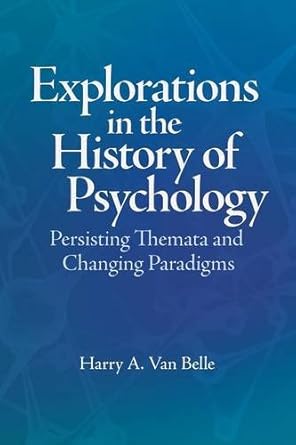
2013. Explorations in the History of Psychology: Persisting Themata and Changing Paradigms. Sioux Center, IA: Dordt College Press.

D Russel Bishop. 1988. Integrating Psychology and Christianity. A Biographical Sketch of Mary Stewart Van Leeuwen PSCF 40 (December 1988): 229-231.

  • 1976. 'View from the lion’s den: Integrating psychology and Christianity in the secular university classroom.' Christian Scholar’s Review 5: 364-373.
  • 1978. 'The behaviourist bandwagon and the body of Christ.' Crux 14 (1): 3-28.
  • 1982. 'The unfulfilled apprenticeship of North American psychology.' Christian Scholar’s Review 11 (4):291-315.
  • 1982. The Sorcerer's Apprentice: A Christian Looks at the Changing Face of Psychology, (InterVarsity Press).
  • 1984. 'The female reconstructs psychology.' Journal of Psychology and Christianity 3 (2): 20-32.
  • 1985. The Person in Psychology: A Contemporary Christian Appraisal (Grand Rapids: Eerdmans)
Contents
1. Psychology in a Postmodern Age.
2. Non-western Psychologies from Ancient Times.
3. Ancient Greek Psychologies: Man as the Measure of All Things.
4. The Biblical Drama & the Meaning of Personhood.
5. Psychologists & Psychology's Paradigm.
6. Psychology & the Brain-Mind Debate.
7. Behavioral Psychology at Seventy.
8. The Cognitive Revival.
9. Social Psychology: A Battleground between two paradigms.
10. Personality Psychology; an Ambiguous Ally.
11. Psychology & the Agenda for the Future.

  • 1987. 'Personality theorizing within a Christian world view.' In: T Burke (ed). Man and mind: A Christian theory of personality. Hillsdale, MI: Hillsdale College Press, pp. 171-198.
  • 1988. 'Psychology’s 'two cultures': a Christian analysis.' Christian Scholar’s Review 17 (4): 406-424.

Paul Vitz. 1994. Psychology as Religion: The Cult of Self-Worship, (Paternoster/Eerdmans, (2nd Edition)).

Worthington Jr, Everett L. 2010. Coming to Peace with Psychology: What Christians Can Learn from Psychological Science. Downers Grove: IVP.

Roderick G. Youngs. 1953. A prolegomena to a Christian psychology Calvin Forum vol. 18 (March) pp. 150-155.

Organisations/ Journals etc.

Christian Psychology is published twice a year, by Society for Christian Psychology. The journal began with the name Edification but changed into Christian Psychology in 2013 to more directly expresses our agenda: Christian Psychology. We are using the term Christian psychology very broadly to cover the disciplined inquiry into the nature of human beings from the standpoint of a Christian world-and-life-view.


Tuesday, 26 December 2017

Resources for Reformational philosophy


Bartholomew, C. and Goheen, M. 2013. Christian Philosophy: A Systematic and Narrative Introduction. Grand Rapids: Baker.

Bishop, Steve (ed.) 2011. Like the First Gleam of Dawn: Reformational Studies - a B. J. van der Walt Reader. Potchefstroom: Institute for Contemporary Christianity in Africa.

Bril, Kor A. 2005. Vollenhoven’s Problem-Historical Method. Sioux Center: Dordt College Press.

Cusveller, B, Verkerk, M and de Vries, M. 2011. The Matrix Reformed: Science Fiction, Technology and Christian Philosophy.  Sioux Center, IA: Dordt College Press.

Clouser, Roy A. 2005. The Myth of Neutrality. Notre Dame: UNDP (2nd edn).

Clouser, Roy A. 1999. Knowing With the Heart. Downers Grove: IVP.

Dooyeweerd, Herman 1960. In the Twilight of Western Thought. Grand Rapids: P&R

Dooyeweerd, Herman 1979. Roots of Western culture.

Hart, Hendrik 1984. Understanding out World: An Integral Ontology. Lanham, MD: University Press of America.

Kalsbeek, L.  1975. Contours of a Christian Philosophy. Toronto: Wedge. 

Kok John, H. 1998. Patterns of the Western Mind. Sioux Center: Dordt College Press.

Ouweneel, W. 2014. Wisdom for Thinkers: An Introduction to Christian Philosophy. Jordan Station, ON: Paideia Press.

Peck, J. and Strohmer, C.2001. Uncommon Sense London: SPCK.

Strauss, D.F.M. 2009. Philosophy: Discipline of the Disciplines. Grand Rapids. MI: Paideia Press.

Strauss, D.F.M. 2015. Herman Dooyeweerd’s Philosophy at allofliferedeemed


Troost, Andree 2013. What is Reformational Philosophy? Grand Rapids: Paideia Press, 2013.


Resources for a Christian approach to Sociology


‘Modern sociology, which is based on evolution, cannot be "cleaned up" and made Christian. The very foundation of modern sociology is corrupt and anti-Christian. Sociologists hope to reach their goals by rewriting history and manipulating people into thinking they are right. When people see this, they realize that something is wrong. But the problem lies at the very foundations of sociology. Since it is based on evolution, sociology has no idea of the source or purposes of human practices and beliefs’
Bartz, P. A. 1985 Bible Science Newsletter   http://www.creationmoments.com/content/biblical-foundation-sociology


But here are some resources that do develop a Christian approach that involves more than a cleaning up!

Barger, George W. 1982.  A Christian Sociology? http://www.asa3.org/ASA/PSCF/1982/JASA6-82Barger.html JASA 34 (June 1982): 100-104.

De Santo, Charles P., Calvin Redekop, and William L. Smith-Hinds, eds. 1980. A Reader in Sociology: Christian Perspectives. Scottdale, PA: Herald Press. 

Dooyeweerd, Herman 1986. A Christian Theory of Social Institutions. La Jolla, CA: Herman Dooyeweerd Foundation.

Fraser, David A. and Tony Campolo. 1992. Sociology Through the Eyes of Faith. New York: HarperCollins. 

Grunlan, Steven and Milton Reimer, eds. 1982. Christian Perspectives in Sociology. Grand Rapids, MI: Zondervan.

Hebden Taylor, E.L. 1970. The Reformational Understanding of Family and Marriage. Nutley, N.J.: Craig Press.

Heddendorf, Russell aand Mathew Vos. 2010. Hidden Threads: A Christian Critique of Sociological Theory. Lanham, MD: University Press of America.
Heddendorf, Russell. 1986. Religion, Science, and the Problem of Modernity. Journal of the American Scientific Affiliation 38:226-231.
Heddendorf, Russell. 1983. The Idea of a Biblical Sociology. Encounter 44:185-196.
Heddendorf, Russell. 1972. Some Presuppositions of a Christian Sociology. Journal of the American Scientific Affiliation 24:110-117. 
Heddendorf, Russell. 1962. Sociology: A Defense. Journal of the American Scientific Affiliation 14:26-27, 53-55, 91-92, 118-119.

Knudsen 1981. Sociology. The encounter of Christianity with secular science. Memphis: Christian Studies Center.

Kooistra, Remkes 1963. Facts and Values: A Christian Approach to Sociology. Hamilton Ont.

Lyon, David 1975. Christians and Sociology. Towards a Christian perspective. London:InterVarsity Press.
Lyon, David 1983. Sociology and the Human Image. Leicester: IVP
Lyon, David. 1983. The Idea of a Christian Sociology: Some Historical Precedents and Current Concerns. Sociological Analysis 44:227-242.
Lyon, David. 1982. Valuing in Social Sciences: Post-empiricism and Christian Responses. Christian Scholar’s Review 12:324-338. 

MaClarkey, Robert. L. 1991. Reformational Social Philosophy and Sociological Theory. Perspectives on Science and Christian Faith 43 (June 1991):96-102.      Response: Heddendorf
Marshall, Paul and Robert VanderVennen, eds. 1988. Social Science in Christian Perspective. Lanham, MD: University Press of America. 

Moberg, David O. 1968. Social Science.  in The Encounter between Christianity and Science. edited by Richard H. Bube. Grand Rapids, MI: Eerdmans, p. 261-303.

Russell, Richard. 1908. Philosophy and Sociology. In A Reader in Sociology ed. De Santo, Charles P., Calvin Redekop, and William L. Smith-Hinds.

Storkey, Alan  1979. A Christian Social Perspective. Leicester: IVP.

Strauss, Danie 1979. Philosophy and Sociology, Philosophia Reformata (Year 44, pp.150-182).

Benn Tweedell, Cynthia. 2010. Sociology: A Christian Approach for Changing the World. Triangle Publishing / IWU Press.

Vos, Matthew S. 2014. Sociology: Faithful Learning. P&R Books.

Vrieze, Maarten 1967. Introduction to sociology 121 class syllabus. Trinity Christian college


Wearne, Bruce  1981. A New Beginning in Christian Social Theory        Anakainosis 4(1)  September, 1981.
Wearne, Bruce 1991. Social Theory and the Myth of Religious Neutrality: Introductory Theses for a Christian Sociology. Paper Presented to Author Meets Critics Session : Roy A Clouser The Myth of Religious Neutrality University of Notre Dame Press 1991. Society for the Scientific Study of Religion. November 8th, 1992. Washington D.C.
Wearne, B. 2003. Deism and the absence or Christian sociology. Philosophia Reformata 68(1).

Van Leeuwen, Mary Stewart. 1989. Evangelicals and the Social Sciences. Evangelical Review of Theology 13:246-263.

The Ilkley Study Group 1975. Christian Commitment and the Study of Sociology. The Ilkley Study Group.

The blog: Black, White & Grey features several Christian sociologists


Sunday, 24 December 2017

Thursday, 14 December 2017

December #Kuyperania

Wes Bredenhof has had two posts regarding Kuyper in the Reformed Perspective blog. Wes regularly blogs at Yinkahdinay.

One piece is a brief but helpful biography and the other is a look at good and the not so good of Kuyper's legacy. Not all would agree that common grace is one of the not so good aspects of Kuyper's work.

Kuyper’s legacy: for better and for worse

Abraham Kuyper: larger than life


A new translation of Kuyper's The Cross Versus the Tree of Liberty by Jan Boer is now available at CCEL. It was originally a lecture delivered at the opening of the tenth annual meeting of the Anti-Revolutionary Party during the centennial of the French Revolution (1889.07)


The original Dutch text is available here.